
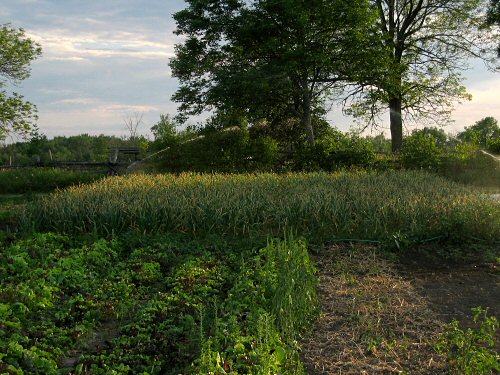
Life moves fast through our short growing season. Lushness and abundance peak and fade quickly into decline. The garlic, so green and promising only a few weeks ago, is already dying back, ready for harvest by month’s end. (Here, we’re splurging on a watering by sprinkler; I’m not sure of effectiveness of this exact timing, but a nice soaking round about now should give those garlic bulbs an extra growing boost during their last days.) In front of the garlic, more crops past their prime. The third planting of mesclun (we’re already harvesting the fifth) has started to bolt, ready to be plowed under. And a bed of arugula that, despite row cover, had been invaded by flea beetles, was chopped down and now lies brown and overdue for tilling in. Wheel keeps on turning…! (LATER NOTE: Watering garlic during its last few weeks is not considered a great idea, but in this case, it didn’t hurt.)
Veggies
Sort, bundle, bag
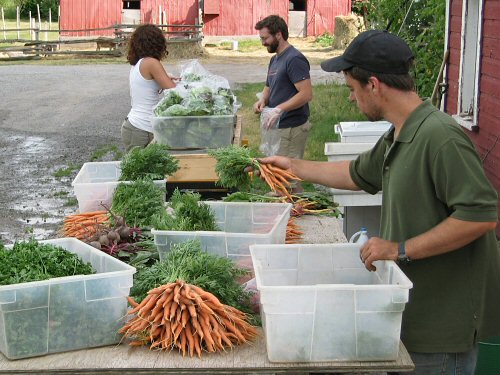
Fridays put this tiny farming system to the test, if we don’t get everything done for market and CSA shares, things would simply…CRUMBLE!!! Rain or shine, Friday is the main day for bringing in the weekly harvest, when we have to pick, sort, rinse, and bundle or bag 60-80 of everything that’s ready for the Saturday farmers’ market (about half of the CSA shareholders also pick up at the market). This week, the veggie selection is still small: beets, carrots, shell peas, green onions, mesclun, parsley. Here, at 6 pm, the picking, digging and pulling part is mostly finished and it’s mainly post-harvest action in the shade of the barn: Erin and Mike (not me, another Mike) bag and weigh just-rinsed mesclun, while Conall bundles baby carrots.
First carrots plus beets!
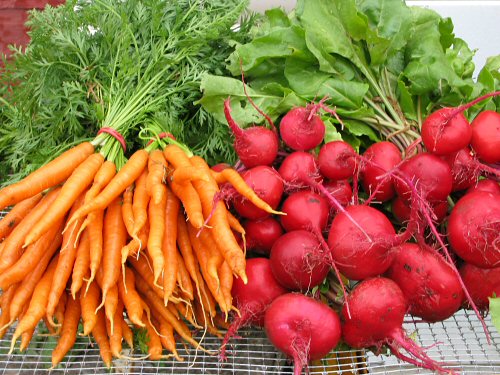
Today we harvested the first carrots of the year (baby Nelsons), along with baby Chioggia beets, for a small custom order. Veggies seen outdoors, especially when wet, are impossibly colorful in their own particular way, quite unlike…other colorful things! I’m still and forever surprised at how deeply pleasing and satisfying it can be to simply gaze at fresh veggies in sunlight (especially after harvesting them, and on overcast, diffuse light days!). Leafy greens are great, but the time for MORE is upon us once again!
At least a little rain
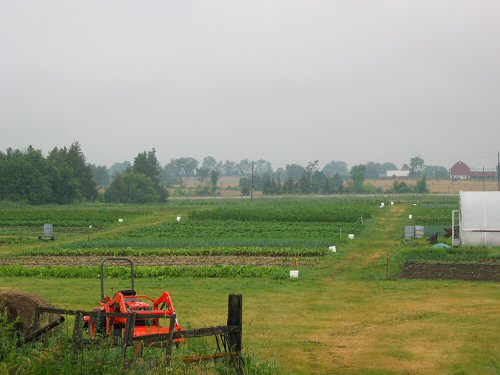
Today had all the makings of a slow, steady, gentle soaking, but so far, a mainly misty downfall has added up to a measly 5mm. Of course, I’m not unappreciative of ANYTHING in the way of rain. And the plants are looking mighty perky. Overall, the field is heading into that final sizing up stage that leads to main season fullness (see three weeks ago). Time can move so fast. Some real rain, please!
Extreme makeover
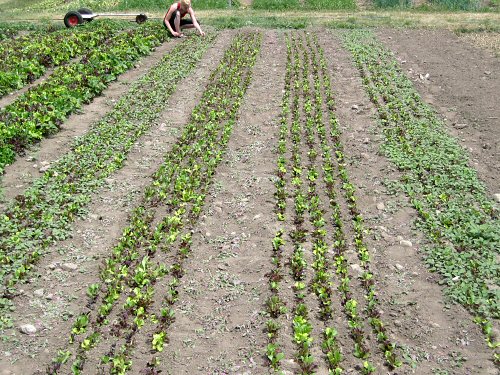
The one dark secret of this organic field, something you couldn’t really tell from selected photos, is the prevalence of pigweed (amaranth, mostly or all Amaranthus retroflexus if I’m ID-ing correctly). About two-thirds of the garden seems to be completely saturated with pigweed seed. Weeding two or three times for all-new outbreaks is common. In some spots, it’s literally as if some phantom planter is broadcasting new seed, thickly, every couple of weeks. And when it’s a closely space crop like the all-lettuce salad mix in the pic, this means painstaking fingertip weeding.
Here, Andrea and I spent about two and half hours clearing 200′ of 5-row beds, the entire latest succession planting. Luckily, conversation made the time transparent (thinking about all of the extra labor devoted just to de-pigweeding is a little painful). As best as I can figure, the pigweed came along with the two-year-old, not-fully-composted cow manure that we spread in the fall of Year 2 (three years ago). We put down I’m not sure how many, but many, tons on just over an acre—the ground was positively springy!—which was great. Except for the pigweed seed. Eventually, the vast store will be depleted (the seed is apparently viable for five years). Until then, it’s a lot of extra work… The pop quiz question: “What have those cows been eating?!”
Spin cycle
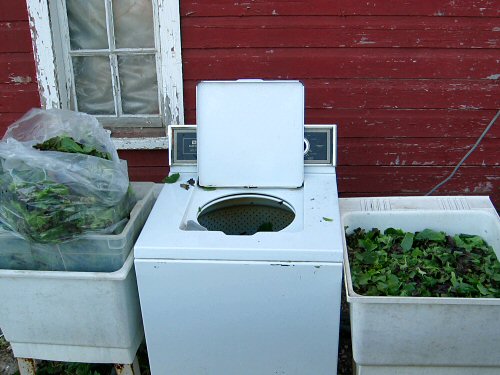
Here’s an important piece of the post-harvest station, the trusty washing machine-turned-salad spinner, flanked by laundry sinks, working on Sunday CSA harvest. The washer idea I read about someplace. When the washer here on the farm started doing odd things to clothes and was heading for the scrap heap, I intercepted it and pressed it into veggie service. With the agitator removed, it’s used on the spin cycle. Good ol’ centrifugal force! The trick to preventing leaves from getting crushed—either shredded (spinach) or veiny (lettuce, other light leaves)—is not to load too much at a time.
The sinks contain cold well water. For the most part, rinsing greens is done to quickly cool them down after being cut in warm conditions (like…a hot afternoon, you can’t always pick your moment). Sometimes, it’s also to wash off dirt splashed up by rain. Rinsing greens for one reason or another happens about 75% of the time during late spring through midsummer. Once the days start getting shorter (yuck…), greens harvests can usually be timed for the cooler evening, and rinsing happens less often. The sinks are also used to rinse other crops when they need it!
Simple, effective!!
Stupice first on the vine
For the third year running, and no surprise, Stupice is the first tomato to start fruiting. This extra-early heirloom is said to be from Czecholslovakia, and its performance hasn’t been even nearly beat for earliness in the 70+ varieties, heirloom and modern hybrid, that I’ve tried over the last four years. The toms are kinda small, maybe 2-4ozs (56-112g). Taste is tart (perhaps not for those sensitive to the mildly acidic) and, um, fantastic… This year, all of the tomatoes are really ahead, with fruit appearing on at maybe two dozen early and mid-season varieties before the end of June. Mmmmm…. (Now, to finish semi-staking, or shall we sprawl?!)