
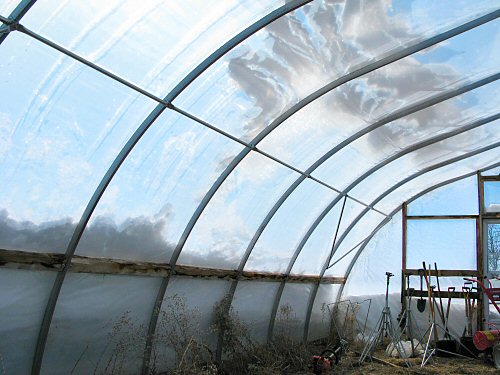
Another snowstorm, come and gone. It snowed steadily all of yesterday, with pretty high winds, but most of the accumulation seemed to be overnight. Today, azure skies, brilliant sun, tons of snow in drifts piled high. Looks like we’re one more heavy fall away from all-time records. I heard there’ve been over a dozen school snow days, compared to three or four a season in recent years. Here on the farm, no extreme hardship so far (knock on wood!). In the barnyard, we’re running out of room around the edges to pile up more snow, and in the field, it’s a couple of feet deep, but snow has kept off the Milkhouse roof, and the main worry, a flattened hoophouse, hasn’t come close to happening. The wind built up the drift on the south side (both photos), and just to be safe (and for the first time ever), I scooped off the new stuff, down to the harder-packed, more permanent base. Luckily, the side walls are inflated (a fan on a looong extension cord continually blows air between two layers of plastic), so the surface is quite taut and doesn’t sag or hold snow easily. And that’s it. Back to waiting for the snow to go…
Celery!
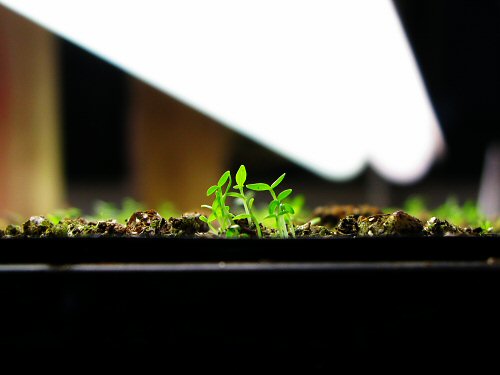
Celery has been surging up over the last day or so, 10 days after seeding. This is Utah 52-70, a pretty common variety. Celery is a member of the carrot family (Apiaceae), along with parsley, parsnip, fennel, Gotu Kola, caraway, cumin, CARROTS, cilantro/coriander, chervil, dill, anise, hemlock. Cool family! It also has a reputation for being hard to grow: maturity in up to 4-5 months, cold-sensitive seedlings, needs lots of moisture. Any two of those three can make it a challenge in this garden, especially with the crazy weather. As great as it would be to grow, celery hasn’t been high on my list! Well, it’s started now, and we’ll see what happens…
Seedlings continue to grow…
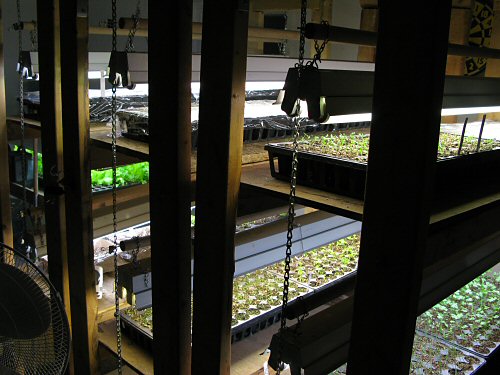
Seedling production is on about the same schedule as last year, except there are a few new things on the go: celery, onions, leek, celeriac. The three grow racks aren’t yet full (and there’s a fourth to build), but all that will change in a couple of days, when peppers and eggplant start. This is also when gambling on the weather begins, which at this point affects when I choose to start certain crops. Already, based on the 15-day forecast, it looks like a much colder March ahead than in the last couple of years, and with all the snow cover, a quick thaw towards the end of the month will still mean a few extra days of drying out time. And then there’s April to “consider”—it’s all basically pure guessing, colored by a little wishful thinking. IF there’s gonna be cold and snow for a good part of April, early transplanting will be delayed. So, starting some things in a couple of days, or in a week, or in two weeks, could make a fair bit of difference. If I have to hold things for an extra 2-3 weeks, there won’t be room under the lights as I start more, and out in the greenhouse, given real sun, growth will be quicker and the seedlings will get crowded. And so on, tons of little calculations and gambles… Nothing is THAT critical, but a little more work here, a little crop slowdown there, it all adds up. I enjoy this, juggling increments in the face of the weather, but it could drive some people into quite a state! :)
Trip to town
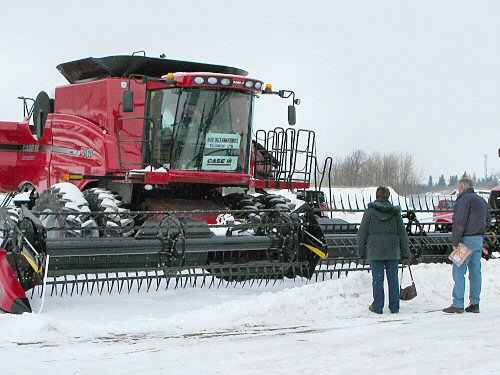
Took a trip to town today. During the winter, I get in once every 3-4 weeks, so it’s a bit of a novelty. This time in, we checked out an agricultural show, 28th year, filling the new fairground’s 45,000 sq ft of indoor exhibition space. It was quite busy, geared to the bigger conventional farmer, with aisles and aisles of heavy equipment, commercial seed, bank financing,… Outside, some even bigger machinery, like the combine harvester in the pic—it’s set up for soy—that could run over my entire garden in about 10 minutes (although the wraparound view from that air conditioned cab looks mighty inviting for a hot summer’s day in the field!). Inside, it’s mostly men in and around their 60s, with some wives scattered in. These guys were here with their fathers three decades ago, discussing new gear as family farms passed from fathers to sons. Now, the sons are the old farmers, and the next generation is nowhere in sight. Quite odd… Oh well, on to the super-sized supermarket, a Loblaws’ Wal-Mart killer, a huge deal with a produce court half the size of my market garden (not literally, but it’s pretty big), bakery, meat and fish counters, endless aisles, automated mini-bank, wine shop, tobacconist, full pharmacy, a whole section of clothing and housewares, and acres of convenient parking outside. It’s the old General Store, scaled up! I seldom do the grocery shopping for the farm, so when I do hit a supermarket, I head straight for the veggies first (I still kinda laugh at myself doing a “professional” veggie appraisal, this is the LAST situation I would’ve imagined myself in not too long ago). I bought some groceries: a bit of “fresh meat”, “fresh-baked bread”, a tub of mixed baby salad greens (and mine so soon to come!)… Only $200! Then, a quick fast food stop at A&W, not a guilty pleasure, or even a pleasure, just an old habit, a town routine… And there it was, a trip through the OTHER local food chain, 12 miles (19km) and a whole world away from the tiny farm. It’s a little surreal. Back to the seedlings… ;)
Trimming leeks
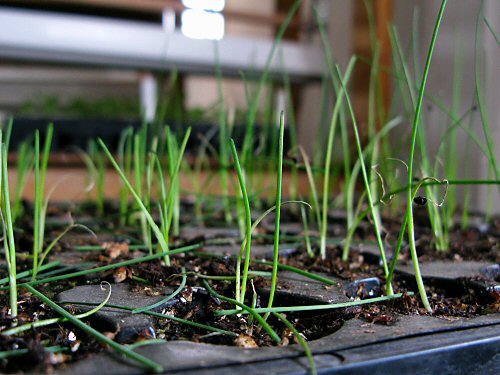
Trimming back leeks is really satisfying. Here, I’m doing the first planting. With most indoor veggie seedlings and my two-lamp fluorescent fixtures, it’s lots of tray rotating and light height adjusting to keep the stretching to a minimum.
Leek can reach all they want: at three inches (7.5cm) or so, I snip them back to about an inch (2.5cm). What could be simpler?! This goes for the onions coming up as well.
With nice low seedlings, the light can be better concentrated across the trays, and cutting back may ensure stockier growth, which is generally a good thing when it comes to seedlings (update: I read a pretty definitive-sounding study that disproved the growing-stockier part; either way, it’s worth trimming just for keeping them closer to the light).
This is the first year of starting both leek and onion indoors from seed (in the past, it’s been direct-seeded leek, and onion sets)—I’ve not actually DONE this before—so there’s the usual slight bit of reservation with trying something new. Seeing is believing. Fun (easy) so far!
Elsewhere, we got what looked like a foot of snow overnight. No problem, no extra work, except the lane, barnyard and path to the greenhouse had to be plowed again…
The wild bunch
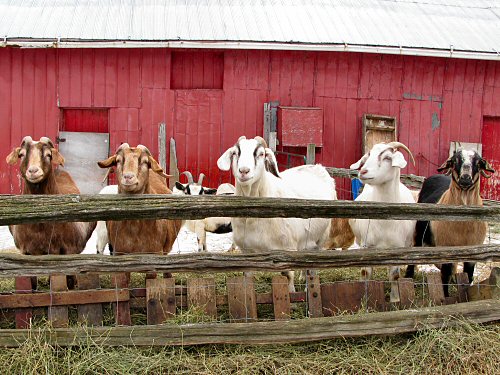
Mainly mucking about today. Visited with the goats. Around 15 of ’em. These girls upfront are the current kingpins of the goat yard. Goats have their pecking order (just like the chickens to come!), which mainly means a few get first crack at food, or crowding at the fence, or whatever else they all want to do, while the rest back away and wait or get butted. It’s mostly rank by size, but a vicious streak counts, too. The one in the middle is on top now (with her friend on the right), the brown pair on the left (the Evil Twins), used to be a vicious tag team running the yard, but they lost their edge. Not that they’re always fighting, a brief burst of deterrent action goes a long way. It’s like a soap opera if you watch ’em every day. Goats…
Every year, this little period in the first half of March is kinda like waiting for the starting gun. I’m full of energy and waiting on the weather. A little EDGY. All the early starts are now under lights: onions (first time from seed), celery (another first), more leek and parsley, plus the stuff started around the end of January (leek, parsley, rosemary, arugula, lettuce). It’s another week to the peppers and eggplant, and then the grow racks will start to get full, and I’m also holding off till then to transplant the early lettuce to the greenhouse. As soon as the snow clears and the temperature warms up a bit, there’s outdoor fix-it work, starting with an old ice fishing hut to turn into a home for the composting toilet (an outhouse for the field!) and the chickenhouse to renovate. There’s a list. Plus a lot of garden clean-up, crops left over winter, that should be pulled as soon as I can. MEANWHILE, I’m waiting…
Chicken catalogs
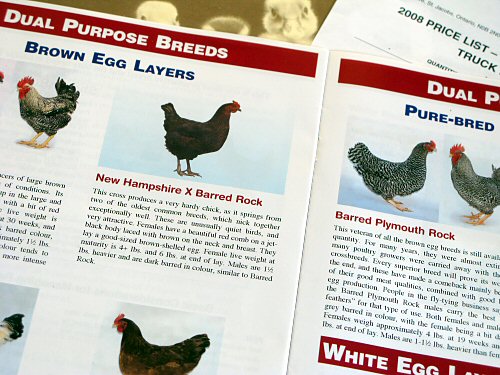
There’s a catalog for everything. Bob dropped off two with chickens (turkeys, ducks, pheasants, partridge and quail, too). I’m looking at dual purpose birds… It’s pretty sure that chickens will return in small numbers to the farm this year, but not a done deal till April. For me, it’s a completely new tiny farming…adventure. I’m going into it much more casually than usual with new farm stuff, because for this year it’s mostly for fun. I don’t really have a PLAN. We have room for about 50 birds in the current chickenhouse set-up, so it’s not such a big thing. We’ll see next month!