
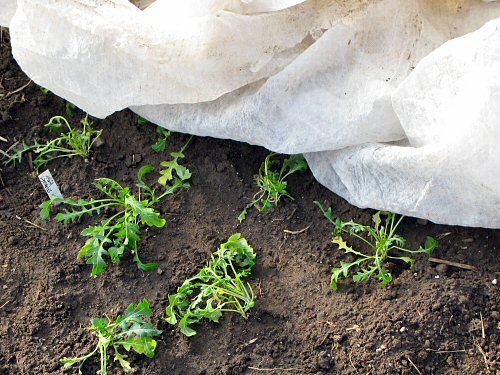
Last night, the greenhouse low was a chilly 5°F (-15°C): the arugula, spending nights under 3-4 layers of floating row cover, still seems to be doing fine. Especially with more extreme transplants like this—a long time in the plug sheet, then an abrupt jump to the harsh greenhouse conditions—there’s a critical period of a few days, waiting for the stressed little plants to settle in. Cover at night, uncover in the morning, till the weather warms up…
Walk to work
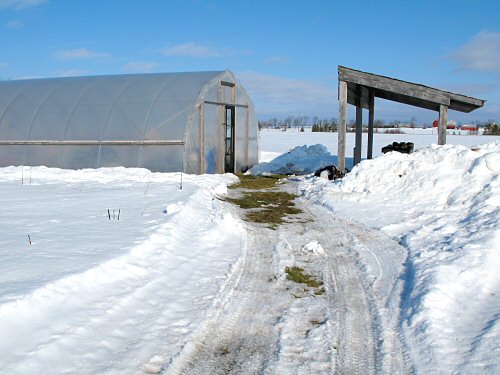
Can’t speak for everyone, for me, heading into the field is the best walk to work I’ve known… The arugula transplants a couple of days ago started this season’s almost ritual morning garden tour. This is an often mildly adrenaline-fueled stroll at the start of every day, from mid-March through early June, and then, mid-September into November, to see what happened with the overnight temperature. Frost-watch, if you like, but actual visible frost you don’t see that often, it’s mostly checking the effect of really cold air on crops in different parts of the garden. Right now, there’s only the bit of arugula to check out (the unheated greenhouse gets as cold as outside once the sun is gone). We’ve kept a path clear to the east side door, where there’s less snow build-up, as the wind usually comes from the west (the greenhouse is laid out east-west, with doors at both ends). Today, all’s well!
New lumber
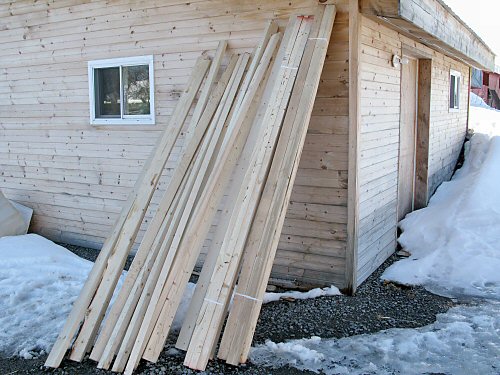
Went through the lumber delivered yesterday, selecting the straightest pieces for a new grow rack. There’s all kinds of scrap wood around the farm, except, there are never enough 2x4s and plywood… I order construction grade for most things, quite inexpensive but the boards have to be hand-picked if you don’t want a lot of warped wood. For rough carpentry, this works fine: the savings add up, and rough edges add character! There’s the grow rack, a double screen door for the Milkhouse, the composting toilet-ice fishing hut conversion, the chickenhouse reno, new tables and trays for the farm and market stands, more… All needed pretty soon. Spring building starts now!
Back in the dirt!

Transplanted the arugula from the end of January into as small a corner of the greenhouse as seemed to make sense, two plants to a plug, about 6″ (15cm) apart. There’s no space to waste, and these guys, already a long time in trays, will likely be ready too early for market (first Saturday in May). So, another experiment in early planting, but leave room for others! The arugula has been out there in the plug sheet for a couple of nights, surviving 10°F (-12°C) nights under a few layers of row cover (an extreme rapid hardening off!; as you can see in the tray, a few much smaller seedlings, started in mid-Feb, didn’t do so well, most of ’em got toasted the first night). And now, the survivors are in the ground, free at last, in full sun during the day, and recovered at night. It felt great to put hands in the soil, first time this year. Mmmm…
The watering tray
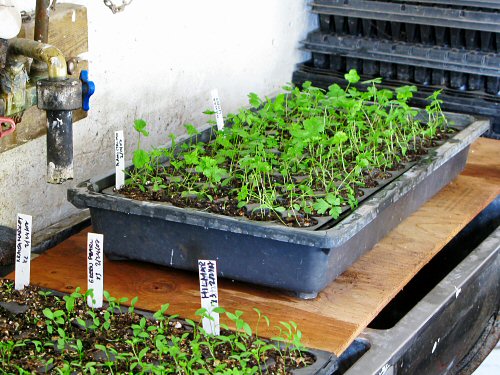
It’s funny how almost random objects can become practically indispensable tools. Like this rigid gray tray, given to me a while back, just the one, amongst a mixed bunch of plastic flower pots from bedding plants, passed along by a local gardener. For four seasons, I’ve used it to water the seedlings (all parsley in the pic): in goes a plug sheet in its webbed tray, sit for 10-15 minutes, then out to drain for a bit over the sink, and it’s back to the grow racks, good for another few days. I’ll keep this up until the seedlings are well-established, three weeks or more, depending on the crop. Perfect, except, at one point I’ll have maybe 50 plug sheets going at once, which means a lot of moving trays and tracking soak time. Not too efficient. I’ve been meaning to build a bigger watering tray, that can handle four or six plug sheets at a time. But I haven’t yet. As odd as it sounds, I’ve grown…attached to the one-at-a-time approach, and this particular, perfectly sized, always reliable gray tray! Every planting gets its own bit of focus each time it’s watered, developing its own little story on the way to the field. It’s part of the fun. Doing batches will be much quicker overall; the attention to what’s in each tray will be slightly less. Not a bad thing, there’s always lots to do with any extra time—continually improving by increments is also a main part tiny farming. With more seedlng starts this year than ever, I suppose I will build that bigger tray… Progress… ;)
Making water
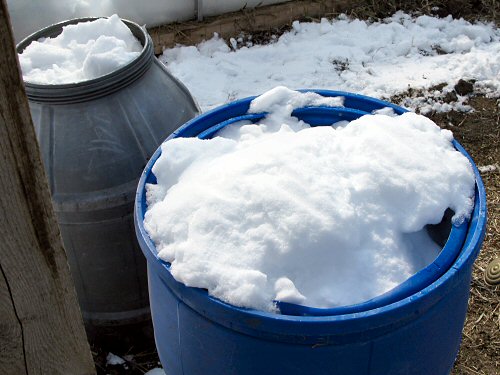
As far as winter irrigation in the greenhouse goes, melting snow in big barrels is the next best thing to a really long hose, a well and an electric pump. Fill ’em up, cover with clear plastic, wait a day (even on a dull, cloudy day, it gets up to 60°F in the hoophouse). Repeat a couple of times, and you have 50 gallons of rainwater in a barrel! The alternative is dragging 200′ of hose through deep snow from the barn to the greenhouse, then reeling it in and draining it, every couple of days. The weather has put the kibosh on the early-March, barely heated greenhouse plan, the happy prospect until March actually came around. The nights have been regularly plunging to 10°F (-12°C), so it’s really not worthwhile to heat things up by 25°F. No worries. Adjusting expectations and schedules more or less by the day is all part of the fun… It’s never boring!
Back to the field!
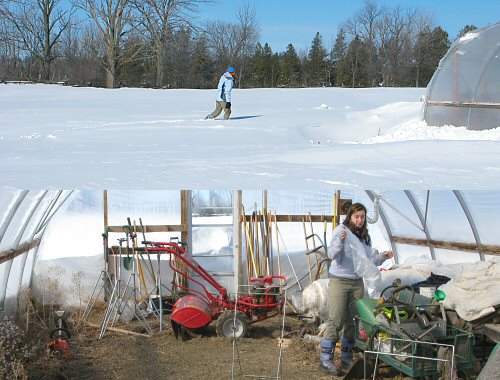
Last seen planting garlic in November as we headed into winter, Lynn is BACK IN THE FIELD, getting a head start on spring. It was great to see her again and…continue! We headed out to the greenhouse and spent three hours or so, bagging the last of the grass mulch, pulling weeds, forking beds, chatting and basking in the sunshiny, 25°C (80°F) greenhouse weather! I also brought out a tray of arugula, couldn’t resist posing it in the snow… It felt excellent to get started out there. Fun!