
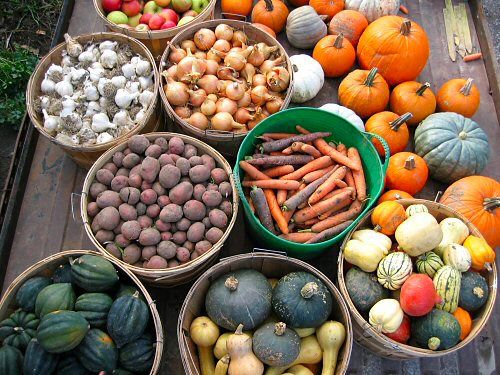
With the farmers’ market over, time to turn to fall-and-winter things. This year, I’m for the first time organizing a proper veggie selection for storage (it’s about time I started…training for that future CSA root cellar!). Instead of the usual bushel baskets of this and that, casually left around the barn to take their chances with temperature and location, now, there’s a bit of plan. For a root cellar, the basement of the farmhouse, the side with a dirt floor that used to be filled with potatoes when this was a fully working, big family farm. For the veggies, today’s haul has a mix of potatoes, assorted winter squash and pumpkins, various carrots, onions, garlic, plus apples picked up at the market. It’s a first step, there’s still lots more in the field: beets, spinach, collards and kale, herbs, and more carrots to go… Harvesting isn’t history just yet!
Autumn
Au revoir to the farmers’ market!
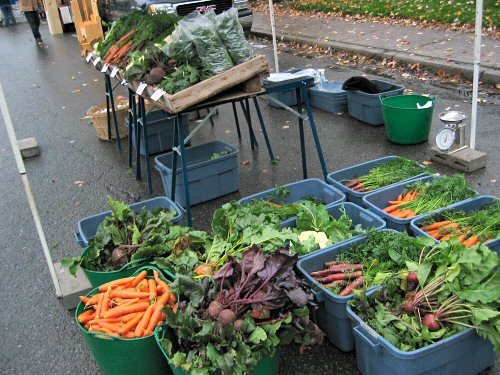
A great last day at the market! We were packing in the rain at 6am, drove in through a drizzle, and by the time I was set up just after 7, the rain had stopped! Despite the dreariness, it was quite warm. So far, so good. I didn’t particularly expect a big turnout, and was happy to find two and three people waiting at a time for a good deal of the peak fall hours, from 9:30-11:30. In the pic, it’s around 8:30, few people around as the weather sorts itself out, time to drink coffee and wander around a bit to chat. Soon, a steady stream of mostly regulars. It’s hard to explain the pleasure I get from this part of the people equation, so at this point I won’t even try. Growing food for people and delivering it directly is simply…great! The stand set-up didn’t change over the season as intended, it’s pretty barebones as it’s been from the start. I’m already renewing plans for a new and improved version for next year. On we go!
Choose your fork wisely
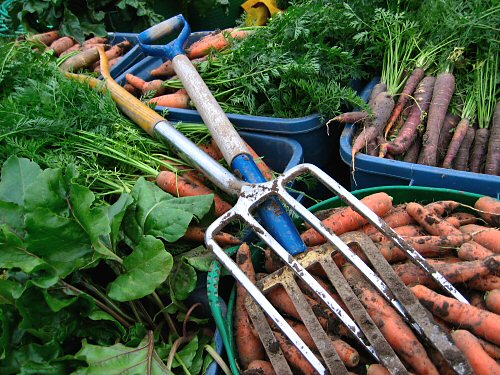
Today’s harvest was the last scheduled one of the season—tomorrow is the final farmers’ market day. Heading out alone felt a little strange, after all the help this summer, but certainly familiar. It’s a completely different…mindset when it’s all entirely up to you! Carrots were featured. There’s lots still in the ground, and some customers at the market will want to double up on the last day. I pulled about 200 lbs (91 kg), not exactly a bulk, root cellaring quantity, but that’s 100 x 2 lb bunches, quite a lot for one market day. That took a little over an hour of digging and pulling, and it’s amazing what a difference the right tool can make. Here, it was a choice between two seemingly similar digging forks. Most of the season, I like the Blue One, with flatter, wider tines that make lifting the soil easy when the ground is fairly dry and loose. BUT, when the ground is cold and wet and dense as it was today—our clay-loam is good at getting that way—the slick stainless steel option, with narrower, pointier tines, simply slides in, where it takes twice the effort to drive down the blue one. No comparison! If the difference sounds slight as described, a few minutes of actual digging and you’d be convinced. It’s the not-so-little things!! It’s in the details… So, lots of carrots, lots of beets, a good haul of cauliflower, bok choi, spinach, kale, plus garlic and onions from storage. A nice cool season selection. Not bad!
View from the other end
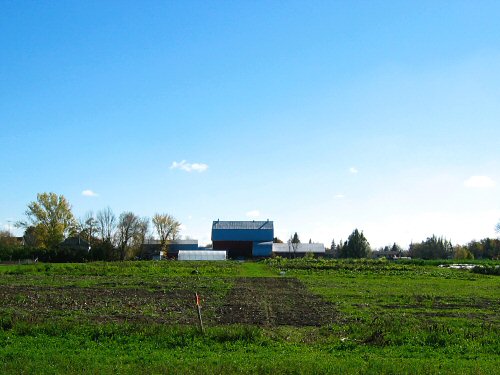
A view from the north end of the market garden field, the reverse angle of a couple of days ago and a relatively rare perspective for me. Although the crops are on a 7-year rotation that marches them from here towards the barn, I still tend to spend more time down around the greenhouse-Milkhouse end, no matter what’s growing where. Today, I’m once again checking things out as fall clean-up proceeds in pieces. The nearest section is the new addition, recently cleared of squash, pumpkins, cucumbers and melons, and the raccoon-fated corn just out of sight on the left. After one season, it’s a little overgrown with grass, but not bad. Next year, this will be beans!
Leftovers
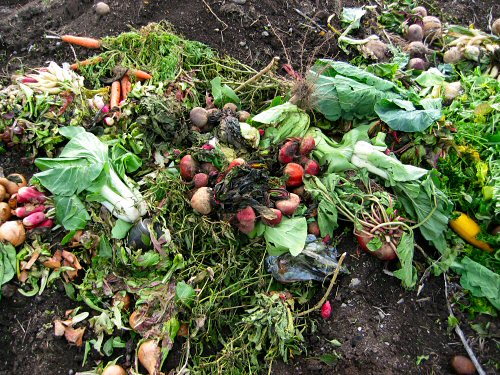
There are always veggies left in bins after the weekend farmers’ market and CSA shares Saturday, Sunday and Monday. You just can’t eat ’em all. After a couple of days grace, the remains are off to the compost heap. Today, it’s a nice selection!
Big old barn
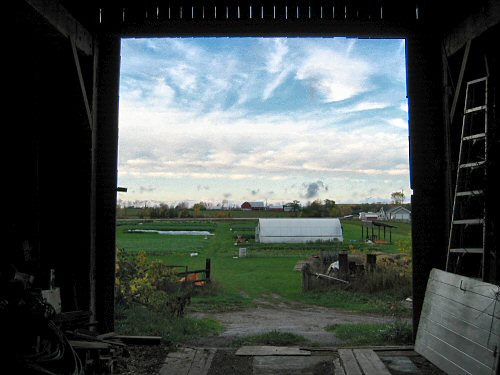
The main barn is huge. I’ve gotten used to it, because it’s always around, but it’s on a whole other scale from my tiny farming, and I don’t know it that well. Upstairs, in the cavernous main space, mysterious rigging and wooden contraptions that probably have something to do with hay float in the shadows 30-40 feet up. There are hidden stairways, built-in ladders, chutes and trapdoors in the floor. In a little corner in the back where it stays cool, I store garlic and onions during the summer and fall. I also take a long view of the garden field from the top of the gangway leading in. The barn was built in 1949, after its predecessor was accidentally burnt down by the idly discarded cigarette of a wandering stranger (“hobo”? “itinerant rural homeless person”?) who’d spent the night. The main structure is all wood—mortise and tenon—with no nails or other metal fasteners involved. I’ve picked up lots of details and stories centered around this barn. It symbolizes farming, it makes this place look like a farm, but to me it’s mainly just…space. That’s a little weird. As I took stock of the last of the onions and the seed garlic today, I decided to spend some time on really looking around. Explore now!
Welding
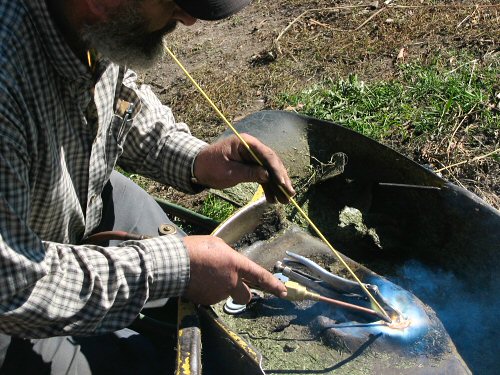
A second incredibly warm and sunny day, perfect for a little welding in the barnyard. Yesterday, something kinda disengaged in the riding mower deck, leaving behind a pretty nasty racket and nearly no mowing action, and now the deck is getting a long-overdue overhaul.
Hitting rocks in the field can’t be reasonably avoided. After four years of pounding, the spline on one of the pulley assemblies that spins a blade was completely worn down and the whole thing had to be replaced. We picked up the part this morning, and an hour later, the mower was back in business. Here, Bob welds on a washer to patch a cracked mounting hole (he’s brazing, which is a type of welding, or high-heat soldering, depending on how precise you want to get…it’s all joining molten metal to me!).
DIY repairs keep the tiny farm rolling. I can do routine minor repairs—splicing hoses, replacing tines, sealing tire leaks, sharpening blades, re-priming pumps, basic rough carpentry, banging on things until they work, and the like—but welding is still far in the distance. Welding is great. We should all learn to weld, right away…! :)