Sweet potato harvest

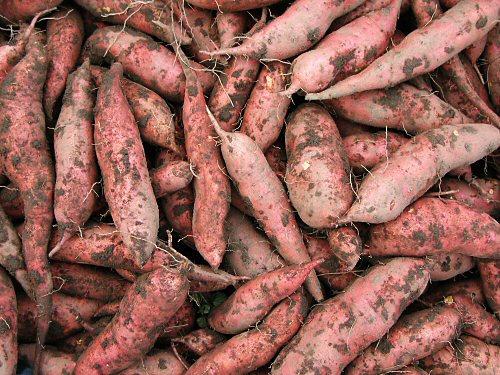
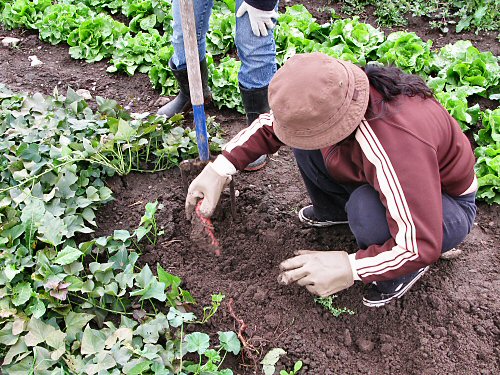
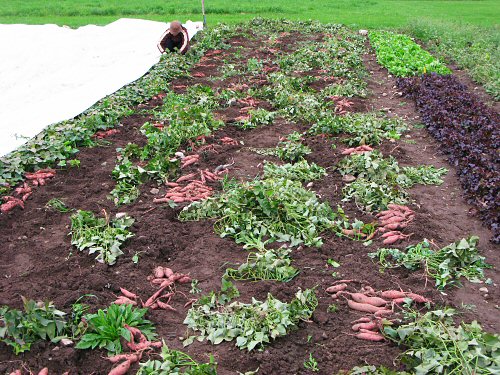
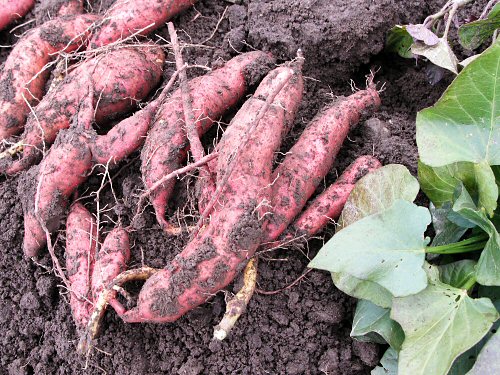
From planting back in mid-June, it’s been 3-1/2 months to the sweet potato harvest. The variety, Beauregard, is listed as 80-100 days to maturity, although, like potatoes, you can dig them up anytime, as soon as the tubers have formed. The vines are frost-sensitive, and the tubers shouldn’t be left in the ground if the tops are frost-killed, so I’ve been gambling with the first frost timing in order to let them grow for as long as possible. Today seemed like a good time to start. This has indeed been a really easy, pest- and disease-free crop, requiring only a little weeding until the vines filled in. Harvesting turned out to be equally easy. After digging up a few plants to see how the tubers grow, Lynn, Toshiko and I set up a quick hand-harvesting system: remove the vine, loosen the soil with a digging fork, scrabble around for the taters.

The soil had quite a lot of moisture from recent rains, so we had to spend a little extra time brushing off clumps of clayey earth. We left them for a couple of hours to dry in the breeze, then collected them in bins and brought them into the Milkhouse. By the book, sweet potatoes could use 10-14 days of curing at 80-85°F (25-28°C) . In part, this allows some of the starch to convert to sugar, making them…sweeter. That sort of HEAT isn’t available around here right now, but for this first time around, and too small a quantity for really long-term storage, I’m not too concerned. I baked some a couple of days ago, and they already taste good. Let’s see what a week or two indoors does for ’em!
Beautifying the good garlic

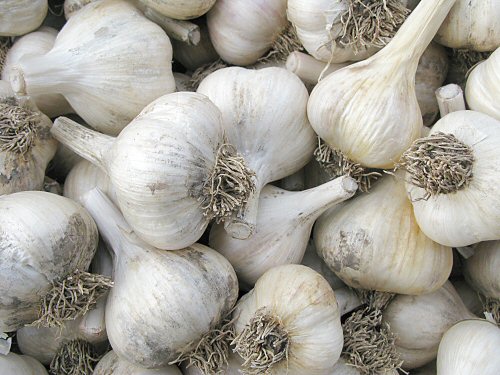
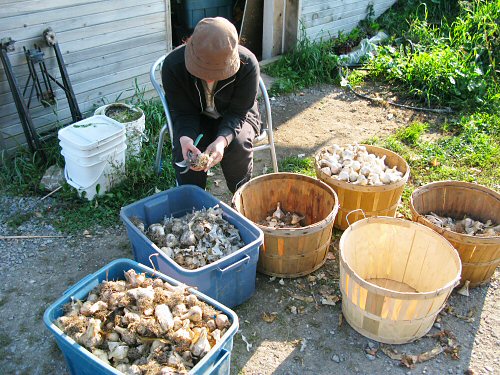
Toshiko, WWOOFing from Osaka, Japan, via Vancouver, where she’d been studying English for the last few months, is our last guest in the field of the year. She arrived last Friday night, and stays until a week from this Sunday, two weeks in all. A couple of years ago, she volunteered on larger farms in Australia, where whole days were spent on one task, like picking a single crop. This is Toshiko’s first taste of really tiny farming, where there’s something different to do every couple of hours. At this point in the season, fieldwork consists mainly of harvest and post-harvest things to do, also, maintaining row cover in case of frost. Here, she does a final, thorough sort through the garlic, separating the good from the damaged bulbs, and trimming the roots of the good stuff.

First frost misses

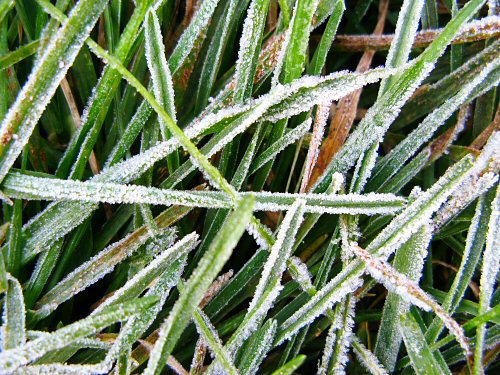
Frost finally hit the garden…but it missed the veggies! Just after sunrise this morning, there was ice on the grass at the very bottom of the field, but it stopped maybe 10′ feet from where the garden begins. Pretty cool. There’s a gentle slope from a high point about two-thirds of the way up the garden, and cold air flowed downhill and pooled at the very bottom of the field. Fun with science: when there’s no wind to mix things up, cold air rolls with gravity along the ground!

Last day of summer in the garden!

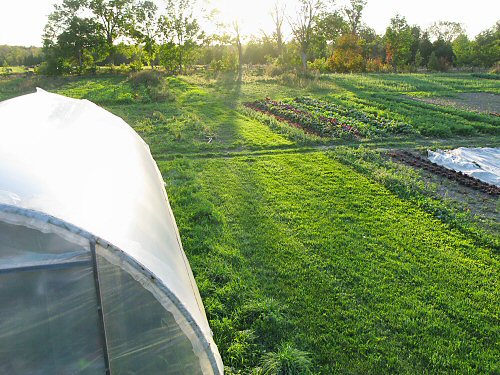
Here we are at the end of the calendar summer, a season of crazy weather largely gone by! Cooler fall conditions have been around for a couple of weeks now, with ample frost watch nights, so summer’s end at this point is only…ceremonial. Still, there’s that little twinge of melancholy that comes with the official end… The fall harvest is looking fine, with lots of brassicas, a good deal of lettuce, and the last of the fall spinach in the north end of the field (above), along with some last tomatoes, lots of peppers and eggplant, spared by frost so far. There’s also Jerusalem artichoke and potatoes, still in the ground. Green beans! And, of course, that section of sweet potato, fully row covered…

Moving down the field, there are the last plantings of beets and carrots, parsnips, some Swiss chard, and lots of mowed but still untilled empty sections…

At the south end of the garden, the herbs and flowers are all hanging in there—row cover has kept even the super-cold-sensitive basils alive and well. If I’ve missed anything in the rundown, well, it’ll still be there!

Fall frost watch 2008

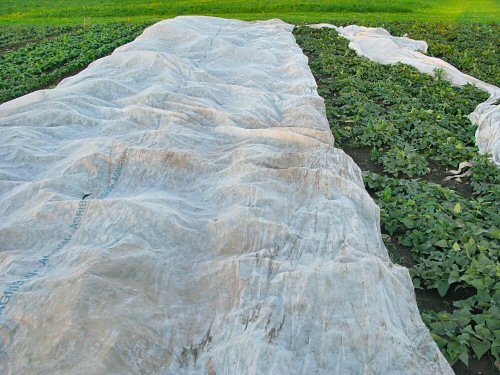
Tonight is the first real frost watch of the year. I covered a bunch of beds for a couple of nights last week, but the chance of frost seemed slim, with the overnight forecast around 35°F (<2°C). Today, they say it’s supposed to go down to 33°F (0.5°C), with clear skies and no wind, perfect frost conditions. Under cover: peppers, eggplant, summer squash, beans, cucumber (a really late experimental planting), basil, sweet potato (above). It’s floating row cover is the usual Agribon AG-19, in 14′ ((4.3m) widths. Let’s see how it goes…!

Bean watch

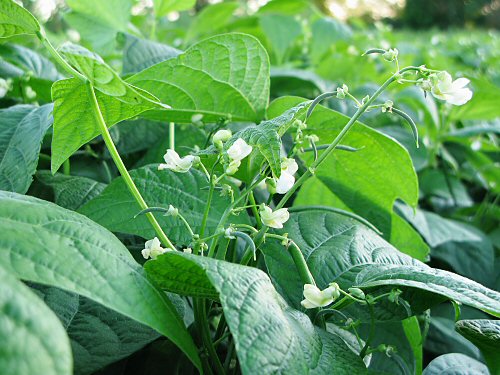
The second bean planting is setting and sizing up nicely, but we didn’t have beans at the farmers’ market today, after a good first and second picking of the first crop over the last two weeks. With succession planting, snap beans are usually a continuous harvest once they start, right through to a killing frost (usually in September, but with row cover, now extended into October in the last couple of years—more of that global warming, I guess). This year, cloudy weather slowed growth and the timing didn’t work out for continuity. There are a couple of ways to insure non-stop beans. Planting really frequently doesn’t work, because if the plantings are too close together, like, only a week or two apart, any two are likely to sync up, either by germinating at different speeds, or catching up during growth (both due to weather), and you’ll have too much one week, and not enough the next. Over-planting is the easiest way to go: if you have a lot ready at once, usually you can hold in the field a week past optimum harvest time and still have good quality, that is, nothing too oversize or woody. Of course, harvesting when ready, then storing in a cooler is the surest way: beans do quite well in cool storage, a good week in the most casual cooler conditions. But of course, there’s fresh and there’s FRESH!

Row cover everywhere

Row cover on spring transplants

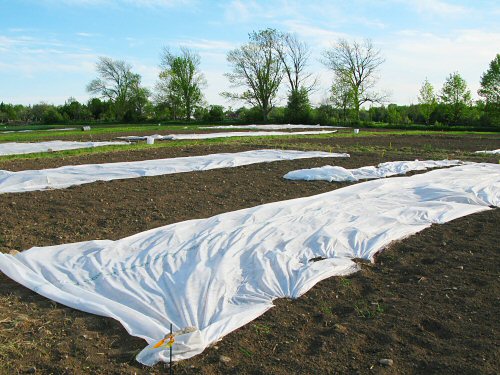
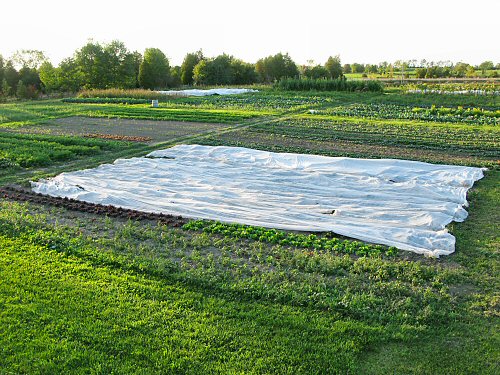
It was impossible to capture all the floating row cover outposts scattered around the feel in just one shot. This pic shows maybe a third of the area under the light, white, spunbond polyester protection. Right now, it’s being used as protection from two separate things: frost and bugs. Let’s see, it’s on all the cucurbits (so far, that’s cucumber, summer and winter squash, and pumpkin) to protect from the cold and striped cucumber beetles, on tomatoes against cold (and coming off in a few days), on the brassicas (broccoli, cauliflower, and the like) against ravaging flea beetles but not the cold (coming off when the plants are fairly big and can withstand the FBs). I’ve used row cover from Year 1, far as I can remember (there are NOTES and even pics…somewhere). Initially, I really didn’t like it, it looked so…unearthy, synthetic,…not part of the garden. BUT, the alternatives, like planting later, ending harvest earlier in fall, temporary wind breaks and cold air channels, trap crops, and all sorts of complex interplanting (so one crop protects another), encouraging beneficial insects, more elaborate timing (basically, closer second guessing of insect cycles and the weather), not to mention a completely adapted, semi-permaculture set-up where everything is at home no matter what, were all way out of what I could handle as I dove into tiny farming with the intention of heading to the farmers’ market in the first season. Floating row cover lets me extend the season by at least a couple of weeks at each and, and I can avoid all pesticides (and there are some killer insecticides allowed even in certified organics) and a lot of bug grief (stemming from lots of LOSS). I still don’t really LIKE row cover, though, the way I like, say, my Sneeboer three-tine cultivator or even the Horse rototiller (I can understand how the Horse is built, get if fixed, or do without). More and more lately, I wonder when FRC will become insanely expensive, or real scarce, or just plain run out… It’s as oil-based as they come, and kind of in a high tech product class of its own. This year, in a small fit of…paranoia (?), I actually ordered a new 1,000’x14′ (300mx4.3m) roll, even though I have enough for this season at least. It’s not much of a stockpile, but, carefully managed, it could get me through 3-4 more years along with what’s on hand, at this tiny farming scale… Oh, well, the more you know, the less you need is what I believe. I’m learning as I go. Keep farming long enough, and I’m sure I’ll get beyond the cover if it doesn’t run out on me first…! :)