
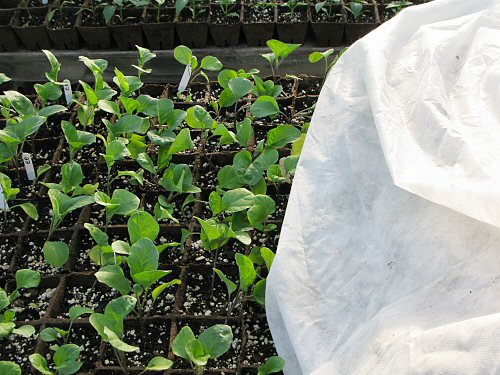
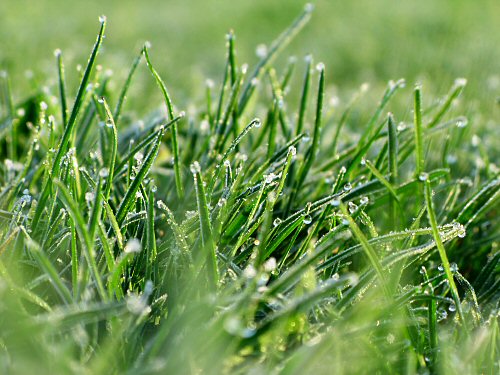
The days have warmed up now, mostly around 60-70°F (15-20°C), but the nights are unusually cold, dropping sometimes to freezing or a few degrees above. Frost burning off in the early morning sun is pretty when you don’t have anything in the field for it to kill, which I don’t… Let’s see: broccoli, cauliflower, radish, carrots, spinach, chard, beets, peas, parsnips, all-lettuce mesclun, tatsoi-mustard-arugula-bok choi mix… Nope, no worries there. (Funny thing, while pea plants are hardy, I believe the pods aren’t… I’ve never seen that in action, fall peas haven’t worked for me so far, and I don’t think there’ll be frost 40 days from now when this year’s first peas come in…). Meanwhile in the unheated greenhouse, although I’ve only fired up the kerosene heater once, just to be safe, row cover goes on all the tender stuff (toms, eggplant, peppers, and now, cukes, pumpkin, melons and squash, just about to poke up): on in the evening, off in the morning, better safe than toasted!
frost
My old friend the min-max thermometer
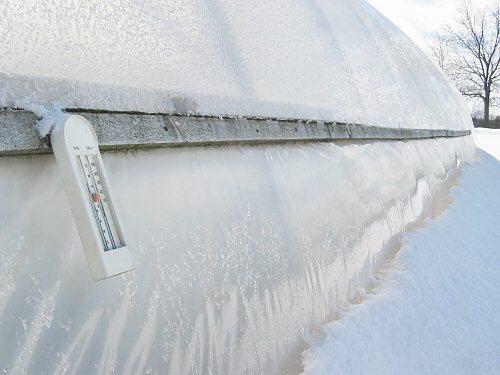
Clearing a path to the hoophouse today, I turned the corner and noticed the original min-max thermometer. I don’t usually. It was one of the first bits of gear acquired in Year 1, when the reality of FROST in the garden was a complete and scary unknown. The thermometer records the lowest and highest temperature that it’s hit; you reset it by pushing the little red button. It’s been hanging on the same nail in the same spot for three or four years, more or less out of sight and mind except in spring and fall, when I check it first thing in the morning to see how cold an overnight cold snap really got. Lately, the min-max is not such a big deal. Each different section of the field, and the particular crop in it, reacts differently to each cold night, so the only way to know what’s happened is to walk around and check things out. And I have confidence in row cover. I still check the thermometer, but it’s not like spring in the first couple of years, when I’d bolt awake at 6:00 a.m. and 10 minutes later be walking through the chill and dewy wet grass, adrenaline pumping, waiting for the verdict from the min-max to see what new transplants may’ve been toasted. It was kinda cool to be reminded, out of the blue, how that’s changed. In the case of gardening, at least, the more you know, the easier going you get!
More weather
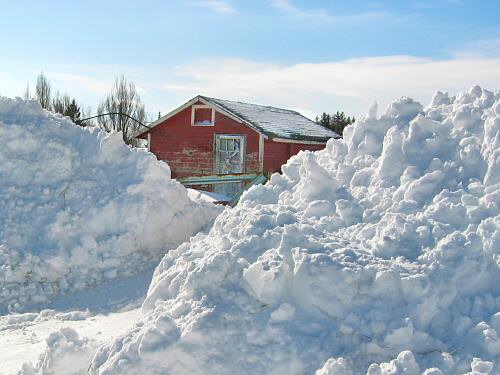
This February, tiny farming for me is mostly about, inside, watching seedlings in a growing number of plug sheets under lights, and outside, watching the weather. In this zone, Feb is a little early for thinking about garden conditions. Well, “normally”, it would be. Now, given the increasingly erratic winter, I’m trying to figure out a new early season production strategy. Conceivably, end of March could be shockingly warm and the ground dry enough to work, and instead of just seeding early peas, I could try some super early field transplants. But then, what if winter happened to come back, not for a day or two of April snow, as sometimes happens, but for a week or two, with freezing temperatures. Early plantings could get killed off, and then I’d need a second set of seedlings! This is how I’m kinda starting to think, about trying to plant around the weather, take advantage of unpredictably good conditions, while expecting some weird bad turns as well. What do last and first average frost dates really mean, given the last five years? Is a 30-year local rainfall average still in any way a useful guideline? Am I…exaggerating? Two days ago, it was 40°F (5°C) and raining right through the night. I was sure the forecast for an even warmer Wednesday would come through to finish off another, fourth big melt-off. Instead, yesterday morning it did a sudden 180, froze up and dumped a ton of snow. Today, there are 7-8′ snowbanks all around the barnyard (from snow plowing). The once and future chickenhouse practically disappeared… ;) Will spring and summer be different from that?!
Heat!
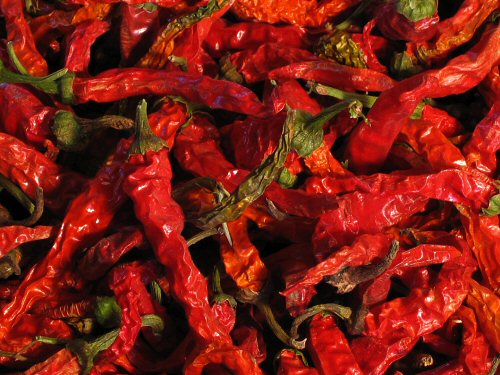
Finally finished a bit of hot pepper harvest, now there’s a convenient pile of dried heat! A few weeks ago, wondering whether to cover for frost, I decided to also pull up some hot pepper plants, roots and all, instead. An experiment! We loaded about 20 of the Cayenne Long Slim on the cart and dumped them in the Milkhouse, heaped on the grow racks that we’d been using, with the lights removed, as summer storage shelves. And there they sat, blending into the decor, drying, the peppers that were still green maturing to red. Until today… (This is the kind of thing you can do in a Milkhouse, not so acceptably in a real house…) They’re satisfyingly high on the heat scale, delivering a little pain if you don’t sample carefully. Great!
Bye-bye, sweet peppers…
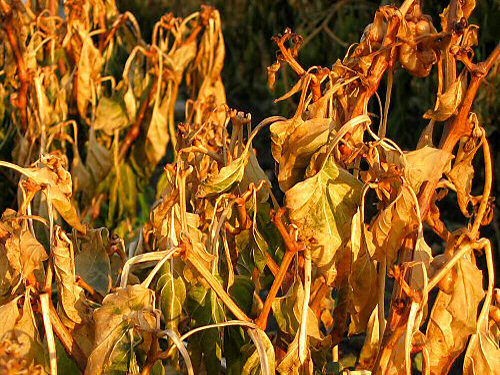
A mildly golden late afternoon sun turned the beds of dead peppers into a stunningly rich sea of color amongst the greens and browns. Peppers seem to have their own way of dying off in the cold (at least, under row cover, where they usually are in autumn). Instead of turning a sickly, muddy green, then quickly to grayish-brown as they dry out, like eggplant and tomatoes, the peppers tend to fade from green to greenish-yellow and dry in pale golds and tawny browns. Interesting… I’m not sure if this is standard behavior, but it’s how they seem to go around here! After rolling up the last of the row cover and snapping a couple of pics, it was on to the Kubota compact tractor for a quick tilling, and this year’s sweet peppers are…gone!
Spearmint and the other herbs
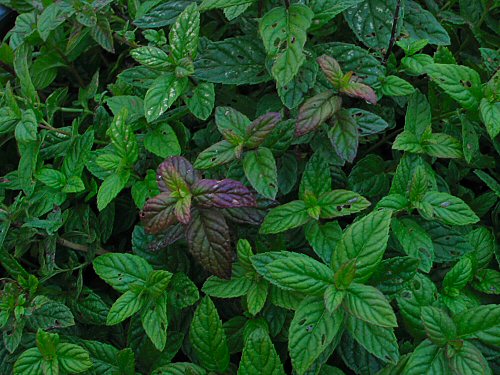
The fall season that wouldn’t quit has more or less come to an end. For the last few days, overnight temperatures plunged well below zero, we’ve had hard frosts and some snow, but the ground is far from frozen, and there are apparently warm days ahead (for more tilling, planting additional garlic, harvesting the last of the carrots and beets)! In the herb garden, there’s not much to do, except bring in the rosemary. Flat leaf parsley is in fine shape, doing better than the curly stuff. Sage seems indestructible, thyme and oregano are largely toast above ground, while the tarragon starters seem to be fine—I’ll put them all under a couple of layers of row cover, although the sage, oregano and thyme have come back no problem for the last two years after overwintering right out in the open. Some of the peppermint was killed off, although the roots may be okay. Apart from a few cold-burned leaves, the spearmint, in the picture, is right as rain…
‘Tis the season…
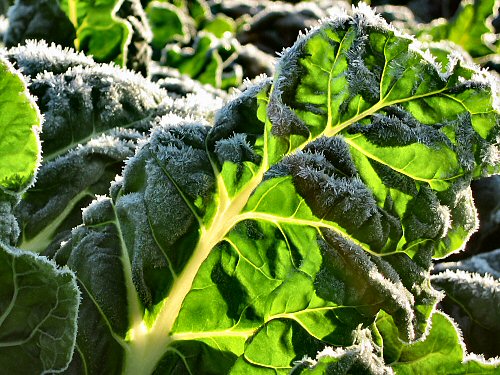
As a friendly reminder that the weather hasn’t gone entirely haywire, the nights have been cold lately, freezing or below, and some days begin with a reassuring blanket of frost on the field. Here, the Swiss chard (it’s trusty Fordhook Giant) is moments before melt-off in the morning sun. The chard can take a freezing and keep on tasting great. In fact, so can the rest of what’s out there: there’s still lots of spinach, kale, cauliflower, collards, plus beets and carrots safely in the ground. People are dropping by daily to get a last bit of whatever there is, so it all works out!