
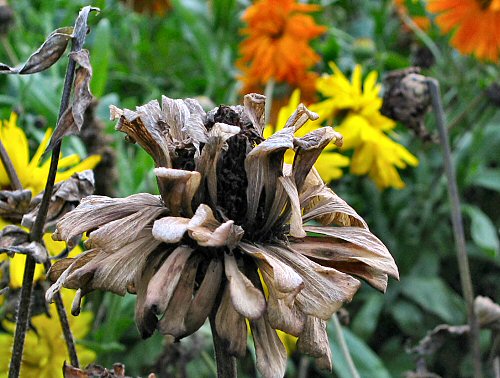
A vibrant slash of orange and yellow—the half-row of calendula seemed to be fairly unfazed by the recent blast of sub-zero cold, where the zinnias didn’t do so well. Another bit of first-hand frost experience to file away. Elsewhere in the flower test plot, the very few centaurea and asters seem to be kinda OK, still holding color. Otherwise, it’s all terminal shades of brown.
frost
Killing frost, kinda
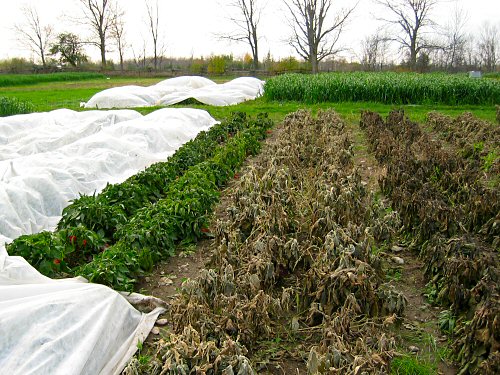
Yes, the weather’s crazy. According to the min/max thermometer outside the greenhouse, last night’s low was a chilly 18°F (-8°C), cold enough to kill off all but the hardiest. Finally, and only six weeks or so late—the endless autumn harvest is interesting, great for personal use veggies, but otherwise, it mainly throws off the fall clean-up schedule (I haven’t changed zones, have I?!). Here, the eggplant is clearly toasted, while the peppers, which had been under fairly light row cover (I pulled it back today to harvest some), came through in relatively fine shape . And the oats, well, it’s a monster, lush and green and if not exactly growing anymore, it seems to be getting thicker. It’s fascinating the way cold works in the field. Wind, cloud cover, mini-windbreaks, slight elevation, all kinds of factors add up differently in spots only a few feet apart to determine life or death by cold. Anyhow, can’t wait around forever. I’m soon going to roll up the row cover and till it all down!
Weed gone to seed
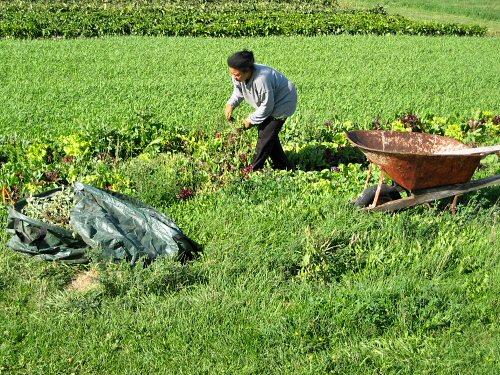
With more people in the field this year, end-of-season clean-up is already well underway. Here, Midori, visiting after moving to France a couple of years back, removes weeds that’ve gone to seed from three older beds of mesclun that’re waiting to be tilled in.
Ideally, finished beds would be promptly mowed down, spread with compost, tilled, and then seeded with a new veggie or cover crop a week or two later. Things aren’t usually that efficient, finished beds sometimes sit for weeks, weeds pop up in the interim, and if they go to seed, have to be removed before tilling so as not to add more seed to what’s already there…
Lying around: the green plastic garden totes are quite useful once the handles have been properly reinforced with rivets; the old builder’s wheelbarrow comes in handy for rocks, fallen tomatoes and the like.
The grass in front, in need of mowing, is part of a wide path on one side of the greenhouse, the grass beyond is the magnificent oats green manure cover crop.
Oh, no frost last night, as you can see from the happy peppers at the top of the pic!
Radish without holes
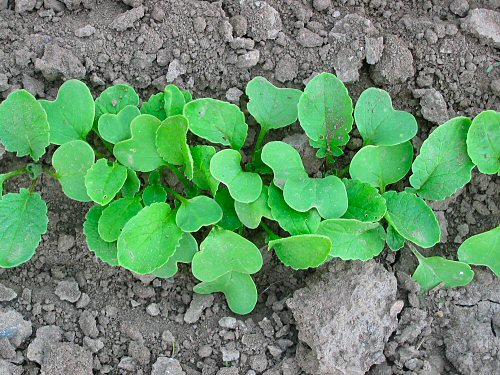
Radishes not riddled by flea beetle bites—it’s a slightly startling and definitely heartwarming sight! The winding down side of the season has its kinda downbeat MINUSES, like frost watch and wholesale row covering/uncovering, and the one special night when most tender crops get toasted by a hard frost and die (even under cover)… It has its PLUSES as well. Round about now, pest pressure declines dramatically, soon to vanish, and that includes PIGWEED, and the tiny but savage flea beetles (cucumber beetles stick around in small, determined numbers right into the subzero nights, but their damaging days are over for the year). Also, the need for irrigation is almost certainly over. These Rebel radishes were planted mid-August and with the recent rain, they’ll do well. Over the last few days, we’ve been laying in more beds of radishes, plus lettuce, spinach, zesty brassicas like arugula for salad greens, even some bok choi, in case we catch an extra measure of sun and warmth during the last of the good growing days. Bonus fall crops? With the pests packing it in, pushing for the latest growing date is the easiest gamble of the year!
Risk crop
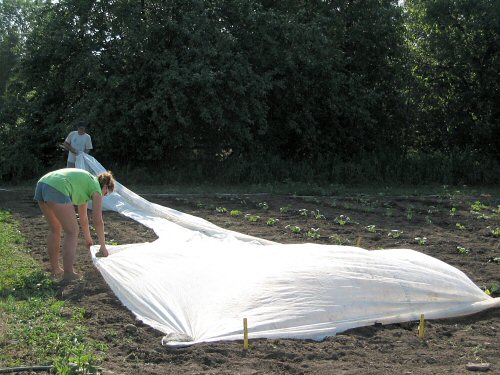
Protecting a final planting of the season, Jo and Conall lay row cover over a selection of summer squash. Also transplanted today from the squash family, more cucumber, an extra early muskmelon, and a couple of early maturity winter squash because there’s space. All of these are pretty much risk crops, with 50-65 day maturity up against our average first frost of around Sep. 20. They could have gone in a week or two earlier, but I’m gambling on another warm fall, with only a mild frost or two to get in the way (against which, row cover once again!), and MAYBE a harvest through October. Of course, the weather can be relied on less than ever, BUT, warm autumns seem to be a good bet. If this pays off, I’ll have some interesting veggies after the standard, safe season for ’em is over. Nothing ventured… You take your chances!
Pounding stakes
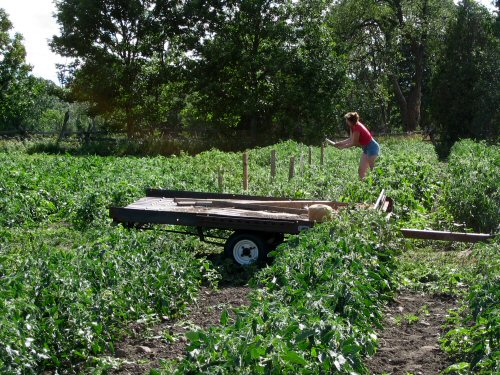
Jo pounds in wooden stakes for a somewhat catch-up version of tomato staking. I think of it as the Modified Sprawl. There are about 600 plants, with maybe 250 in home-style tomato cages. The rest are so far on their own. The cages work great, until a mighty wind comes along and blows a bunch over—they’re not really rugged field gear. It’s too late for proper basket weaving support, so it’s on to my previously tried and OK version, pulling the plants up with twine on both sides, to stakes set every three plants apart, with a bit of pruning and suckering as we go…
This is the point in the season where we start playing catch-up as a million different things need handling. It can get a little frantic, depending greatly on how it went earlier in the year. To add to the…decision-making puzzle, it’s last call, and even very iffy last call, for planting many crops (60 day maturity and under), with day length shortening and frost risk building to a significant consideration just 6-8 weeks down the road. So, thin here, or weed or seed there, or water elsewhere, you can’t do everything at once! It’s all in the timing, with much of the schedule in the hands of Ma Nature (where’s that RAIN!?!). Gambling, yes! Still and all, quite FUN.
Back to growing
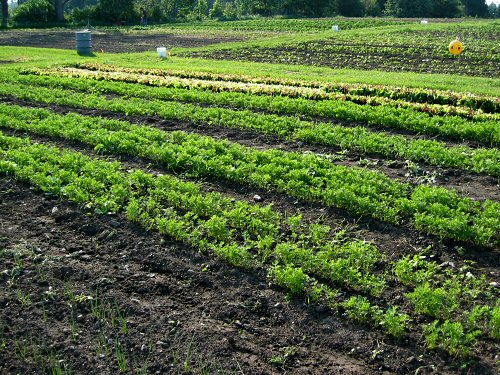
From the left: green onions, carrots, mesclun, snap beans, potatoes… After back-to-back frost warnings for the last two nights, the sun is shining, the air is warm, conditions have returned to reasonable, veggies are growing. Overnight, the min/max thermometer in the field went down to -1°C, but only a few rows of beans were slightly burnt by cold. Meanwhile, 25 miles away where we dropped off some greens today, the pond had frozen over solid and a kitchen veggie garden was completely toasted. Lucky us!