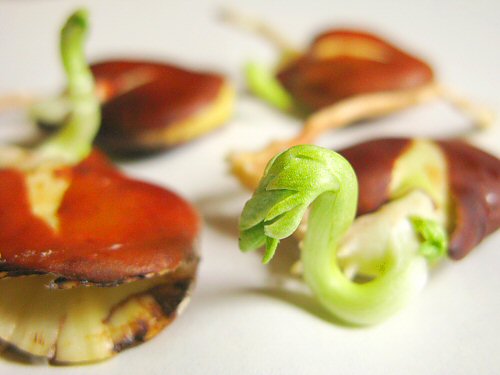
It’s that time of year again when obsession with seedlings somehow takes hold for a short while. I wonder if I’ll ever get over it, that almost overpowering early spring feeling that you don’t want to waste even a SINGLE seedling. Here, I germination tested a few Witkiem fava beans (broad beans) from an overlooked four-year-old supply. Bean seed viability is often rated at three years, but I didn’t doubt that these were fine, they looked and felt great. I tested some anyhow: wrapped them in a paper towel, misted them with water, popped them in a clear ziploc plastic bag, put them in a warm spot. That was about three weeks ago. Sure enough, a week later, the not-so-little white radicles were poking out of all of these big beans. Excellent! So I put them back in the bag and kinda forgot about them, moved them and all. Today, they were unpacked, and even without any light for at least a week, the seedlings were lustily struggling to break free. Now the kinda obsessive part is, I FEEL BAD ABOUT THROWING THEM OUT! This is pretty crazy. There is no good reason to pot them in February and have ’em hanging around for months until it’s warm and dried out enough to transplant. After two-three months in a pot, they’ll be useless as proper transplants, anyhow. Meanwhile, in a couple of weeks, there’ll start to be so many seedlings around here, and this keep-’em-all urge I’m having now will be gone without a trace. So I stuck ’em in some water, just for now… I thought this beginning of the season hang-on-to-every-seedling thing would wear off after a few years, but apparently not yet. Maybe I don’t take this business of tiny farming seriously enough! :)
timing
Seedling room settling in
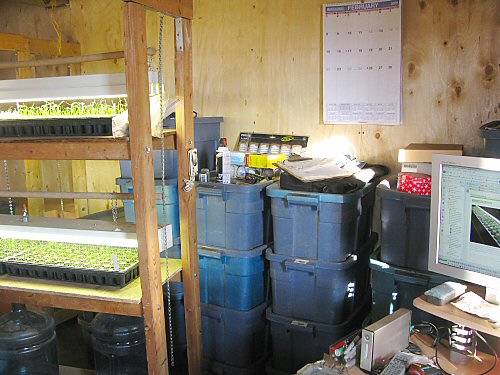
Things are moving along on all fronts, some less visible on the farm than others, like calls to locate various local suppliers, supply runs to the nearby village (pop. 2,400) and the bigger nearby town (pop. 70,000), and so on. The actual UNPACKING is going at a steady pace. The photo above pretty much sums things up so far for the new seedling room. There’s still a fair bit of finishing to do, and for that, we’re going to have to work from one side to the other, moving things back and forth. The computer is online, which is good, being able to check things out on the web is a big part of my tiny farming this time of year. I set up a couple of light rack shelves for the seedlings that’ve been started, but most of the lights are still packed away with the composting toilet. Around 25 harvest bins, doing moving duty, are still stacked, contents waiting for shelves—I labeled each one, so it’s not too hard too find stuff needed now. And the calendar is getting ready to flip again!
Strolling on the new field
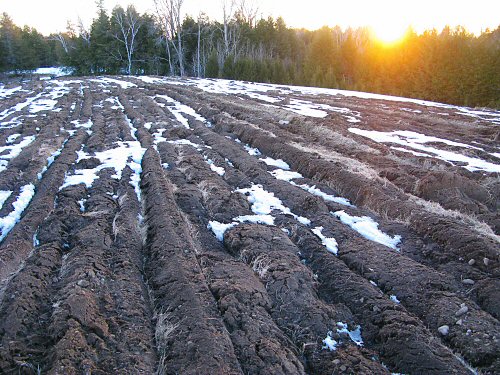
With the sun setting on a long day of packing and unpacking, we took a walk along the frozen ridges of the moldboard-plowed fields. The plowing, custom work by the organic beef and grain farm down the road, happened on the very last two of days before the snow and cold took over last November. The timing couldn’t have been luckier. One big step towards the new market garden. Well, after all the waiting and work-up, it feels great to be here!
New seed started!
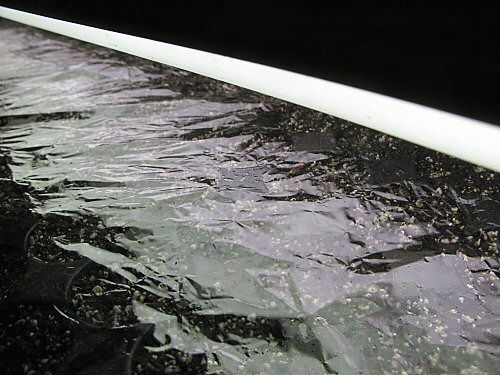
This is it, the official start of the new growing season (since there wasn’t time to plant out garlic in the fall at the new farm)! I seeded a fresh packet of 1,000 Red Wing red onion seeds in three 72-cell plug sheets. That’s 4-5 seeds per cell—after the good results last season, I’m going the multi-plant route again, 3-4 onions in one spot, instead of singles. There are lots more onions and leek to come, including sets, this is the beginning. I’m still at the old farm, the new seedling room is not quite ready, so I’ll be starting a few more things here in the next couple of days, and take them along on the move! For the Red Wing, I hung a couple of lights on one of the light racks. As usual, the trays are covered in plastic wrap to hold heat and moisture. This tiny farm marches on!
Bringing in the pipe
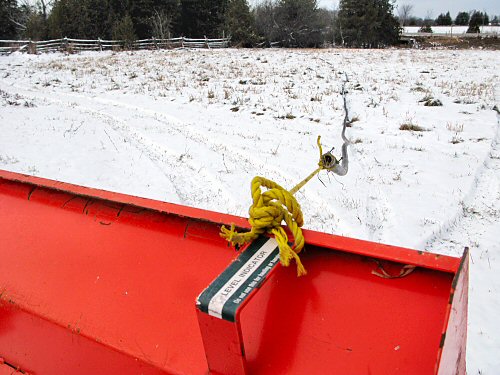
Bit of unusual fieldwork on the menu today, something we don’t do every year. Bob and I brought in about 1,000′ (305m) of 1″ (2.5cm) and 1-1/2″ plastic irrigation pipe, that ran all the way from the pond to the gate into the garden field. Why wasn’t this done in better weather, when, besides having no snow to deal with, warmer plastic would’ve been a lot easier to handle, especially to BEND? There’s no good answer, except maybe, “Didn’t think it’d be this cold and snowy so soon!” Anyhow, it got done, and probably in exactly the same time…
I used the Kubota compact tractor to drag the pipe in three 300′ sections, right into the barnyard (the rope is tied to the front end loader bucket; in the pic, this is at the very end of the garden, where it meets the hay, so all that stubble is mainly long grass). Backing up down the field, I worked it from the far end for the section that lay in the unmown grass right near the fence, so that it could more easily tear its way out of the overgrowth. Then, some coiling (that’s Bob), tying off the loops every few turns with baler twine (plastic twine used to bale hay, it’s all over the place)… Easy!
Hoarding wood like gold
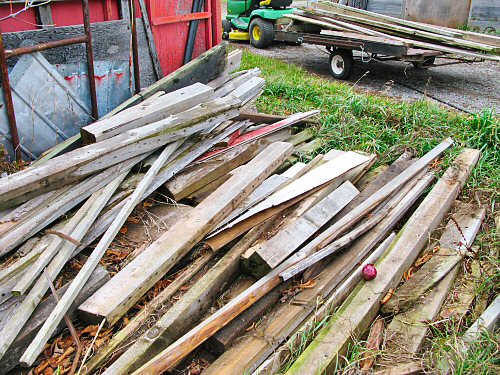
Calling it scrap lumber doesn’t do any pile of spare wood justice. On the tiny farm, you always make space to accumulate someday useful stuff that elsewhere might get tossed. Waste not, want not! This collection of old fence boards, rough cut cedar planks, odds and ends of 2×4’s, and other bits will piece by piece have its day. Meanwhile, it needs to be moved to a more sheltered spot, raised off the ground, before the snow really comes in. Today seemed like a good day to do it…
Sweet potato harvest
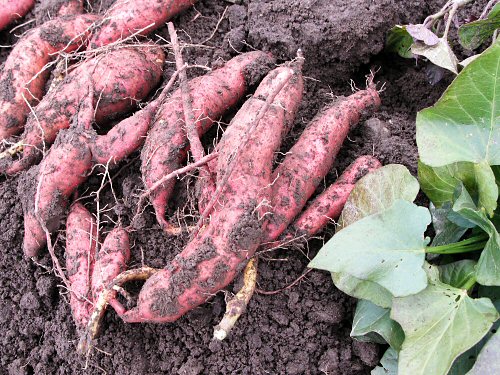
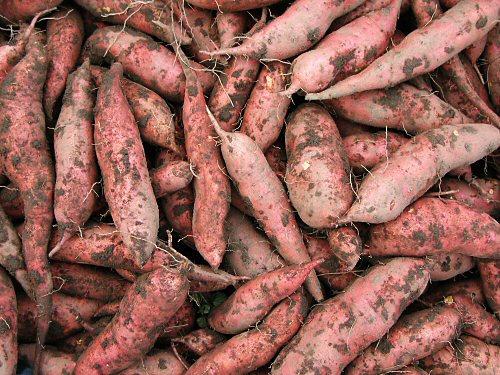
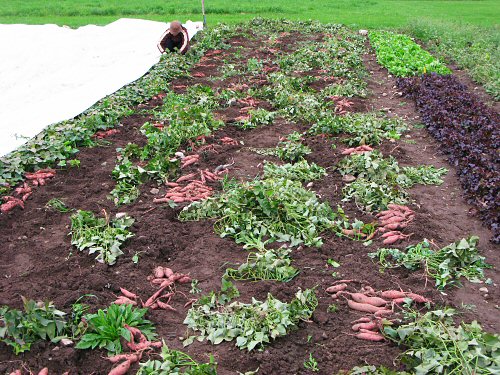
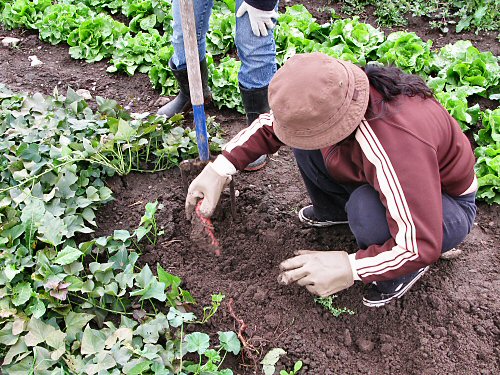
From planting back in mid-June, it’s been 3-1/2 months to the sweet potato harvest. The variety, Beauregard, is listed as 80-100 days to maturity, although, like potatoes, you can dig them up anytime, as soon as the tubers have formed. The vines are frost-sensitive, and the tubers shouldn’t be left in the ground if the tops are frost-killed, so I’ve been gambling with the first frost timing in order to let them grow for as long as possible. Today seemed like a good time to start. This has indeed been a really easy, pest- and disease-free crop, requiring only a little weeding until the vines filled in. Harvesting turned out to be equally easy. After digging up a few plants to see how the tubers grow, Lynn, Toshiko and I set up a quick hand-harvesting system: remove the vine, loosen the soil with a digging fork, scrabble around for the taters.
The soil had quite a lot of moisture from recent rains, so we had to spend a little extra time brushing off clumps of clayey earth. We left them for a couple of hours to dry in the breeze, then collected them in bins and brought them into the Milkhouse. By the book, sweet potatoes could use 10-14 days of curing at 80-85°F (25-28°C) . In part, this allows some of the starch to convert to sugar, making them…sweeter. That sort of HEAT isn’t available around here right now, but for this first time around, and too small a quantity for really long-term storage, I’m not too concerned. I baked some a couple of days ago, and they already taste good. Let’s see what a week or two indoors does for ’em!