
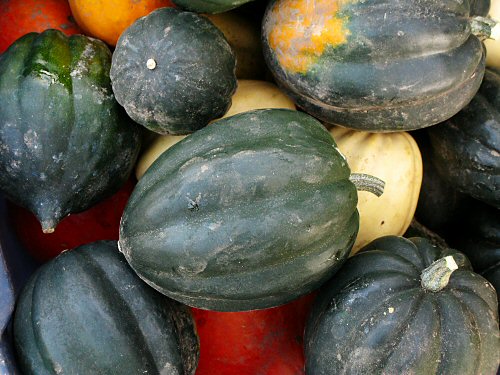
At our farmers’ market, winter squash is the final course on the year’s harvest menu. From here on in, it’s mainly squash, pumpkins, root crops like carrots, potatoes and beets, and…cabbage. Most of the growers at market start bringing their squash in on the same day, like, today, by the trailer load. We harvested about half of our small, assorted crop—a few bushels in all—around 10 days ago, and left the rest to maybe eke out a little more growth until the first killing frost. For today’s market we took in a selection of acorn squash: green Table Ace, yellow-orange Table Gold, and white Cream of the Crop…
timing
Pumpkins and pigweed
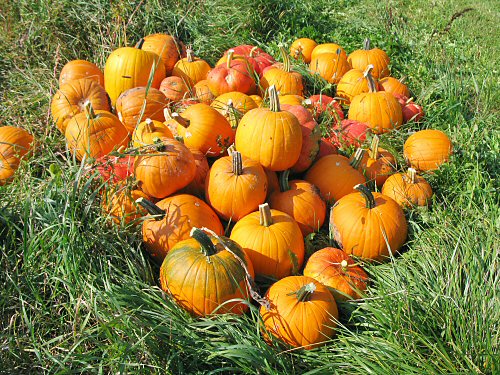
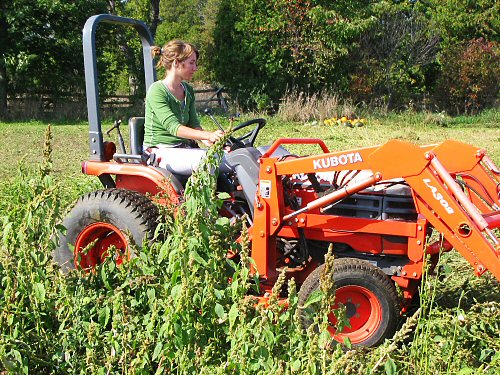
Today, the pumpkins came in, wrested from a jungle of pigweed gone wild. Every year, a few of the 40 50’x50′ sections that make up the 2.5 acre garden get a little overrun with one weed or another (usually, pigweed). This year’s pumpkin patch was a good example, with pigweed growing unchecked for a good six weeks—no time made to weed, not IMPORTANT enough a crop—until today, when Raechelle used the belly-mounted 52″ mower deck on the Kubota compact tractor to mow it down!
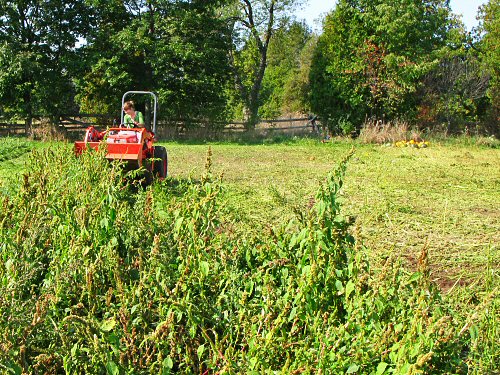
Of course, this is exactly what you DON’T EVER DO in a garden: allow weeds to flourish and go to seed, then mow them down, broadcasting seed everywhere… Oh, well. The alternative, pulling the pigweed by hand, then carting it off, we also do when necessary—see the Pigweed Mountain—but once in a while, I go for the instant gratification of seeing a section clean and clear in an hour or two. The millions of pigweed seeds, ensuring healthy future generations for years to come, will be dealt with…later. (As long as we weed on time next time around, how bad can it get?! :) Anyhow, it’s all part of the grand experiment! Guest pumpkin photo by Lynn.
Trimming garlic
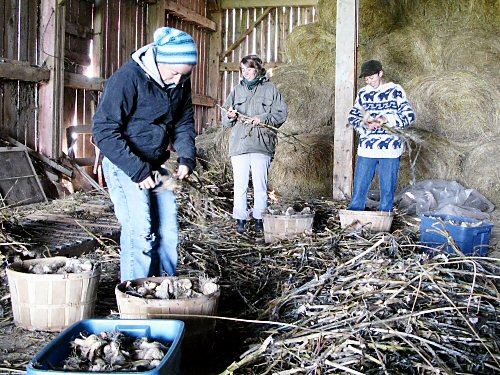
From the long stack of garlic drying in the barn, we’ve been taking out about a bushel a week since harvest began in late July. Today, we finished preparing the rest of the harvest. Lynn, Raechelle and Mel snipped the stems and sorted at the same time. (The roots weren’t trimmed; that can be done for some as we go through the bins and baskets each week for CSA shares and the farmers’ market.) In past years, the sorting was for size: dividing the mostly medium and large bulbs, and putting aside the very few tiny and damaged ones. Garlic does best with a dry final month of growth—this time, coming out of ground that had remained quite wet all summer, the harvest wasn’t in as good shape…
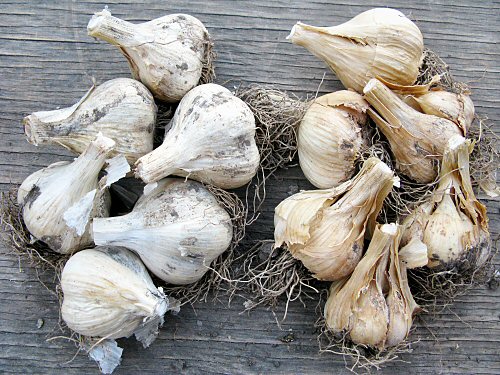
Sizing evened out, with most bulbs about what I call “medium” (this is the most useful size for cooking, but the big ones are so…impressive, everyone loves ’em). A little over half dried not to the usual tight, white skin, instead, to a tan color, wrinkled and split. So, we sorted into “good” and “not so good”… There was also a much higher proportion of really damaged bulbs, maybe 10% compared to a usual couple per hundred. Still, the taste is great, and the cloves themselves are fine. Only appearance and storage life are affected. We’re selling the less pretty, less storable bulbs at a couple of dollars less per pound. They’re good for immediate use (within 3-4 weeks, maybe a little longer) and as seed garlic for fall planting. Overall yield was great, although I’m not sure whether the hugely reduced number of large bulbs was due to weather, or to the more intensive 5-across planting we tried for the first time. As usual, more to observe and learn from. All in all, given the poor garlic weather, it all worked out quite well!
Cutting spinach
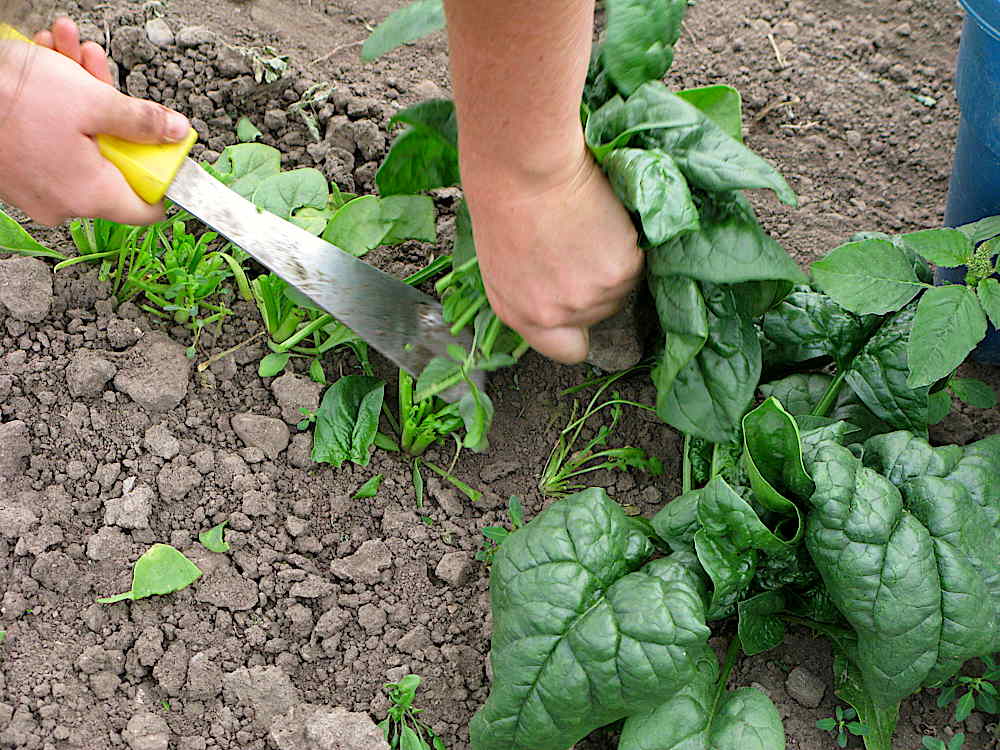
Spinach has kinda been the star of the harvest for the last couple of weeks. After a “normal” summer—hot and dry for the last three years—it’s usually not around at this time of year due to poor germination. This season, with cloudy, cooler days and all the rain, spinach is in abundance: glossy, deep green, succulent, full of flavor. Libby and Lynn chop away, cutting an inch or two up the stems. This technique takes out the small new growth leaves, but it’s fast and efficient, and the plants still grow back for a second harvest. The alternate picking-single-leaves approach is more laid back, great for leisurely field chats—this harvest, we opted for quick…
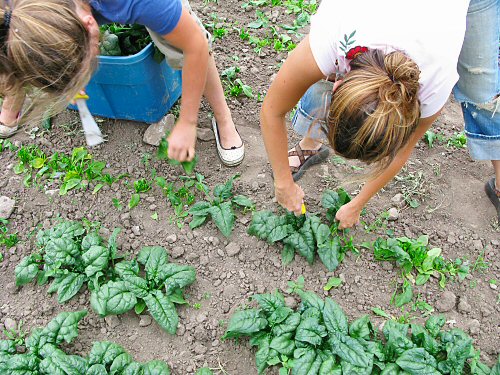
Nothing like teamwork: head down, knife in hand, side by side…
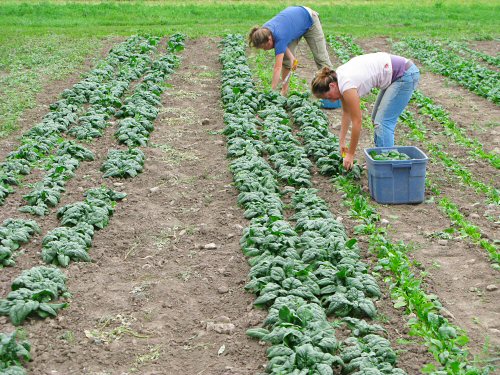
My, what a nice, wide path!
Parsnip surprise
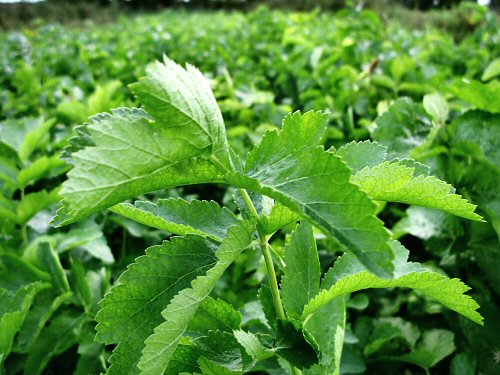
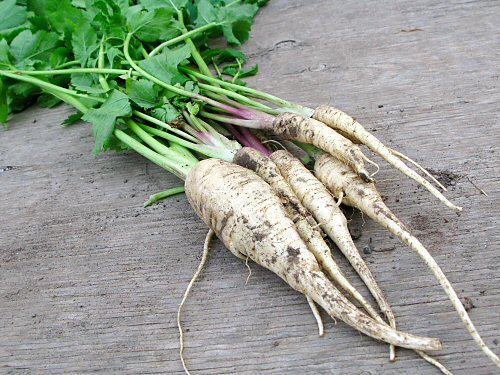
Parsnips, at last! This is a crop I’ve tried to grow almost every year, but until this season, it’ hasn’t come through. Parsnips take a while to germinate, a couple of weeks or more, right in the middle of the spring planting-out rush. Weeds would start to take over, parsnips weren’t a priority, and I’d never find the time to save them. This year’s warm, wet spring made a difference. Germination was quick and the seedlings surged ahead of the weeds! Nearly four months later and, even in dense, unthinned rows, the parsnips are thriving. Yay! Today, I dug up about 6″ (15cm) of a row to check ’em out. With the crowding, there’s a motley assortment of sizes, but overall yield looks good. Another month in the ground, a little post-harvest sorting, and it’ll be parsnips for all!
Good beans…
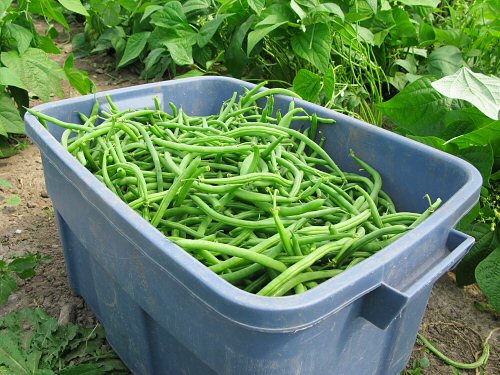
Just a few sunny days and the new planting of snap beans have sized up perfectly for the Friday harvest. They’re the crop of the week, a shade on the young side, maybe 2-3 days from being fully filled out, super-long and slender, with firm, thin pods (compared to the sturdier skins of the slower-growing first set), and only a hint of the actual bean inside. Cool! Because everything is fresh-picked on Fridays, regardless of when the “perfect” picking day may’ve been, it’s interesting to see what the luck of the draw brings to certain crops. These beans are an example. By being a little early, I lose a bit of yield, maybe 10-15%, but the beans are at that elusive, slightly young stage. Mesclun may reach that perfect first cut, when the leaves are still mild-tasting and almost melt-in-your-mouth, on, say, a Monday or Tuesday, and, especially if there’s sunny weather, grow past it by the Friday—still excellent, but a little firmer and stronger-tasting. Same for some of the fastest growing summer squash, like the zucchinis, which can practically double in size in 4-5 days. I’ve found the picking window for tasty veggies is usually quite forgiving for even the fastest growers, at least a week in summer and longer in the fall. As always, it’s mainly about the weather: how much heat, sun, and moisture they get. Since I’m not harvesting or sorting for uniformity—I don’t NEED carrots of a certain length and diameter and so forth—there are no worries on this front, and it’s fun to see and eat the variations of each crop and planting at each harvest all through the season….
Fall crops
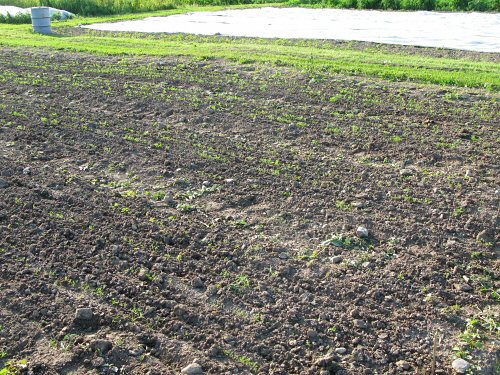
Not much to look at, yet, but the last plantings of 50-day-plus fall crops are doing fine. Here, carrots and, protected from flea beetles by floating row cover, one of two sections of brassicas, including broccoli, cauliflower and kale. There’s a bit of timing risk here, depending on the weather, if growing goes slow, they might not make it to maturity in time for market. But the sun’s been shining for a couple of days now, and the long range forecast is for more of the same. If all goes well, these will be ready for harvest through October!
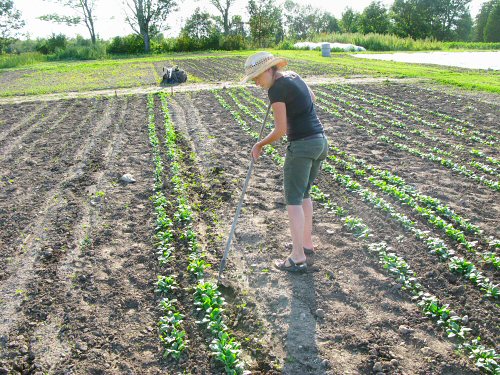
And the summer-seeded spinach couldn’t be doing better. There are two plantings, the first on July 22, and the second (left of the photo) a couple of weeks later. Here, Lynn hoes the first set: in this summer’s wet, cooler, cloudier conditions, germination was absolutely solid, as good as or better than regular spring seedings. Fall spinach has never been this good, by far. Excellent!