Shifting gears for summer…

The spring rush is over, and fieldwork is shifting into summer mode, from mainly planting to mainly weeding and watering, and then, HARVESTING. Seedlings for the most important crops and varieties are in, although there’s still quite a lot to transplant.

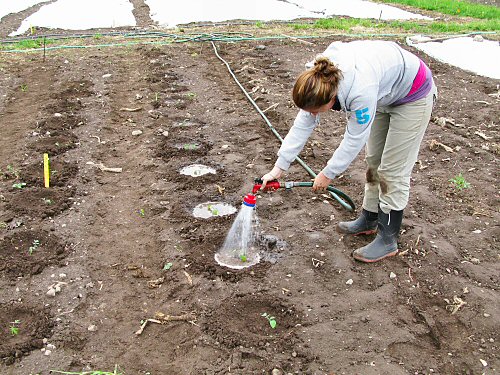
Here, we’ve just finishing another 100 or so tomatoes, with Lynn watering them in (the Redhead water breaker is GREAT, delivers as much water as you’ve got pressure, while softening the flow so that you’re not smashing or burying the seedlings). Creating a little basin around each seedling makes the most of hand watering in.

In my continuing experiment with shortening seedling production time, these are the youngest toms to go out ever, a third set started at the beginning of May, with their first true leaves now just coming in!

There are also more squash, melons, and a few more toms to transplant—in years past, I’d’ve been concerned about the date, but I’m learning to adapt the season’s resources (time, people, irrigation capacity,…) to the WEATHER.

Keep the workflow balanced is my new first mantra, so we also spent a few hours weeding today (Ryan dropped by to help for a few hours, he’s a new CSA-er this year who is also about to move his family to their own tiny farm at the end June!), instead of rushing on the last transplants.

It’s hard to measure, but for this type of small, diverse market gardening, in this time of extreme weather, things quite often don’t work out as they traditionally should. For example, the recent rain and cold, and now, more heat, have created a situation where the dominant weeds—pigweed, mallow, and lamb’s quarters—are seemingly slow, but are in fact about to explode. Weeding now will probably save way more time and deliver more harvest than putting off weeding just to transplant a few more beds a few days earlier.

I dunno, I’m figuring this out as I go, but I think traditonal garden rules and timing have to be increasingly bent as the weather gets crazier… I guess you could say: EXCITING TIMES! :)
Farewell to the Colonel!

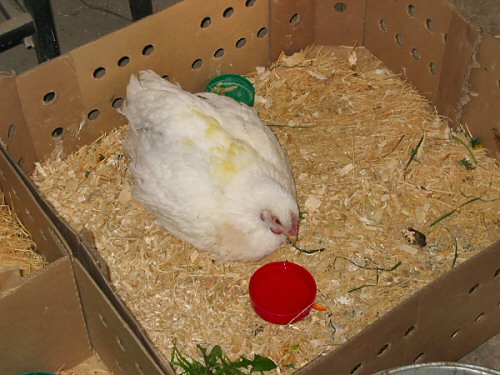
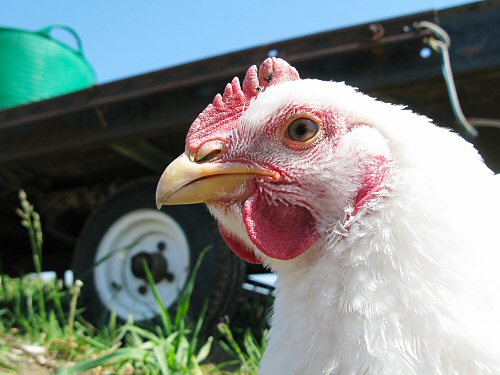
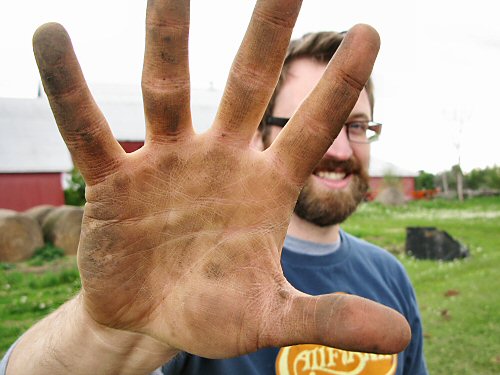
After a full day of seeding and weeding in quite glorious sunshine, with pet chicken Colonel Saunders in attendance, Shannon took her leave this evening, heading on to other interning adventures. She’d worked just about every day of the last month. Our daily chats were…interesting! For my part, it was a really great chance to articulate lots of stuff that’d been bubbling around in my head. Tiny farming can be quite the mental trip, as well as a lot of work—having the chance to bounce ideas and thoughts off someone both completely new and cool to talk to, who’d also been on many other small farms (I’ve STILL to really visit another market garden), was a definite treat. I also at times argued against the market garden practicality of some of her well-thought-through ideas about gardening in a more holistic, permaculture vein, but in the end, they brought useful thoughts to the forefront. And of course, the spring planting and a bunch of other stuff got done. I guess it’s clear: Shannon was a cool person to meet in the field! I hope the…immersive Tiny Farm Experience was equally good for her, that she learned stuff and had fun as well! As I’m discovering, more than anything else, tiny farming is about people… (Guest photo by Shannon.)

Ah, the Home Garden…

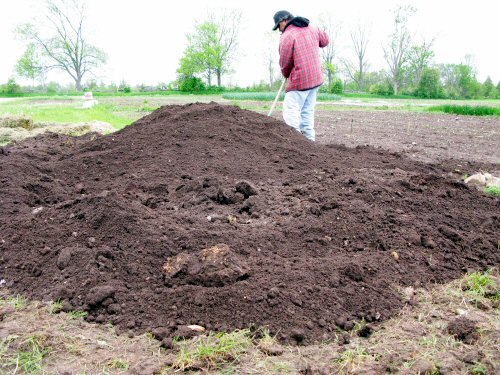
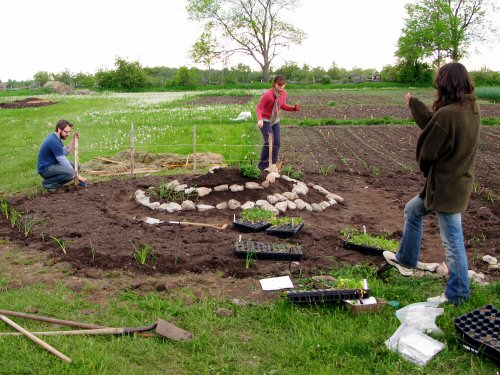
After quite a bit of talking about it, and last year’s false start, a Home Garden is suddenly in place in one corner of the field. The idea is to have a small demonstration veggie plot, to encourage people to grow at least some of their own stuff in whatever space they have. Why? Well, it seemed like fun. Located by the farm stand, it would be an extra little attraction to farm visitors… Just a thing worth doing… Anyhow, last year, I staked out a section, but didn’t get too far in planting anything in it, a couple of tomatoes and a few potatoes… This time around, I’d been chatting with Shannon, who has a lot of permaculture-based ideas, from reading and interning, so I asked her to plan it out. The final design was done really quickly earlier today (it was a busy month…), it’s more a freeform, jumbled garden with a permaculture flavor: all annual veggies, no rows, lots of interplanting, a herb spiral on a mound (a mix of annuals and perennials), an anti-pest barrier of alliums (onions and garlic chives) around the perimeter, and three little keyholes, which are dugouts that you can kneel in to garden within reach around you, as an alternative to working from paths. At about 10’x20′ (3x6m), it’s fairly small. One cool thing: the home garden layout is entirely unlike the rest of the market garden, which is all flat, linear and grid-like, lots of rectangles and squares and straight paths. Now, we have a deliberate elevation and CIRCLES! To make the mound, I dumped a few buckets of compost using the Kubota compact tractor, and raked it into shape. We then added stones for the spiral, and Erin and Mike dropped in and helped plant it out, using odds and ends of transplants and also seed, with Shannon directing. The rough plan is to have Lynn and Raechelle develop and tend it over the season (Shannon leaves tomorrow after a solid month in the field).

At just over two acres of veggies, the tiny farm is really small by most any modern agricultural standard, and starting up a MUCH TINIER space is its own private…thrill for me. It’s so…opposite! ;) It’ll be interesting to see how Home Garden 1 turns out as the season rolls along! Any way you can, getting your hands dirty is what it’s all about… (Guest photos: top by Shannon, below by Erin.)

Potting for market

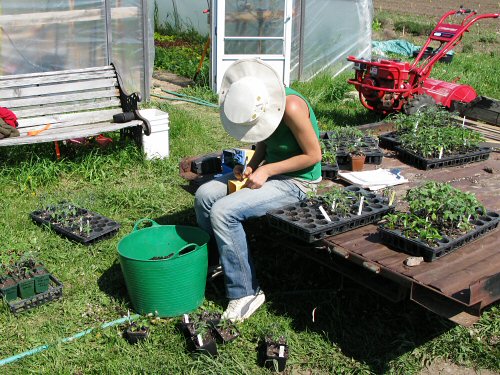
With the recently warming weather, field crops have started to grow more quickly, but nothing but radishes will be ready for this Saturday’s farmers’ market, and the early lettuce in the greenhouse has gotten pretty low after two weeks of harvesting. This is a first: by the end of May, mesclun and usually spinach have been ready in the field. Not this time. Sooo, we decided to fill out the week’s market stand offerings with seedlings. Selling my extra insurance seedlings at the market is something I’ve avoided until now: for the few dollars more, it didn’t seem worth the chance of complaints if anything goes wrong (I’ve heard people blame all kinds of things on the plants they buy)—usually, I’d sell or give only to people I know. There’s always a first time, so Shannon potted up and labeled a couple of dozen spares. We’ll take a walk on the wild side and see what happens… :)

What I’m not up to…

Pesticide fill-up

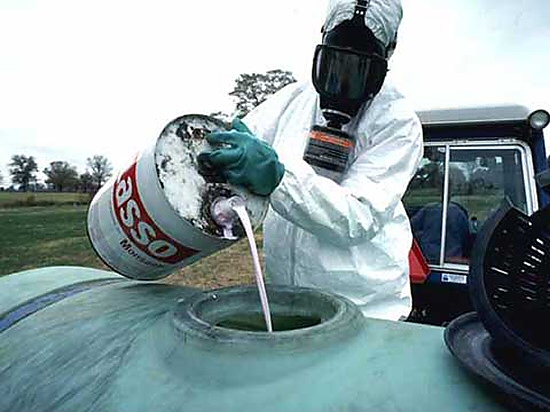
Don’t know who that is in the photo…it’s not me! I last posted this image—I found it online; I think it’s public domain; he’s loading up a herbicide called alachlor—in an October, 2007 post, And now for something completely different… I like the image. It’s a way for me to make quick sense of this organic tiny farming, so I guess I’ll post it every so often, as a reminder, until something better comes along… I have zero first-hand experience with industrial agriculture or its direct effects, all I know about it is what I’ve read and eaten (and I think I’m doing OK so far). I do know that things are never the same when you’re on the inside, so when I think Big Ag is all wrong, it’s just a semi-educated guess. I haven’t seen it DO wrong in person, and (unfortunately), it still feeds me part of the time. But when I see a picture like this, and compare it with what I do in the field, the contrast is pretty clear. With all of the mind-numbing complexities of the green/what-have-we-done-to-the-planet-and-what-should-we-do-now- to-fix-it/save-ourselves debate, I can simplify: I immensely enjoy growing food for people, and I don’t want to be that guy…

Great day in the field

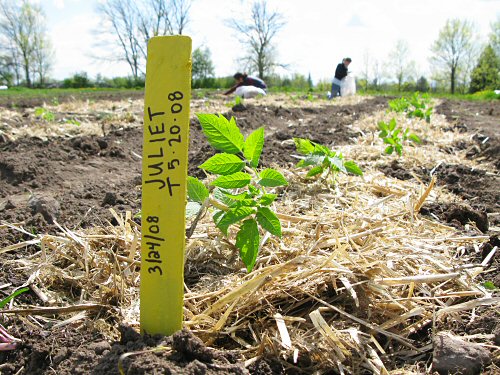
Especially compared to yesterday, today’s mainly sunny, quite warm weather added up to a glorious day in the field. Lynn, Raechelle and Shannon were all on hand, plus the inadvertent pet chicken, Colonel Saunders (I guess there’s no going back to the flock for him now, he’s been separated for a few days and probably wouldn’t be welcome, but, uh, he will be eaten…). It’s so absolutely fun to do even the most potentially tedious tasks (like hand-weeding between tiny green onion seedlings—done!) in a group with such a happy vibe. Besides a good amount of weeding, and putting ALL the chickens outdoors for the first time (those White Rocks don’t seem to want to do anything chicken-normal on their own, except eat), we transplanted the first 100 tomatoes. These were the deluxe early starts (Juliet, Striped German, Big Beef, Stupice), and they got the best transplant treatment ever: a deep, dug hole with a generous amount of compost, burying to the topmost leaves, a thorough watering in, mulching with the oat straw, and then, floating row cover over top for the coming few cold nights—it’s hard to imagine this is a…commercial operation, especially when you’re selling toms for only $1.50-2/lb. :) We mulched directly around the plants with straw, I’ll fill out the rows with grass mulch as soon as there’s enough. On the marker stake, there’s the variety, seedlng start date, and today’s transplanting date. At the other end of the row, Raechelle and Lynn mulch (Shannon seems to mysteriously avoid the occasional snapshots most of the time…). With all of the recent cold, we’re definitely at least a week behind the last couple of years in transplanting and in growth, but with a few hot, sunny days to complement the decent amount of rain we’ve been getting (not usual in recent years at this point), we might even catch up… Anyhow, a fine day!

Free-range chicken

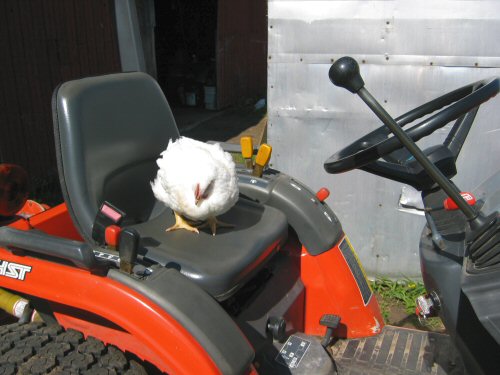
Guest post by Shannon: This is our pet chicken who is named Colonel Saunders. He almost died in the chicken house a couple days ago so we rescued him. He’s very dramatic and plays dead (but not on demand). He’s very chill and doesn’t give us any problems. Mike thinks the colonel has some brain damage due to a recent stroke but I think he’s smart. He gets to live on his own, with lots of space, we feed him whenever he asks (by tapping incessantly on his food dish), and he hangs out with us while we work. I dyed his top feathers yellow with dandelion flowers so we could tell him apart from the rest.