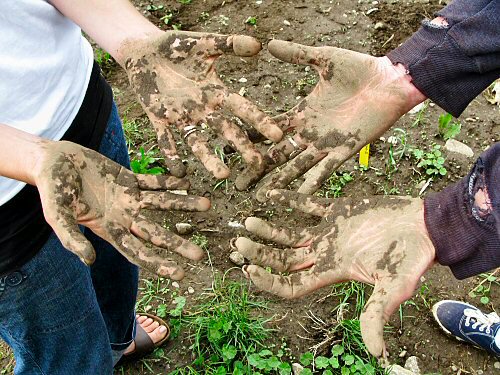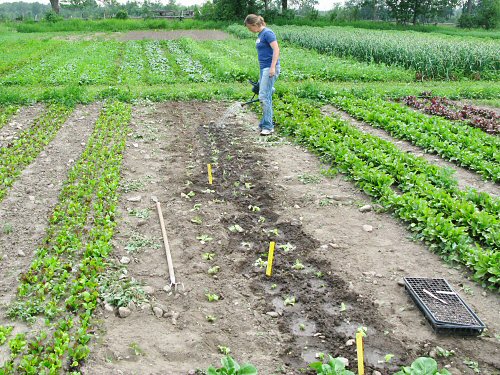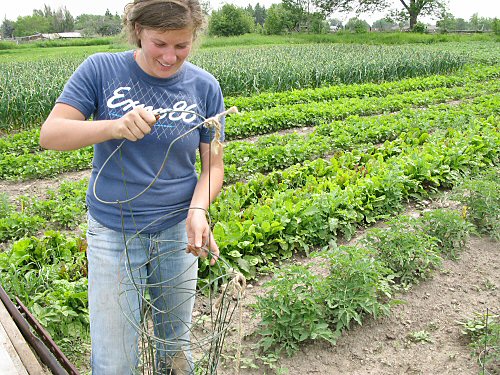
Libby’s first day on the farm: a full day in the field, plus a Big Salad lunch! There’ve been a few first-timer days this year, and a bit of a casual presentation routine has developed. Starts with a tour: “How much detail do you want?” The difference between growing more or less by hand, as we do here, and different degrees of tractor-based farming is probably the main point I try to get across. And then, it’s on to the fabulous WORK, a taste of the many tiny farming fieldwork pleasures. Today, Libby pulled weeds from carrot beds, on her own for a while, and then I joined in. Weeding carrots and tomatoes, hand-pulling and with the wheel hoe, setting up some home garden-type tomato cages, transplanting lettuce…the time flew by. Chatting is usually a big part of working in the field (with no noisy machines to get in the way): farming stuff, trading bits of personal history, and inevitably, it seems, some Bigger Topics. Today, the concept of MINDFULNESS came up and really stuck with me… And so, another fine day on the tiny farm. Libby seemed PRETTY HAPPY with it all. Cool. We’ll see her next week! :)
People
Tiny farming: it’s a garden party!?
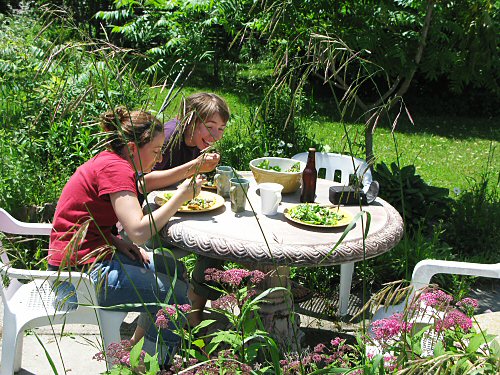
For the month of June, after Shannon, who’d been in the field just about every day in May, and while waiting for Lynn to start full-time for the rest of the season (July 1st!), I’ve been back working in solo mode, which has been, surprisingly to me, a little strange and…unfamiliar. Right now, there are several great people sharing the tiny farm experience (TFE ;) each week, but coming on single days. Here, with Lynn and Raechelle (Tuesdays!), we take an extended Endless Salad lunch break in the backyard. It’s as relaxed and fun as it looks. This, I think, is how it SHOULD BE, a laid back mix of fieldwork and practical leisure. It’s a lot different than the 10-12-hour, garden-obsessed days of the first 3-4 start-up years, when I worked largely alone. After working with Conall right through the season last year, I realized that my original solo mission, one-farmer-one-field mode had…changed. Evolved. To continue to grow on this tiny farm, it seems I’ve taken the path that needs not more production acreage or machinery or straight, head-down hours of labor, but simply more happily committed PEOPLE. Hmmm… Not a brand new discovery, but driven home over the last month. An interesting twist on tiny!
Chickens to the slaughter
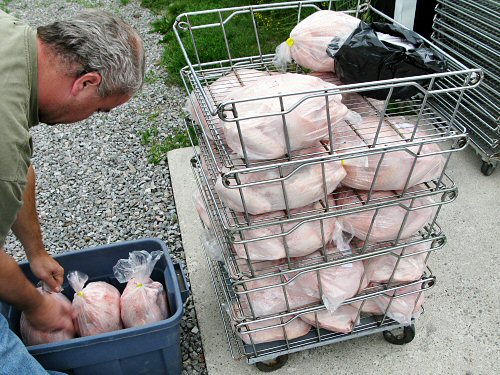
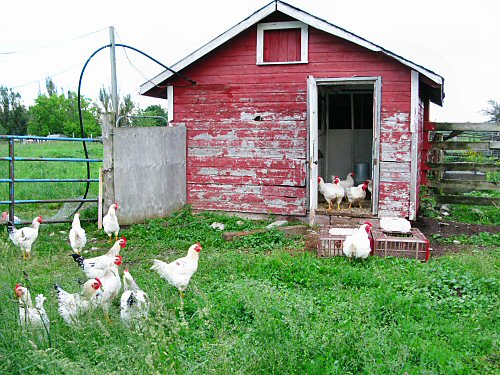
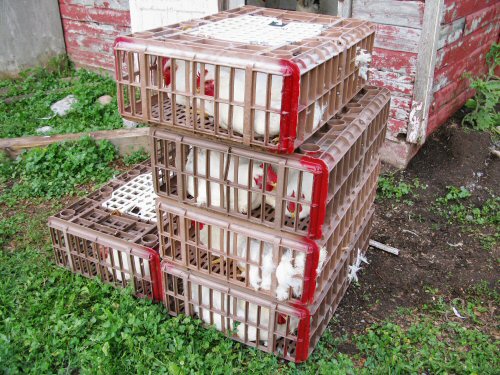
Raising your first chickens, killing them, and eating them has gotta rank up there with other Firsts worth a little attention. Now, I’m at least part of the way there: the killing this time was done behind closed doors, with me on the outside—chicken PROCESSING. Still, first enough to be worth a few photos… I’d been cutting it close with booking a processing day for the White Rocks, the local processor is known to get solidly booked for weeks. I finally called yesterday, looking for a date in two weeks, and was told there was also a cancellation for tomorrow (today!). I checked out the WRs, and, man, how could I imagine them getting any bigger (I think I was mesmerized, waiting for them to explode)? So I called back and booked. We drove over last night to pick up crates (20 minutes each way), then it was up at 5:30 this morning to load ’em. As soon as I opened the door, all of the Frey’s dual purpose darted out immediately, as usual, while the WRs, who mostly go nowhere, stayed in: it was kinda fitting that the Frey’s stood around in unfenced-in freedom, ready to run (and they would’ve!), while the WRs kinda dumbly looked out at their crates (above).
Five to a crate, 25 in all, 30 minutes or so to loaded…no need to chase down these lumbering beasts (while I was packing, most of the Frey’s figured out no good was afoot and entirely disappeared around the other side of the chickenhouse, something they’d never done before, while a couple stayed to watch).
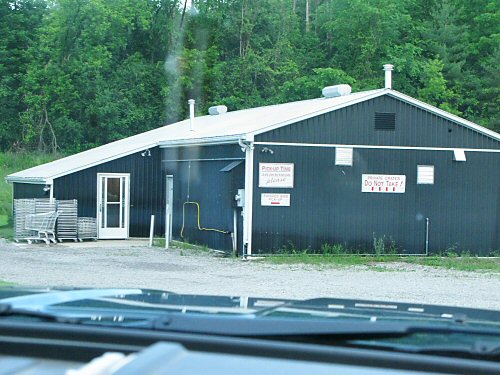
The processor is on a farm, a low building where birds go in live on one side, and come out the other, cleaned and chilled, weighed and government-inspected, ready to go…
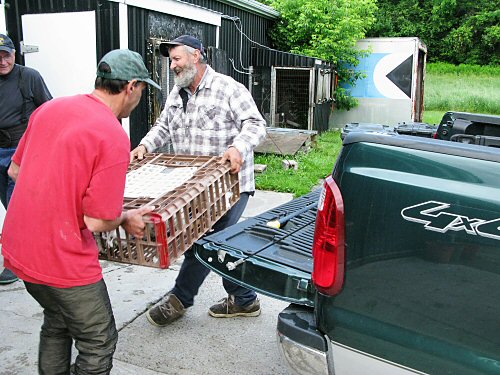
Bob and a processing guy unload. It’s 6:45am. The paperwork is quick and painless, I didn’t even have to write or sign anything. The only sign of bureaucracy in action is the required chicken purchase number, a serial number that’s on the form that you fill out when purchasing the chicks. And the on-premises government inspector popped out and did a little of his own paperwork. Other than that, just processing choices. For a few cents more (like 75-85), you can have the chickens halved and put in separate bags, or halved or quartered in the same bag. We got 10 halved and separated, for when cooking a whole fat chicken would be a little too much. Modern conveniences?! :) I also chose to get the organs back (in the black bag; below).
Eleven hours later, it’s 5:30pm and we’re back. Matthew helps pack the big birds for the trip home and into the freezer. Average weight is around 8lbs (3.6kg), where the Frey’s are maybe barely 3lbs. Hmmm… Not the most satisfying little adventure, with three 40-minute round trip drives, and the chickens disappearing through yet another middleman, reappearing neatly packaged for $3 more… With the processing fee tacked on for good measure, these are EXPENSIVE chickens, but I’ll do the math, and review the overall, somewhat unsettling White Rock Experience…later. On the other hand, you can’t beat the results: a lotta REALLY plump chickens! Next up in Meat Birds, Take 1: waiting for the free-ranging Frey’s to bulk up, and THEN it’ll be a fully DIY field-to-table chicken dinner!
Weeding day
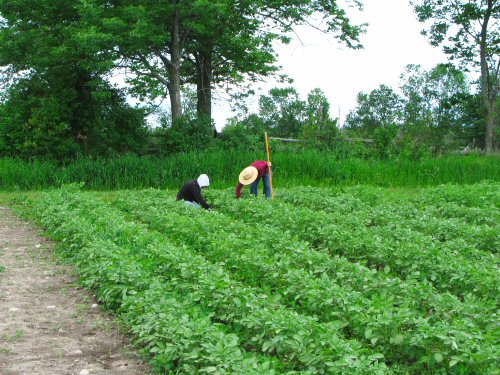
A cool, gray, peaceful day of WEEDING. Lynn and Raechelle combine hoeing and basic hand weeding to pull up a nice mix of pigweed and lamb’s quarters, with a little mallow and orchard grass for variety. I did paths with the wheel hoe. At the same time, we checked for Colorado potato beetle eggs (orange clusters on the undersides of leaves)—they’ve been here for a week or more, but so far not in troublesome numbers. It’s slow work, but satisfying in the end. The potatoes are growing abundantly with all of the moisture (which isn’t a problem so far), so much of what’s weeded now won’t be coming back under the expanding leaf cover. That’s nice.
The Endless Salad…
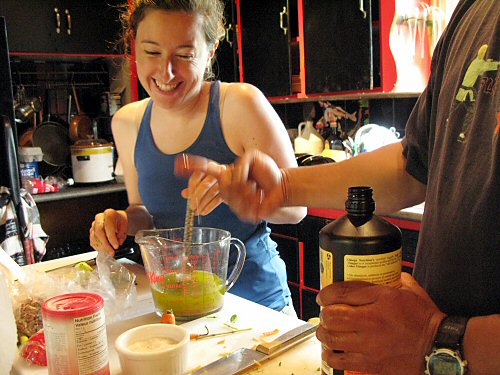
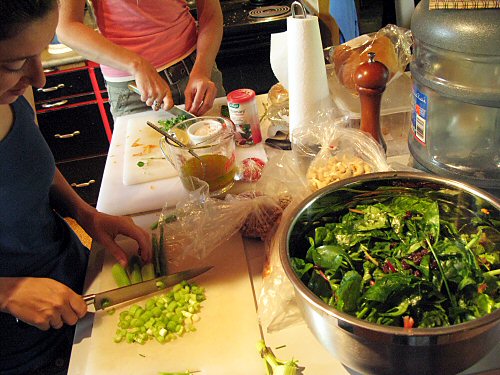
Lunch has turned into a collaborative cooking affair, built around the near-infinite possibilities of the Endless SALAD. Everyone who’s around pitches in: here, Lynn and Melissa chop. We build it from what’s available in the field, plus supplies from the farmers’ market and from the supermarket (with mixed feelings, I’m now buying mostly organic), a variety of raw nuts, and sometimes meat (turkey, chicken, fish, so far). We pick the ingredients, and there can be MANY, by whatever sounds good together. It always works! The salads started last month, when I asked to join Shannon in her vegetarian lunches, and Lynn and Raechelle would fill out the table on the days they were here. This direct connection between growing and cooking and eating and people started last season, with Friday evening dinners after harvest, and the first, occasional all-local-food mini-barbecues, and now it’s become part of everything…
Thinking about it now, this deepening food awareness is happening over what seems like a curiously loooong time, this being Year 6 in the garden. For the first couple of years, I was out in the field alone, spending 10-12 hour days at least six days a week during the main growing season. At the end of the day, I ate TONS of veggies. It was normal to harvest several types of greens for a salad, plus whatever was around for a sauteed side dish, and every three-four days, I’d roast a bunch of root crops. Meat was definitely in there, regular supermarket fare, but almost as a garnish, a small steak or a big pork chop or a chicken breast, on top of a mountain of veggies. I relished dinner every day, partly from the novelty of having grown the better part of my meal, a lot because I has HUNGRY, and mostly, as I remember it, because it simply attracted me: the taste, the super-simple preparation, but also the physical feeling of satisfaction these meals brought. Then, I wasn’t giving much personal thought to nutrition or “local food” or anything like that, it wasn’t a calculated, conscious enjoyment, it seemed simpler, more common sense. During the winters, in between gardens, my old eating habits didn’t change: not much junk food, no instant microwave meals, still, the regular parade of meat-and-starch industrial food type eating, straight from the convenience of the supermarket aisles. It seems a little odd now that this didn’t concern me. Then again, I wasn’t tiny farming to save my health or save the planet, this wasn’t any sort of cause, instead, something I had wandered into, seemingly by chance, that took hold: there was no agenda, only an unfolding path to somewhere cool…hopefully! And then came last year’s people in the field transition. While the garden stayed tiny in size, the intensity increased as really relying on others became a part of it all. Along with that, the food we’re growing has become linked to…daily living, plain and simple, whether it’s sharing meals from the field, or people stocking up on things to take home at the end of the day (not so different from the farmers’ market or CSA, but even more…personal). And this increasingly deeper connection to FOOD, not based on concepts or conscious direction but just on what’s happening, is surprisingly new to me, yet another part of the tiny farm experience, where what should be obvious to us all is revealed in unexpected ways… (Guest photo: Lynn laughing, me tasting, by Raechelle.)
Scaling up the grass mulch
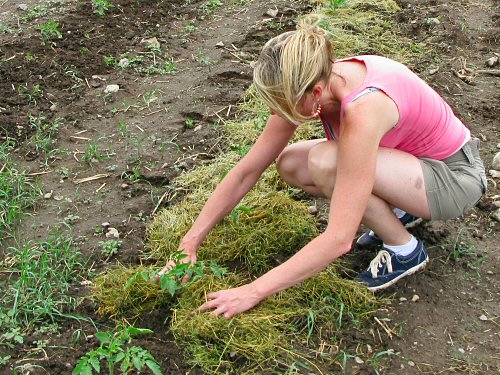
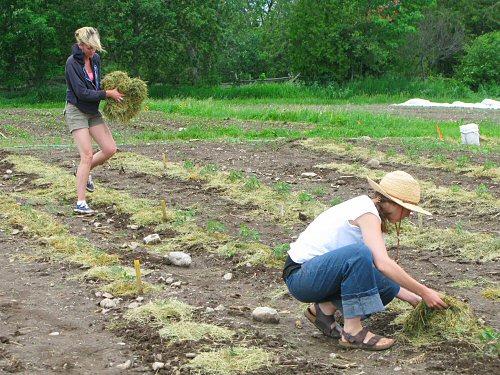
Not the nicest weather today, but good for gardening: not too hot (finally) and not too wet. The grass mulch experiment continues. With all of the recent rain, there’s been good growth, and I’ve cut and gathered quite a bit. Still, the volume of grass mulch available earlier in the season is still unknown, and it takes a lot to cover just one section. Here, Raechelle and Melissa (first time in the field) mulch tomatoes…