
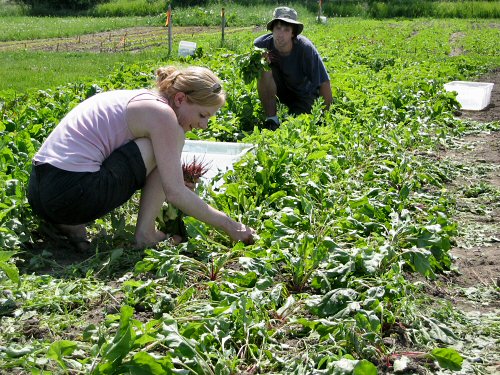
Andrea and Conall harvest Cioggia beet greens in the hot mid-afternoon sun. In tiny farming, it seems that every action has several different effects and offsets, some good, some not so, and a balance, hopefully leaning to the positive side, is struck each time. Here, harvesting greens in the heat is not the greatest for the freshly pulled leaves or the plants that remain, but this is the time we had (a cloudy afternoon with a mild, refreshing breeze every harvest day would be nice!). A quick bath in cold well water instantly refreshes the harvest, and the plants will recover overnight. This particular bed of beets had gotten quite weedy, so weeding while harvesting slowed things down. But, the fairly dense piles of pulled weeds, spread between rows, dries into a decent mulch that’ll help retain moisture and prevent more weeds from germinating. And, the harvest is also a thinning session, giving the remaining plants the space to fill out into proper beets. It all works out…!!
beet
New view
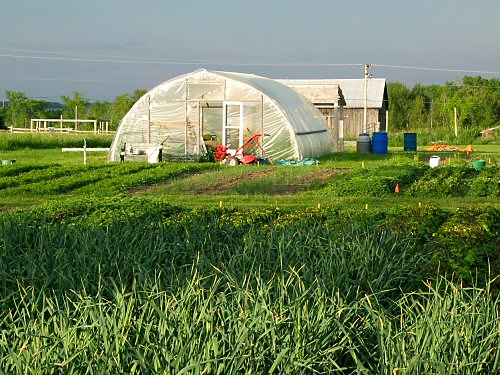
Here’s a view of the lower part of the field, from an angle that I don’t check out too often, looking over the garlic, past mesclun, carrots, green onions, beets, to the greenhouse, and you can see the veggie stand—it’s still roofless—tucked away behind. (Normally, only the mesclun would be in this area, with the root crops at the top of the field, but because the new section wasn’t ready in time for putting in fine seed—too much sod to break up—I’ve had to move things around a bit.) And so, it’s nearing the end of another hot and sunshiny day of weeding, seeding, more weeding…and so forth. We started pruning, staking and caging tomatoes, before they got too far carried away—it’s good to be on time!
After the rain…
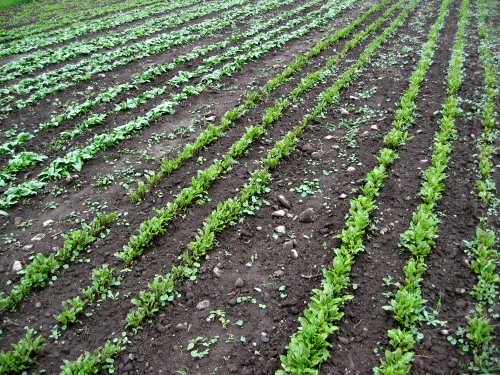
After a rain, it’s easy to see exactly how much work is ahead in the organic field! The dark wet soil and the flat light of a cloudy day make every detail stand out: weeds exploding, dense rows that’ll need thinning (thanks to the generous Earthway seeder), rocks to get in the way of hoes and tiller both. But it’s usually better than it looks. Here, the Horse tiller can be walked up each path in about a minute. Thinning the beets (first two beds on the right) is actually a harvest of excellent beet greens. The rocks, well, the bigger ones just have to be picked. The worst is in-row weeding, for stuff right in with the crops. This has to be done mostly by hand, but if you get the worst spots, the veggies soon grow to where they can more or less fend for themselves, shading out new weed growth. Or the crop is soon finished (like spinach, on the left) and the whole bed can be tilled up. With a little thoughtfully directed labor, it all works out! (We got 15mm (3/5″) of rain… Not bad.)
Gardener of all I survey…
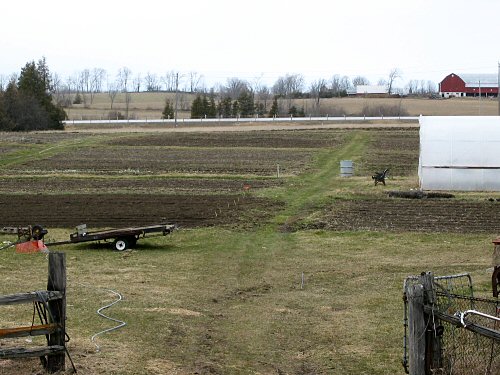
The View from the top of the gangway that leads into the upper level of the barn. Once things get growing, I go up here every day to survey the scene. Today, it pretty much sums up the spring so far, mainly damp, grey and gloomy (see Mar.16, Feb.18). Without sun, the grass has hardly started to green up. You can just make out the yellow markers in the very first section on the left where yesterday I got in beds of spinach (Bloomsdale, Spargo), beets (Scarlet Supreme, Detroit Dark Red) and radish (Rebel, French Breakfast). That felt good!
Fuller share
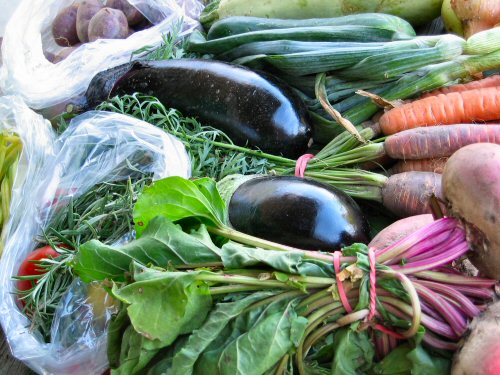
By mid-August, the CSA shares are nearing their peak. Here we have eggplant, carrots (including a new purple addition, Purple Haze), onions, beets, potatoes, yellow beans, summer squash, tomatoes, rosemary, plus salad mix out of sight. Still waiting on melons, winter squash, main season broccoli, fall cauliflower. And there’s more! :)
CSA share!
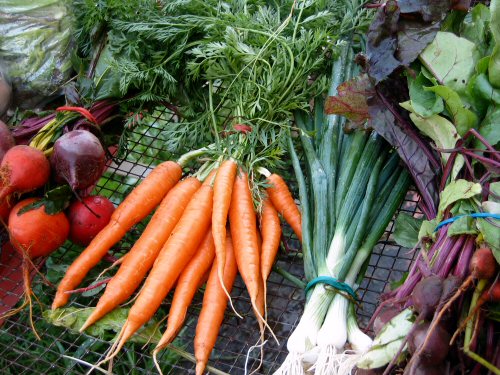
Here’s part of a weekly CSA share. There are about 25 members this year. A third pick up here, the rest on Saturday mornings at the farmers’ market 15 miles away. It’s all local! In the pic, this week’s washed: carrots, beets (red, golden and striped), mesclun (the bag’s in the top left corner), green onions, baby beets for cooking greens. These go in with cucumbers, string beans, baby potatoes, zucchini and other summer squash, garlic. Still waiting on early tomatoes, but the main season harvest is picking up! (I’m still thinking over the what-to-wash question. Washed veggies look nicer and are less messy when you get ’em home, but there are various arguments for not washing, like longer storage and even better nutrient retention. Not to mention, saving lots of post-harvest time. I do know it’s a lot more work)
Beets and competition
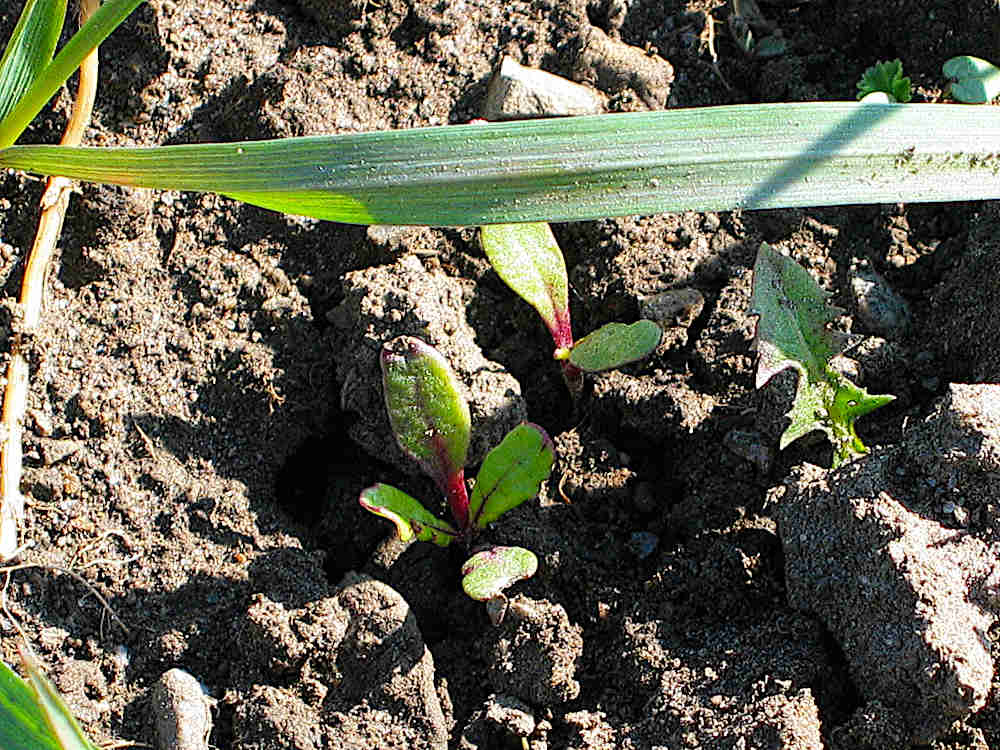
In the real world of this organic field, it’s not all close-up beauty shots of picture-perfect seedlings growing into pristine vegetables all in a row. Competition is the order of the day. Here, a couple of beet seedlings are surrounded by grass, dandelion, and round-leaf mallow (peeking out from behind the grass in the top right corner). It’s a motley assortment of weeds competing for water, food and even the sun (observe the grass shading out the baby beets). We call them weeds when we don’t want them to be there, yet they’re the ones perfectly suited to the conditions and able to grow fast. It can be a pitched battle when you’re not rooting for Nature to take its course!