All posts tagged with "Mike (tfb)"

Skinning the hoophouse

Hoophouse: getting the plastic over

This is the spring of Finally… Today, we finally got the plastic on the hoophouse, can’t believe it’s been over a month since the frame went up! Anyhow, it’s done! A kinda huge turnout of people: Libby, Jordan, Andie, Tom, and Lynn (planting grain elsewhere during the hoophouse skinning). A bit of a breeze, but it didn’t get in the way. First, the ends went on, and then, the big job, which with a lot of hands is pretty simple. Started by pulling the plastic over* and loosely fastening it at one end (the many hands really help)…

Hoophouse: plastic half on

Next, we slid it along. I’m on the ladder, putting UV-resistant greenhouse tape over the edges of the ribs where they join the ridge, so they don’t rub on the plastic (clearly, that’s a one-person job…could’ve been done ahead)…

Hoophouse: plastic on

Get to the other end, and fasten it! There’s still a fair bit of wood work to secure it all, and electricity and then the squirrel cage fan to install, to inflate the double layer of plastic, but the main job is basically DONE. One more thing on the new-tiny-farm start-up-from-nearly-scratch list, practically checked off! (I should move the jumbo rain gauge to a completely unsheltered spot…)

*It’s a lot easier to lay the plastic out lengthwise beside the frame, then pull it over from both ends in one shot. We did it this way because there was only one tall stepladder, and to avoid catching the breeze on the full length of the plastic as it went up—a completely calm day is best, but with a lot of people, you can handle a little wind. (Photos 1 and 2 by Andie)
Comments (14)

A field day

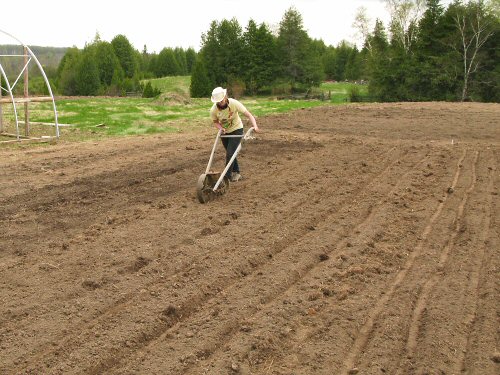
Seeding with the Planet Jr.

At this point in the season, EVERY day is a field day, unless it’s totally rained out. Today was no exception. Lynn brought a couple of friends, Julia and Tom, to check things out and lend a hand. They’re off to work in one of our fine parks this summer, but wanted to see what was going on on this tiny farm. No problem!

I seem to’ve gotten pretty good at tossing people into the tiny farming action, with little work-up or ceremony. A quick tour around (and here, there’s not much to see just yet), and it’s on to the hands-on. Neither Tom nor Julia had experience with market gardening, but in no time, they were seeding with the seeder of the day, the trusty and heavy Planet Jr. (above). We’re doing a second planting of spinach, and a third of peas…

Explaining the fine points of the Planet Jr.

The Planet Jr. can take a little getting used to, so there I am, explaining how it works as we go! Knowing exactly what a tool is doing and why really makes learning to use it so much more…satisfying. I think.

Marking out new beds

Just about EVERYTHING in tiny farming is quite simple and straightforward (there’s just a LOT of simple things to know!), still, some people have a natural talent for this or that. Like, Tom can clearly walk a very straight line as he measures off more beds for onions and peas. The current bed marking method: measure and stake the path centers at both ends of the bed, and walk ‘em in! It’s pretty simple.

Planting onion sets

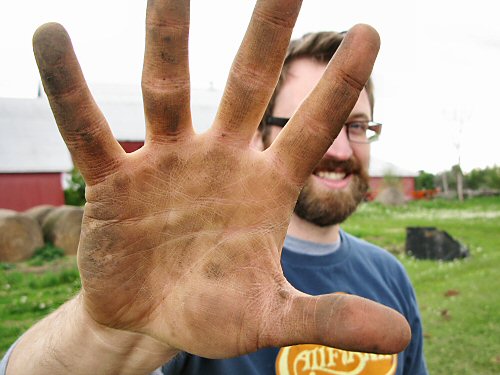
For getting your hands dirty, there’s nothing quite like crawling along in the dirt, pushing Stuttgarter-type yellow cooking onion sets into the ground, six inches (15cm) apart, by the hundreds. Once you get into the rhythm, you can sow and chat, and things get done in no time! All in all, relaxing and productive day in the field. Fun and useful, I hope, for all! (Photos 2, 3 by Lynn.)

Comments

First day at the new farmers’ market

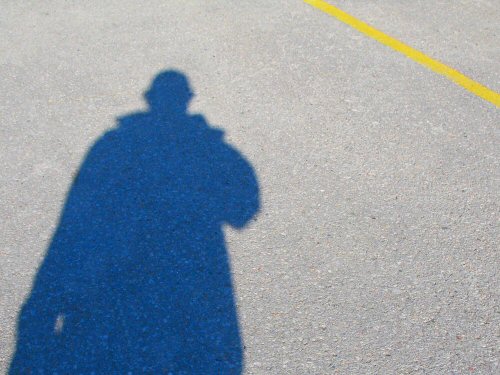
Our space at the farmers' market

Here’s our so-far-unoccupied space at the new farmers’ market… This photo was accidental, clicked while checking some camera setting or the other. But when I saw it on the computer, it reminded me of the totally transient nature of farmers’ markets (and tiny farming in general!). Here we are, standing in a rectangle of asphalt marked out by some yellow lines, a PARKING SPACE, that transforms for a few hours into our little veggie emporium. All of the intention and energy of the tiny farm, concentrated…RIGHT HERE?! In a giant parking lot. Kinda weird… Life is what you make it, I guess! And I do love going to market! :)

Showed up at the 7am start of summer market opening day, to make an appearance, check things out (like, our new spot!), meet some of the other vendors, buy some food. Tara will also be here every Saturday, plus others when they can, but for the next couple of weeks at least, we won’t be setting up, and some veggie vendors won’t be here till June.

This market is at least 4-5 times bigger than the one we attended at the old farm. It’ll be a big change, with more small-scale organic growers offering similar veggie selections, and also way more people, but none of the familiar faces I’ve gotten to know, in many cases over 5-6 years. That last part is sad, but overall, it’s exciting.

Our stall is in a central spot—the empty space beside the round, yellow “honey” sign (below)—which seems good. Upfront in the photo is an array of unseasonably available produce—nice sweet peppers for early May!—from one of the several larger vendors who presumably buy at least part of their menu where the supermarkets do: a local food issue that’s concerning, but doesn’t upset or anger me the way it does some—everything tends to shake out…

We’re located beside another tiny farm, and I chatted with neighbor Anna about whether that might be a plus or not, if people have to choose from similar things on both stands. We’ll see, but it sounds to me like more choice, MORE FUN, and from what I’ve heard so far, all the small growers usually sell out by the end of the morning anyway. I bought some wild leek from our neighbors, a bag of great mixed baby greens from another aisle, an excellent bag of mixed sprouts…there’s lots to buy at the market when you’re not tied to your own veggie stand!

So, in its own exploratory way, our new season at the new farmers’ market begins…!!

Summer farmers' market: Day 1

Comments (4)

Tossing onions

Libby tosses

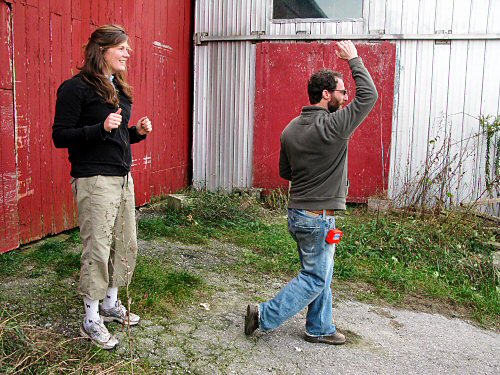
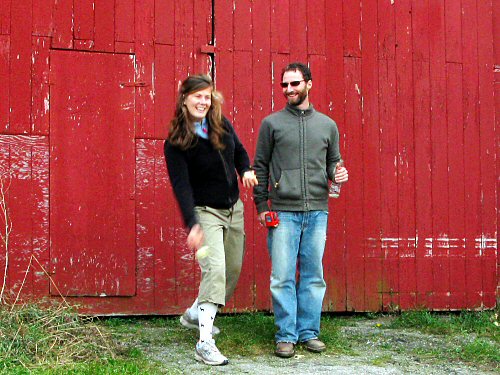
Well, Friday harvest is over…what to do? A few onions and a little winter squash you’re  set for ALL-TERRAIN ONION BOCCE. Libby used yellow cooking onions (Stuttgarter), Grant took a mild white (Superstar), I went red (Red Wing), four onions each. A stunted orange acorn squash (Table Gold) served as the target ball. Toss away!

Grant tosses

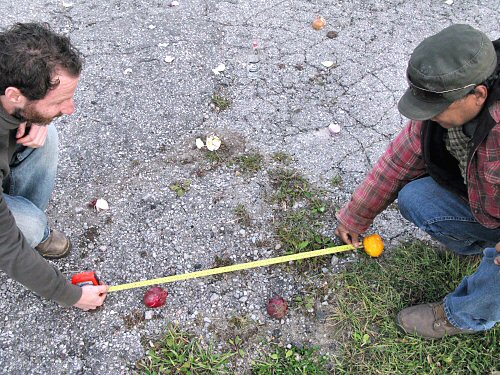
The rules are simple: the player with the closest one or more onions to the squash scores a point apiece. The all-terrain part means the winner of a turn gets to toss the squash anywhere. We played up and down the gangway to the barn, through gravel, long grass, chicken hazards (roosters peck onions)… Good thing no-one got really competitive, ’cause onion bocce is pretty imprecise, what with eventually exploding onions (largest piece counts), and ragged edges that make down-to-the-millimeter measuring kinda futile. Still, we did get out the tape measure… Wholesome outdoor fun on the farm. With veggies. Must be a new age of innocence! :) (Guest measurement photo by Libby)

Measuring for points

Comments (2)

After the row cover: weeding!

Weeding after row cover

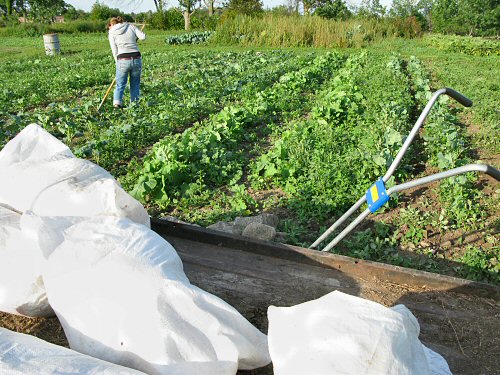
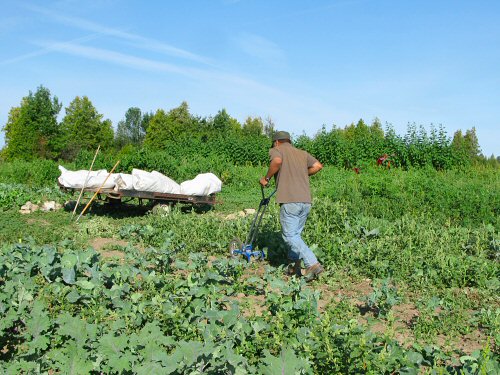
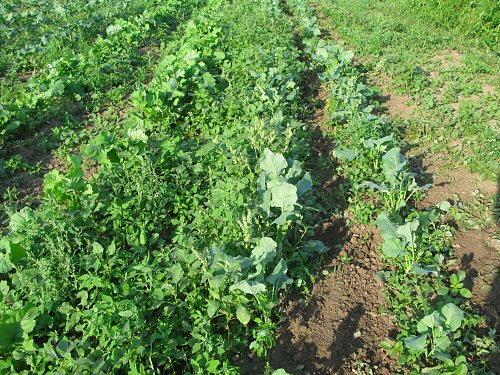
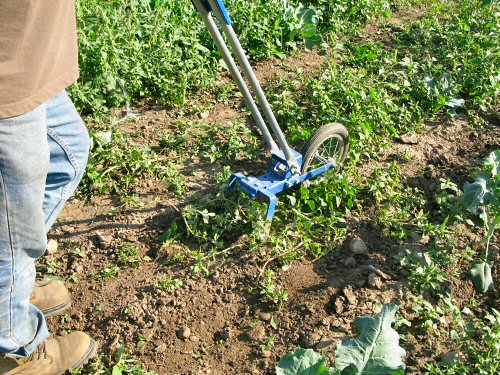
It’s been about six weeks, time to permanently remove the row cover from the last transplanting of fall brassicas! There are two sections, about 20 x 50′ beds in all, with broccoli, caulflower, cabbage, collards, kale. The cover protected against flea beetles, and at this point in the season, the FBs aren’t around much. Which leaves the post-cover weeding! I generally plan to remove the cover earlier, weed, and then replace it quickly, but this seldom seems to happen. Instead, it’s one big weed-a-thon at the end… Here, the mainly pigweed looks fairly big and dense, but it’s actually not much of a problem. The row cover has protected the ground from many days soil-packing rain, so the beds are nice and loose (it’s amazing how much rain can compact clayey soil).  Weeds come out easy! With two people, it’s a relatively quick job, 2-3 hours for a pretty thorough clean-up. We worked with a combination of hoe and wheel hoe, me doing the paths and between-row clearing, and Lynn hand hoeing in-row, between the plants spaced at 18″ (45cm)…

Wheel hoe in brassicas

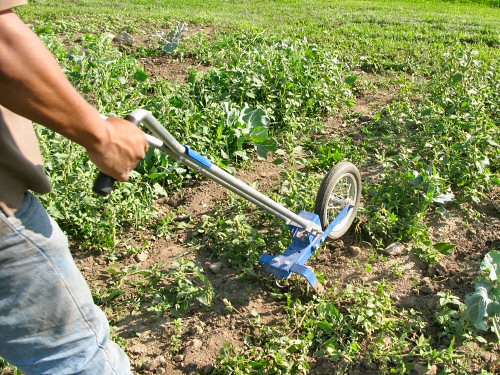
Each time I use the wheel hoe, I grow to love it that much more. So easy, so TIME-SAVING! It’s such a sophisticated yet simple tool, a perfect marriage of wheel, leverage and steel (you could say! :)… Today’s job is heavier work than it’s usually used for, the weeds aren’t just emerging, they’re pretty big. Rather than rolling the wheel hoe continuously down the rows, I’m cutting the weeds with a series of forward and backward strokes that either slice the plants below the surface, or pull them out, roots and all…

Wheel hoe: before and after

Clearing a path (before and after, above) in the loose soil takes maybe 3 minutes for 50′, many times faster than hoeing or hand pulling…

Wheel hoe forward stroke

For this heavier weeding work, I use a fairly forceful forward stroke that travels about 1-1.5′ (30-45cm), then raise the blade to clear the felled weeds as I step forward to start the next bit…

Wheel hoe backstroke

The wheel hoe is equally good at cutting on a backstroke, which comes in handy for dense areas and tough specimens… It’s not particularly strenuous work: the blade is sharp, the wheel and angle of the handles give lots of leverage and momentum, and some part of the hoe is always in contact with the ground, so you’re never completely lifting the whole tool. Like most things I do here in the field, I’ve figured out how to use the wheel hoe on my own, by reading instructions, looking at pictures and applying my version of common sense. Techniques no doubt vary. It’ll be interesting to eventually see how others do things! Meanwhile, everything seems to work out…especially, the wheel hoe! (Wheel hoe action photos by Lynn)

Comments (2)

People in the field update

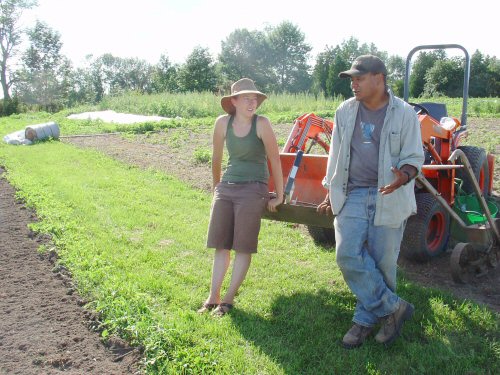
Lynn and Mike chat

This has been an interesting summer for learning about tiny farming, people, and the ups and downs of growing largely without machines. I’ve had an ongoing debate with Bob over the years about the garden layout, using relatively short, 50′ beds, and hand cultivation, rather than planting long rows and doing most of the between-row weeding by tractor. The tractor approach lets one person, one machine, and some cans of diesel do most of the routine work alone. The hand-grown approach requires lots of labor, and you either settle in and do it yourself with many 10-12 hour days right through the weekfor a good part of the season (as I used to do), or…have help. I’ve found it’s definitely more fun to work with others, BUT, once there’s a bit of a regular crew, there’s the new matter of keeping the group dynamics smooth and making sure everyone’s HAPPY. Long days of often repetitious work, finishing one job only to launch directly into another, and working around the vagaries of the weather—this year is an exceptional case in point—aren’t what most people are used to. And when some of the people live on the farm, for a few days a week like Lynn (chatting with me in the pic), or 24/7 in the case of WWOOFers, things can get even more complicated, like, when is quitting time! At least in the start-up years, tiny farming can be pretty much an all-consuming focus during the growing season, and that’s not something most people really want or can handle, either—you’ve gotta love it! So finding the balance between going all out, and, well, providing a fun taste-of-tiny-farming experience for others, can be a bit of a puzzle. At least, that’s what I’ve found so far. All just another part of the ever-changing TFE…! (Guest photo by Maria)

Comments (2)

TFB & the Web

Locations of visitors to this page

Free PageRank Checker

website uptime

Best Green Blogs

Home and Garden Blogs - Blog Catalog Blog Directory

Download Firefox