
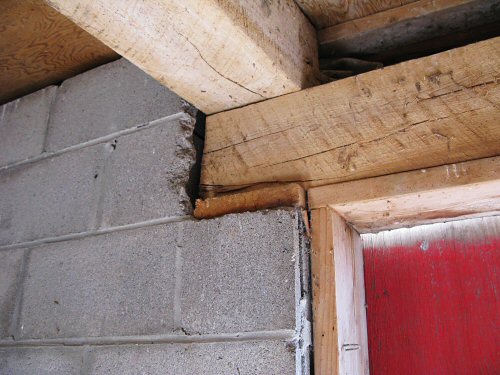
Made it back to the new farm to start demo for the new seedling room. I don’t get to do much bigger construction work, and this is really just interior framing and insulating, nothing complicated or structural, but it’s a fair-sized project, involving new windows and doors, what I’d still call big rough carpentry fun! The barn is a small one, 24’x30′ (7.3x9m), about 20-30 years old. The structure is simple, basic, easy-to-understand—what you see is what it looks like. The beam in the pic is one of a dozen or so that support the upper floor. What could be clearer! We’re turning half of the lower level, with its poured concrete floor and concrete block walls, into a fully winterized space that’ll hopefully be home to new herb seedlings by the end of January!
projects
Demo to go
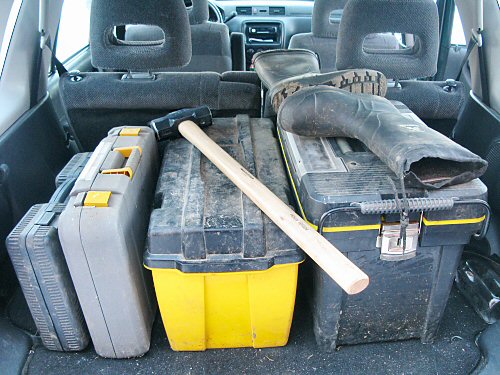
The plan was to spend tomorrow at a nearby, soon-to-be tiny farm, helping build a winterized seedling room in the barn. Day 1: a little demolition and clean-up. This didn’t work out because of a snow storm warning, so after an overnight visit to a nearby town, we returned and I unpacked. False start. Still, this was another mini milestone for me, a first, loading up my tools for an off-farm job! This is all gear assembled bit by bit while working on projects here on the farm, guided by the tools I’d borrowed from Bob. Every purchase, I knew exactly what it was for and how it would come in handy again. Although I’m far from an experienced rough carpenter/farm fixer, choosing tools yesterday made me realize how much I’ve learned. The feeling of place and context really struck me, how the little memories of using each tool tied into the overall tiny farming fabric. It may seem ODD to be celebrating such basic stuff, but it reminded me how unsettlingly disconnected things can get: the job you go to every day, the weekend shop project at home, the weekly grocery run, endless other routines that have no real connection to each other, except in your head. Not like on the tiny farm, where one thing leads another… Hmm. :)
Greenhouse upgrades
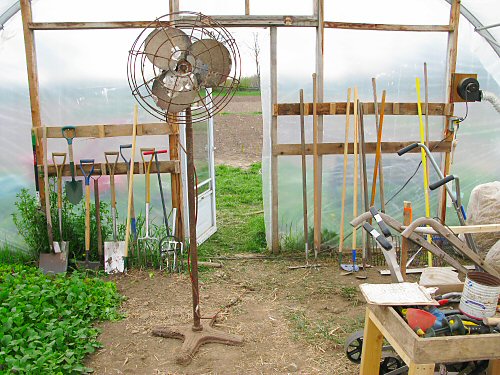
Another cloudy, cool, kinda chilly day. There’s always fieldwork to do, but this type of weather is also good for building, fixing, organizing…indoors. Today, some long-planned greenhouse upgrades. They may not look like much, but it’s a pretty big bunch of improvements! As part of Shannon’s kinda intensive “this is what I do around here,” hands-on experience (with full narration!) on this tiny farm, I showed her how to use a couple of basic power tools—cordless drill, chop saw—and she built simple legs for a wooden tray that I use for various small, often-used bits of gear (the tray’s shallowness is an automatic organizer: things can’t get really buried!). Really simple, rough carpentry, but if you haven’t used tools much or at all, and then you build something that’s immediately used in the course of the farming day…it all makes more sense! At the other end of the hoophouse, I put up another wooden crosspiece for leaning long-handled tools, and we separated the most-used and put the least used at the other end. Again, by avoiding a pile of stuff, everything’s easy to grab and put away. And then, we pounded a couple of 2×2 wooden stakes into the ground (pounding with a mini-sledgehammer was also on the farm experience menu today, I pound a lot of stakes for tomatoes every year as well…), and screwed another 2×2 as a crosspiece to make a leaning rack for the seeders and the wheel hoe (you can see one end on the right of the pic, one of the posts has orange tape on top). Finally, a machinery addition, a big, old, rusty, dangerous-looking high-volume fan on a really heavy iron stand. I’ve been meaning to work on greenhouse ventilation for ages…but always ended up using much smaller home-type fans. This one, which was actually being stored in the chickenhouse, I hadn’t noticed till now. It moves a ton of air, and reduces the temperature a full 10-15°F in the middle of a hot day. Cool! To look at, these little building projects are absolutely basic and kinda primitive, but they’re quick, easy, solid cheap, and really make a huge difference when you actually use them… (I just noticed in the pic how the right side of the end wall seems to be sagging, it doesn’t look that way at glance, I should check it out and see what’s up…)
Catalog shopping: chickens on order!
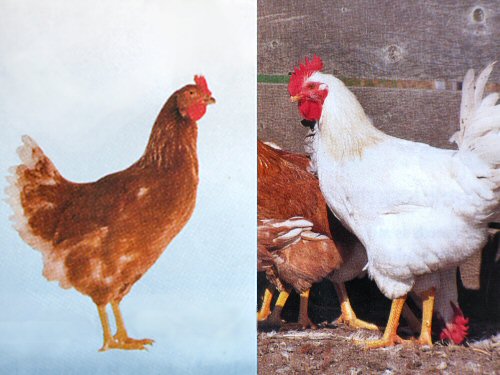
Chickens are on the way! On the left, a reportedly prolific brown egg producer, the Shaver Red Sex-Link. On the right, the reputedly hardy, healthy Frey’s Special Dual Purpose as our meat bird.
I almost broke a pretty basic rule on this one—get your questions answered first!—and ordered White Rock Cornish X for meat. Chatting with Bob, we’d decided on the Frey’s Special, but at the last minute—on the phone ordering them from the feed store—I asked about the Frey’s, and was told that “99%” of the small quantity meat birds were “White Rock” (meaning WR Cornish X), that people were often disappointed with the dual purpose for meat, that for meat, White Rock is the way to go. White Rock! White Rock!
So I got off the phone, and did some quick extra research. Talked to Bob again, who said the thousands of meat chickens he’s raised were all White Rock, BUT, they have to stay indoors, WR just stand around and EAT, which is why he thought Frey’s would be better for outdoors.
Next, hit the Web, and found stories of people successfully free-ranging WRs, even in the heat. BUT, they also said things like: “They did wander around a lot but nothing like the regular birds. They did all the normal bird things just a whole lot less gracefully. Only thing they couldn’t do was perch or fly.” Hmmm…
Which took me back to the original stuff I’d read in the hatchery catalog, things like: “Unfortunately, the White Rock’s increased efficiency at feed conversion has not been matched by improvements in the bird’s cardiovascular system. Simply put, too often the bird’s heart just can’t keep up with the rest of its body.” Yikes… Hello flip-over disease (aka Sudden Death Syndrome, aka…heart attacks), which tends to afflict the biggest, healthiest birds… And there’s lots more disease warnings, feeding restrictions, general strict instructions… Extremely fast-growing meat chickens, no doubt, and I’ll probably try some…later, but too weird for now…
For good measure, I got through to the Frey’s hatchery. The woman on the phone was great. She said most people just want to produce meat quick and go for the WRs, and they may do OK free-ranging, but really, they’ve been bred for rapid growth in a controlled broiler barn environment, AND, for a hardy, free-ranging, TASTY meat bird, dual purpose are great, friends of hers raise the Frey’s Special and love ’em. So Frey’s Special Dual Purpose it is, more traditional chickens that grow a little slower and weigh a little less, but can actually have fun, run around, eat insects, scratch in the dirt, and won’t…flip over! There are 50 2-week Frey’s Special cockerels coming either April 16 or 30, and 25 ready-to-lay Red Sex-Link on June 23.
Entering the world of CHICKENS, I’m excited!
(UPDATE: After writing this post, I read the comments below, did some more online reading, and switched the order to 40 White Rock Cornish X and 10 Frey’s Special…)
(UPDATE 2: It’s a year and a half later, and we recently processed a second flock of White Rocks. My original last-minute double-switch to White Rocks was a good one. I still want to raise other breeds, but you absolutely can keep healthy, free-ranging WRs, and they do get to a good size!)
New lumber
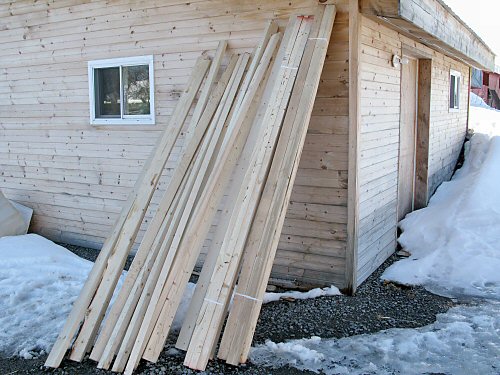
Went through the lumber delivered yesterday, selecting the straightest pieces for a new grow rack. There’s all kinds of scrap wood around the farm, except, there are never enough 2x4s and plywood… I order construction grade for most things, quite inexpensive but the boards have to be hand-picked if you don’t want a lot of warped wood. For rough carpentry, this works fine: the savings add up, and rough edges add character! There’s the grow rack, a double screen door for the Milkhouse, the composting toilet-ice fishing hut conversion, the chickenhouse reno, new tables and trays for the farm and market stands, more… All needed pretty soon. Spring building starts now!
Welcome to the chickenhouse…
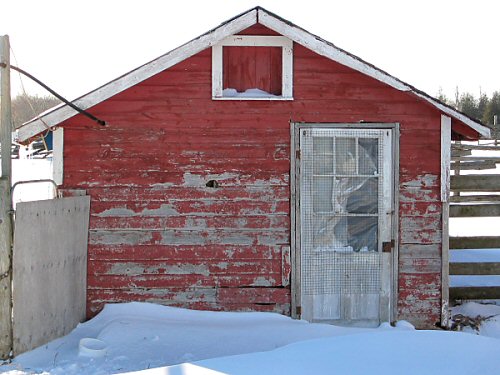
Chicken coop? Henhouse? I like ’em all. This weather-beaten little building has been empty for a while, but a little fix-up and it’ll be ready to go. You can see the electricity cable and water hose snaking out at the top left of the pic. All the modern conveniences! The last tenants, three years ago, were half a dozen turkeys, lead by crazy Tom, an increasingly aggressive male known for a flying drop kick that could stagger a grown human. I didn’t have any close encounters with Tom, although I was curious. Before that, when I first started the garden five years ago, a dozen or more incredibly colorful ornamental chickens roamed the barnyard, darting out of hedges, zipping under fences, you never knew where they’d pop up. These were all, like the goats, kinda pets, and were eventually given away. Now, the loose plan is to get, well, WORKING chickens, for meat and eggs. At first, it won’t be directly part of the organic veggie garden, more of a side project that I’ll do with Bob. We were going to start last season, but that wound up on the still-to-do list. Yesterday, I took a quick look at the chicken-raising regulations—here in Ontario, there is a quota system that requires buying permits to raise chickens, with an exception for small numbers, and I imagine it’s similar everywhere in North America. Oh, well, more on that as it happens!
Stakes vs cages

Every year so far, there’ve been two or three major projects that I’m sure just HAVE to be done. They’re usually EXPENSIVE (at least, expensive in the world of tiny farm finances!), which means, they take some thought. We’ve had the seedling greenhouse, excavating the pond, the Milkhouse Extension, the tiny tractor, the first full-time field hand (Conall!), and a few other steps… So far, so good. For the coming year, I have in mind a few more…important upgrades. I was reminded of one of them in the drive shed today, where the stakes used for my semi-effective semi-sprawl method of tomato support are stored, along with some of the couple hundred (largely useless) home-style tomato cages. For a while, I was dreaming of moving up to the basket-weave method—lots of twine and…weaving—although I have a hard time picturing all of that suckering getting done. What I REALLY want is BIG CAGES made from concrete reinforcing mesh…but it seems so expensive. Rough pricing: about $7 a cage times 500 cages, plus a fair bit of labor setting them up and taking them down. I know the method works well, but will it work well HERE, this year? Is it worth the money? For the same cash, I could almost build a second, production-size greenhouse. Or put more into drip irrigation. Or build a cooler for better short-term storage. Come to think of it, does growing dozens of varieties of tomato really make sense, couldn’t I just sprawl two or three big, round red varieties that would be easiest to sell…? In fact, I could grow a lot more of a lot less, cut out many varieties and entire crops, concentrate on the trendy best sellers, and get on the waiting list for an upscale farmers’ market in the big city. Top dollar! Maybe try for a bank loan for a bigger tractor (hey, there’s more acres in the garden field!) and a refrigerated truck?! If this is a (tiny) farm business, that seems to make sense: GROW! Yet somehow I’m heading in the OTHER DIRECTION. Stopping the city CSA to go local. Trying more crops and varieties every year and figuring out ways to buy stuff for them, like big tomato cages… It seems so…contrary. Which, in tiny farming, is something I guess you gotta like!!