
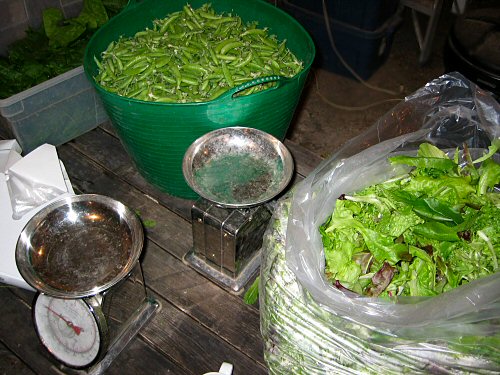
The post-harvest is a simple, straightforward process that has to be done fast since we don’t have a cooler. The set-up is manual and basic. Today, we packed indoors to get out of a stiff breeze that would’ve taken the salad greens sailing (usually, we do everything outside, in the shade of the barn; the indoor option is part of the new luxury of the Extended Milkhouse). There are a couple of 2 kg kitchen scales for the snap peas and lettuce mix. Everything is sold by bunch and bag, not weight, but the scales are useful for keeping things consistent. It’s quite easy to get the right amount by eye, so it’s into plastic bags and pop onto the scale for a quick check. If it’s underweight, add more, otherwise, somewhat over is just fine!
Month: June 2007
Farmers’ market stand described…
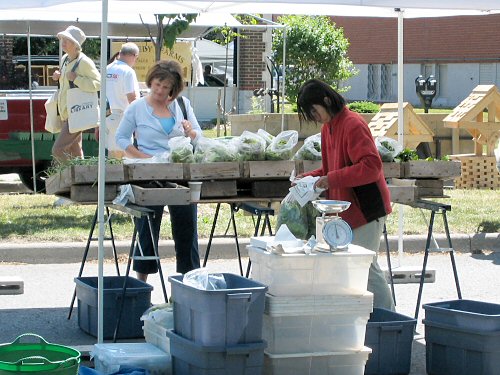
Setting up a stand at the local farmers’ market reminds me of a traveling circus, at least, the way I imagine one to be. Everything has to be compact, easily packed away in a limited space (in our case, a pick-up truck), quick to set up and tear down, and quite rugged to handle the wear and tear. There are also lots of critical bits and pieces that it simply doesn’t do to forget. Overall, the stand is a bunch of simple pieces, assembled into a functional little veggie selling spot. In this picture, taken from behind the stand, it’s near the end of a fairly busy day, with crates and big leaf bags of greens all empty, and Kikuyo the WWOOFer-for-a-week from Japan helping out.
Where carrot seed comes from
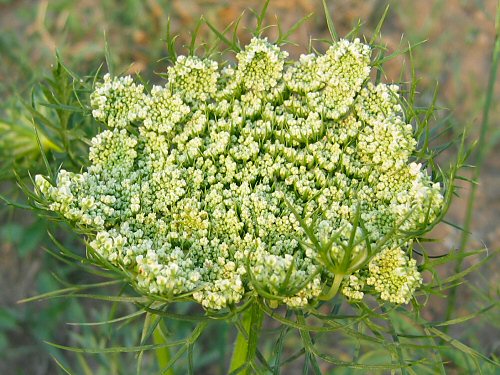
This is where those tiny, slow-to-germinate carrot seeds come from! For leaf and root crops, you often have to go out of your way in the veggie garden to see first-hand how exactly their seeds are produced—the crop is harvested and eaten before the flowering stage starts. Carrots are biennials, they go to seed only in their second year, so unless you’re seed-saving, or accidentally leave some behind over the winter (as we did here), the entire flowering process will remain a garden mystery. For carrots, if it was a mystery, no longer…!
Meet the beans!
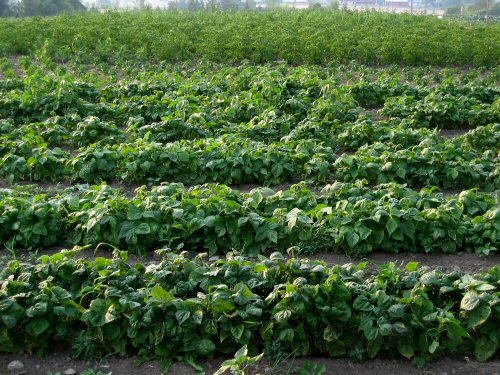
The first planting of snap beans is coming along quite well. Although the rows look nice and full now that they’re growing out, germination hasn’t been great this year, with annoying gaps that still have to be cultivated. If it’s not a matter of not enough water, I usually end up faulting it to the less-than-precise (but trusty!) Earthway seeder. A couple of days ago, I started looking more closely into what manner of germination troubles can happen underground. Yikes! For example, apparently some larval insects living in the soil (possibly earwigs, which are EVERYWHERE) will sometimes eat the emerging root tip (radicle), leaving the seed to absorb moisture with nowhere to grow, and quickly turn to paste. This would explain lots, starting with the pasty little blobs I discovered where beans should’ve been. I’m not sure if this is HOW it’s happening, but the little blobs are real enough—an exciting first! :) More as I discover it. In any case, we’re on our third planting, a fourth to go in right about now, and the first ones in are starting to flower. The selection this year is basic: green (Derby, Jade), yellow (Indy Gold) and purple (Royal Burgundy). Coming soon!
Pumpkins unveiled
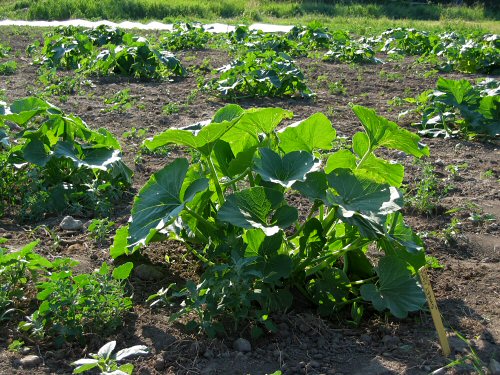
Removed the row cover that had been protecting the pumpkins from the cucumber beetles. The pumpkins are doing fine! The CBs will keep coming, but the plants should grow faster than the beetles can munch. There’s also a chance of CB-transmitted disease, that’s a chance I’m taking. One spray-free alternative is to reposition and replace the row cover more loosely, giving the plants room to grow, but the cover I’m using also traps heat under there, and cuts off some sunlight. I could buy super lightweight cover, designed for insect protection only—it doesn’t protect against frost and lets in most of the light—but that’s an unwelcome expense this year, and possibly more of an additional expense than it’s worth. From here, the pumpkins should come out fine, CBs and all!
Corn
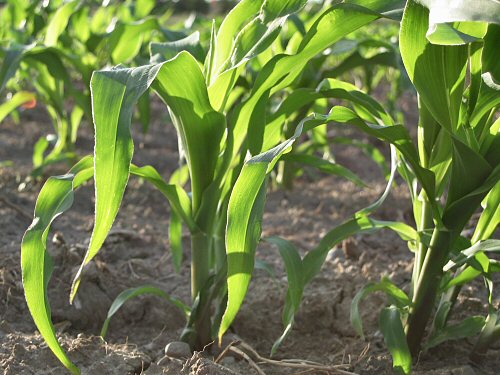
After a month, the first planting of corn is about a foot (30cm) high and doing fine. There are two varieties this year, Earlivee, an “old fashioned corn taste” (su) type, and Bon Appetit, a sweeter (se) type, only about 800′ of each. Corn every year is a battle all its own, the corn and me against the raccoons. The coons are my biggest (as in, size and intellect) garden foe, and unfortunately, they usually win. A couple of years ago, I invested in electric fence and a solar-powered controller. This only kept them at bay for a while. I still haven’t figured out how they got past it…I’ll have another chance to find out this year. No fence, positively no corn (maybe a few ears, literally, out of a couple of thousand). I grow only enough to eat and to include a dozen or so in the CSA shares. With the amount of sweet corn out there, and the ridiculously rock bottom prices when it’s in season, selling corn at the market or stand hasn’t seemed worth it. At the very least, it’s fun to watch it grow!
Bicycles?!
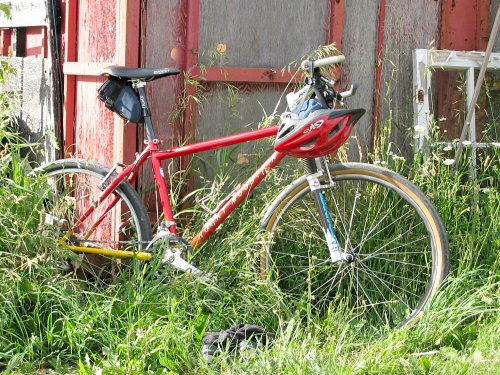
Somehow, bicycles figure quite prominently in this season of people in the field. Everyone comes in one or two days a week each, mostly from the town 12 miles (19km) away. Andrea and Jo both usually bike in and get a lift back with Conall. There are combinations of lifts, with and without bikes, lifts with bikes in and biking home… Described, it sounds even a little complicated, but people call each other to set up rides, and it all seems kinda effortless. Which is, of course…great! That’s Andrea’s bike in its usual parking space…