Earth Day observed

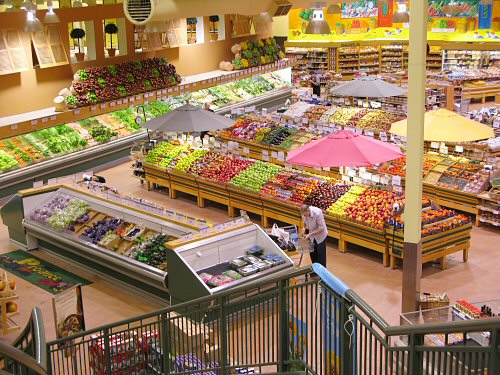
This year for Earth Day (a Day I don’t usually…observe), I gave a talk on small-scale organic farming for an audience of three in the airy designer meeting room in the Upstairs at Loblaws zone. Here’s the view from…upstairs (this is the same super-sized supermarket mentioned from another recent trip to town).

It was fun! To be more accurate, though, this wasn’t actually an Earth Day event, it just happened to fall on it, as part of an on-going series of talks and cooking classes and stuff that happen all the time, an effort of the giant Loblaws chain to be more community-oriented, engaging, one-stop. A veggie customer at the farmers’ market had suggested me for one of the slots way back last September or so, they called me up, I said OK, and a few months later…

Yesterday, the coordinator called to say there were only six sign-ups (it’s free registration), so I could cancel if I wanted. Apparently,  attendance here can be low, with as little as one or two sign-ups for some, and 15 is a crowd. Since I had no expectations in the first place, I still made my I-don’t-drive transportation arrangements and there I was.

It was actually really interesting, talking to people who weren’t as predisposed to organic food and…greenness as most everyone who tends to shop at the stand at the farmers’ market or sign up for CSA. I’d decided no presentation, just questions. It only took a minute to get things rolling: I asked everyone (all three), why they’d come and what they were expecting (“to learn more about organic food…”) and took it from there.

The non-stop conversation lasted 90 minutes, without a pause or signs that any of us had had enough, until I took a natural exit point and casually wrapped it up. It was kind of a live, concentrated version of this blog: explaining what I do every day, giving what larger contextual background on agriculture I have—all directed by the flow of questions.

The cool part was seeing another first-hand example of how people don’t seem so much PROGRAMMED to be all-out industrial consumers, as not given any CONVENIENT alternatives…like having someone with first-hand experience cheerfully answer their questions in a pleasant room with a parking lot. At one point, talking about how tiny farming and local food seem quite workable, and also ENJOYABLE for everyone involved, all people have to do is try, I said it’s like the audience in a movie theater: everybody stares at the the screen, and even when the movie’s truly terrible, most people keep watching because it’s easier than leaving…

Anyhow, it seemed like I put on a good show, and I’d bet that it generated at least a little carry-on conversation and a couple of experimental purchases. Does that mean that tiny farming done well is at least one part entertainment?! I guess so… ;)
Spring fieldwork continues

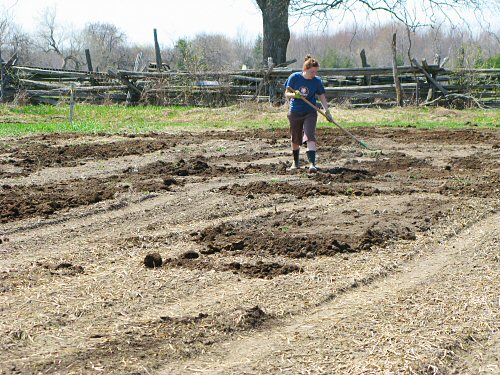
Bed preparation and first seeding continue. Today, Lynn’s tiny farming experience broadened to include rakes, and using them to spread compost. Moderately hard work in the heat, but it was a fairly small area. Overall, things are generally on schedule, but at least a week behind last year for the earliest stuff (and first peas were in last year on April 3rd!). Also, after the lingering snow, conditions changed practically overnight, but with the extremely hot, dry week, despite some watering in, the crops seeded so far are slower to germinate (we need rain!), and may come up a little thin when they do. So far, peas, spinach, beets, radish, all-lettuce mesclun and green onions have gone in over the last few days, and everything but the peas got one watering… I should have direct-seeded leek and parsnips in, but I’m kind of waiting for some rain. Also coming up in the next day or two, carrots and Swiss chard. And there’s a mountain of onion sets and seedlings ready to go, plus a few other transplants. And potatoes arrived today…

Chicken check-in

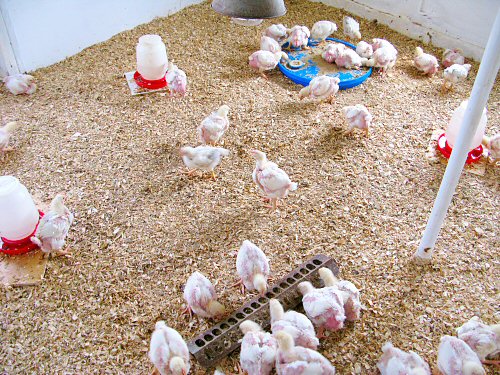
Chickens at three weeks

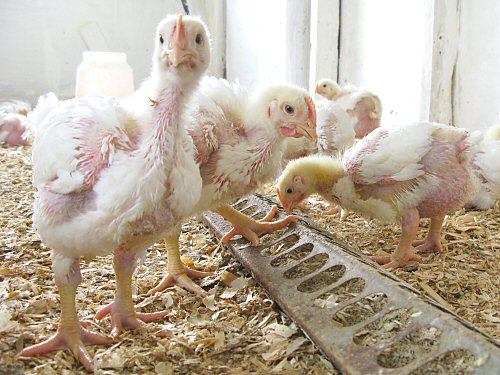
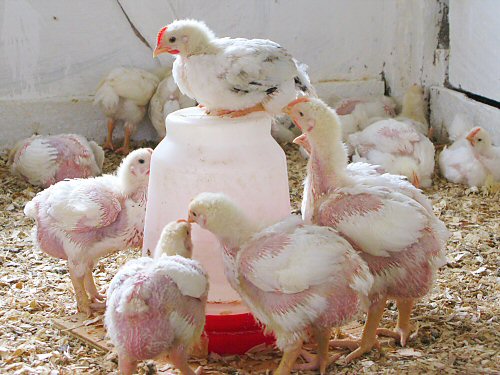
A week after their arrival, the chickens at three weeks old are doing fine. They settled in no problem, eat like maniacs, drink a lot, and I guess they’re too young to fight, ’cause they’re all getting along. I’ve been cycling through music—a radio is always on in the chickenhouse, to scare off PREDATORS—started with a couple of days of country, then a stretch of classical (they go a little crazy during big, building crescendoes), and now it’s rock (“’80s, ’90s and whatever”…a weird-format local FM station). So far, behavior seems pretty much the same no matter what’s playing—the experiment continues, maybe they want custom mix tapes. And they’re growing. They started off about the same size, but there are definitely some big guys now amongst the White Rock Cornish X, and the Frey’s Special are all at the smaller end, faster-feathering, too (there’s one on top of the waterer). They’re all getting along, but Bob noticed a red pecking spot on one of the White Rocks, so I’m gonna be watching the blending of the breeds: I read that sometimes the WRs get pecked (attacked?) because they’re slower to feather than others… The gang (the posse, the flock!) does keep busy, exploring corners and cracks, piling up and napping in sunlit patches, zipping around, drinking a lot, and of course, eating…

Chickens hanging out

Definitely a lot of eating…

Chickens at feeder

Read more

Garlic the Reliable

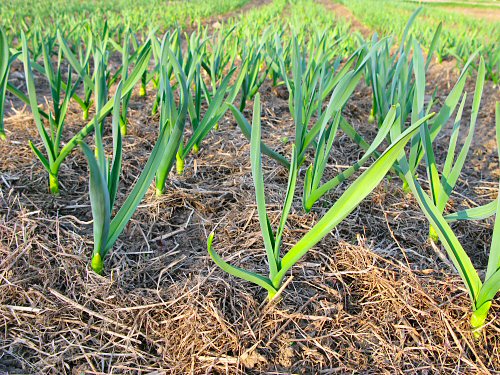
The garlic is looking great, here in unusual shades of green thanks to a bright yellow sunset. They’re doing pretty much the same as this time last year, and the year before. I read somewhere that garlic reproduction from cloves is cloning, so the garlic we’re eating now is genetically identical to the original varieties from thousands of years ago. Dunno, sounds cool and kinda reassuring, even our weird weather doesn’t seem to affect these guys. Gazing over the garlic patch on a warm evening after a satisfying day in the field, it’s almost enough to make me believe that all’s right with the world, and Blue Fox Farm‘s motto, “Farming like there’s a tomorrow” (it’s been running through my head all spring), is just amusingly paranoid wordplay. Maybe… And then I think about filling up the tiny tractor (diesel just hit $1.25 a liter, that’s $4.70 a US gallon, good thing I don’t use much…), and the bizarre weather (from mid-summer conditions in mid-spring, we’re plunging back to way subzero nights in a couple of days), and, well…it’s good to be working in the garden, and the garlic looks great! :)

Potting up

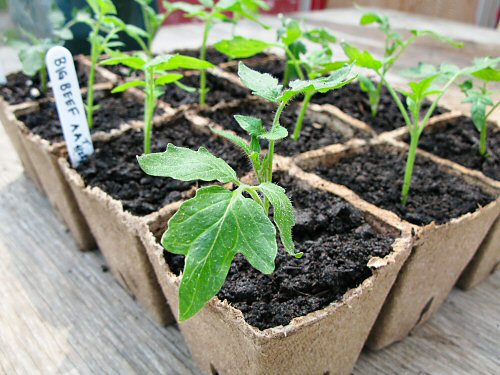
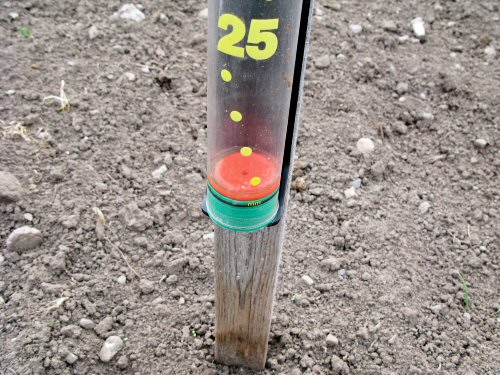
Many things are going on at once, and one of them is potting up seedlings and moving them out to the greenhouse. Already, onions, leek, parsley, lettuce, and the first trays of cauliflower and broccoli are out there, all of them hardy enough to take whatever cold comes along. What’s really going to use up space once they’re potted up are the tender tomatoes, peppers and eggplant. I’d like to’ve had them all done by now, BUT, there’s going to be a cold snap for 4-5 days starting early next week, a couple of nights may go down as low as -8°C (18°F), and I’m concerned that row cover and the kerosene heater may not be enough protection in the unheated greenhouse. So I’m waiting, potting up a few every day and finding room for them under the lights. I started with the Chosen 100, my earliest 100 tomato starts, 25 each of Big Beef (above), Juliet, Striped German and Stupice (in order, two hybrids and two open pollinated heirlooms). They’ve gone into 3″ peat pots, with a mix of peat, compost and soil, and I’m also hardening them off outside. The rest of the toms were started a couple of weeks later. They’ll move from 72- to 38-cell trays, all part of the spend-less-time-on-transplants experiments… Waiting on weather forecasts is a bit of a risky way to work, it’s really not a good idea to delay anything at this point in the year, I’ve found it’s generally better to get on with things and deal with problems as they come up, not try to second guess the future. But I have so much else to do, I’ll take the chance and wait a couple more days to finish them all…

Big rototiller breakdown

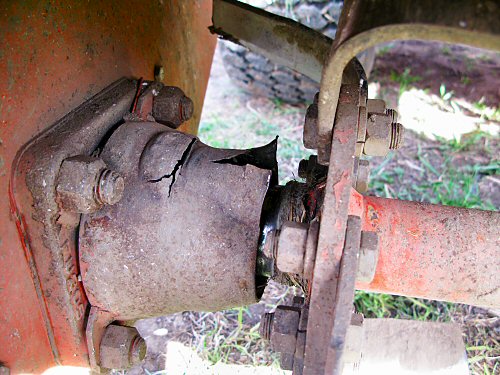
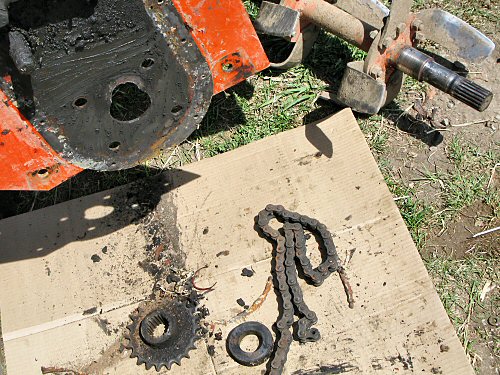
This is the not-good look of torn metal, not something you want to see on gear that’s both fairly essential to the tasks at hand, and ALWAYS expensive to repair. Right in the middle of some very satisfying tilling on Thursday, I heard a mild, unalarming scraping-squeaking sound coming from the rototiller on the Kubota compact tractor, so I stopped to check, just in case. When I rotated the tines by hand, I noticed the shaft had a lot of play on the left side, you could move it up and down a good inch or two. I cleaned off some wound up bits of plant and then dirt from the end and found the cap protecting the bearings had been split and peeled back. Uh-oh. It turned out to be not great, but could’ve been a lot worse. Somehow—not enough grease, or dirt finding its way into the bearings and gearbox, or both, or…something else—the shaft that drives the tines had completely pulverized the bearings and had been rotating directly against metal! Imagine the heat, the tortured, red-hot metal-on-metal—but it was still tilling real good… In the pic below, you can see where it ground out its own path, that extra piece of  hole on top of the larger one. It had burned through the tiller housing, another plate behind it, and a heavy die-cast fitting that supports the shaft (that bolted-on square piece in the pic above), and jogged up enough to split the dust cover. Man!

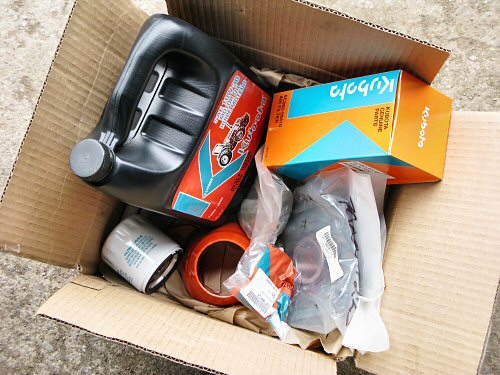
Of course, PARTS are always at hand, it just takes cash and a call to the tractor dealer, and presto, delivery by next day. Like an expensive little miracle… I hate buying parts, you need ’em, have absolutely no way to tell what they’re “really” worth, and they cost a fortune. This little boxful: $400 (well, besides the 4-bolt flange bearing, oil seal plate, bearing cover, and a couple of other bits, that includes the annual air and oil filters, and oil…). Anyhow, that’s the way it goes: things break down, gotta be fixed! This morning it was put back together, like nothing had happened at all…