
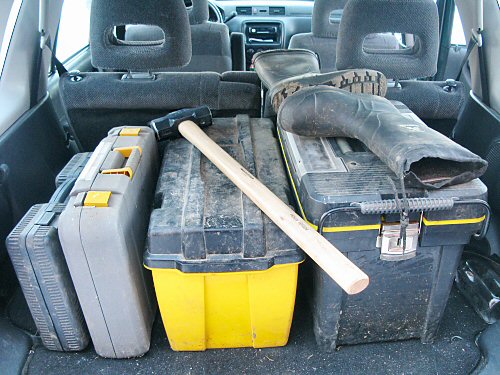
The plan was to spend tomorrow at a nearby, soon-to-be tiny farm, helping build a winterized seedling room in the barn. Day 1: a little demolition and clean-up. This didn’t work out because of a snow storm warning, so after an overnight visit to a nearby town, we returned and I unpacked. False start. Still, this was another mini milestone for me, a first, loading up my tools for an off-farm job! This is all gear assembled bit by bit while working on projects here on the farm, guided by the tools I’d borrowed from Bob. Every purchase, I knew exactly what it was for and how it would come in handy again. Although I’m far from an experienced rough carpenter/farm fixer, choosing tools yesterday made me realize how much I’ve learned. The feeling of place and context really struck me, how the little memories of using each tool tied into the overall tiny farming fabric. It may seem ODD to be celebrating such basic stuff, but it reminded me how unsettlingly disconnected things can get: the job you go to every day, the weekend shop project at home, the weekly grocery run, endless other routines that have no real connection to each other, except in your head. Not like on the tiny farm, where one thing leads another… Hmm. :)
Building & Fixing
Snow load watch
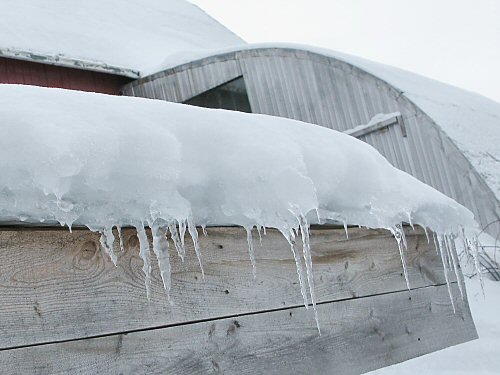
Time once again to keep an eye on the snow build-up on the Milkhouse roof. From the last two year’s experience, this shouldn’t be a problem. Still, it bears watching, because of all the heavy ice formation lately, including the extra load that slides off the much steeper barn roof. There hasn’t been that much snow, and usually, between wind and the radiant warmth of sunny days, this roof has cleared. But the crazy amount of sub-freezing cold this year has left a thick, dense, icy, layered crust that’s a little more of a concern. Hope it doesn’t get to the point where I have to clear it! A day of warmth and rain is forecast for Monday. That ought to fix things for a while. Count on climate change! :)
Battery change
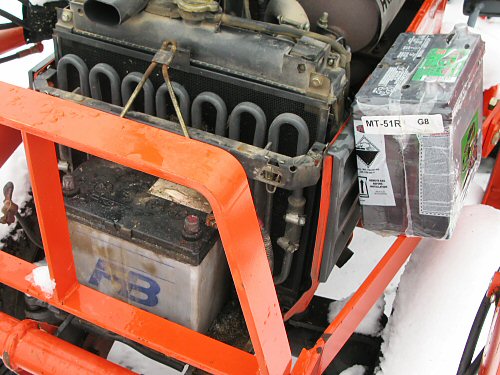
There’s nothing remarkable or even that interesting about changing a battery—routine maintenance on the tiny farm—EXCEPT… Today, I finally got around to replacing the battery, for the first time, on the Kubota compact tractor. It was a quick and simple operation that put instant new life into the trusty little tractor. It also made me realize how fond one can become of a MACHINE. I know this is nothing new: for example, car lovers. For me, though, it’s a first. Like, I love my wheel hoe, but it is such a simple tool, the attachment is more to the idea of it than to the machine itself. The complex workings of the tiny tractor, however, are largely a mystery to me. I can maintain it, and fix an increasing number of things, and I understand the general principles it runs on, but mostly, I simply trust that turning the key will bring it to life. And it hasn’t failed me over the years, faithfully and reliably performing its tiny farming tasks, asking little in return (it’s even good on diesel!). So here I find myself, strangely, with a deep affection for a machine… Cheers! This new $100 Mega-tron II battery is on me! :)
Bringing in the pipe
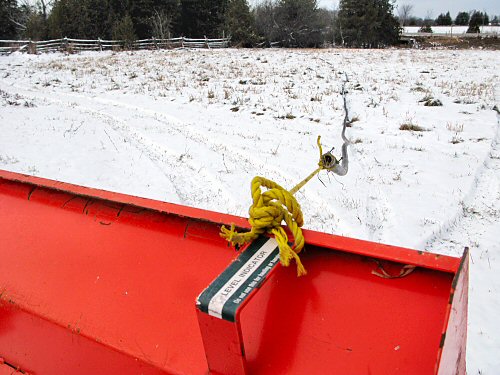
Bit of unusual fieldwork on the menu today, something we don’t do every year. Bob and I brought in about 1,000′ (305m) of 1″ (2.5cm) and 1-1/2″ plastic irrigation pipe, that ran all the way from the pond to the gate into the garden field. Why wasn’t this done in better weather, when, besides having no snow to deal with, warmer plastic would’ve been a lot easier to handle, especially to BEND? There’s no good answer, except maybe, “Didn’t think it’d be this cold and snowy so soon!” Anyhow, it got done, and probably in exactly the same time…
I used the Kubota compact tractor to drag the pipe in three 300′ sections, right into the barnyard (the rope is tied to the front end loader bucket; in the pic, this is at the very end of the garden, where it meets the hay, so all that stubble is mainly long grass). Backing up down the field, I worked it from the far end for the section that lay in the unmown grass right near the fence, so that it could more easily tear its way out of the overgrowth. Then, some coiling (that’s Bob), tying off the loops every few turns with baler twine (plastic twine used to bale hay, it’s all over the place)… Easy!
Hoarding wood like gold
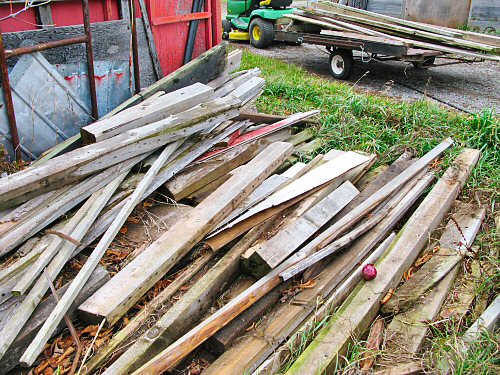
Calling it scrap lumber doesn’t do any pile of spare wood justice. On the tiny farm, you always make space to accumulate someday useful stuff that elsewhere might get tossed. Waste not, want not! This collection of old fence boards, rough cut cedar planks, odds and ends of 2×4’s, and other bits will piece by piece have its day. Meanwhile, it needs to be moved to a more sheltered spot, raised off the ground, before the snow really comes in. Today seemed like a good day to do it…
Night work
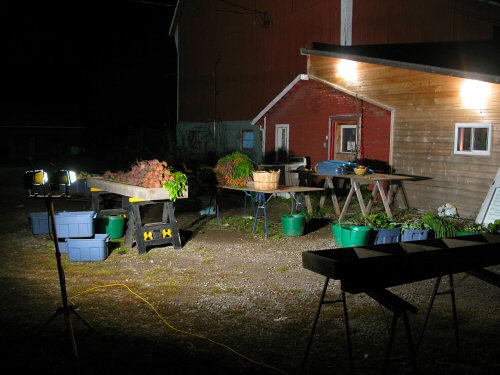
In the fall, post-harvest work doesn’t necessarily end when the sun goes down (it’s dark by about 7:30pm right now). Actually, this year the fall Friday harvest has gone great, with Lynn, Libby and usually Michelle knocking things off in the field by around 5pm, with only bundling and rinsing to go. But I’ve been wrapping up with the crew by 6, taking a break, and doing whatever’s left on my own…later at night. It’s something I’m used to from the first few seasons, when the mainly solo harvest usually went straight through until 11pm or midnight. Tonight was the first time I’ve hauled out the light stand this year. It’s around 10pm, the two lights specally installed on the side of the Milkhouse for this purpose are on (they’re both regular 100W bulbs, the full plan is to install floodlight fixtures), and there are twin 250W all-weather halogens on a stand. It’s not perfect lighting, but quite enough to get the job done without stumbling around. Tonight is a quick set-up to rinse carrots and beets. Full-on post harvest lighting includes a second light stand, with both set higher up and beaming down, and floodlights properly positioned, to give pretty good 360° coverage of the work area, and enough illumination to watch the mud wash off…
Outhouse deluxe in action
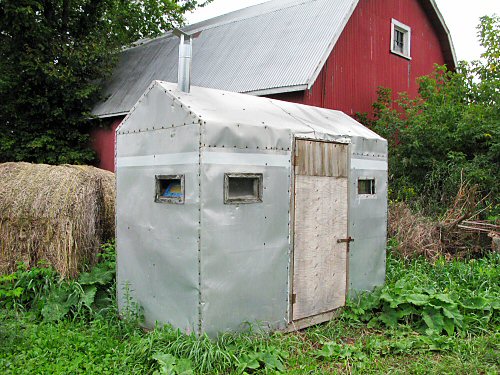
The deluxe outhouse—deluxe because this converted ice fishing hut houses a slick new composting toilet—has been sitting out in the field for a month now, nestled behind the drive shed, just inside the gate at the top of the market garden field. It’s all clean and shipshape, but the interior decorating plans bouncing around back in early summer haven’t come to pass. No whitewash, no Tibetan prayer flags, candles, incense, or other deluxe fittings and accessories, just single-ply toilet paper and a small bucket of peat moss, for tossing in, a handful a day. No frills! The toilet is equipped with an electric heater and fan for dealing with high traffic—up to eight people, three times a day—but I haven’t plugged it in so far, as I’m the only regular client. So far, in fact, there’ve been only TWO other takers to pass through the door. Oh well, if you haven’t experienced convenient, in-field evacuation, without plumbing…you haven’t tried it all! No odor, no flies… It’s great!