Direct-seeding peas

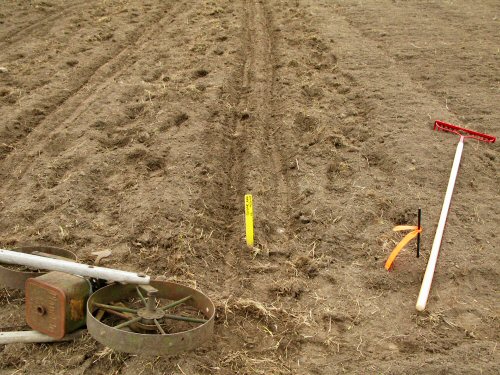
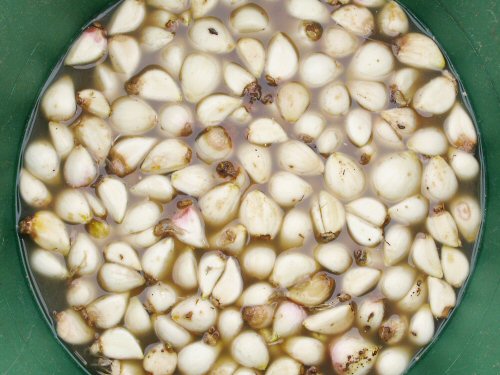
The first direct-seeded crop went in today: Sugar Ann snap peas. As usual, the peas were inoculated with Rhizobium bacteria: dampen the seed with a little water, sprinkle with inoculant powder, and shake.

Rhizobium bacteria enter legume roots and form a symbiotic relationship with their hosts, producing plant-usable nitrogen in exchange for carbohydrates and other nutritious goodies from the plants. The net result is…more nitrogen for all! Or as the inoculant package says: “bigger yields and better quality”!

Sounds great. I take it on faith (in the science, I guess), since I haven’t actually observed the with-and-without inoculation difference. I have a couple of times planted without, but I wasn’t taking measurements…

Each legume (peas, beans, clover, etc) needs its own species or strain of Rhizobia. Luckily, there are packets of premixed assortments that cover the common veggie legumes. What I’ve been using, called simply enough, Garden Inoculant, is good for beans, peas, lima beans and sweet peas.

The bacteria do establish in the soil so that they’re available from year to year, but I’m not sure how long and in what quantities it takes to get set up with the strains you need—until I find out, I’ll inoculate every time…

Then it’s on to the seeder. I’m using the older, heavier, probably-antique Planet Jr. over the usual Earthway.

And minutes later, 3oo’ (91m) done. It’s an almost painfully small start for April 20, but I’m figuring that every few days I leave the broken up sod to break down more, the better off we’ll be. Soon, though, all the rest of the early direct seeded crops will just have to go in!

Soil inspection

A sunny, still chilly, fairly busy outdoor day. Did some test tilling this morning, with the Kubota compact tractor and 48″ rototiller. The solid ground hasn’t fully thawed out, but the plowed area is already nearly 50°F (10°C) at 6″ (15cm) deep. So I thought I’d have a go on a 30′ (9m) strip, to see how well it’d chop up with the Kubota.

The full plan is for disking—big plow, big tractor—by Peter down the road. That would break up the moldboarded strips, finishing up with the little (but mighty!) Kubota. But between the weather, and unexpected things happening, you never know when a date with off-farm machinery will fall through.

I want to get the early stuff—spinach, garlic (yes, have to try spring planting this year), onions and so forth—in as early as possible. So we’ll probably be prepping an area with just the Kubota.

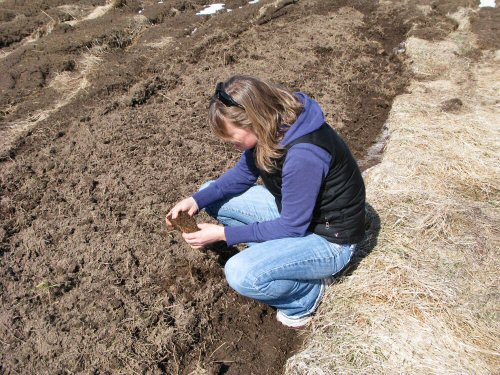
In the afternoon, Andie (aka Andrea, aka Max) dropped by for the first time, to check things out. She’s finishing up school, and planning to spend a couple of days a week for the summer, learning about small-scale farming the hands-on way… We strolled around, Andie tried out some seed starting with a tray of arugula, and we chatted.

Everyone’s first visit to the farm is a bit different, and there are all kinds of reasons why people want to get out in the field. This time, a good deal of the conversation involved university, graduate studies and the like, along with…tiny farming. It’s good to have an idea of who you’ll be working with, both ways—a comfortable, interesting fit really makes a difference in the tiny farm experience!

This season, there’s a bit of a blog plan: to show a lot more of the people side of the market garden! Today, as often happens, I forgot to take photos while we were actually doing stuff, so right at the end of her visit, Andie checked out the freshly rototilled ground, and I snapped an official Her Day 1 pic. The soil looked good, it’s a clayey loam (pretty much like at the old farm), with the sod breaking up nicely, and Andie seemed happy with the prospects, so we should be checking in again with both real soon! :)

Tiny cultivation

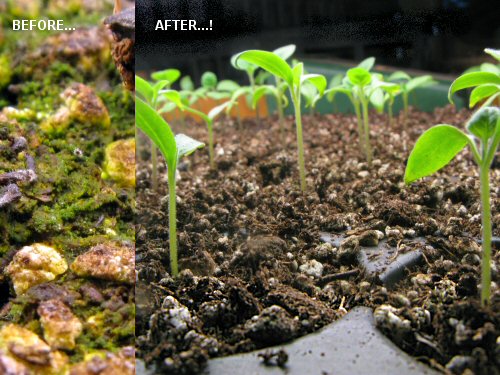
Tending seedlings on this tiny scale is pretty much literally fieldwork in miniature, especially with the pesky GREEN MOSS. The seedlings have to be watered, of course. And with the green moss, they have to be weeded as well. I use something pointy to stir up the surface of the peat-perlite seedling mix…

It comes back quickly, in a day or two, whenever the surface is wet.

I’m not even sure it’s moss, could be algae? Mold? Lichen?! I haven’t been able to ID it for sure, but I’ve often seen it called…green moss.

Not too appetizing to look at, the green moss has been quite harmless. At the old farm, I wondered if it came from the well, but here, we’ve been using filtered water and there it still is. It could be from the peat.

In any case, no worries, just a quick scuffling once in a while to keep it from sealing off the surface while the seedlings are small, which it looks like it would eventually do. I suppose I could find some clever, NATURAL way to kill it off, but I really don’t mind it. Once the mix dries out, the green moss is gone. At least, it disappears…

Tomatoes galore

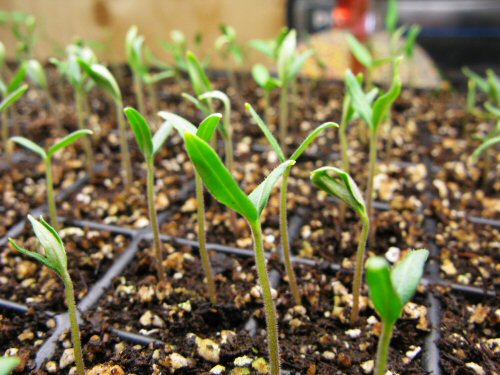
Tomato seedlings are suddenly everywhere! We planted out the whole of this year’s line-up in a couple of days, starting a week ago. The first tray (above) started popping in just 4 days! There are over 60 varieties, including around a dozen cherries. Except for half a dozen hybrids, they’re all heirloom.

Heirloom tomato seed seems to be more quirky than the hybrids, with noticeably different germination speeds and rates from variety to variety, and year to year. Here, we’re waiting on Cherokee Purple from some leftover 2006 seed—one’s up, there in the distance, the rest may come along soon, or not. Meanwhile, right beside, three rows of 2008 CP are up and at ’em, so we’re covered either way.

I haven’t really looked into all this—setting up more efficient storage than my current airtight-bags-and-cool-place method, whether the plastic lined packets from the big seed companies do better than the plain paper ones from many smaller seed houses, presoaking seed for some crops in a kelp solution or whatever, and so forth—because there isn’t much older seed, and most seem to do just fine. So much to try, so little time… Luckily, it always works out!

Broccoli shapes up

Broccoli, seeded a couple of weeks ago, is now putting out its second true leaves. This is good, watching the wee seedlings turn into stronger, fully-adapted little guys. This season, with a whole bunch of unknowns in a brand new garden, I’m particularly aware of every little stage, not concerned, but…watchful. Indoors, conditions are pretty well controlled, but there are different factors, like a smaller seedling room, with much lower ceilings and different ventilation and air flow, that COULD make a difference.  Probably not. Probably, with the temperature and humidity the same as always (I watch the little min/max thermometer/hygrometer a lot), that’s all that really matters. But maybe not! :) So it’s good to ACTUALLY SEE the seedlings shape up. Nothing wrong with a little extra excitement to top up the spring rush…

Different kind of compost heap

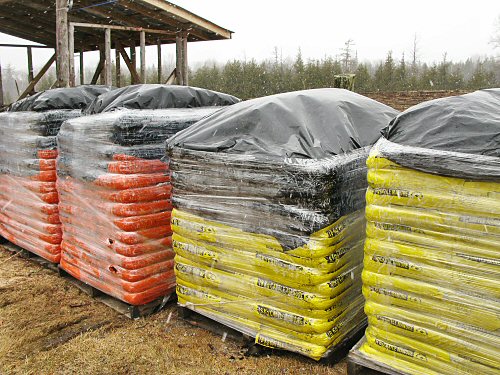
Back to cold and wet, with a bit of snow… Today was an interesting first in my brief tiny farming career: compost on skids! Fertility delivered! How convenient… This is about 5.5  tons (5,000kg) of fully composted, certified organic cow and sheep manure (half and half). According to the people who make it, at this point there’s no appreciable difference between manures, it’s all just high-grade compost now. Our organic certifier agrees: it’s “legal” to use any time, unlike any type of manure, which has to be spread a minimum of 90 days before veggie crops are planted. So here it is, from around 65 miles (96km) away, via flatbed truck and forklift up the drive…

This is a one-time thing, part of what we’re doing to start the market garden from a hay field plowed late last November. Unlike at the old farm, where cow manure was well-aged and plentiful, available by the ton, there are so far no animals here.

While I like the idea of animal manure, and find DELIVERY kind of odd and offputting, the current reality does force one to really think about hidden costs. The cows at the old farm ate far more hay than the farm produced, which meant buying in, so all of that free, on-farm manure wasn’t exactly free, or on-farm. Factor in the total cost and complicated logistics of raising and selling local beef, and the relatively low return, and manure on a tiny farm can seem quite unsustainable.

In any case, maintaining fertility here is a whole new game. Green manure, compost, and a small amount of on-farm manure, from chickens first, are this tiny farm’s future. And today’s delivery is the kickstart. Here we go!

Kale in survival mode

At first, it looks like some sort of horrible, fuzzy mold, about to devour your newly germinated seeds. But when you get really up close, it turns out to be superfine, hairlike extensions growing from the radicle. These kale sprouts pushed themselves right out of the seedling mix, probably because they weren’t pressed in and covered deeply enough.

Kale, broccoli, cauliflower and other brassicas do this in a very visible way during a surface emergency, sending out a mass of fine root hairs in search of water. Root hairs are normal below ground, but I’ve only really noticed them growing exposed on brassicas, other newly emerged seedlings with bared roots usually seem to just dry up. An unusual glimpse of what plants are up to with their vast root systems down below.

Given half a chance—a little surface moisture—these guys can actually manage to burrow down and root themselves. Pretty cool trick.