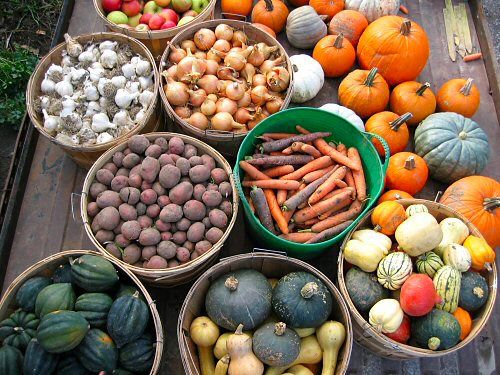
With the farmers’ market over, time to turn to fall-and-winter things. This year, I’m for the first time organizing a proper veggie selection for storage (it’s about time I started…training for that future CSA root cellar!). Instead of the usual bushel baskets of this and that, casually left around the barn to take their chances with temperature and location, now, there’s a bit of plan. For a root cellar, the basement of the farmhouse, the side with a dirt floor that used to be filled with potatoes when this was a fully working, big family farm. For the veggies, today’s haul has a mix of potatoes, assorted winter squash and pumpkins, various carrots, onions, garlic, plus apples picked up at the market. It’s a first step, there’s still lots more in the field: beets, spinach, collards and kale, herbs, and more carrots to go… Harvesting isn’t history just yet!
Harvest
Choose your fork wisely
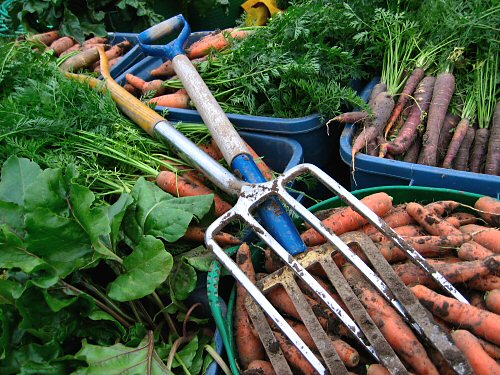
Today’s harvest was the last scheduled one of the season—tomorrow is the final farmers’ market day. Heading out alone felt a little strange, after all the help this summer, but certainly familiar. It’s a completely different…mindset when it’s all entirely up to you! Carrots were featured. There’s lots still in the ground, and some customers at the market will want to double up on the last day. I pulled about 200 lbs (91 kg), not exactly a bulk, root cellaring quantity, but that’s 100 x 2 lb bunches, quite a lot for one market day. That took a little over an hour of digging and pulling, and it’s amazing what a difference the right tool can make. Here, it was a choice between two seemingly similar digging forks. Most of the season, I like the Blue One, with flatter, wider tines that make lifting the soil easy when the ground is fairly dry and loose. BUT, when the ground is cold and wet and dense as it was today—our clay-loam is good at getting that way—the slick stainless steel option, with narrower, pointier tines, simply slides in, where it takes twice the effort to drive down the blue one. No comparison! If the difference sounds slight as described, a few minutes of actual digging and you’d be convinced. It’s the not-so-little things!! It’s in the details… So, lots of carrots, lots of beets, a good haul of cauliflower, bok choi, spinach, kale, plus garlic and onions from storage. A nice cool season selection. Not bad!
Pumpkins on the stand
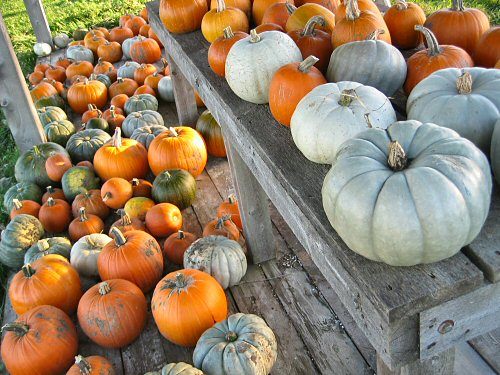
This year’s pumpkins eventually made it to the newly roofed farm stand. It makes a nice autumn scene, especially on a fine, balmy fall day like today. I suppose this coming together of pumpkin and stand is a fitting progression and a good sign, since both are works in progress. For the last couple of seasons, I’ve PLANNED to open the stand full-time for at least a day or two a week, but various things got in the way. And pumpkins have been too bulky to take in quantity to the market so far (we absolutely pack a pick-up truck; a roomy, custom-fitted trailer is on the big-purchases-when- I’m-able list). At least, the pumpkins are now on the stand! Several CSA shareholders have picked some up, and I’ve given away a few, so it’s working, kinda. The greenish-gray ones are Jamboree, the white ones are Lumina…
Last big harvest of the year!
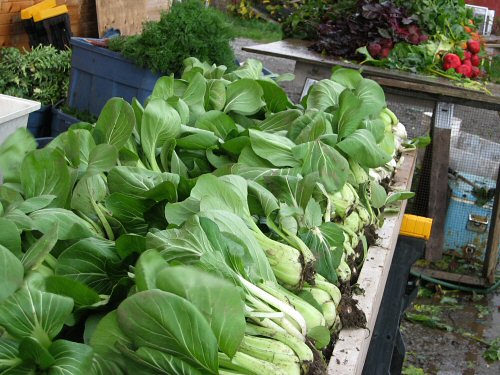
And then there were two! For the last big Friday harvest of the season—it’s the 18th and final CSA share and second to last Saturday at the farmers’ market—the crew was down to Conall and me. It was a rainy one, with the ground soaked from a couple of days of showers, but it was all smooth. With the cooler, cloudy conditions favoring a little extra storage time, Conall did the Brussels sprouts and eggplant yesterday. And with the shortening days, the mesclun growth has slowed to a near halt, and there’s not enough for CSA shares, so that fairly time-consuming task was out. In fact, things went so well, we managed to take a couple of hours off and head into town to pick up some things, and were still done by 7 pm. In the pic: bok choi and beets up for rinsing, with carrots and Brussels sprouts already in the bins. In today’s harvest: the spicy greens mix (arugula, tatsoi, mizuna, mustard), about 20 lbs (9 kg) of mesclun, collards, parsley, beets, carrots, bok choi, kale, a few broccoli and cauliflower, plus potatoes, onions, garlic, pumpkins and winter squash from storage. Conall’s done for the season tomorrow, so next week for the last farmers’ market harvest, it’s down to one. Time flies…!
Harvesting Brussels sprouts
That was interesting! I’ve harvested Brussels sprouts by picking the individual heads, but for our first bigger harvest of about 60 plants, to speed things up, I decided to take the whole thing.
First try: chopping the base of the stem with the machete-like harvest knife was like hitting a piece of hardwood. Wow! Tough and cut-resistant… Next up, a sharp hatchet fared no better: a solid whack hardly penetrated.
So, we pulled ’em up, roots and all. They set in pretty good, but the main roots are shallow, so even with knocking off the clumped soil, this went quickly.
Next, we discovered that removing the roots is easily accomplished with a short, fairly rigid hand saw. Once we figured out the right starting angle, one and half strokes cut through the stems like butter: zip-zip!
Then to the harvest knife: swipe off the head, and then, holding the base of the stem, about four downward lopping strokes, rotating after each, to shear off the leaves. Kinda odd looking results, but efficient all around.
The sprouts, catching up from the summer drought, haven’t all filled out, still, a healthy yield of full-size to tiny heads from each one.
It was a completely novel, different harvest process than for all the other veggies. All the chopping and cutting was…fun!
Seasonal eating
The veggie selection changes over the season, but it’s not necessarily reflected too dramatically on the stand at the farmers’ market this year. Compared to mid-August, the absence of snap beans and tomatoes is clear (with the mild weather, some vendors did have standard field tomatoes today). As for early June, well, more variety now is to be expected. Still, most of the cool-season crops for around here, like broccoli, cauliflower, and collards, also, winter squash, I have only enough of for CSA. On the stand, two types of radish (White Icicle, French Breakfast), three types of beet (Golden Detroit, Scarlet Supreme, Bull’s Blood, in smaller sizes here), two types of carrot (Nelson, Purple Haze), Red Russian kale, two types of bok choi (Mei Quing, Joi) and mesclun, plus Yukon Gold potatoes, Music garlic and Stuttgarter onions in baskets. The stand could be a lot bigger, offering more display space, and the harvest could be expanded (there are still herbs, summer squash, sweet and hot peppers, tomatillos, Brussels sprouts,…) but the marginal sales for many “secondary” veggies at this slowing down time of year don’t make it worthwhile. I’m still working on the balance between production planning, labor, harvest selection, post-harvest prep, and presentation… Sounds complicated, but it’s just…work! ;)
Big beets
Something excellent and hard to pin down happened with the last planting of beets: they became HUGE. This was the fourth planting of the season, around mid-July (see them on the left), and the seedlings got caught in the near drought, although they were around the top of the irrigation list and got a decent share of water. In mid-September, the steady, plentiful rains started, along with continuing warm weather, but that was well into their growth (they’re all 50-60 day varieties). And thinning was good, though just the usual. Whatever the cause, all of them—Scarlet Supreme, Golden Detroit, Bull’s Blood, Chioggia—blew up, most weighing in at 1.5-2.5 lbs (700-1100 gms). Maybe I don’t get out enough (to check out other people’s produce around the country and the world :), or maybe more irrigation would do the trick, but to me it’s somewhat of a mystery how these got to double and triple size. I’ve tasted them all, raw and cooked: they’re firm, tender, with great color and flavor. Smaller beets are more convenient for some purposes, but these big guys are versatile and…easy to harvest and pack… Two to a beet!