
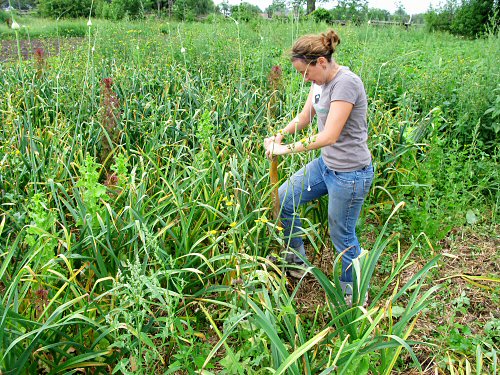
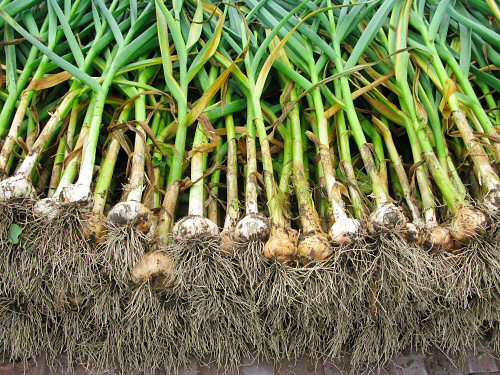
Considering that our clayey soil has hardly had a chance to dry out with all the rain, this year’s garlic is looking good. With Lynn digging away, the first third of the garlic patch is up and stacked to dry in the barn. I’d been worried about rotting (and Con at the market had already reported losing a lot of his to rot), and checking every couple of days for the last two weeks. Maybe 20% of the bulbs are soaked and come up pinkish-brown—dunno how they’ll look when they dry out, but the cloves are fine, so it’s lots of home use and seed garlic at the worst…
People
Beans and big weeds
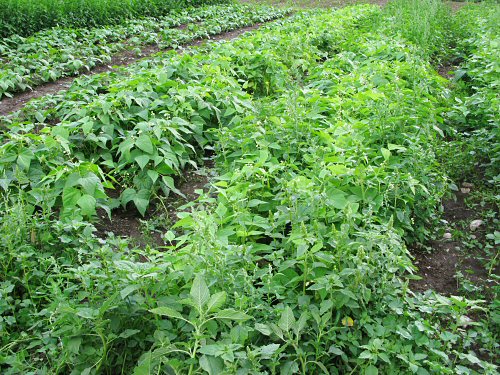
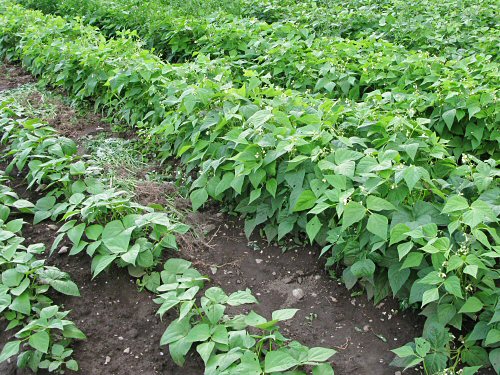
Hand pulling big weeds is a regular garden feature this summer of rainy, weed-favoring weather. In the before and after, the second and third plantings of snap beans (Jade and Indy Gold) are disappearing under soaring lamb’s quarters and pigweed: a couple of hours and a couple of pairs of hands later and they’re looking good.
More carrots
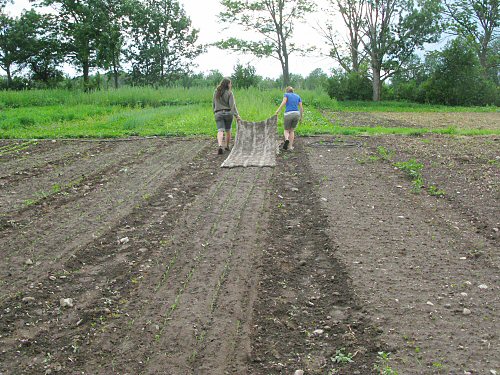
Wouldn’t DREAM of starting carrots without the burlap method now. Maria and Lynn remove burlap from the third planting of the season, using the fold and fold again approach rather than rolling it up…
Harvest wet work
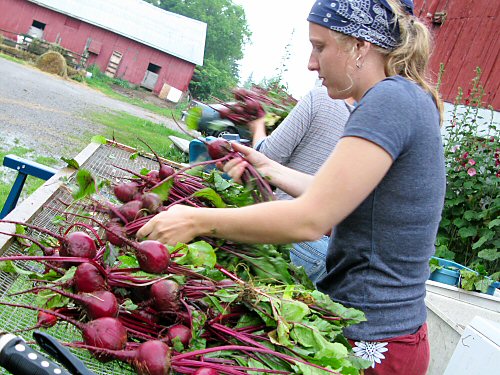
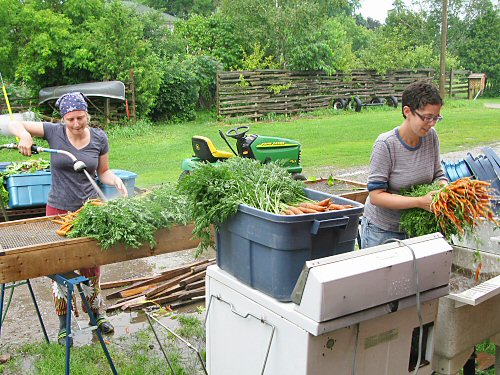
Yet another in this summer’s series of wet and gray afternoons, the weather blending perfectly with the wet work of rinsing and sorting muddy root crops. Instant efficient team chemistry between Rachel and Mel, both doing post-harvest here for the first time. (Above, carrots, below, beets.) The process is very small scale and manual. Crops are first dumped from harvest bins onto the screen table, clinging earth is quickly blasted off with the jet setting on the water wand. Next, double handful bunches are dunked for a final rinsing. Then it’s back into the bins… Simple and quick for a few bushels. Get wet!
Dirty hands at the farmers’ market
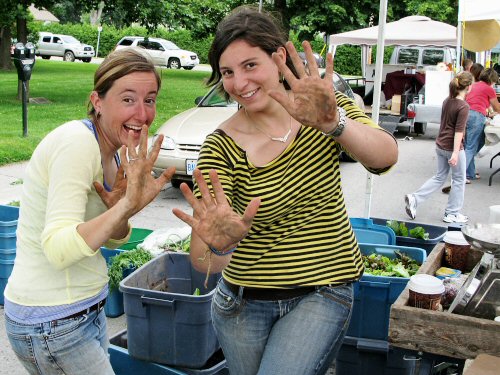
Over the last couple of weeks, we’ve been experimenting again with rinsing versus…not rinsing. This comes up a couple of times every year, where I think (or someone suggests) that rinsing various veggies is not necessary: to save time, to improve storage, to preserve nutrients,…the reasons vary. (For me, the time-saving is always a big attraction!) Sometimes, crops just have to be rinsed to cool them down quickly if harvested in the heat, or because they’re really mucky from heavy, mud-splashing rain. In any case, this week, we didn’t rinse the carrots, beets and beet greens, so sorting at the market was a bit messy. That’s Lynn and Maria, happily dirty-handed… The conclusion is usually the same: when the harvest is really kinda muddy, which is often the case this year with all the rain and wet ground, a quick rinse is better all around, for handling and for presentation. Still, the experimentation continues!
Kids in the field
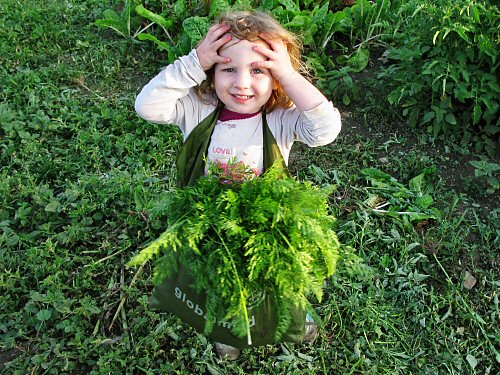
A fair number of kids have dropped by the farm, parents in tow, but today was the first time since I’ve been doing the tiny farm blog WITH PEOPLE INCLUDED, that smaller children figured directly into the fieldwork picture. Michelle, whom I’ve known for 4-5 years from the farmers’ market, and who now comes by to help harvest on Fridays, dropped in today with her three…kids. There’s the impossibly cute and BUSY Violet, age two (above), who was into a bit of everything, like collecting carrots and eating every veggie she got her hands on. Allie (6) was really helpful, harvesting carrots with Lynn and Maria, harvesting beets and cauliflower with me, totally pulling her weight. Big brother Michael (8) kept Violet out of trouble here and there, but mainly chatted with me in some depth about his rugby and hockey teams, his parents views towards his sports performance, the video game he’s currently playing,…and other stuff. While Michelle cut a huge amount of all-lettuce mesclun, the kids hung out, did some useful fieldwork, and overall contributed in a surprisingly great way to the harvest afternoon vibe… Another happy side of the Tiny Farm Experience!
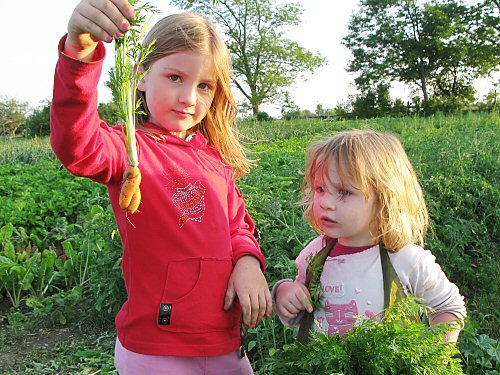
Fun with carrots…
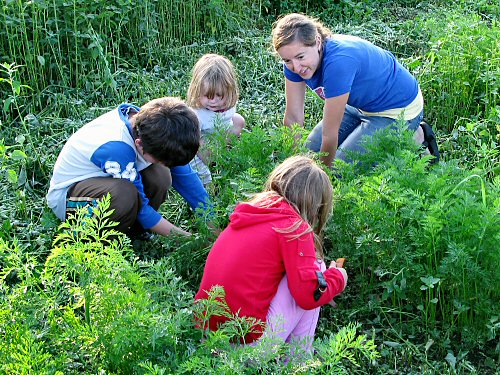
Lynn conducts an impromptu field seminar, featuring…carrots.
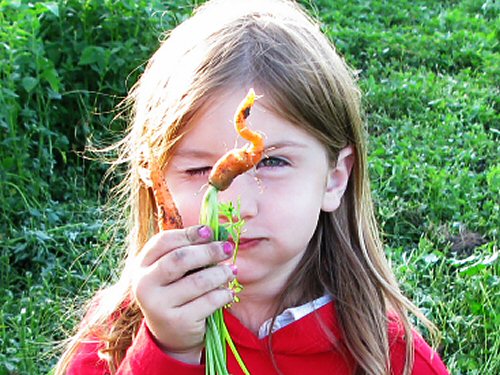
Allie eats and inspects carrots at the same time…
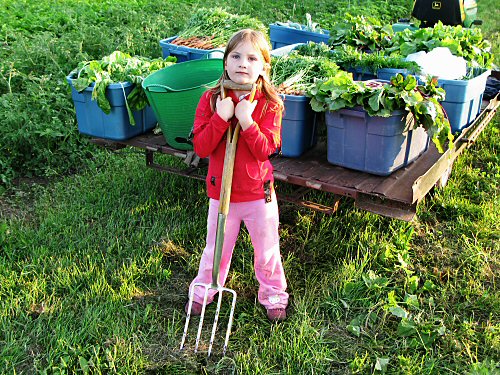
Strike a pose… Kids in the TFE!
Working the tiny tractor
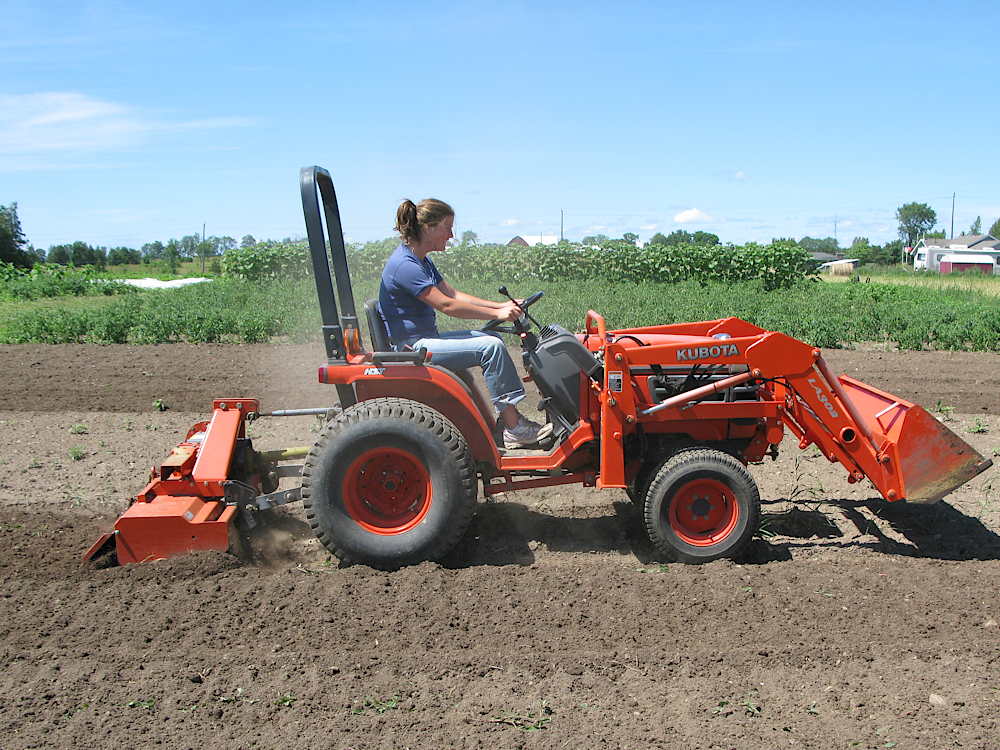
Working with the tiny tractor always looks like fun: after three seasons, it’s still fun for me, and just about everyone else seems to enjoy it, too! This Kubota compact tractor is dead simple to operate, rugged and reliable, easy on diesel, and nonthreateningly…tiny. And it’s as close as we’ve gotten to the other world of big, mechanized agriculture. Tilling with the 48″ rototiller is the Kubota’s main in-the-garden-beds field duty (and that’s something I try to keep to a minimum). I’ve come to rely on it for this one critical task, and to a lesser degree, for moving earth, manure, compost and other things with the front-end loader. Particularly, when time gets short and weeds on open sections start to go crazy, it’s great to have around. Here, Libby tries rotilling for the very first time, working up two sections for planting out fall brassicas (broccoli, cauliflower, cabbage,…). And, yep, looks like she’s having fun!