Books! Seed! Orders arrive…

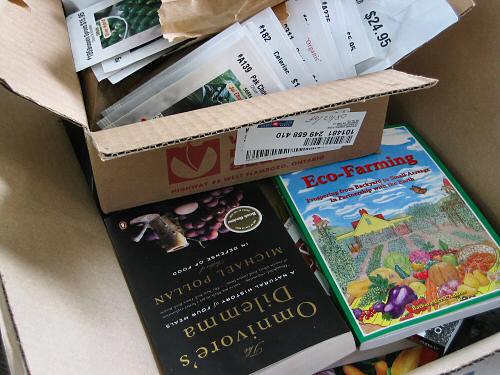
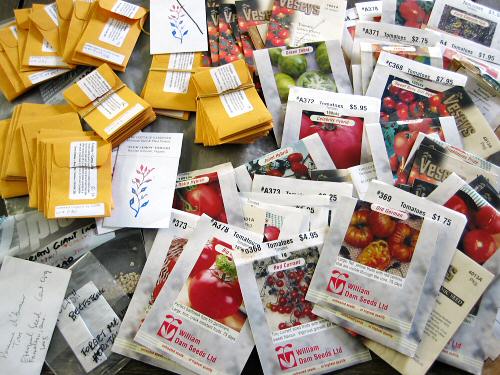
Better than Christmas! The first half of the first big seed order, and my first book order in months, both arrived today.

Seed every year comes almost entirely from three companies: William Dam, Veseys and Terra Edibles. The first two are both bigger, family run companies, one definitely slicker and more marketing-oriented, with a series of color catalogs through the year in addition to their main one, all kinds of enticing special offers involving free shipping, a call center with almost no waits, y’know, the works. The other is definitely more…”indie”, with a single annual catalog, a written commitment to untreated seed only, and a busy signal more likely than not right through the order season: keep calling till you get through. The third is a tiny company specializing in heirloom seed, grown in-house or directly sourced from small growers.

The cool thing about all three is that you’re actually dealing wtih the owners, right to the top. Even in the case of the slickest one, when a seed potato order was a WEEK late last year, the prez himself called to apologize. And I’ve had great, informative chats with various people from all. It’s another small satisfaction, knowing to a degree from where and whom your seed arrives.

The book situation is a little different: Amazon.com (Amazon.ca, in my case). It seems like a sprawling, faceless, digital megacorporation, and I long ago stopped keeping track of who bought out who, but as far as I know, it’s still…OK (like, not like Facebook). And it’s downright depressing/futile to browse a small-town bookstore if you’re looking for specific titles (of course, they can always order in, so I do it myself instead).

Anyhow, the few titles (selected from a long list of must-reads): The Complete Vegetable & Herb Gardener: A Guide to Growing Your Garden Organically (based on a recommendation), The Omnivore’s Dilemma: A Natural History of Four Meals (finally…eek! :), The Art of Simple Food: Notes, Lessons, and Recipes from a Delicious Revolution (hmm, high hopes for this one, based largely on a Charlie Rose PBS (US public TV) interview with author Alice Waters; I WILL cook more, but we’ll see if this helps…), Micro Eco-Farming: Prospering from Backyard to Small Acreage in Partnership with the Earth (I have NO IDEA how this came to the long list, I forget, but I did mark it with a bunch of stars…). And then there’s the Linux Pocket Guide, ’cause with blogs and web sites, like tiny farms, it’s usually best to know your way around the territory…

Off to start some rosemary really late, and read!

Seed ordering sanity

Seed ordering sheet

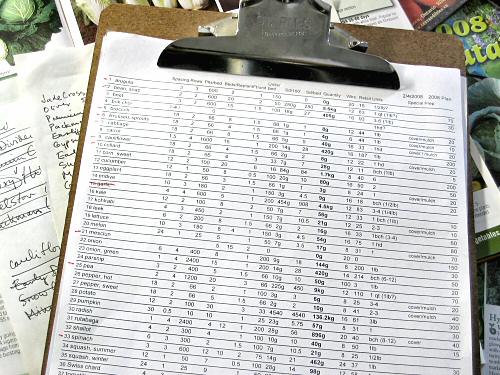
The first main seed order is finally done. There will be one more in a week or two, and then I’ll be set for the season. Working out the order was relatively painless, it does get easier every year, but without this handy Seed Quantity Calculator, my head would still be spinning. There are at least 65 different veggies, herbs, and flowers, and must be well over 200 varieties overall (wow, hard to believe when you add ’em up). It’s a lot to piece together.

Of course, I could REDUCE. That’s a whole other story (and then there’s the hybrids/seed-saving issue), but basically, I think variety is a great thing on all levels, so instead of reducing, I resist the urge to add more. For mainstay crops like green snap beans, I’ll try at least 2 or 3 similar varieties to see how they perform in this particular field (depending on conditions, the differences can be quite big). And you’ve gotta Try New Things, grow a little okra, some Jerusalem artichoke, LOVAGE, a row of tomatillos, and…lots more—even if a crop’s not exactly popular (self included), we can all learn! Crops, cultivars, there’s a lot of seed to choose from… And it gets more complicated.

On this tiny farm, where plantings are measured in multiples of 50 row feet, not in acres, the catalog price breaks are a maze of temptations and false economies. Seed for many crops becomes tantalizingly less expensive right after the first “bulk” quantity. For example, if 5g of something is $6, and 25g is $18, how can you pass up savings like that, especially when the difference is “only” 12 bucks? Freeze the extra and it’ll be good for years! But those extra 10 and 20 dollars add up real quick, and there are always lots more varieties to try.

So it goes, crop by crop, variety by variety, at ordering time. It could get real messy if I hadn’t long ago (Year 1!) worked out my seed quantity order sheet, which at least allows me to instantly check on how much space I really have, how much seed I really need, what the yield might be like… That helps!

Read more

Paperwork!

January paperwork

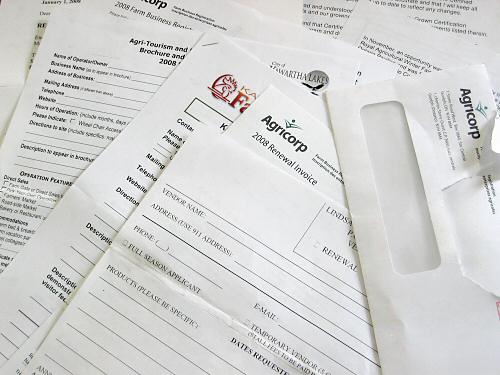
Ahhh, nothing quite like a pile of blank forms, waiting to be filled in, fitted with checks, and returned by deadline. January is the month to get the market garden squared away with the various powers that be. There are renewal forms for the farmers’ market (this form I like to see every year), farm business registration (need it for agricultural property tax rates, and to generally be considered an “official” farm), organic certification (a LOT of forms for that one), and for our spot on the small farm promotional map put out by the municipality. This farm is tiny and local and sells fresh veggies, all of which exempts it from a whole other world of paperwork that comes with organic wholesale, larger scale livestock, and anything to do with food processing. Once my forms are filled in and sent out, I’m luckily able to more or less forget about rules and registrations, and turn to the big garden for another year!

Virtual local?

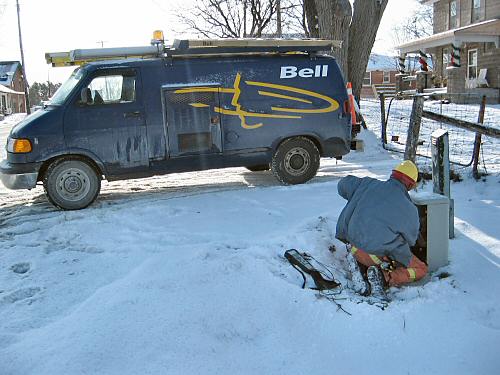
This morning, there was a phone company tech at work on the junction box at the top of the drive into the farm. I’m not sure what the guy and his logo-truck were up to exactly, but the picture made me think about tiny farming and the Web. Right now, Bell and an independent telecom company are in an extravagant, introductory-offer battle for subscribers to the newly available DSL broadband service. High speed Internet access has been in this area for years, in towns and even villages, but dial-up was the only easy, painfully slow connection for most farms (we’re on the edge of a village, so we’ve had cable modem all the while). Now, word-of-mouth is that people on farms are signing up for DSL—will more abundant web access mean more interest in having a web presence? This could be interesting because, out of 30+ vendors at the farmers’ market, I think this farm is still the only one with a web site. An odd situation, considering that online is really the only practical place for small producers to let people know what they’re up to. With the novelty of DSL, maybe more farms will finally get around to getting online, which is probably a good thing, because it takes more than a few people to make a local market thrive. Just as Tiny Farm Blog has rapidly become embedded in my farming life (BTW, TFB isn’t the farm site), maybe this technology, where you sit in front of a screen and TYPE, is what it takes these days to hook people up in the communities where they actually live… I suspect, in some ways, to at least some people, you’re not all that REAL if you’re not represented online… Even if you’re practically next door! A little weird, but whatever works!

Field map and field…

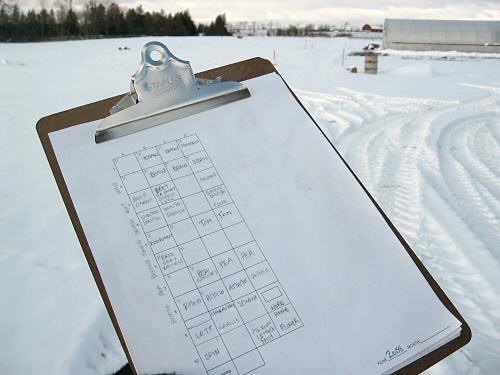
Map of the market garden and a snow-covered field

Here’s the new garden map, companion to the two calendars, all part of the latest version of my planning set-up. The simplicity and spareness are deceptive, this is the result of FIVE YEARS of refining complicated planning and record-keeping paperwork, stripping away stuff I didn’t really use. Really! My old maps were way more detailed, with varieties and planting dates for each bed, hand-printed in really tiny letters (each of those squares represents a 50’x50′ section containing 10 beds). The grid now takes up only half the page, leaving lots of room for little notes, and the sections are just big enough for blocking in the crops (varieties, dates and bed locations go on a separate list). It’s not fully filled in yet, and everything’s in pencil for easy rearranging. I was working on it today along with the seed order list, and took it for a walk to take the pic. Pretty plain on paper, but when I look at it, I see the whole season unfolding… (Overnight last night, the snow suddenly came back!)

Stakes vs cages

Every year so far, there’ve been two or three major projects that I’m sure just HAVE to be done. They’re usually EXPENSIVE (at least, expensive in the world of tiny farm finances!), which means, they take some thought. We’ve had the seedling greenhouse, excavating the pond, the Milkhouse Extension, the tiny tractor, the first full-time field hand (Conall!), and a few other steps… So far, so good. For the coming year, I have in mind a few more…important upgrades. I was reminded of one of them in the drive shed today, where the stakes used for my semi-effective semi-sprawl method of tomato support are stored, along with some of the couple hundred (largely useless) home-style tomato cages. For a while, I was dreaming of moving up to the basket-weave method—lots of twine and…weaving—although I have a hard time picturing all of that suckering getting done. What I REALLY want is BIG CAGES made from concrete reinforcing mesh…but it seems so expensive. Rough pricing: about $7 a cage times 500 cages, plus a fair bit of labor setting them up and taking them down. I know the method works well, but will it work well HERE, this year? Is it worth the money? For the same cash, I could almost build a second, production-size greenhouse. Or put more into drip irrigation. Or build a cooler for better short-term storage. Come to think of it, does growing dozens of varieties of tomato really make sense, couldn’t I just sprawl two or three big, round red varieties that would be easiest to sell…? In fact, I could grow a lot more of a lot less, cut out many varieties and entire crops, concentrate on the trendy best sellers, and get on the waiting list for an upscale farmers’ market in the big city. Top dollar! Maybe try for a bank loan for a bigger tractor (hey, there’s more acres in the garden field!) and a refrigerated truck?! If this is a (tiny) farm business, that seems to make sense: GROW! Yet somehow I’m heading in the OTHER DIRECTION. Stopping the city CSA to go local. Trying more crops and varieties every year and figuring out ways to buy stuff for them, like big tomato cages… It seems so…contrary. Which, in tiny farming, is something I guess you gotta like!!

Calendars love catalogs

I got these about six weeks ago, when the selection was good (because, just any calendar will not do!). Today, I busted them out of their plastic. It’s only three weeks to the new year, the Holidays will vanish in a blur as they always do… I don’t know if it’s the new extra focus that comes from garden BLOGGING, this year’s extended Real Winter, Garden Season SIX coming up, or merely some planetary alignment thing (or…something else), but I am really, well, unusually EDGY and wanting to get started… Hmmm. Anyhow, the calendars…

It comes down to record-keeping. You read about all kinds of intense systems of garden notes and, from market gardeners, intricate planting schedules distilled from reams of precise planting data. I started out with all that in mind, recording every crop and variety by planting date on a map, and meticulously noting all the action in a pocket notebook (use waterproof ink, field notebooks in your pocket inevitably get SOAKED…forgotten in the laundry or otherwise!). This note-taking activity would trail off a bit as the season got underway, and more so over the years…

Now, I’m a minimalist when it comes to records, and this season’s system is the simplest yet. Almost everything worth noting goes into these two fabulously FRESH calendars. And there they are! Like the new seed catalogs, for me, new calendars in December hold all the promise of things to come…!

Details! Well, these aren’t just any calendars, they’re At-A-Glance brand calendars. Like any other tool, when you find the right one, nothing else will do.

I’ve examined and tried all kinds of free and commercial calendars (and notebooks, and journals…) and there’s always been something missing, something slightly WRONG. Then I discovered the large-format AAG, which I’ve been using for the past three years. It is…just right. I tend to get distracted and a little messy when it comes to field notes as the season progresses, and a simple thing like not having enough space to write in can throw things off. The AAG large wall calendar gives me ample, uncluttered room for every day of the week, and a crisp, matt surface to write on. And it doesn’t get lost. I hang a pen on twine from the same nail and it’s set. Perfect!

The little AAG I found this year. It’s the ideal companion to the wall calendar, the missing link. It even has the monthly moon phases, which I used to fill in by hand on the big one (planting by moon cycles is somehow always at the back of my mind…). The little one replaces scraps of paper and various notebooks for jotting down field work hours, market and stand sales, and the like. It’s more “business”, while the wall model holds the field stuff: planting and harvest dates, mowing, rainfall and other weather notes, a very few other basics like gas can refills, repairs and the like, plus upcoming events and various due dates. Easy! Whenever possible, I use a black pen for notes, red to highlight future stuff, and a mechanical pencil to pencil things in.

Bonus: For the small mountain of annual organic certification paperwork, the calendar format is a ready-made chronological log (They really insist on one…!).

So there you have it! A straightforward, impossible-to-lose place for everything usually keeps me on track, and this two-calendar system certainly ought to do it. ;)