
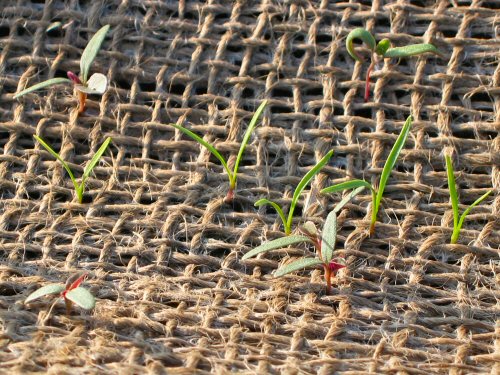
From the last carrot planting of the year, a new development in the burlap method! The variety is Nelson, and germination in less than a week was so vigorous, the seedlings came right up through the fabric, where in all previous seedings, they remained scrunched under. I’m not sure whether the burlap wearing down and loosening up helped this effect, or that there may have been less of a gap between burlap and soil due to a shallower seed furrow. In any case, it’s working better than ever! Rolling up the burlap, the seedlings slip through with ease, while most of the little pigweed emerging alongside get yanked by their aggressive leaf growth. Perfect!! (Clearly, I have carrots and pigweed on my mind…)
Veggies
The Friday harvest
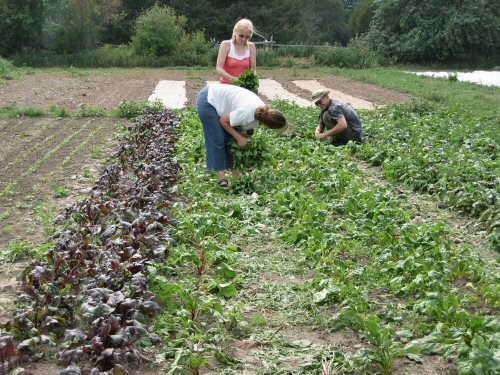
If it’s Friday… This week’s big harvest was the smoothest yet, with everything in, sorted, rinsed, bundled, bagged and COUNTED by around 8:30 pm. The crew this week: Sherry, Andrea, Molana, Lynn, Cezary, Conall and me. I’m over being slightly unnerved by the number of people—my reflex is still to wonder, “If I had to, could I do it all myself?”, but now it’s also…no worries, it’ll get done! Here, Andrea, Sherry and Cezary harvest beet greens, thinning at the same time. (And that’s last plantings of more beets to the left, carrots up top under burlap, and summer squash under row cover off to the upper right. Demolished pigweed strews the path.) In today’s harvest: beets, beet greens, eggplant, mesclun, arugula, carrots, green onions, potatoes, 60-80 units of each.
Supporting tomatoes
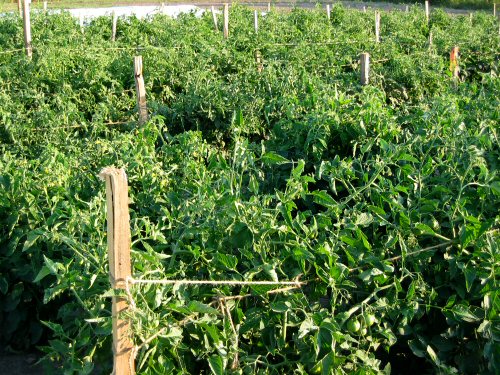
Time is tearing by, and there’s still lots more tomato-supporting work to be done, but it’s coming along. The good thing about my for-now semi-sprawl method is that it can be done reasonably effectively quite far along. The toms are indeed starting to really sprawl, but we still have a week or so when pulling them up is fairly easy and it will keep the paths clear and the fruit off the ground. Off course, stringing them together from both sides does make for a dense mass of tomato plant, but a bit of quick pruning and it’s better all around than without! We’ll see for sure over the next few weeks of tomato harvest…
Hauling garlic
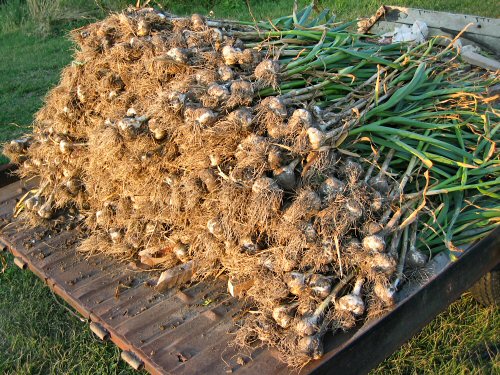
Today, we started bringing in the garlic. A gentle loosening of the soil with a digging fork—don’t spear those bulbs!—a gentle pull, and it’s done. When to harvest is a bit of a toss-up, at least, as far as I’ve made out from my three years of garlic growing. The general indicator of leaves dying off is a start, but I’m a little wary from last year’s harvest, where the garlic left only a week or so into August, with half the leaves still green, gave up a whole lot of split bulbs (the cloves began pushing back and the skin at the top split open). So now, I dig up a few, and if they look good, it’s time to harvest! This first haul is about a quarter of around 2,400. It’s off to the barn for curing in small stacks. The rest should be done in the next few days!
Pumpkin update
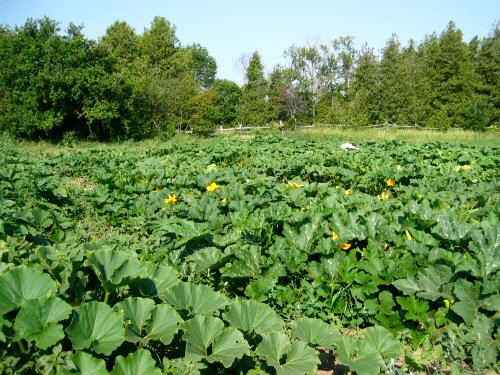
After a marathon session of pigweed pulling, the pumpkin patch appeared, looking rather orderly and much expanded from one month ago. So, all’s well with the PUMPKINS, on to the hopefully last major de-pigweeding of winter squash. I noticed back-to-school ads in a local paper already, and as obnoxiously early as that is, we are also preparing for that final summer stretch in the field. Oh well, tomatoes, peppers and eggplant are doing great, garlic is soon to be pulled, the best eating and market days are still to come!
Eggplant on the way
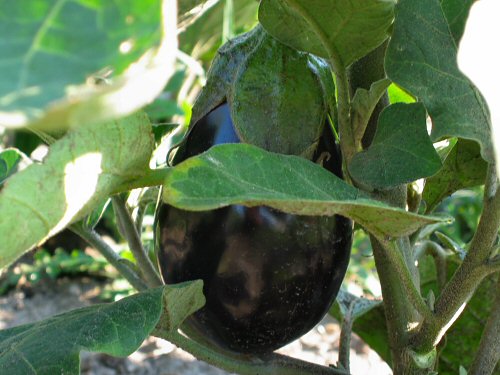
Tucked away and safely shaded from scorching sun, a Dusky eggplant happily expands. The earlier tiny eggplant puzzle, while never solved (eggplant and peppers were fruiting extra early, tiny fruit on tiny plants), no longer matters, and the brief Colorado potato beetle onslaught was successfully weathered. All varieties of eggplant are doing great (that’s Dusky, Black Beautry, Vittoria, Fairy Tale and Millionaire), with abundant fruit well ahead of any other year on this tiny farm!
Sunflowers show up!
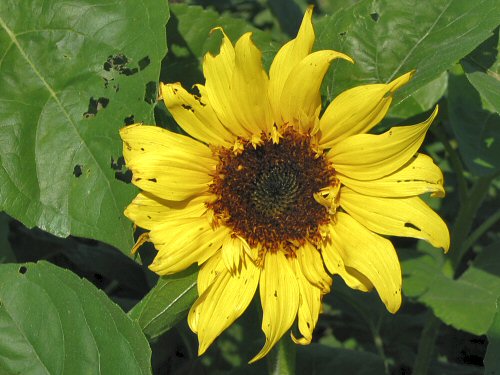
The first few sunflowers are unfolding, this one’s from the Go Bananas! mix (there are also burgundy Claret and familiar orange Sunrich). It’s a little bitten and tattered—the rough and ready look!—but a welcome sight nonetheless. The cutflower garden‘s received very little attention since seeding, and only maybe half have flourished in spite of lack of water and a fairly weeded-over state. The flower test plan included minimal care (which is what they got), so I’m not disappointed, although it’s always nice when crops take care of themselves (this doesn’t happen often enough :)! Anyhow, we should have at least a couple of hundred fair sized sunflowers, and some others, all headed for the CSA shares. I hope the zinnias do well!