
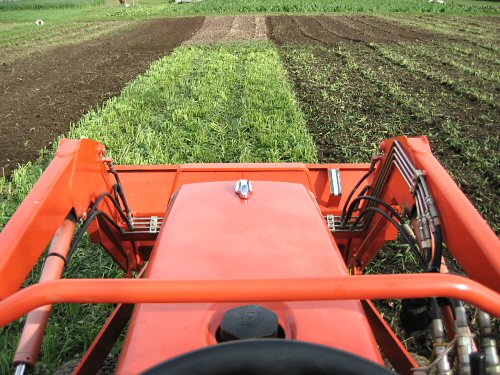
Tilling in the monster oats green manure/cover crop is a task where the Kubota compact tractor sure comes in handy. The oats is tall, dense and seemingly unstoppable by cold. It took a double mowing to get it down to a manageable state, and even then, it’s a slow till. The walking rototiller could’ve gotten the job done as well, but it would’ve taken several passes and a couple of tanks of gas, so I was happy to be at the wheel for this one. Originally, the plan was to let the oats winter kill, and work it in in the spring, but there’s just so much of it, I decided to take it out now rather than lose an extra week or two next year, waiting for it to break down. Decisions!
Tools
Equipment for large-scale agriculture is too big or too expensive, and many home gardening tools don’t work efficiently on larger jobs or break easily. Tiny farming on plots up to two or three acres requires its own special gear…
Killing frost, kinda
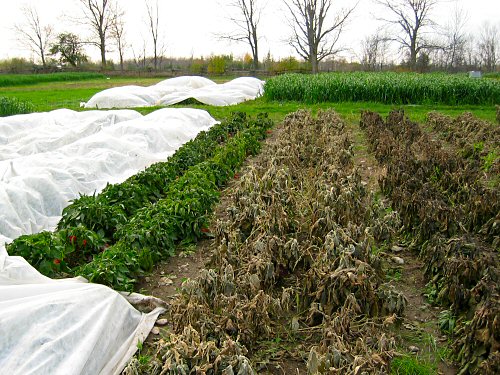
Yes, the weather’s crazy. According to the min/max thermometer outside the greenhouse, last night’s low was a chilly 18°F (-8°C), cold enough to kill off all but the hardiest. Finally, and only six weeks or so late—the endless autumn harvest is interesting, great for personal use veggies, but otherwise, it mainly throws off the fall clean-up schedule (I haven’t changed zones, have I?!). Here, the eggplant is clearly toasted, while the peppers, which had been under fairly light row cover (I pulled it back today to harvest some), came through in relatively fine shape . And the oats, well, it’s a monster, lush and green and if not exactly growing anymore, it seems to be getting thicker. It’s fascinating the way cold works in the field. Wind, cloud cover, mini-windbreaks, slight elevation, all kinds of factors add up differently in spots only a few feet apart to determine life or death by cold. Anyhow, can’t wait around forever. I’m soon going to roll up the row cover and till it all down!
Choose your fork wisely
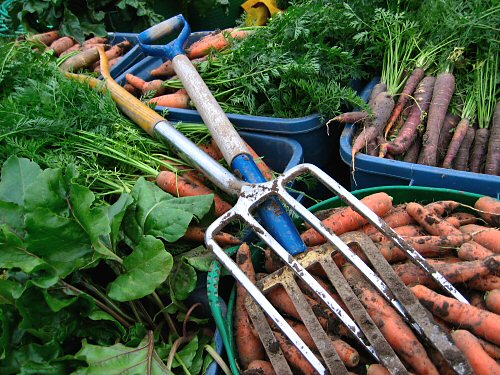
Today’s harvest was the last scheduled one of the season—tomorrow is the final farmers’ market day. Heading out alone felt a little strange, after all the help this summer, but certainly familiar. It’s a completely different…mindset when it’s all entirely up to you! Carrots were featured. There’s lots still in the ground, and some customers at the market will want to double up on the last day. I pulled about 200 lbs (91 kg), not exactly a bulk, root cellaring quantity, but that’s 100 x 2 lb bunches, quite a lot for one market day. That took a little over an hour of digging and pulling, and it’s amazing what a difference the right tool can make. Here, it was a choice between two seemingly similar digging forks. Most of the season, I like the Blue One, with flatter, wider tines that make lifting the soil easy when the ground is fairly dry and loose. BUT, when the ground is cold and wet and dense as it was today—our clay-loam is good at getting that way—the slick stainless steel option, with narrower, pointier tines, simply slides in, where it takes twice the effort to drive down the blue one. No comparison! If the difference sounds slight as described, a few minutes of actual digging and you’d be convinced. It’s the not-so-little things!! It’s in the details… So, lots of carrots, lots of beets, a good haul of cauliflower, bok choi, spinach, kale, plus garlic and onions from storage. A nice cool season selection. Not bad!
Welding
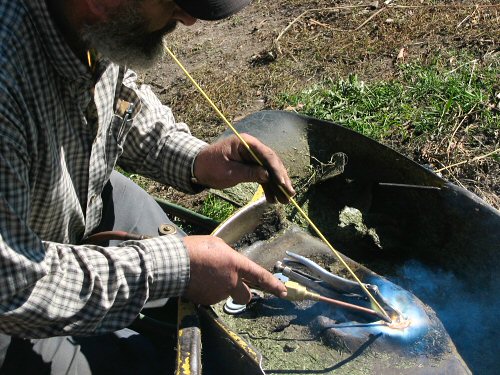
A second incredibly warm and sunny day, perfect for a little welding in the barnyard. Yesterday, something kinda disengaged in the riding mower deck, leaving behind a pretty nasty racket and nearly no mowing action, and now the deck is getting a long-overdue overhaul.
Hitting rocks in the field can’t be reasonably avoided. After four years of pounding, the spline on one of the pulley assemblies that spins a blade was completely worn down and the whole thing had to be replaced. We picked up the part this morning, and an hour later, the mower was back in business. Here, Bob welds on a washer to patch a cracked mounting hole (he’s brazing, which is a type of welding, or high-heat soldering, depending on how precise you want to get…it’s all joining molten metal to me!).
DIY repairs keep the tiny farm rolling. I can do routine minor repairs—splicing hoses, replacing tines, sealing tire leaks, sharpening blades, re-priming pumps, basic rough carpentry, banging on things until they work, and the like—but welding is still far in the distance. Welding is great. We should all learn to weld, right away…! :)
And now for something completely different…
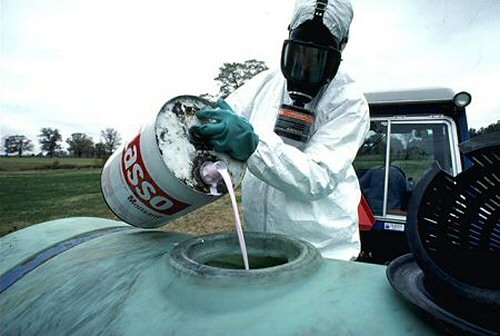
Looking through photos on the computer today, on a rainy afternoon after the farmers’ market, I ran into this one. I’d saved it from somewhere on the Web three or four years back (public domain, I think). It’s a striking shot, although whether it’s advertising safe pesticide handling or the scariness of chemical agriculture, I’m not sure. And, hey, that could be me, all dressed up and getting ready to go—you’re never too tiny to do some spraying! I looked up the pictured product, Monsanto Lasso. It is, or was until recently, the biggest selling agricultural herbicide in the US, used “everywhere” on corn and soybeans. It’s also a “known or probable carcinogen” and apparently messes with human reproductive and developmental functions as well. Hmmm… Luckily, I use a wheel hoe…
Harvesting Brussels sprouts
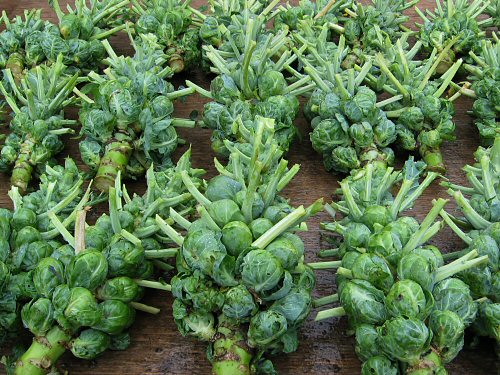
That was interesting! I’ve harvested Brussels sprouts by picking the individual heads, but for our first bigger harvest of about 60 plants, to speed things up, I decided to take the whole thing.
First try: chopping the base of the stem with the machete-like harvest knife was like hitting a piece of hardwood. Wow! Tough and cut-resistant… Next up, a sharp hatchet fared no better: a solid whack hardly penetrated.
So, we pulled ’em up, roots and all. They set in pretty good, but the main roots are shallow, so even with knocking off the clumped soil, this went quickly.
Next, we discovered that removing the roots is easily accomplished with a short, fairly rigid hand saw. Once we figured out the right starting angle, one and half strokes cut through the stems like butter: zip-zip!
Then to the harvest knife: swipe off the head, and then, holding the base of the stem, about four downward lopping strokes, rotating after each, to shear off the leaves. Kinda odd looking results, but efficient all around.
The sprouts, catching up from the summer drought, haven’t all filled out, still, a healthy yield of full-size to tiny heads from each one.
It was a completely novel, different harvest process than for all the other veggies. All the chopping and cutting was…fun!
UPDATE: The kind of odd presentation was loved at the farmer’s market—certainly said, “Fresh!”
Frost protection
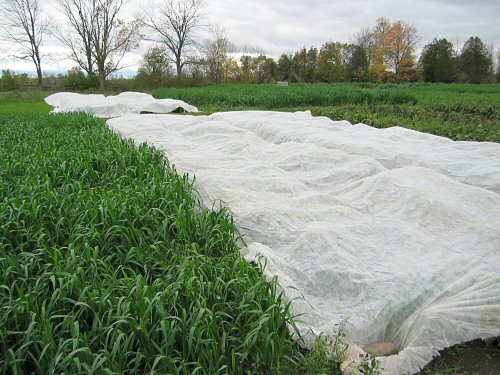
With last night’s forecast calling for -3°C, I finally figured a little floating row cover frost protection might be a good idea. In fact, though, with the cloudy, windy, wet conditions right through to Saturday evening, a solid freeze didn’t seem all that likely. And that turned out to be the case. The min/max thermometer outside the greenhouse registered a low of -5°C, but only a few crops suffered minor damage. Even the basil, which is really tender, did well: the top layer of leaves took one for the team, but the rest were fine. Here, some sweet pepper plants sit under cover, but the forecast for the next week is…quite warm. When exactly does the season end?