
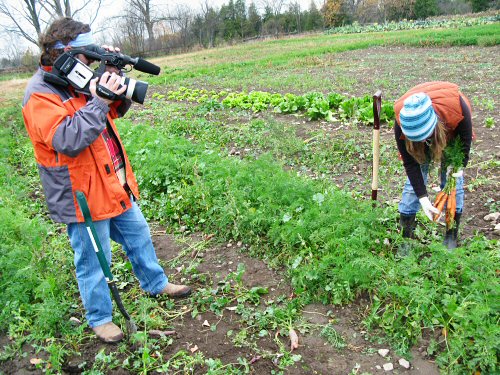
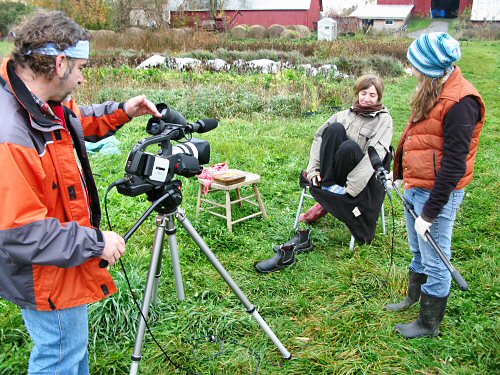
A bit of unusual activity in the field today, a mini-video interview! Raechelle and Lynn brought their friend David, who brought some video gear. The whole thing was casual, the video being mainly to record our impressions of tiny farming for a possible magazine article. Still, with the tripod and the boom mic, a certain “we’re on TV!” flavor hit the field for a couple of hours. We each did a sit-down interview (it was fun watching Lynn rustle up sound bites to describe the simple pleasures of…fieldwork), then David taped some atmosphere: digging carrots, chasing chickens,… And we had cake! Earlier this season, we had our own, self-styled, TFE version of a photo shoot for a newspaper article. Now, this! Are we becoming increasingly…media-friendly?! ;)
carrot
Allie’s photo gallery
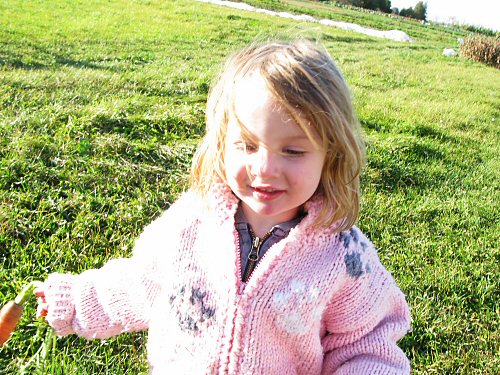
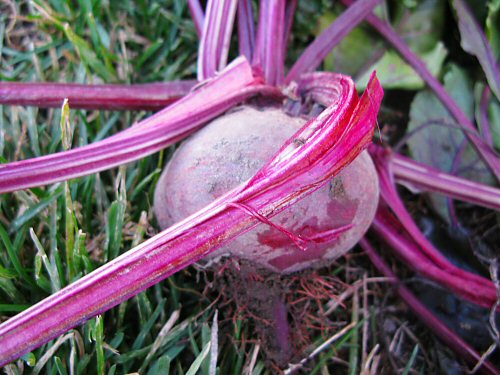
Without much thought, I handed visiting Allie my camera and let her take pictures around the farm. After she’d disappeared from sight, I did start wondering if the camera—500 bucks to replace—was safe. But if this six-year-old can, just from watching, efficiently harvest sweet potatoes with a digging fork about as tall as she is, she should be able to handle a point-and-shoot, right?! Right! First, I showed her what button to press to take a photo. A few pics later, I showed her how to use the autofocus (“point at whatever, hold the button down halfway till it beeps, wait till the rectangle turns green, then push all the way!”). That went well, so I showed her when and how to switch between normal and macro mode (“turn the dial when you want to shoot up close”), which is how she shot the Bulls Blood beet (above). Wow, that was easy!

She took around 40 photos in all. Above, mom Michelle rinsing beets, below, her little sister Violet, with carrot. Kids, digital technology, and the field…all part of the TFE! (Guest photos by Allie)
The incredible shrinking harvest!
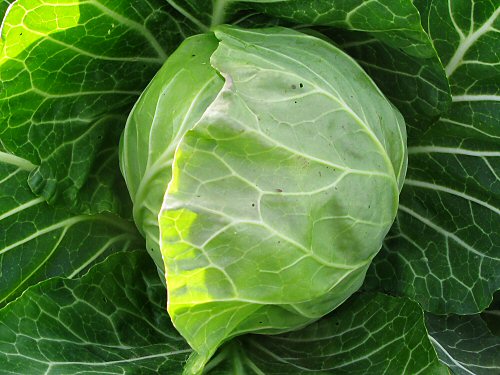
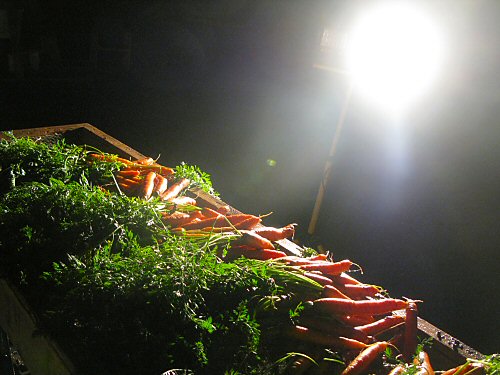
The Friday harvest is shrinking. This is the second to last of the year, and the last for CSA members, and we’re down to mainly root veggies. Some of the last cabbage planting has firmed up, and we’re picking them as “baby,” about 1-2 lbs (450-900g) each (multiplanted, the yield is good, the size really convenient for cooking, and the taste quite fantastic). And there are beets, carrots, parsnips, plus onions, garlic and other storage crops. And some lettuce… As the harvest gets shorter, so do the days, and I’m out rinsing beets and carrots after dark once again. Try not to get wet when it’s COLD…!
The autumn view…
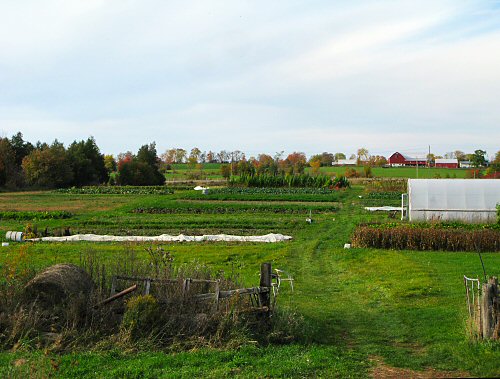
Compared to one month ago, the outline of the garden is pretty much unchanged, but a whole lot has gone dead and brown. Alive and well, there are lots of hardy brassicas, straining to grow in the diminishing sunlight. And there’s still quite a bit in the ground: tons of carrots, a fair amount of parsnips, and a huge quantity of Jerusalem artichoke, all sweetening in the cooling soil…
Night work
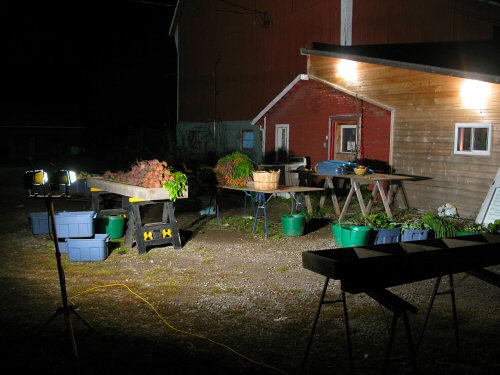
In the fall, post-harvest work doesn’t necessarily end when the sun goes down (it’s dark by about 7:30pm right now). Actually, this year the fall Friday harvest has gone great, with Lynn, Libby and usually Michelle knocking things off in the field by around 5pm, with only bundling and rinsing to go. But I’ve been wrapping up with the crew by 6, taking a break, and doing whatever’s left on my own…later at night. It’s something I’m used to from the first few seasons, when the mainly solo harvest usually went straight through until 11pm or midnight. Tonight was the first time I’ve hauled out the light stand this year. It’s around 10pm, the two lights specally installed on the side of the Milkhouse for this purpose are on (they’re both regular 100W bulbs, the full plan is to install floodlight fixtures), and there are twin 250W all-weather halogens on a stand. It’s not perfect lighting, but quite enough to get the job done without stumbling around. Tonight is a quick set-up to rinse carrots and beets. Full-on post harvest lighting includes a second light stand, with both set higher up and beaming down, and floodlights properly positioned, to give pretty good 360° coverage of the work area, and enough illumination to watch the mud wash off…
This week’s share
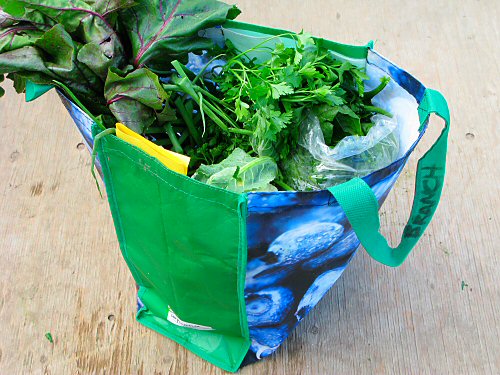
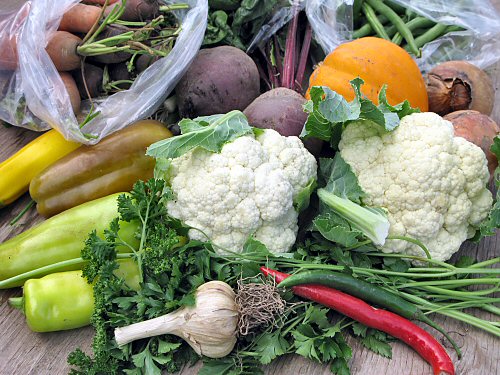
Another rather nice fall CSA share this week! Thanks to no killing frost so far, we’re still picking beans (Jade), peppers (Gypsy, Ace, Cayenne Long Slim), and zucchini (Golden Dawn III). There’s also winter squash (Table Gold acorn), cauliflower (Minuteman), onions (Stuttgarter), beets (Scarlet Supreme), carrots (Nelson, Purple Haze), spinach (Spargo, Bloomsdale), parsley (Green River curly, Plain Italian flat), and garlic (Music). Plus a newsletter. Monday shares are left at a drop-off spot, with shareholders’ names printed on the handles…
Friday harvests get quicker!
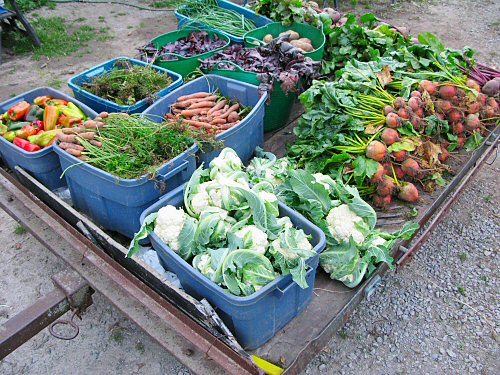
Friday harvests are getting quicker as the season winds down. This has happened at least for the last couple of years. Where earlier in the season, we finish around 8-9pm, we’re now mostly wrapped up by 5 or 6, and sometimes with less people than during the summer. I’m not quite sure why this happens. Probably, a big part of is that everyone out there in the field is now experienced and comfortably fast. Also, many of the crops in the weekly veg line-up are pre-harvested: garlic and onions first, and now, winter squash, pumpkins, potatoes and the new sweet potatoes. Still, it’s a pretty big harvest, and quantities are the same now as earlier in the year. Then there’s the shortening days—it’s starting to get dark around 7:30 pm now, down from 9:30 in late June-early July—and CHILLY WEATHER that likely speed us up! Anyhow, this is the most time I’ve spent wondering why—whatever the reasons, getting done quick is good! The trailer-load in the pic is about half of the day’s field haul, and there’s also the pre-harvested stuff. In this week’s harvest, in no particular order: carrots (2 varieties), cauliflower, beets (3 varieties), sweet peppers (several varieties), hot peppers (several varieties), green onions, spinach (2 varieties), summer squash (3 varieties), beans, tomato (several varieties), parsley, basil, all from the field, plus, pre-harvested, garlic, potatoes, winter squash (several varieties) and onions (2 varieties).