
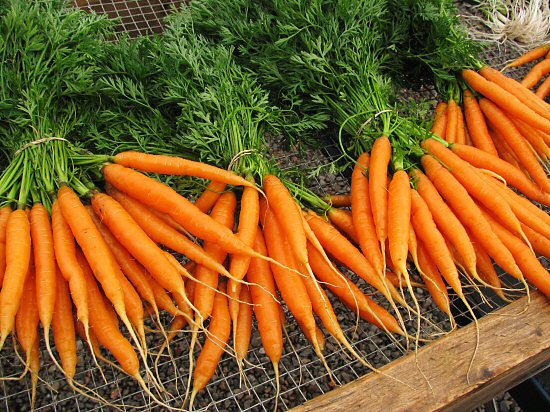
Just-rinsed carrots in the soft light of an overcast day: beautiful every time! Some veggies look particularly good without trying… These are freshly pulled Nelson, at a pretty fair size but not yet fully mature, from our fourth planting of the season. Every year so far, I’ve put in at least four, sometimes five plantings in succession, and we rarely see really fat, full-sized carrots. This has worked well for CSA and farmers’ market: our carrots are freshly harvested every week, never from storage, and at a versatile size, always perfect for eating raw and usually big enough for convenient cooking as well. Today’s haul, bundled and laid out for rinsing on the long screen table, will be heading into CSA share bags in just a minute, for pick-up this afternoon…
carrot
So it’s…colors!
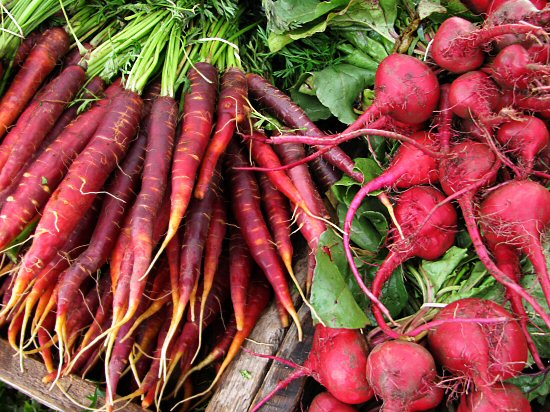
Cloudy, coolish weather continues, and the growing’s so slowwww… At the farmers’ market today, instead of all-new main season veggies, it’s kinda more of the same. No super-early tomatoes (Stupice!), not even BEANS (not even the super-early yellow wax beans…). But the root crops are doing well with the rain, and their colors are…refreshing. Here, purple Purple Haze carrots, and radish-red Chioggia beets, freshly misted, drenched with…color. That’s nice… :)
Baby veggies go to market
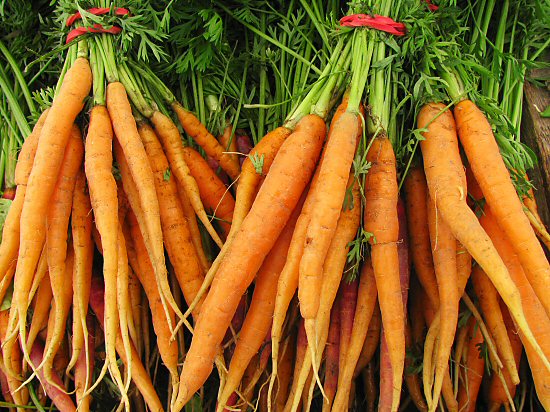
You can’t go wrong with baby carrots, it seems. They are, well, cute (I’ve heard people say that way more than once). So you can buy them and eat them, or maybe stick ’em in a clear vase full of water for a while (idea!)… In any case, these Nelson carrots are not only fun to look at, and small, they’re pretty tasty! Nice crunch, and good sweetness for summer. Because of the kinda slow-growth in this cloudy weather, we took the time to do a second carrot thinning, just to harvest these (often, at this point, they’d be bigger, and we’d start digging up whole rows).
Also along for the ride, and sold out quite early, baby beets, mostly the candy-striped Chioggia (below), with a few red Kestrel in there. And, a couple of varieties of lettuce, the super-red Granada oakleaf and the butterhead Kendo. Both have a strong, bold taste, able to hold their own in sandwiches or…anywhere else. Plus, not in sight, all-lettuce mesclun (well, baby leaf mix).
Along with the last of the Sugar Ann snap peas, that was it for a fairly rainy, kinda rained-out Saturday at the farmers’ market… Still, fun!
Carrot-burlap method gets a twist
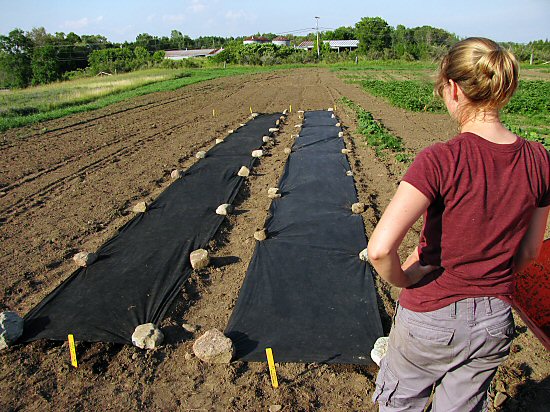
Here’s one of the more extreme displays of crazily labor-intensive tiny farming technique. Andie surveys our work, the result of deciding to try landscape fabric in place of burlap to help carrot seed germination. It’s actually a double experiment, because one of the beds is green onions.
The burlap method has been the way to start carrots around here for the last two seasons: tried and true. The main purpose is to preserve moisture in the seed drills, and the increase in heat helps as well.
After a good run, the first round of burlap expired, and I couldn’t find rolls of it in time for this season (I know it’s out there, somewhere). But, I spotted this gear, landscape fabric, a porous plastic mulch used to permanently suppress weeds in…landscaping. It’s light, and just wide enough (3’/30 cm) to cover 4 rows of carrots (that’s a little closer than usual for the bunching onions). I tried it on two beds earlier in the season, and it works fine!
One little problem: it tears easily, so how to hold it down? With the burlap, we made wire staples out of heavy gauge wire. Here, we placed a LOT of heavy rocks, close enough together that there’s no room for the wind to get under and start really pulling. This does the trick for now, but overall, it’s a little TOO intense. The hunt for burlap: still on!
Frozen chokes harvest
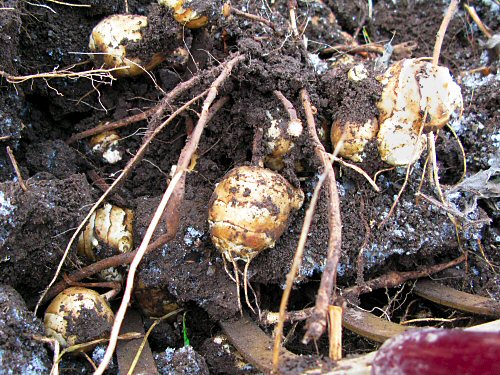
Despite the six inches (15cm) of snow on the big garden, fieldwork goes on. Today, I harvested about 30lbs (13.5kg) of Jerusalem artichoke out of the partially frozen ground, just to be sure planting stock is around over winter in case I need it. Since we don’t have a root cellar or walk-in cooler, storing crops in the ground as winter comes along is a risky but useful alternative. There’s still lots of carrot, parsnip, and some more chokes out there. Until the ground is frozen several inches or more down, it’s possible to harvest, although too much snow can make the whole thing a little crazy. Once thoroughly frozen, I’ve found carrots get killed off and thaw to mush, while parsnip and chokes withstand freezing just fine, staying alive and available again in spring. So far, though, everything’s still cool for digging. You can see the ice crystals in the frozen crust (above), but below that, it’s all cold, friable soil and plump, healthy choke tubers…
Snow carrot harvest
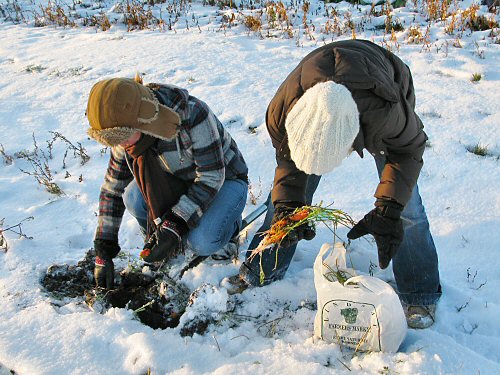
What’s a little snow when there’s crispy-sweet CARROTS buried under there? Lynn (the new Celebrity Farmer) and Raechelle headed up the field late this subzero afternoon, digging forks in hand, and scored sackfuls of Nelson and Napoli, no problem. It’s been well below zero (32°F) recent nights, and for the last couple of days as well, but the ground isn’t nearly frozen, and the layer of snow, fresh from overnight, actually acts as an insulator and helps soften it up. For now… The season’s not over until we SAY it’s over… :)
The snow-on-veggies effect…
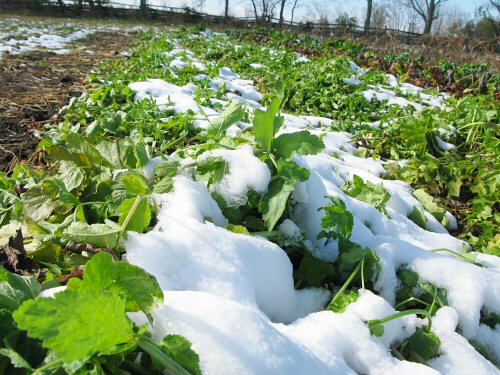
The sun was out today, and although it wasn’t too warm (about 5°C/40°F), most of yesterday’s snow melted off pretty quickly. On the remaining crops—brassicas, carrots, some herbs, and parsnips (above)—the brief overnight blanketing of snow did what several nights of sub-zero weather hadn’t managed, wilting them down without killing them off. It’s interesting to watch the accumulating effects of cold on hardy crops. Tastes and textures change, different veggies behave…differently. I don’t imagine this is somethig that veggie growers and gardeners generally explore as the season ends: crops are harvested or tilled under, and that’s that. Here, though, there is no giant cooler for long-term cold storage, and I try not to waste, so the field is the best place to hold crops as people continue to drop by for the last of the season’s fresh veg! Meanwhile, it’s cool to watch the cold effects and learn…