
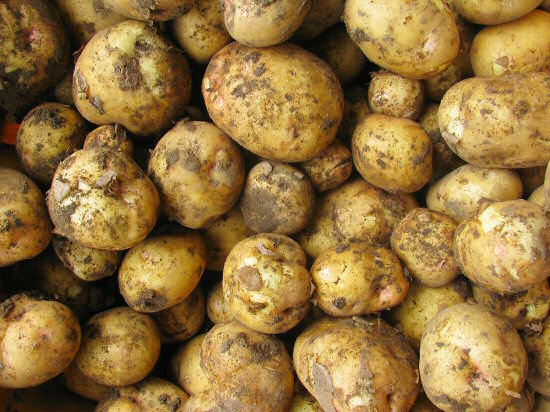
Dug up 40 lbs of Yukon Gold potatoes, to see how they were doing, and for this week’s harvest shares. Not a bad haul for 50′, planted late, at the end of June, but they still have some growing to do. We’re harvesting spuds in our usual labor-intensive way, with a digging fork, then scrabbling around by hand. Slow but fun. One drawback: with newer potatoes, scraping, prying fingers can tear up those delicate skins. Here, we did pretty well.
labor-intensive
Potato digging party
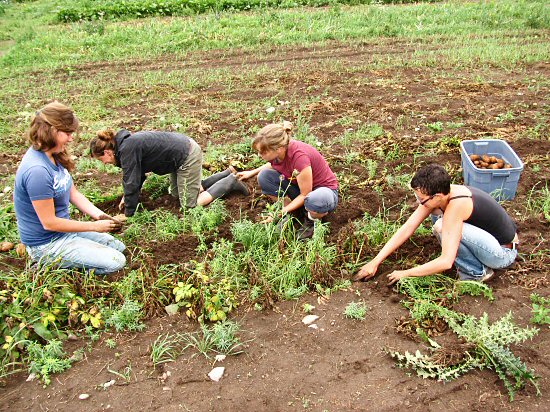
It’ll be hard to top THIS one for extremely labor-intensive tiny farming involving lots of peeps! Here, Libby, Lynn, Andie, and Mel hand-dig potatoes for tomorrow’s farmers’ market. The taters happen to be Gold Rush russets, and they’re in fine form, with a little wireworm damage (surface blemishes or tiny holes) to only a few. We’re right at the end of the first (of three) potato areas of this year, 600′ (183 m), evenly divided between Penta, Chieftan and Gold Rush.
So, what’s with all these people, digging together in a cluster, with just one bin? A little inefficient, pehaps? Well, not really. When there’s a lot of folks happy to mix it up with the dirt, tackling a single task all together can work out! We only needed about 70 lbs of each variety (that blue bin full). With the moist-but-not-mucky soil, pulling plants and scrabbling around was quick and easy. BIG POTATOES helped. Working close together wasn’t a problem because we had so little area to cover. Each bin got filled in maybe 15 minutes. Satisfying!
In the photo, you can also see how relatively good shape we’re in with weeds. The bit of grass growing back is in separate clumps, all the runners haven’t started to reach out and hook up. Further up is a section of more heavily overgrown onions. But that’s actually doing well as well: the onions were thoroughly weeded twice, and hoed a couple more times, so what you see is mainly grass from the last three weeks (without much shading out from the onion plants, everything else grows fast!).
Anyhow, when we tackle the main potato patch, around 2,000′ (609 m), methods will change. But we’ll still be digging in the dirt…!
Working the new potatoes
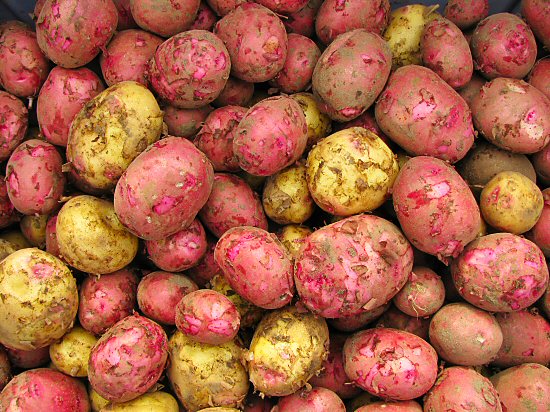
Another installment in the crazily labor-intensive tiny farming techniques series: Andie and Jordan in action, hand-digging for new potatoes without uprooting the plants! This one is hard to top for stunningly low hours-to-yield ratio. It makes picking peas and beans seem like something that goes by quick. Of course, for all its slowness, it has its rewards: beautiful little, amazingly fresh and tasty, new potatoes…and the plants still get to grow some more! Plus, if you don’t have to do it forever, it’s a lot of fun…
The “technique” is simple (and well-suited to the home veggie garden, but not too scalable). Gently feel around the base of the plant for anything that’s golf ball-sized or bigger (this batch is golf ball to XL egg). Stick to the surface, don’t dig too deep, and try not to break the single roots connected to other, littler, potatoes (you’ll easily feel the stringy roots). When you’re done, hill up the earth you’ve moved aside, and it’s on to the next one. That’s our method. ;)
Yield today was pretty good, about 2-3 per plant, and about 40 lbs (18kg) in all. Won’t go into the time per plant and the weight per tater…because I didn’t. Maybe a peaceful hour or so, with three people. We only did this for a CSA share treat, because today it worked out that we had the time. There are red skin/white flesh Chieftan, and yellow-flesh, Yukon Gold-like Penta.
The only downside to the hand scrabbling method: the delicious, delicate skins get quite roughed up. We’ll soon start pulling whole plants for young potatoes, and that tends to leave the skins in better shape (and goes MUCH faster).
Anyhow, slow food, for sure. Tasty!
Carrot-burlap method gets a twist
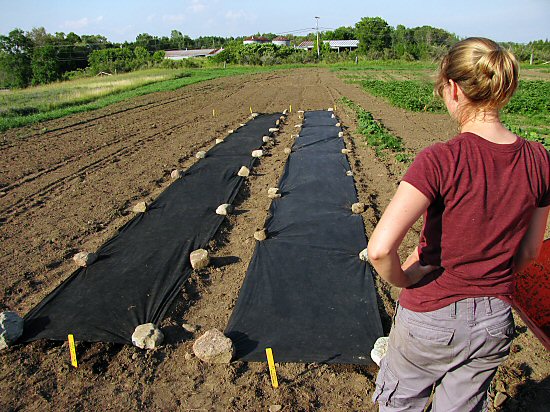
Here’s one of the more extreme displays of crazily labor-intensive tiny farming technique. Andie surveys our work, the result of deciding to try landscape fabric in place of burlap to help carrot seed germination. It’s actually a double experiment, because one of the beds is green onions.
The burlap method has been the way to start carrots around here for the last two seasons: tried and true. The main purpose is to preserve moisture in the seed drills, and the increase in heat helps as well.
After a good run, the first round of burlap expired, and I couldn’t find rolls of it in time for this season (I know it’s out there, somewhere). But, I spotted this gear, landscape fabric, a porous plastic mulch used to permanently suppress weeds in…landscaping. It’s light, and just wide enough (3’/30 cm) to cover 4 rows of carrots (that’s a little closer than usual for the bunching onions). I tried it on two beds earlier in the season, and it works fine!
One little problem: it tears easily, so how to hold it down? With the burlap, we made wire staples out of heavy gauge wire. Here, we placed a LOT of heavy rocks, close enough together that there’s no room for the wind to get under and start really pulling. This does the trick for now, but overall, it’s a little TOO intense. The hunt for burlap: still on!