
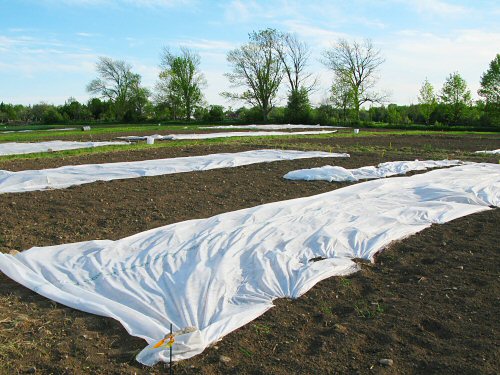
It was impossible to capture all the floating row cover outposts scattered around the feel in just one shot. This pic shows maybe a third of the area under the light, white, spunbond polyester protection. Right now, it’s being used as protection from two separate things: frost and bugs. Let’s see, it’s on all the cucurbits (so far, that’s cucumber, summer and winter squash, and pumpkin) to protect from the cold and striped cucumber beetles, on tomatoes against cold (and coming off in a few days), on the brassicas (broccoli, cauliflower, and the like) against ravaging flea beetles but not the cold (coming off when the plants are fairly big and can withstand the FBs). I’ve used row cover from Year 1, far as I can remember (there are NOTES and even pics…somewhere). Initially, I really didn’t like it, it looked so…unearthy, synthetic,…not part of the garden. BUT, the alternatives, like planting later, ending harvest earlier in fall, temporary wind breaks and cold air channels, trap crops, and all sorts of complex interplanting (so one crop protects another), encouraging beneficial insects, more elaborate timing (basically, closer second guessing of insect cycles and the weather), not to mention a completely adapted, semi-permaculture set-up where everything is at home no matter what, were all way out of what I could handle as I dove into tiny farming with the intention of heading to the farmers’ market in the first season. Floating row cover lets me extend the season by at least a couple of weeks at each and, and I can avoid all pesticides (and there are some killer insecticides allowed even in certified organics) and a lot of bug grief (stemming from lots of LOSS). I still don’t really LIKE row cover, though, the way I like, say, my Sneeboer three-tine cultivator or even the Horse rototiller (I can understand how the Horse is built, get if fixed, or do without). More and more lately, I wonder when FRC will become insanely expensive, or real scarce, or just plain run out… It’s as oil-based as they come, and kind of in a high tech product class of its own. This year, in a small fit of…paranoia (?), I actually ordered a new 1,000’x14′ (300mx4.3m) roll, even though I have enough for this season at least. It’s not much of a stockpile, but, carefully managed, it could get me through 3-4 more years along with what’s on hand, at this tiny farming scale… Oh, well, the more you know, the less you need is what I believe. I’m learning as I go. Keep farming long enough, and I’m sure I’ll get beyond the cover if it doesn’t run out on me first…! :)
row cover
Tender to the greenhouse
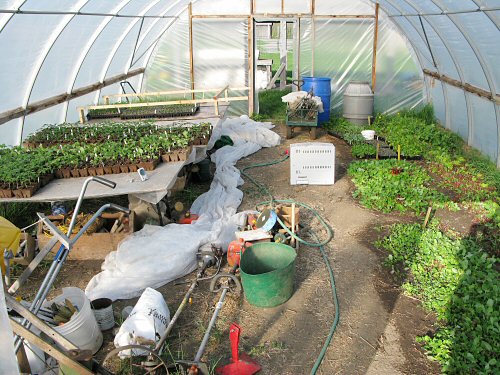
Moved the first wave of tender seedlings—100 tomatoes, plus eggplant and sweet peppers—to the greenhouse yesterday, with zero (32°F) predicted for the overnight. There’s just no more waiting, with all of the light space in the Milkhouse…taken. It’s a long way from the ambitious barely-heated greenhouse plan of February, but there’s row cover, and the new KeroWorld heater is ready for action (it’s the white box in the middle)… That’s how some plans go when you’re dealing with the WEATHER. Elsewhere in the hoophouse, I’ve let the early lettuce and mesclun blend with volunteer lettuce and arugula from last year’s early stuff going to seed. It’s unruly, tasty, and growing fast. I don’t know how much of it will make it to the farmers’ market: since there’s too much to do around here, I’m not aiming to go extra early this year (yesterday was the first market day), but one way or another, the greenhouse greens will get eaten!
Arugula under cover
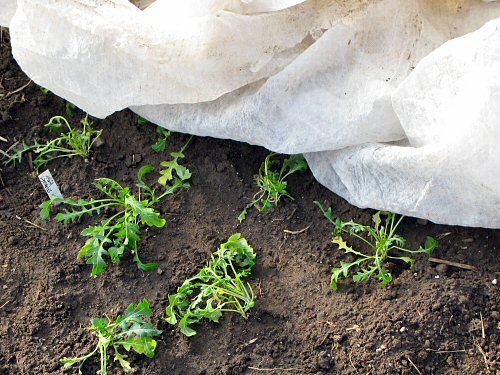
Last night, the greenhouse low was a chilly 5°F (-15°C): the arugula, spending nights under 3-4 layers of floating row cover, still seems to be doing fine. Especially with more extreme transplants like this—a long time in the plug sheet, then an abrupt jump to the harsh greenhouse conditions—there’s a critical period of a few days, waiting for the stressed little plants to settle in. Cover at night, uncover in the morning, till the weather warms up…
Assessing greenhouse clean-up
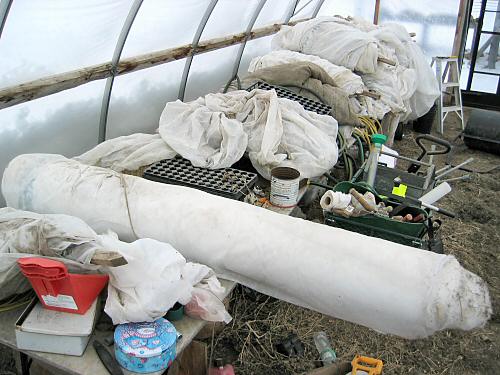
The greenhouse is small, and the layout hasn’t really changed in its three full seasons. A row of tables on the north side are where the seedlings go. On the south side, unshaded by the tables, is an open strip, about 8’x32′ (2.4x9m), where I pursue ever earlier lettuce, trying to have something for the very first farmers’ market of the year (it’s the first Saturday in May; last year’s second Saturday is the earliest so far). It’s a simple set-up. Still, every year, there’s one day when I head out there to assess the clean-up requirements and plan what to do. This year, today was that day. A lot of different gear gets stored on and under the tables. It varies each year. Here, it’s mostly floating row cover, kept up off the ground because, apparently, voles don’t like to climb (voles gnawed a hole through a good part of a roll one year…very annoying, imagine unrolling a neat row of ragged holes). Exposure to UV from the sun is not good for plastics particularly, and I do store most things in the drive shed, or the Milkhouse and barn, or under the tables, but things do get left out… Anyhow, this year’s action plan is settled: clean up!
Cleaning up
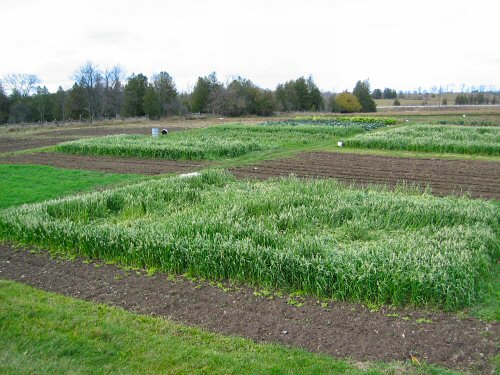
Here’s a look to the north from my new favorite photo spot, on top of the farm stand. We’re down to mainly brassicas, oats and rye (that’s the low, darker green section poking in on the left). The oats has started to die off and topple over, leaving collapsed areas that look as if animals had bedded down… The days lately have mainly been overcast and quite cold, just above 0°F, with a fair bit of rain that leaves the ground mucky. My hours a day spent in the field are winding down, a two or three hour job at a time, weather permitting. Elsewhere, there’s lots of putting in order and stowing away, and clean-up in the Extended Milkhouse where all kinds of junk accumulates over the year. Getting set for winter.
Turn to the left and here’s the view over the greenhouse. The grass-alfalfa mulch is still inside, along with stacked rolls of row cover.
Killing frost, kinda
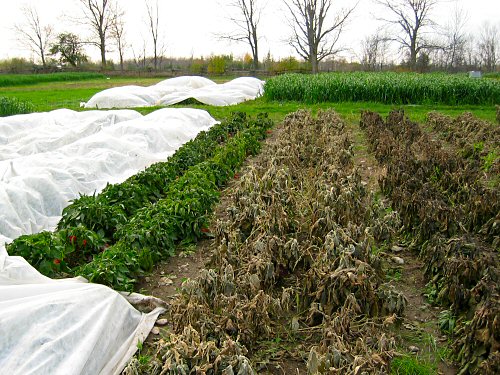
Yes, the weather’s crazy. According to the min/max thermometer outside the greenhouse, last night’s low was a chilly 18°F (-8°C), cold enough to kill off all but the hardiest. Finally, and only six weeks or so late—the endless autumn harvest is interesting, great for personal use veggies, but otherwise, it mainly throws off the fall clean-up schedule (I haven’t changed zones, have I?!). Here, the eggplant is clearly toasted, while the peppers, which had been under fairly light row cover (I pulled it back today to harvest some), came through in relatively fine shape . And the oats, well, it’s a monster, lush and green and if not exactly growing anymore, it seems to be getting thicker. It’s fascinating the way cold works in the field. Wind, cloud cover, mini-windbreaks, slight elevation, all kinds of factors add up differently in spots only a few feet apart to determine life or death by cold. Anyhow, can’t wait around forever. I’m soon going to roll up the row cover and till it all down!
Frost protection
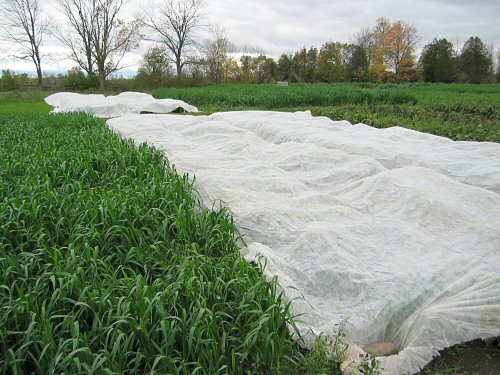
With last night’s forecast calling for -3°C, I finally figured a little floating row cover frost protection might be a good idea. In fact, though, with the cloudy, windy, wet conditions right through to Saturday evening, a solid freeze didn’t seem all that likely. And that turned out to be the case. The min/max thermometer outside the greenhouse registered a low of -5°C, but only a few crops suffered minor damage. Even the basil, which is really tender, did well: the top layer of leaves took one for the team, but the rest were fine. Here, some sweet pepper plants sit under cover, but the forecast for the next week is…quite warm. When exactly does the season end?