Tiny harvest!

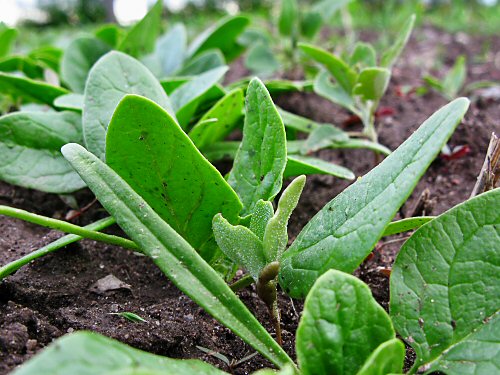
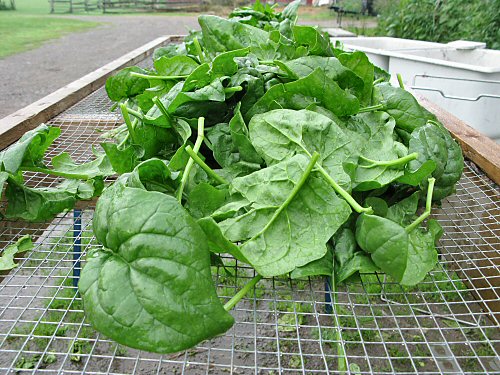
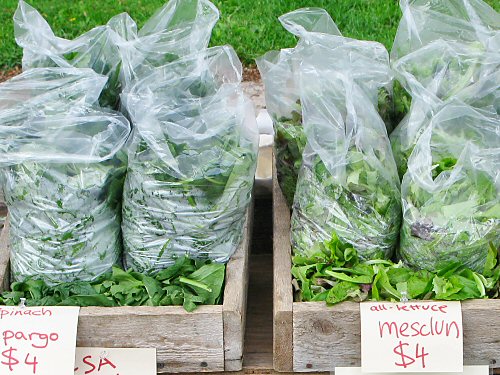
Spent the early morning harvesting a few CSA shares for a Monday drop-off. This is the first week of shares, and they’re still small, mainly greens… There are many tiny farming routines, things you’d probably never do in a bigger operation, that I find extremely relaxing and fun: the final rinsing and putting together of a handful of shares is one of them (it’s not really economical to separately harvest and drop off less than 10 shares or so, this is an…exception). There’s something deeply satisfying about this final post-harvest step, with the veggies together at their finest, the memory of the different quick individual harvests—picking, cutting, pulling—still fresh, that’s…cool! The spinach (above) was quickly dunked in cold well water to rinse off dirt splashed up from recent rain, then allowed to drip dry for a bit on the screen table.

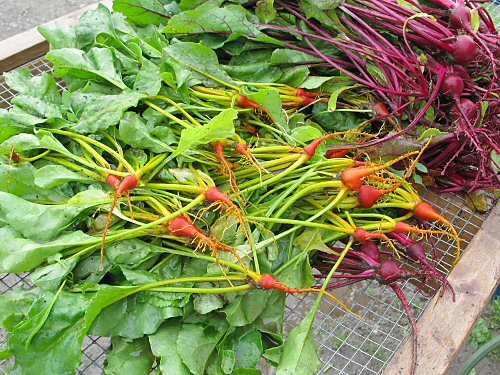
Picked two types of beet greens, Golden Detroit and Scarlet Supreme. The stems are a little long on these—it all depends on the density of the rows, the weather, the harvest timing, leaf size is the luck of the draw since these are really thinnings, they’re not being grown just for the greens. Still young and tender, the baby beets and all can be cooked up, or the leaves used raw in salad (or as a salad!). Really tasty…

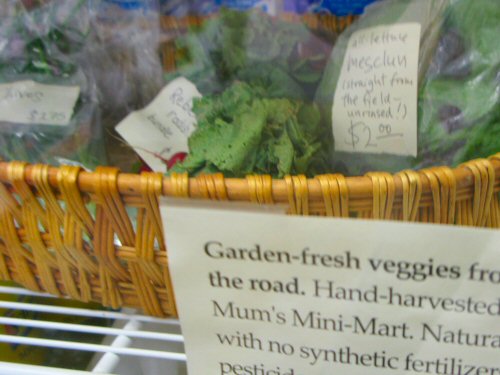
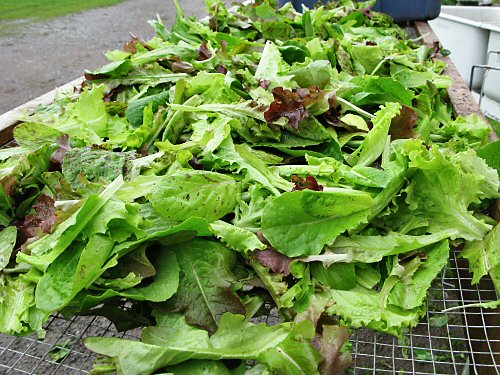
And mesclun, of course. This all-lettuce salad mix is a staple crop this year as usual, always on my mind! This cut’s nice and clean! Unrinsed—I let the morning dew dry off a bit on the screen table… More simple pleasures for the simple of mind! ;)
Plastic…fantastic?

At the market today, greens were finally in great supply, with loads of mesclun and spinach: two giant, clear leaf bags full of each. I went home with quite a bit—no sold out sign this week!—which was great, ’cause I was selling right up to the end. And, as usual, I noticed all of the disposable plastic involved…

Greens, and market/CSA share harvests in general, usually involve lots of PLASTIC BAGS. In the beginning, this didn’t overly concern me on any level, other than that buying bags by the hundreds and thousands was kinda costly. But being on the dispensing side of this steady stream of plastic gradually made me realize how much of it is continuously being tossed out there FOR NO LASTING PURPOSE.

What got to me first wasn’t the environmental issue, but the fact that people were profiting off of this useless mass consumer habit of taking tons of “free” bags at every stop… Don’t like being fooled again and again… This culminated in one way for me about two years ago, when I stopped taking shopping bags for, like, 98% of my store shopping. Last year, I started cutting down on the way I offer shopping bags at the market: instead of automatically grabbing a bag for a customer as I asked if they needed one, I ask in a  leading way, kinda eying what they’re carrying already—not surprisingly, with all of the anti-plastic bag attention lately, the majority of people so far this year bring a basket or cart, or fit their purchases into a bag they already have.

I mean, to grow greens, it takes 40-60 days of watching, watering, weeding…and suddenly, in less than 24 hours, they’re harvested, bagged, distributed, and, hopefully, within another 2-3 days, EATEN. And the really useful life of the plastic in a bag of fresh-market greens is more like a very few hours, because once you’ve gotten your greens home, there are many more efficient ways to refrigerate them (like in a nice cotton bag, in a salad spinner, in a big bin,…). But there’s nothing that easily replaces the convenience of plastic for that last little trip between stand and home (a couple of people have asked that everything, greens and all, be tossed loose into their own shopping tote, which is kinda cool and should work no problem, but doesn’t sound too easy to encourage amongst ALL…).

So what am I getting at exactly, besides the OBVIOUS? Well, I guess it’s that plastic is curiously useful stuff, I’m not about to outright REJECT it in all its many handy shapes and forms, but I should learn more about it for a start… More as it unfolds! ;)

Finally, a field harvest…

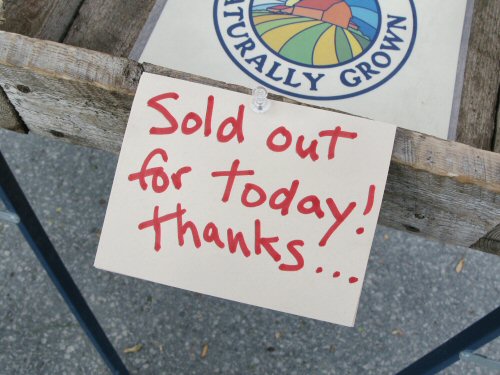
Finally, this year’s field-planted all-lettuce mesclun and spinach were ready for harvest, and that’s all I brought in to the farmers’ market, but in decent quantity. Unfortunately, I still underestimated and was sold out by 10:30 (the market runs 7:00am-1pm). It kinda looks good, being sold out, but really, if you’re doing things right at the market, you want to go home with a very little bit left over. That means you’ve brought enough for everyone who comes by, and have enough to display more than the last one or two of each veggie—it’s a pretty tried-and-true rule that selling the last of anything is harder, one of the few rules that seem useful to me. Overall, I don’t give much thought to sales tactics: with really fresh, high quality veggies, clean presentation, and a (genuinely) cheerful, helpful presence, word of mouth should do the rest. But making the food look attractive I think is a pretty basic part of food enjoyment and…celebration, and having enough for an inviting display right till the market ends is part of that. Of course, selling all you can is another part…the farm may be tiny, but there are still things to buy and normal-sized bills to pay! ;)

Veggie Outpost 2

Last year, a little experiment with veggie sales in a town 12 miles (19km) away didn’t go so well. I guess you could sum it up as No Quality Control. This year, in line with the tiny farming trick of thinking SMALLER, I had the sudden idea to put some veggies in at the convenience store three minutes down the road in the village. This is now the only store for quite a ways around, and it has the post office where everyone in the village picks up their mail. Since I’m always meaning to get the farm stand fully open, putting veggies out a couple of minutes away hadn’t quite made sense, but the way it came to mind now was a little different. If I could get a single shelf in one of the coolers, this would be an interesting, easy way to learn about veggies and refrigeration, and even be able to watch a mini version of the supermarket, convenience-shopping experience, by seeing what sells, the effects of labels and pricing, and…whatnot. All on the most casual level. Refrigeration is, of course, yet another of those many worrisome topics that come up along with Peak Oil and the generally somewhat alarming state of the world, BUT, fridges will likely be around as long as any number of other taken-for-granted things, I figure, so whatever’s learned from a little, low-impact experiment like this should be worth it. It’s an extremely simple set-up, with a small sign taped to the inside of the cooler door, hand-labeled bags, and an honor-system account book for inventory. I also like the idea of super-fresh garden veggies popping up in this most unlikely place, just below the shelf where a few supermarket-purchased veggies are kept for resale. Outpost 2, the Shelf, has been open for around three weeks now, stocked with ones and twos of mesclun and spinach, a few radishes, some herbs. I’m by there every day anyway, so I check the veggie condition often…and things are selling… Interesting enough…!

Farmers’ market: Day 2

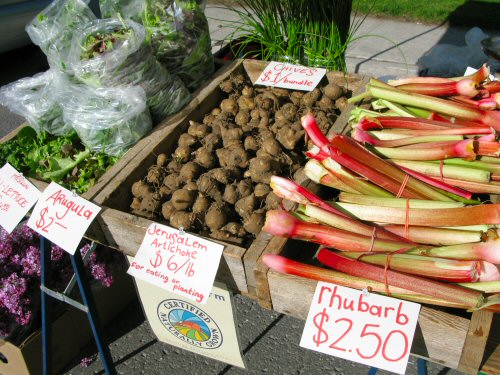
Really fine weather for our second market day of the season: sunshine, warmth, a pleasant breeze…! A bit more variety than last week, with all-lettuce mesclun, spinach, arugula, Jerusalem artichoke, chives and rhubarb, but still not much quantity of anything. We were sold out by around 10 a.m. Hanging below the chokes bin is the “Certified Naturally Grown” sign. It’s a new certification this year, in addition to our “certified organic” status. Naturally Grown is a grassroots, farmer-to-farmer program, started in the USA, and entirely voluntary and at no charge, where farmers’ certify other farmers according to essentially the same production standards as the government-regulated organic program. Instead of a lot of paperwork and fees, it’s simple and straightforward, but of course the legal word “organic” can’t be used, so it’s…”naturally grown” instead. Since there are only a couple of other NG farms in Ontario, and none close by, the inspection for this tiny farm will be done by CSA members. I’m still maintaining regular organic certification, but for what we’re doing, selling local food direct to people, Naturally Grown makes most sense to me…

Found: chives, spinach, rhubarb…

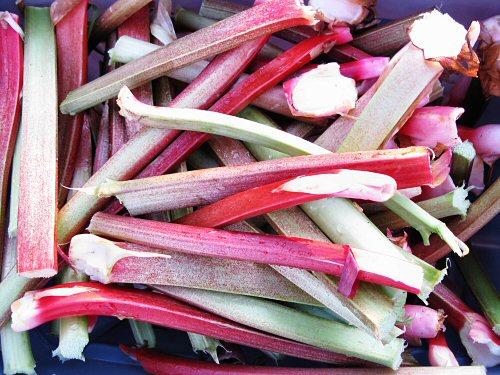
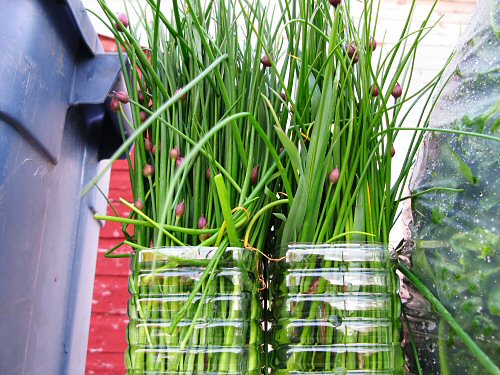
Harvest for the second farmers’ market of the season was OK, but still what I think of as kinda found crops. There’s the first market harvest ever of rhubarb, a binful (20 bundles or so) from the fairly giant patch (about 60 divisions) planted three years ago—kinda stubby, compared to the more sheltered rhubarb behind the farmhouse, but tasty all the same. There’s also 15 lbs (6.8kg) of all-lettuce mesclun from the greenhouse, around 10lbs (4.5kg) of new-growth spinach from a few beds planted last fall, 15 pounds of Jerusalem artichoke, some chives, overwintered and in full return in the herb garden, and a few bags of arugula. Enough to keep our hand in at the market, but I’m really waiting on new stuff from the field…!

Slow…

When you look back at last May on this tiny farm, overall, the state of the field isn’t all that different, BUT, the really cool nights for much of the month have slowed growth noticeably. Compare the first planting of spinach today, to the near ready crop of a week earlier last season. It’s the same for mesclun, beets, and chard. Snap beans are taking forever to germinate. And so forth. We’ll definitely be going to market at least a week later with the first field spinach and lettuce. Oh well, with all of the different crops going, bad weather for some benefiting others, it’ll overall catch up and more or less even out, I’m sure. It just about always does…