
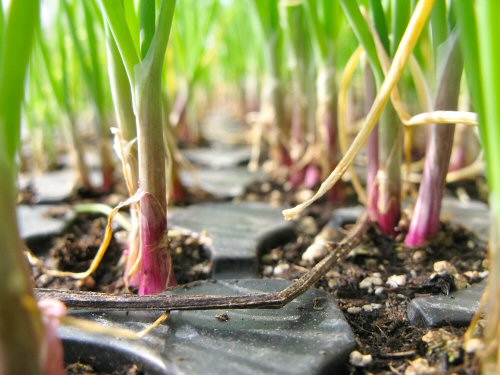
A last tray of onions—Red Wing hybrid red onions that did well last year—is hanging around the seedling room. What are they doing still not in the ground? Well, most of our onions—Stuttgarter-type yellow cooking, yellow Spanish, Red Wing, around 3,o00 in all—are already planted, in two sections, far apart. As I jigsawed together this season’s garden layout (now with the garden MAP), these guys just didn’t fit in the first two onion plots. So, they’ll get a bed of their own, somewhere, real soon, and we’ll see how they do compared to the others. Timing!
seedlings
Hardening off continues
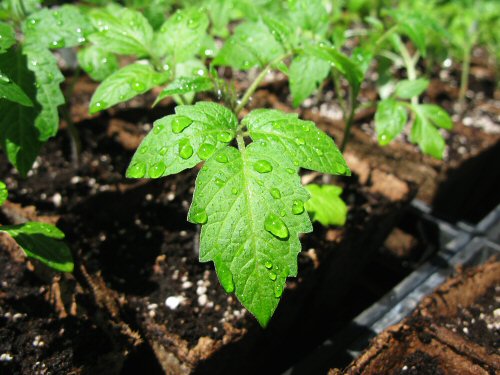
Ferrying 60 trays of seedlings in and out of the seedling room continues. When you focus up close on a lush green tomato leaf, decked out in droplets after a gentle hand watering, everything seems peaceful and orderly on the tiny farm. This is not untrue, but it’s also pretty crazy around here with the MANY THINGS TO DO. One more rainy stretch in the next few days, then heat and sun are in the longer range forecast—looks like our big gift for spring, free irrigation via regular rain, will soon run out, so WATER in the field is next on the gotta-get-it-running list. As May rapidly unfolds, it’s all about the To-Do-Now!
Transplanting team…
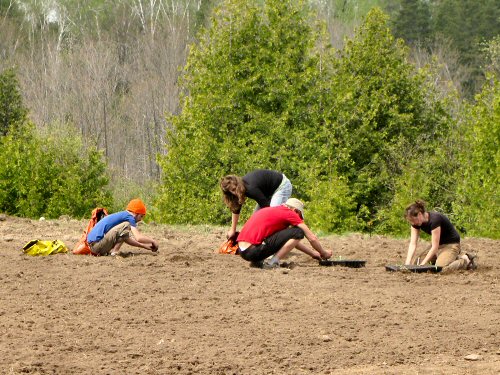
Another big Friday showing of people in the field: Chris, Libby, Jordan and Lynn transplant broccoli and cauliflower, while Andie is on a solo rototilling mission in the other field. Later, everyone got together to plant a few hundred onion seedlings and sets. And some other stuff got done.
Although we’re in the thick of it as far as timing and weather and urgency to get things out, our spring schedule is slower than it could be, and the field days are so far fairly laid back. Slowing things down is the start-up stuff: a ton of tillage to do (working in the grassy remnants of last year’s hay field), water for irrigation to put in place, electricity to run, chickenhouse to build, and a long list of other basic things that we have to put in place along with starting the season’s crops. Getting it all rolling together on this new farm, now that’s fairly intense!
Spot the tiny farm!
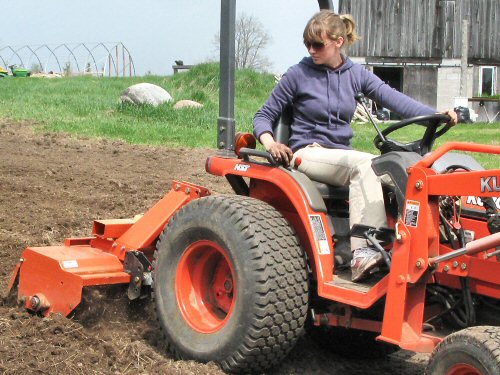
What’s in a photo? Depends what you’re looking for! Take this pic of Andie, rototilling today with the Kubota. Pretty straightforward: woman, machine, field. BUT, can you spot practically EVERY main part of a really tiny farm (at least, of this one), represented right here?
It’s mostly hand work, but there’s some gear: Of course, we have the Kubota compact tractor, flagship of an motley assortment of gear specifically suited to tiny farming. It’s rugged, very much a diesel TRACTOR, but small, and designed more for the big estate crowd than agriculture. Around here, though, it’s the workhorse machine, a people multiplier with its bucket and essential 48″ rototiller. As far as I know, rototillers aren’t core gear on tractor farms, but it’s our ONLY field implement so far, a huge labor-saver over walking up and down with the walking rototiller, or digging by hand. And the turf tires seem to work just fine.
New people diving in: And then there’s Andie, doing (tiny) tractor work within the first few hours of her entire market garden experience. (It’s cool that she’s already looking over her right shoulder, it’s a classic tractor farming pose—except maybe not with GPS?) She also has DIRTY HANDS on the wheel, from checking out the tilling results, and they’ll stay dirty as she moves off the tractor in a few minutes, on to hands and knees to plant onions.
A big shed (aka barn): A barn of some sort is the main, sooner-or-later essential, working structure that separates clear land from a working tiny farm. Really, a basic barn is just a big, all-purpose shed (this one, 20’x32′, is pretty tiny, just four walls), for getting things out of the weather. You use it to store harvests and gear, and to work out of the wind and rain (and of course, we have winter). With rough carpentry, you remodel and reconfigure it to fit: an extra hook here, new door there, closed off room in a corner, whatever you need!
Lots of work, all day long: Elsewhere in the pic, less obvious but clear signs of tiny, labor-intensive veggie growing. In front of the barn, tables of seedlings are hardening off. They’re brought out in the morning, taken in at night, back and forth, back and forth. That’s because the greenhouse (hoophouse frame on the left) isn’t finished yet. And THAT’s because there is just SO MUCH TO DO ALL AT ONCE. Like, mow the grass for mulch, before it gets outta control. And get a new battery for the John Deere riding mower (on the top left), so it can haul around the trailer loaded with whatever we need to get LOTS MORE STUFF done. It all weaves into one big picture of tiny, simple, interdependent tasks that go on and on and on, all day long…
It can get a little intense, but it’s also really fun, if you don’t get all grim and serious about it and try to tie in the state of the entire planet (try to stop following the news!). You get to pretty much see where you’re going. Meet people in a really interesting way. Eat well. Sleep well. Kinda…simple! I think that’s a pretty good start…
Seedlings queue up
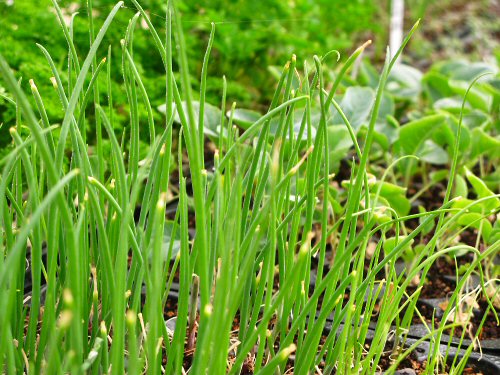
It’s a jumble of seedlings around the seedling room, inside and out. Actually, it looks like a good part of the entire market garden, neatly in miniature, lined up in trays… Due to a pile of one-thing-waiting-on-another (for example, we have to run electricity for the fan that inflates the two layers of covering), the greenhouse is STILL not refit with its plastic, so the fallback plan is ferrying the seedlings out to tables—4×8 plywood on sawhorses—in the morning, and back in at night (when it’s still as often as not hovering around freezing).
Hardening off! All that daily moving is a bit of a pain, but they have to come in at night. In the hoophouse, without wind, it’d be a lot easier to row cover, and we could apply a minimum of overnight heat with the kerosene heater (or propane space heater). Outside is too much of a risk, particularly for the tomatoes, peppers, eggplant, squash,… Moving takes a total of maybe an hour a day, around 60 trays in all. (And the upside: it’s always cool to see backup plans work! :)
In the pic, the last of the onions from seed, plus cauliflower, parsley, and summer squash just germinating in the distance. Waiting to go…!
Red cabbage
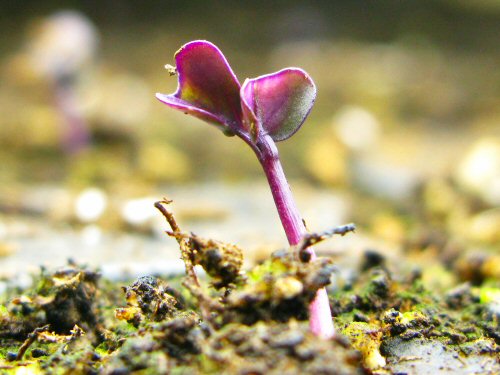
Besides the older seedlings, clamoring to get out, we’ve been starting new guys as well, for later planting. Here, a few days after emerging, a baby Cairo (hybrid) red cabbage, for crowded growing (12″ spacing), to produce “baby,” “gourmet” cabbages—basically, small ones! Elsewhere, Brussels sprouts, savoy cabbage, bok choi, and more. And it’s time for a second set of broccoli and cauliflower, to follow up the first wave. In our short May-September main growing season, now’s the time… Tick-tock!
Jostling tomatoes
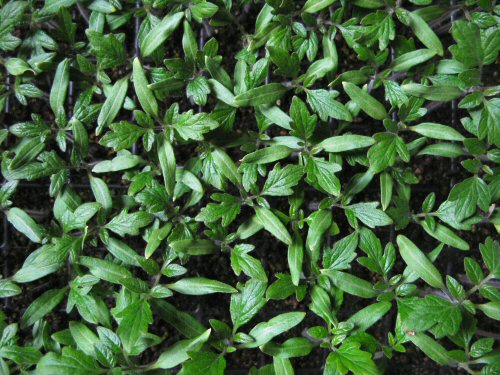
Tomatoes that appeared in their 200-cell trays only a couple of weeks ago are already competing hard (using the old let-my-leaves-overlap-yours tactic) with their neighbors, fighting for a place under the fluorescent sun. A month ago, every seedling looked like a little miracle to be celebrated. Today, they’re an insistent, unrelenting horde, pressing for better conditions NOW. The timing pressure is starting to mount, with the greenhouse to finish and field preparation (aka sod-busting) ongoing. The calendar is getting ready to flip a page, and the 15-day temperature forecast is pointing UP. At this point, after the long wait of winter, and the slow ease into spring, everything suddenly moves so FAST. Remain calm! :)