
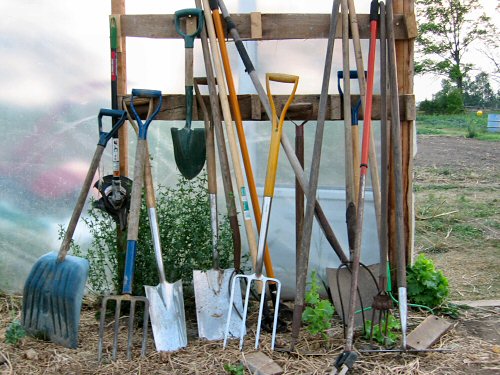
The quick hand tool reorganization in May has worked out well, with everything staying sorted and easy to find. Oddly this year, the hand tools themselves seem to be getting less of a workout than in the past. It only struck me today, kinda strange, so I gave it some thought. Forks are still used regularly for harvest digging, rakes for finishing off beds for seeding, but the various hoes, usually grabbed daily, have in great part been replaced by the wheel hoe! Even the Horse rototiller is getting noticeably less work. Cool. The wheel hoe has proven, as expected, to be a brilliant tool. Saves countless hours, makes tedious jobs fun. Don’t market garden without it!
Summer
Row cover mystery
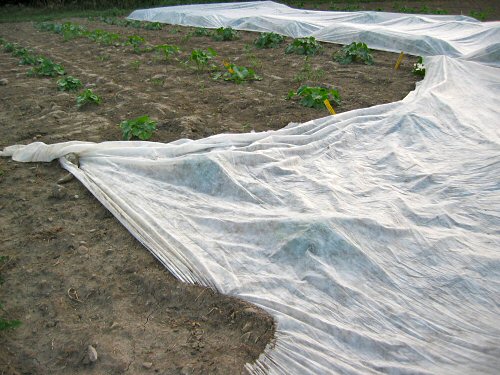
Odd bits of strange, unexplained phenomena turn up in the field from time to time, nothing to get overly excited about, but definitely weird stuff, like this case of mysteriously removed row cover. Earlier in the day, I noticed the cover on one section of risk crop squash was off, thought Conall had removed it, but found when I walked over that about two-thirds of the 50′ (15m) sheet had been ripped off, and lay, bunched up, about 10′ away. In the pic, you can see the remaining piece, perfectly in place, and above it, an adjoining covered row that hasn’t been disturbed in the least. The cover is 14′ wide, and while not hard to tear, isn’t easily sheared right across like that. There’s been no heavy wind in the last few days. There are no footprints or animal tracks in the bed. How did this 35’x14′ section of row cover, anchored by burying the edges every few feet, and with heavy rocks at the corners, manage to detach so cleanly?! It’s a mystery!
Turning to corn…
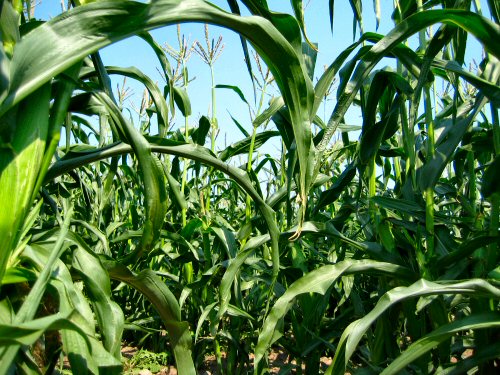
Attention turns to corn. Disproportionately lots of attention, as we prepare for the annual battle of wills and technology with the coons. It’s solar-powered electric fence versus opposable thumbs… Earlivee, the first of two small (50’x50′) plantings, made an impressive leap upwards over the last few days, and now looks set to deliver! Once previously with the super-early 57-day Earlivee and dry conditions, the corn remained stunted, only about 3-4′ high, and produced ears so small they were hardly worth munching. This time around, it’s jumped into the usual 5′-6′ range and the ears are filling out. From one delicately torn back and slightly nibbled ear, I think the early raccoon scouting has already begun.
Peppers…
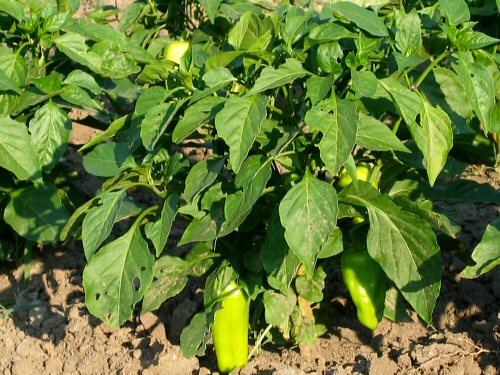
It’s all joy with the peppers (and eggplant). Here, Gypsy sweet peppers put on size and begin to peek out. In the past, these two crops barely made it in, if at all. I planted the varieties, but for eggplant, only the very early Dusky produced satisfying yields toward the end of summer, and peppers made it in decent quantity last year because of the freakishly extended warm weather that went into October. The reason is no mystery: doing the transplanting mostly alone, I’d get to peppers and eggplant last (they’re not prime farmers’ market sellers); this year, they got a good week or more head start. So we have the fruit of extra labor (and pretty good pepper-growing weather)—straightforward and…satisfying!
The end of July
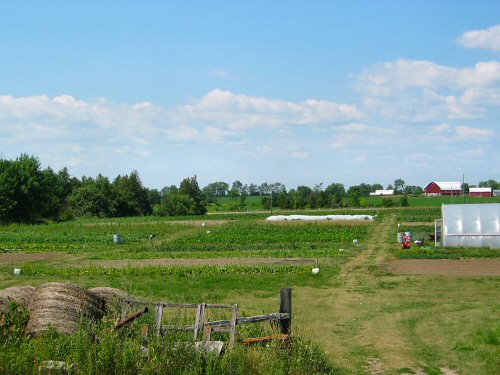
From the gangway to the upper level of the barn, the View shows the new, unusual pattern of the field as summer progresses: less veggies! Compared to barely a month ago, the difference is clear. And it’s even more striking when you walk through. What’s happening is, with this year’s more intensive planting and harvesting, larger sections are finished earlier than in previous seasons. I don’t find this pleasing: too much emptiness, where crops should abound—it’s not the main season fullness I remember (although even now, there is still more upcoming yield out there than ever before)! That’s the way of the busier market garden. And according to the plan, this year’s first organized fall cover cropping—oats, winter rye—should actually fill up the emptied sections, starting in August. I guess you’d call that positive progress, though I still take great, simple pleasure in seeing pure abundance in the field. Not logical, but there you go!
More on the carrot-burlap method
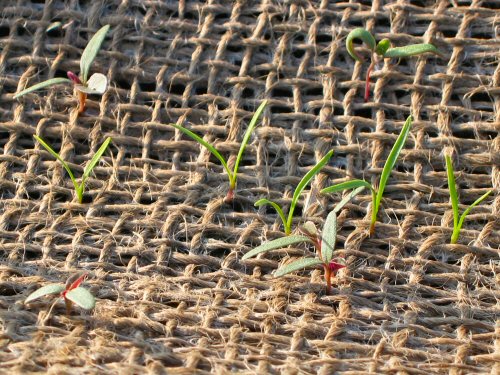
From the last carrot planting of the year, a new development in the burlap method! The variety is Nelson, and germination in less than a week was so vigorous, the seedlings came right up through the fabric, where in all previous seedings, they remained scrunched under. I’m not sure whether the burlap wearing down and loosening up helped this effect, or that there may have been less of a gap between burlap and soil due to a shallower seed furrow. In any case, it’s working better than ever! Rolling up the burlap, the seedlings slip through with ease, while most of the little pigweed emerging alongside get yanked by their aggressive leaf growth. Perfect!! (Clearly, I have carrots and pigweed on my mind…)
The Friday harvest
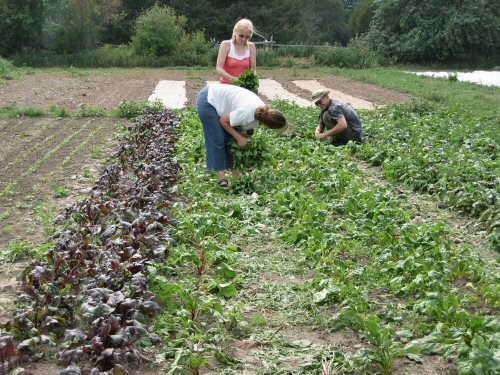
If it’s Friday… This week’s big harvest was the smoothest yet, with everything in, sorted, rinsed, bundled, bagged and COUNTED by around 8:30 pm. The crew this week: Sherry, Andrea, Molana, Lynn, Cezary, Conall and me. I’m over being slightly unnerved by the number of people—my reflex is still to wonder, “If I had to, could I do it all myself?”, but now it’s also…no worries, it’ll get done! Here, Andrea, Sherry and Cezary harvest beet greens, thinning at the same time. (And that’s last plantings of more beets to the left, carrots up top under burlap, and summer squash under row cover off to the upper right. Demolished pigweed strews the path.) In today’s harvest: beets, beet greens, eggplant, mesclun, arugula, carrots, green onions, potatoes, 60-80 units of each.