
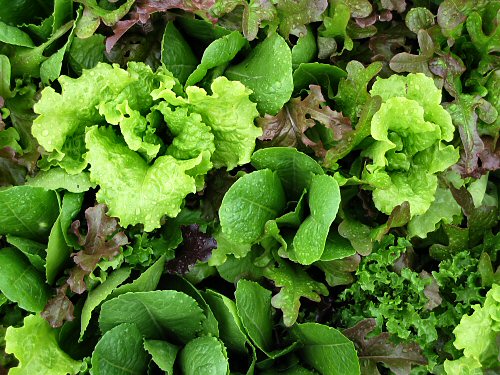
Mesclun remains the mainstay crop on this tiny farm. What I grow is perhaps not strictly “mesclun”, it’s nine varieties of lettuce with no other, more exotic greens—arugula, mizuna, and so forth—mixed in. Also, at times if it gets away a bit, the leaves can be kinda large, making it more of a basic salad mix. Still, it’s all mesclun around here, and this year particularly, we’ve grown LOTS. Salads are popular, and for no reason easily explained, the acceptable price at our farmers’ market is way higher than for any other crop (except, perhaps, blueberries?!). It’s a top seller on market day, it’s dead easy to grow, most of the time, and none of the other, larger local growers bother with it (only one other farm regularly has lettuce). So it’s an all-around winner. Then there’s the big BUT: hot, dry mid-summer weather, when the germination rate is usually terrible, the beds grow rapidly and are hard to time, and the heat can easily turn a fine, fresh-tasting crop into a messier, partially bolted bit of a nightmare. Simply seeding in many extra beds isn’t a solution, because the watering and weeding this would require would be insane. You simply have to keep planting moderately and frequently, and hope for nice weather breaks. Shortages are inevitable, and cut directly into customer satisfaction (expectations, expectations!!). For these reasons, at this time of year, mesclun is always on my mind. For the last couple of plantings, we’ve used…BURLAP for the first few days after seeding, which actually works, reducing watering in time and increasing the germination rate quite a bit. Next year, I intend to finally figure out an even better way…
Summer
Pulling onions
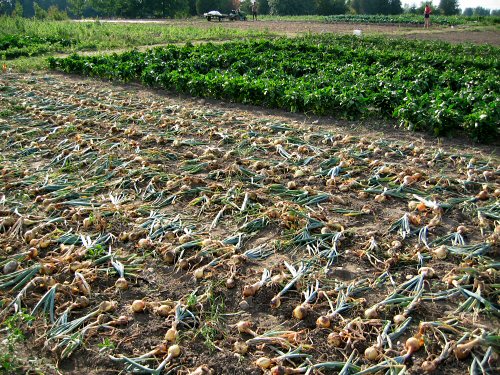
Started the full onion harvest today. This is about half the crop, pulled and layed out to dry (although, with NO RAIN, drying is hardly an issue). Above, it’s peppers and eggplant; at the top left, an almost depleted section of Yukon Gold potatoes with a scraggly weed cover that needs to be tilled in. The onions will be topped, put around half deep in the old style wooden bushel baskets (lots of air, no sweating), and set in the barn to cure. Once again, this year I took the easy way with onion sets, which limits my selection and also seems to produce flatter rather than rounder bulbs. Here it’s the usual two: Stuttgarter yellow cooking and Spanish Yellow (that’s apparently the variety name). Next year, it’s gotta finally be onions from seed! For now, nothing fancy: strong, flavorful onions that bring tears to your eyes!
Carrots, next up!
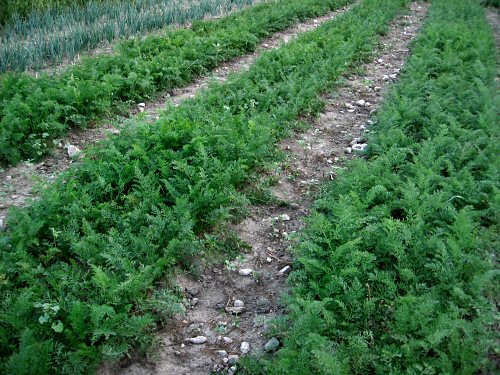
We’re just starting on the second planting of carrots, and green onions as well. It’s the standard four rows (200’/61m) to a bed, which goes a long way. Depending on thinning, and of course, the weather and amount of irrigation, anywhere from one to two feet of a single row of carrots makes up a 1-2 lb bunch, so that’s 100-200 bunches per bed. Here, it’s Nelson, Purple Haze and Touchon, with Ramrod onions up in the corner, and another bed of Nelson out of sight to the right. Once they work through germination and tiny seedlings being eaten issues, carrots around here are a carefree, low maintenance garden veg, a pleasure to host (and munch)!
Crops for Fall
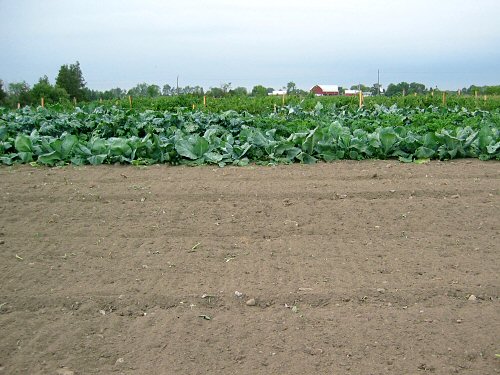
Newly released from row cover, five new beds of brassicas (cabbage, broccoli, cauliflower, kale) get ready for Fall. Beyond, tomatoes (and beyond that, the farm across the road, they gather honey). In front, a vacated section that contained the season’s first planting of peas seeded way back in April, and is now awaiting a mid-August green manure cover crop of…oats! And still, no rain…
Anti-raccoon measures
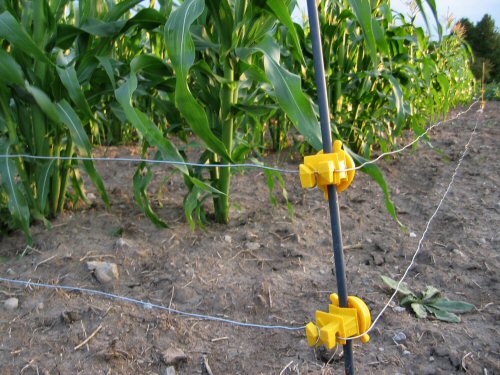
Finally strung up the electric fence to protect the corn from raccoons. Powering the short, hopefully sharp shocks is a solar-charged controller. The lower wire is place about 6″ (15cm) from the ground, with a second strand about 10″ (25cm) above it. The perimeter has to be kept clear of weeds that might ground the fence, which would reduce or eliminate the shocks. In theory, this is a totally effective, non-lethal, physically harmless method, but coons are clever. Already, there’s been some pre-fence eating activity. We shall see what comes next!
Last of the seedlings
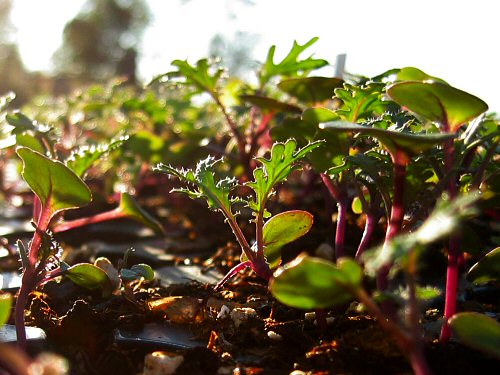
A tray of Red Russian kale are the last transplant seedlings for this year. It’s extremely late to be planting this out now, but RR is a fast grower, there’s space, and it’s always fun (and good experience) to see what happens! Any extra kale is a bit of insurance against a cold October that would see hardy crops as the last ones standing…
Farmer in field
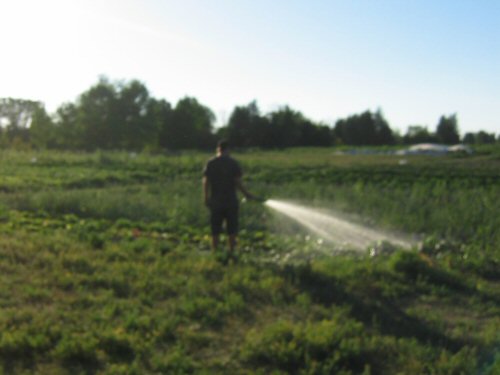
Conall watering in mesclun in the late afternoon. Even on busy harvest Friday, plants need water if they’ve had no rain. Guest photo by Erin, with a different than usual, no less…realistic, view of the field. There’s nothing like being there to see for yourself! I cropped the photo to fit the format, but it’s the original that just catches a certain tiny farm feeling…