Onions and potatoes go in

A satisfying planting day: all of the onion sets (around 2,500) and 300 lbs (136kg) of potatoes are in.

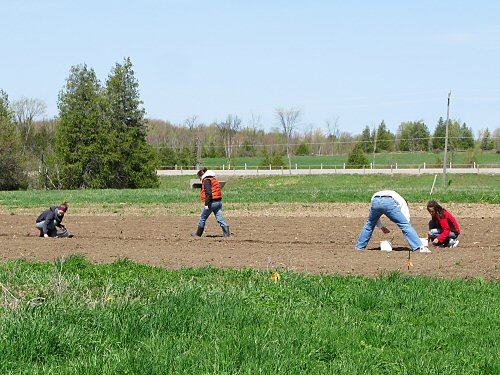
For the onions, Raechelle (first day in the field), Lynn, Jamie (a new CSA member), Shannon (here for a month), and I made quick work of the onions: Stuttgarter yellow cooking and yellow Spanish.

It’s amazing how much fun people working together in a garden can be, there’s a positive, happy, energy that I think comes from sharing time in the dirt (maybe that’s just the tiny farming romantic in me, but I think not… :). Plus, potentially tedious tasks are done in no time!

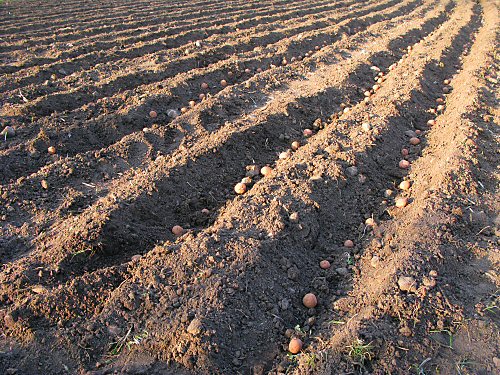
For an encore, Shannon and I polished off the potatoes, finishing just as the sun set and another chilly evening set in. This year, I used the furrower attachment on the Horse walking rototiller to plow what turned out to be excellent trenches, in ground that had been tilled up about a week ago. Varieties are Yukon Gold, Chieftan (red), and Kennebec. In this batch, all varieties were about chicken egg-sized, so, no need to cut ’em into pieces. In-row spacing is 12″ (30cm), between row is 24″ (60cm), with a bit wider path every two rows. We covered them by hand-raking. In all, 40 x 50′ (15m) rows, which is about 2000 plants.

Every year, I’ve tried a different potato approach. Last year, I made much shallower trenches with a hoe. As far as set-up, this time around was the best yet.

The onions are in a bit later than usual, I’ve had them done as early as mid-April, but no worries, and potatoes are around the usual timing. I grow a relatively small quantity of both of these crops, they always sell out, and they feel like a good fit for CSA and farmers’ market from the middle of summer on, so having them at the absolutely earliest date isn’t that important at this stage. And what would tiny farming be without lots of room to improve?! :)
Spring fieldwork continues

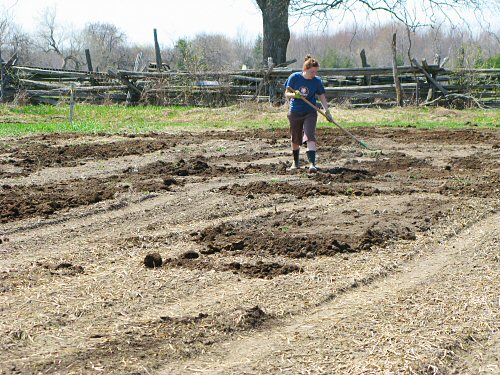
Bed preparation and first seeding continue. Today, Lynn’s tiny farming experience broadened to include rakes, and using them to spread compost. Moderately hard work in the heat, but it was a fairly small area. Overall, things are generally on schedule, but at least a week behind last year for the earliest stuff (and first peas were in last year on April 3rd!). Also, after the lingering snow, conditions changed practically overnight, but with the extremely hot, dry week, despite some watering in, the crops seeded so far are slower to germinate (we need rain!), and may come up a little thin when they do. So far, peas, spinach, beets, radish, all-lettuce mesclun and green onions have gone in over the last few days, and everything but the peas got one watering… I should have direct-seeded leek and parsnips in, but I’m kind of waiting for some rain. Also coming up in the next day or two, carrots and Swiss chard. And there’s a mountain of onion sets and seedlings ready to go, plus a few other transplants. And potatoes arrived today…

Hanging in the greenhouse

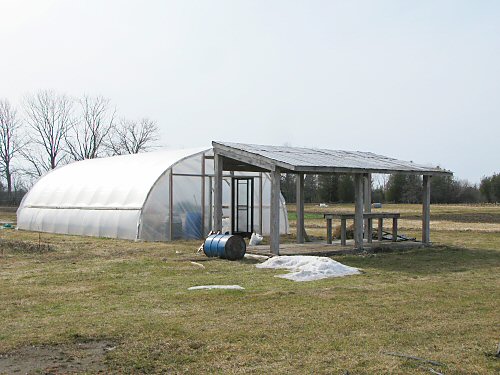
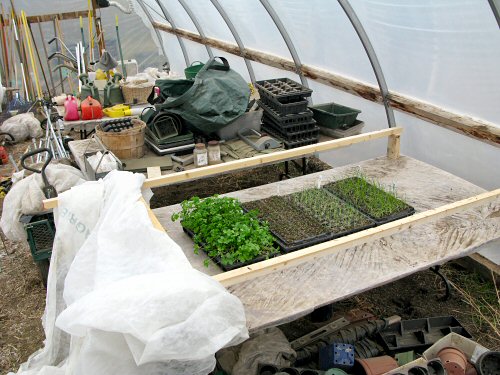
A couple of days ago, I moved out four trays from the Milkhouse to the greenhouse: parsley, leek, onion, leek. I made a quick frame to keep the row cover off the alliums. Although it’s been just below zero for the last couple of nights, they probably didn’t need the protection. They’re doing fine. All around, it may look a bit of a mess, but everything is actually sorted out and ready to be put away… Soon. Everything seems to be going in slow motion lately. Maybe it’s the extra attention from blogging—writing about waiting and reading about waiting—that makes all of this waiting on the next turn of the weather seem so painfully slow. And right now, there’s LOTS to do… Life imitates blog? :)

Drying out

Muted browns and greens are the colors of drying out. The wait for the snow to go is over, now, it’s waiting for the soggy soil to dry enough to till. Until then, there’s not much to do in the field other than walkaround and lookat future things to do. Lots of rock picking, lots of tilling in winter-killed crop residue (kale, Brussels sprouts, etc) and cover crops. Hoses to repair and run. PEAS to seed… I moved a couple of trays of onions and a tray of parsley to the greenhouse today, to see how they’ll do. No reason not to’ve moved all of them out, but, well, the rest can wait a couple more days, it’s supposed to be subzero the next few nights. The giant puddle that had nearly half the garlic underwater was gone by this morning…and the garlic under there was doing better than in the rest of the beds! That’s interesting, probably a combination of them stretching for more light, and the accumulated extra nutrients from being in a runoff collection spot. But it COULD have to do with just being underwater for a while. A discovery? Flood your garlic patch like a…rice paddy? Well, maybe not…

Ah, SPRING!

Hardening off onions, leek, parsley

Man, what a difference a day and a bunch of degrees can make! The temperature didn’t exactly shoot up, but it went from hovering around daytime zero, to around 10°C (50°F). This was one weather trend, predicted on the 15-day-forecast weather site, that I figured wouldn’t suddenly go south (it’s gotta warm up sometime), so I’ve been waiting for it, to the day, for a couple of days now. It’ll get steadily warmer for a week or so, than maybe drop a bit, but even if we get another BLIZZARD, the ground will have warmed up enough that new snow won’t be able to stick around for long. So, I do believe, SPRING IS HERE!!!

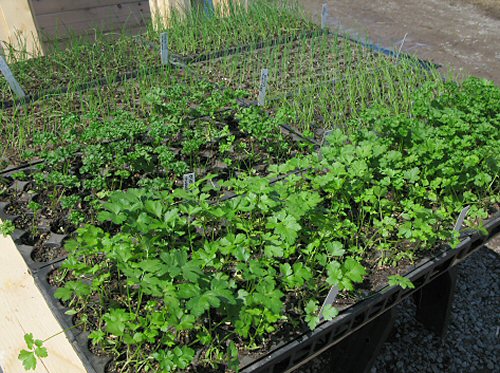
I woke up to sunshine, and without even checking the temperature or confirming the forecast, set up a table outside the Milkhouse and out went the leek, onions and parsley for a little rapid hardening off. Getting them out to the greenhouse in a couple of days will free up a lot of rack space!

Wandering around the field a bit, checking the melt-off’s progress, I poked around the edge of the Jerusalem artichoke bed. The ground was still fairly frozen, and had melted to clayey muck only in spots. Poking around in a soft spot at the base of one of the plants, I came up with a handful! First harvest! The tubers look beautiful, the ones in the front of the pic about marble size, the biggest in the back, like a golf ball. As seed stock, there’s going to be a ton from the 45 pieces planted last year. I didn’t end up harvesting any in the fall; now, I’ll get to for the first time eat ’em!

Inside and out…

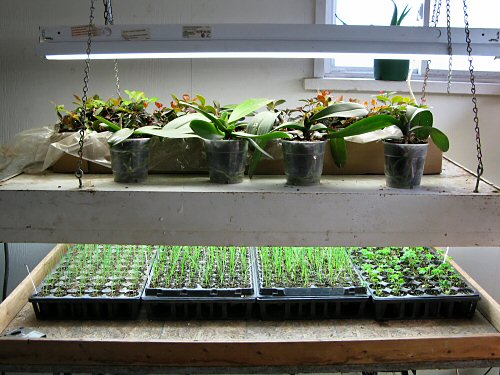
Inside, in the increasingly GREEN Milkhouse, this year’s artificial sun set-up is done. It’s about fitting in as much area-under-lights as possible, while making sure all of the trays are easily reachable, for watering, rotation, thinning. So, there are the four grow racks, and the lightbox (that’s leek, onions and parsley under there), with its second level (why waste a flat surface that comes with chains?!). For now, this extra space is the new spot for the rescued-and-passed-along decorative plants (the heather was too dried out and didn’t make it, the wintergreen are doing fine, and the orchids seem OK…), but they’ll eventually be crowded out and moved somewhere else. The shelves are filling up fast… MEANWHILE, outside, it’s snowing and snowing, again. That’s a lot of snow. Around here, we’re definitely off to a later start this year than at least the last couple, but I’m still not particularly put off, not just yet. Although, it’s not supposed to warm up for another week, maybe two…

This is today’s peaceful but uninspiring view of the garden from the north-facing Milkhouse window…

Trimming leeks

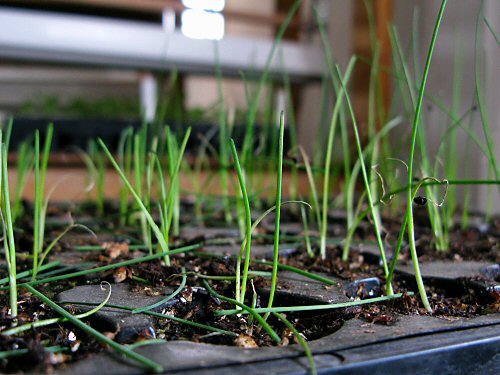
Trimming back leeks is really satisfying. Here, I’m doing the first planting. With most indoor veggie seedlings and my two-lamp fluorescent fixtures, it’s lots of tray rotating and light height adjusting to keep the stretching to a minimum.

Leek can reach all they want: at three inches (7.5cm) or so, I snip them back to about an inch (2.5cm). What could be simpler?! This goes for the onions coming up as well.

With nice low seedlings, the light can be better concentrated across the trays, and cutting back may ensure stockier growth, which is generally a good thing when it comes to seedlings (update: I read a pretty definitive-sounding study that disproved the growing-stockier part; either way, it’s worth trimming just for keeping them closer to the light).

This is the first year of starting both leek and onion indoors from seed (in the past, it’s been direct-seeded leek, and onion sets)—I’ve not actually DONE this before—so there’s the usual slight bit of reservation with trying something new. Seeing is believing. Fun (easy) so far!

Elsewhere, we got what looked like a foot of snow overnight. No problem, no extra work, except the lane, barnyard and path to the greenhouse had to be plowed again…