Fieldwork: Day 1

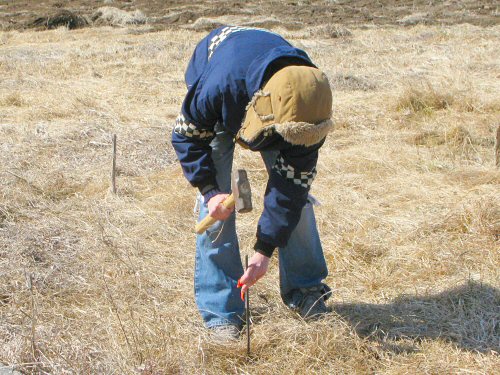
Sunny and quite warm (not as chilly as Mel’s deep-winter-ready, ear-flapped headgear might suggest). Probably 50°F+ (10°C) in the sun. Not the first nice, dry day this season, but this one became this farm’s official first fieldwork day of the year, just like that. We were only out for around three hours (including a walk to check on the beehives—there are some bees!—and the creek), but got a lot done, so it definitely counts as work in the field!

First, we selected a spot for the greenhouse, moving it from where we’d originally planned, to a more sheltered, overall all more PLEASING site. Pound in stakes at the roughly measured-in four corners, and admire the spot. The stakes are graphite tent pole sections Bob got at a yard sale long ago; flagged with orange surveyor’s tape, they’re great field markers. Normally you can just push ’em in, but here, Mel is using a mini-sledgehammer (above), because the ground is still frozen from a couple of inches (5cm) down…

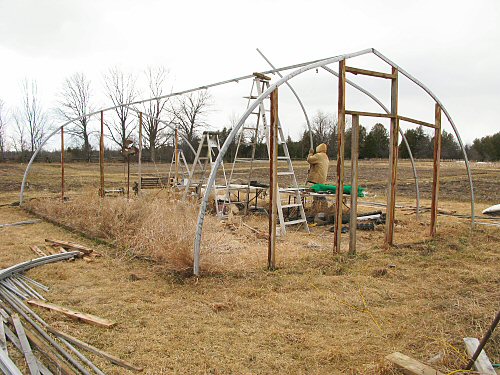
Next up, sort all the hoophouse pieces. The steel ribs and braces are on the right. There’s a surprising amount of wood involved, and that’s now divided into what goes where. And then, we dumped all the hardware out of the barrel it’d been moved in: a bucket of assorted, screws, nuts and bolts, plus springlock (wire that attaches the plastic to the frame) and aluminum springlock channels.

A surprise find: the last five potted wintergreen plants (Mel is chosing some to take home). I’d put them in the barrel on top of a bunch of parts when we were moving the greenhouse, and forgotten them there. After spending an entire winter totally exposed outdoors, and the last couple of weeks tumbled down into a barrel full of wiry metal, they’re still alive and looking cheerful. Tough and pretty. With minty berries…

And so, the return of the greenhouse is underway. The GH is sorely missed and really needed! Just gotta wait till the ground thaws, so the area can be tilled up and the 3′ (0.9m) t-bar anchors that keep it from blowing away can be driven into the ground…!
Tiny farm moving – Part 3

Headed to the old farm to pick up the greenhouse. It’s only been a month since the main move, but the return to a place where I spent practically every day of the last six years felt strange. Inside the farmhouse, it was just a familiar space, but rounding the corner into the  barnyard, surrounded by all the old red buildings—barn, goat barn, drive shed—and then, walking into the field, that was different.

I guess this is the first real attachment to LAND that I’ve experienced. It was definitely unusual, not at all emotional, just a really strong, quiet sensation, a deep familiarity maybe describes it. I suppose the memories of all that thinking, observing, and working, tying together place and weather and ground conditions and seasons coming and going in one long, continuous arc, couldn’t help but leave their own type of mark. So that was interesting! :)

Bob had already started dismantling the farm stand, but that was so solidly put together, with thick, rough-cut cedar, heavy old fence boards, and 3″ nails (if you ever expect to move the things you build, for a few dollars more, consider screws!), that’s gonna be for another day. On to the hoophouse teardown…

The hoophouse is all screwed together, so taking it apart was easy. I’d considered lining up some extra hands for removing the plastic—there was a breeze, gusting to 4-5 mph (6-8kmph)—but Bob thought we’d be fine. And we were: the plastic skinned off amazingly easily, without catching the wind at all, and it didn’t disintegrate or tear…it will live again.

Around five hours later, and it’s all in pieces, ready to load up and take down the road. Going up and coming down are exactly the same, so I decided to take step-by-step pictures when we put it up again at the new farm…

Abandoned bee village

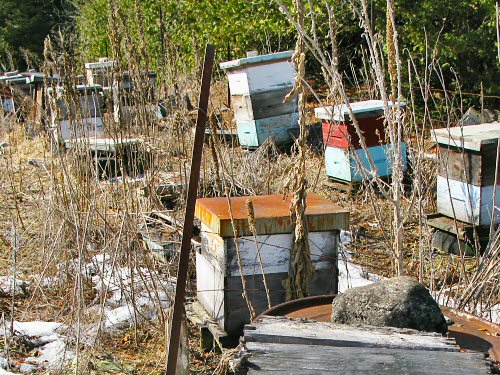
There’s an apparently abandoned bee village on the edge of the tree-enclosed clearing just beyond the main field (the clearing is past the fence, covered in snow, in this pic). There is a backstory here, still to be fully figured out, but the basic fact of the moment is a forlorn, ghost town-looking double row of hives, maybe 15 in all. I don’t know anything about beekeeping, so I did a little research. These seem to be the standard Langstroth hive design, used all over the world. From the photos I saw, the set-up here looks pretty normal, except for the tilting, the worn out paint, and the solidly rusted electric fence that surrounds them. Sorting this out is something new to do this spring. Our future in bees…

The great WARM outdoors!

First really warm day of the year!

Ahhh, yes, THIS is what warm weather feels like! For the first time this year, the temperature topped 60°F (15°C), with a hazy sun and a gentle breeze. We’ve had some melt-off days already, but this one tastes like spring! Usually, there’s a day like this sometime in February, so it’s been a long time coming, and makes me wonder how even crazier the rest of the weather will be. No worries…today feels great.

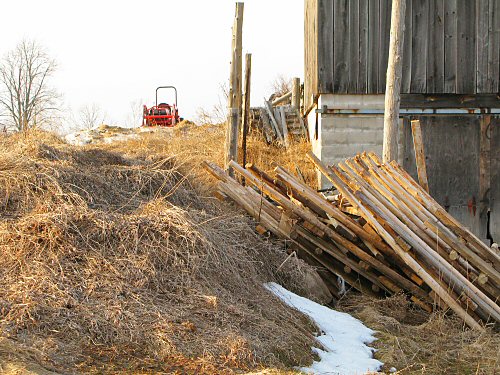
The photo is a good to-do list for when real spring comes and the ground is dry enough to work and get around on. There’s a jumble of spare lumber taken from the barn when we cleared an area for the new seedling room—it needs to be sorted and stacked, and some of it will be the new chickenhouse! (Only patches of snow are left on much of the land, but I’m sure it’ll be back before it’s really gone.) The abundantly overgrown grasses that partially surround the barn and border the moldboarded garden areas is a big clean-up job. And, up the slope, the Kubota compact tractor calmly waits for after the hired-big-tractor disking and the compost spreading, when we do the final tilling of the garden beds. Coming soon. Cool!

Loaded

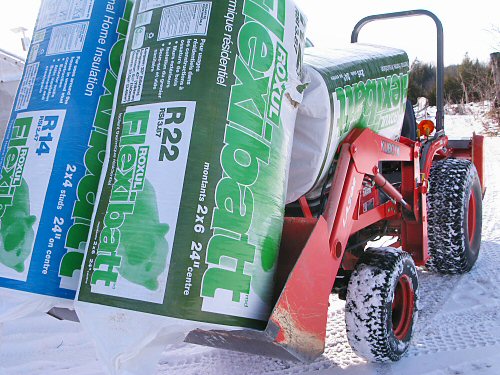
The Kubota compact tractor is a real work horse, it can do just about anything you set it to. On a tiny farming scale, of course. It’s had to winter outside this time around, but it’s been starting no problem, on first try, after the recent battery change. Who knew that a fresh, premium battery could make such a difference (well, many know, and now I’m one of them!)? Today’s beast of burden mission: moving a dozen bales of rock wool insulation—a last bit of the new seedling room—from the lower barn, up a slope, to the upper level doors on the other side of the building. Three trips instead of 12. They’re not particularly heavy, just big and bulky, so no problem wedging them on the hood. When loading up like this, it’s important not to mess with the hydraulic lines that run along the arms and across the front of the loader. Besides that, just pile ’em on!

Seedling room settling in

New seedling room mainly packed up

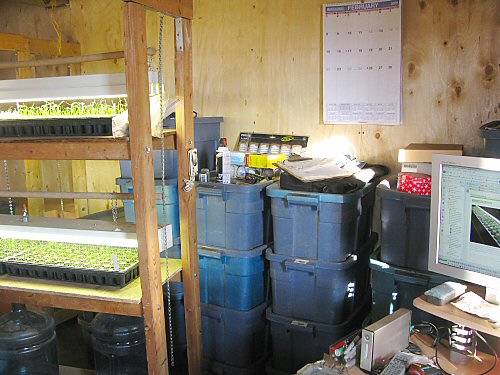
Things are moving along on all fronts, some less visible on the farm than others, like calls to locate various local suppliers, supply runs to the nearby village (pop. 2,400) and the bigger nearby town (pop. 70,000), and so on. The actual UNPACKING is going at a steady pace. The photo above pretty much sums things up so far for the new seedling room. There’s still a fair bit of finishing to do,  and for that, we’re going to have to work from one side to the other, moving things back and forth. The computer is online, which is good, being able to check things out on the web is a big part of my tiny farming this time of year. I set up a couple of light rack shelves for the seedlings that’ve been started, but most of the lights are still packed away with the composting toilet. Around 25 harvest bins, doing moving duty, are still stacked, contents waiting for shelves—I labeled each one, so it’s not too hard too find stuff needed now. And the calendar is getting ready to flip again!

Tiny farm moving – Part 2

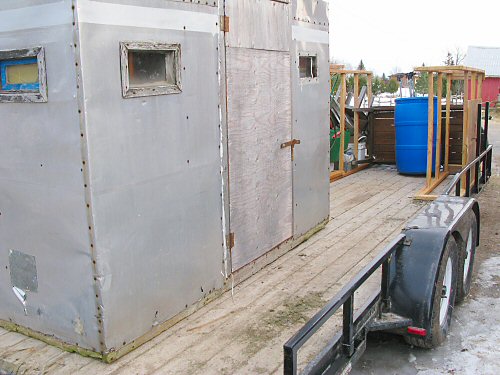
Moving day minus one. Tomorrow we take the second trailer load, the main haul (when moving a tiny farm, it’s good to have access to a 20-foot trailer like this one, it’s Bob’s) The first move day, Part 1, was at the end of November, with the Kubota compact tractor and some other bigger stuff, like irrigation pipe, the greens-drying washing machine, the Horse rototiller, heavier things. This time around, it’s all of the smaller, indoor tiny farming gear: seed inventory, light racks, plug sheets and other seed starting tools, books, computer, PAPERS (lots of paper, somehow, bins full of notes, print-outs, brochures, receipts, you name it), hand tools, and so on and on. The one big item is the composting toilet, complete with its converted ice fishing hut enclosure (which is crammed with fluorescent light fixtures and plug sheets for the move). We did a bit of loading today, but most will happen tomorrow morning. After this, there’s a final trailer load in March: John Deere riding mower, greenhouse, farm stand, a heap of valuable scrap lumber. Moving an entire line-up of tiny farming gear is a really interesting way to see exactly what STUFF we think it takes to grow food on a small scale, on a couple of acres. Of course, the equipment list can vary a lot from tiny farm to tiny farm, but this overall set-up is probably pretty similar to the majority of North American under-five-acre farms. It’s not SO much gear, but we still rely on a lot to grow. A lot more than a handful of seed and a pointy stick!