
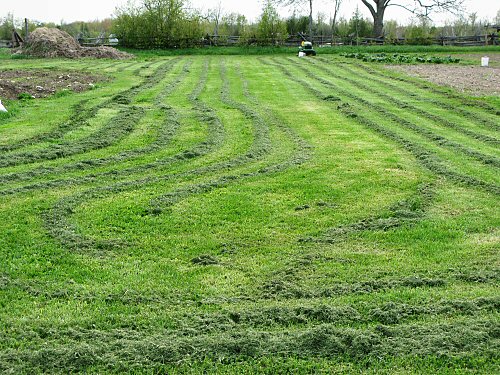
The grass seemed just long enough for a productive mulch cut without overloading the John Deere riding mower, so today was the day to start season 2 in the grass mulch experiment. This is just one part of the total mowing area: including the field perimeter and another big area behind where I’m standing to take the photo, there’s maybe four times that much (this area is being kept clear for the eventual bigger greenhouse). The JD’s deflector forms those nice mini-windrows instead of scattering the cut, making raking it up much quicker. I’m still not sure if the time it takes to mow, hand-rake and bag will be worth it on a larger scale: will the work be offset by savings in irrigation and weeding, and maybe better yield, for the crops that’ll be mulched? It takes a lot of big, packed leaf bags to properly mulch just a few beds… Well, we’ll soon find out!
Farm lab (research!)
Submerged garlic and root-diving voles
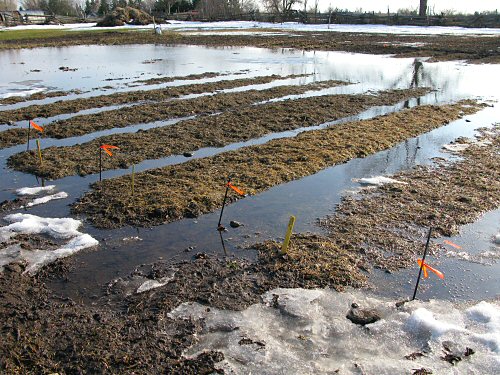
For all of the melt-off’s magical moments—garlic tips emerging and big puddles that look like tiny seas—there are mild melt-off concerns as well. About one third of the garlic beds have been fully submerged for nearly two days now, and may stay that way for 2-3-4 more, especially if it rains tomorrow as promised. (This area usually doesn’t get flooded with runoff, but I should’ve paid attention to the natural gully and not rotated the garlic there, just in case.) I doubt being underwater for a while will affect the garlic, but I don’t know for sure… How long garlic can hold its breath is another thing I’ll soon find out! And elsewhere, I discovered the handiwork of VOLES (it had to be them) in the herb patch. Under cover of snow, they’d neatly excavated 25′ feet of parsley roots, methodically working their way down the double row. These aren’t tunnels, just holes that go down about a hand’s length. Interesting. Another first. And no loss. But could this be population explosion year in the local vole cycle? Last year’s spring lettuce raids in the greenhouse were nothing compared to organized action like this… Good thing they don’t like garlic!
Trimming leeks
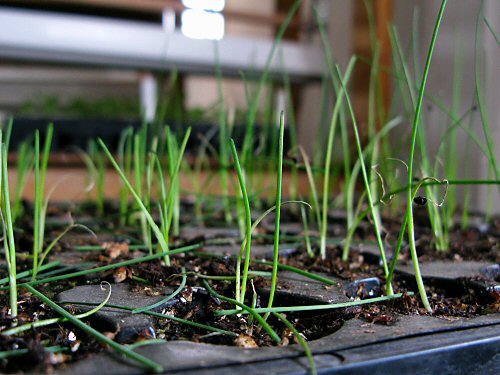
Trimming back leeks is really satisfying. Here, I’m doing the first planting. With most indoor veggie seedlings and my two-lamp fluorescent fixtures, it’s lots of tray rotating and light height adjusting to keep the stretching to a minimum.
Leek can reach all they want: at three inches (7.5cm) or so, I snip them back to about an inch (2.5cm). What could be simpler?! This goes for the onions coming up as well.
With nice low seedlings, the light can be better concentrated across the trays, and cutting back may ensure stockier growth, which is generally a good thing when it comes to seedlings (update: I read a pretty definitive-sounding study that disproved the growing-stockier part; either way, it’s worth trimming just for keeping them closer to the light).
This is the first year of starting both leek and onion indoors from seed (in the past, it’s been direct-seeded leek, and onion sets)—I’ve not actually DONE this before—so there’s the usual slight bit of reservation with trying something new. Seeing is believing. Fun (easy) so far!
Elsewhere, we got what looked like a foot of snow overnight. No problem, no extra work, except the lane, barnyard and path to the greenhouse had to be plowed again…
Tea and fungi
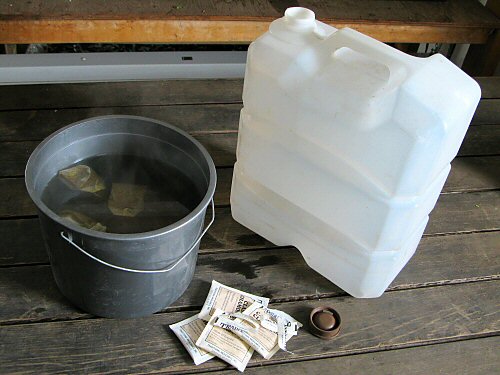
Chamomile tea prevents damping off—I’m a believer! It’s one of those natural but-do-they-really-work remedies, used where more product-minded folks would fork over a few bucks for a bottle of No-Damp fungicide… I brew up a batch of tea, dilute it by eye to a pale gold, and apply every couple of days with a fine-misting spray bottle. I’m pretty casual about the recipe, and keep spraying until the seedlings are established (that’s my method, there are more precise instructions around as well, search online).
Damping off is the name for a bunch of different fungal infections that can hit seedlings in trays with similar effect. In my encounters, the damage appears right below the soil line, strangling the stem just out of sight. Dig up a stricken seedling and there’s a small section of the stem, all pale and shriveling to nothing, while above and below, all looks well (the symptom’s called “wire stem”). It’s pretty shocking to see in action. One minute, your seedlings are looking all perky, and then you touch one…and it topples over! Whooaa!
Up to a couple of years back, I’d lose a few seedlings, usually PEPPERS for some reason, never anything major, parts of a tray or two, but enough to be scary. I seed-start in soilless mix (so it should be disease free), trays and tools are given a good disinfection at the beginning of the season, there’s always plenty of air circulation, and I make sure the soil surface doesn’t stay wet—all the things these soil-borne fungi don’t like. Still, damping off was sneaking in, until chamomile tea spray came along… Coincidence?
Welcome to KeroWorld
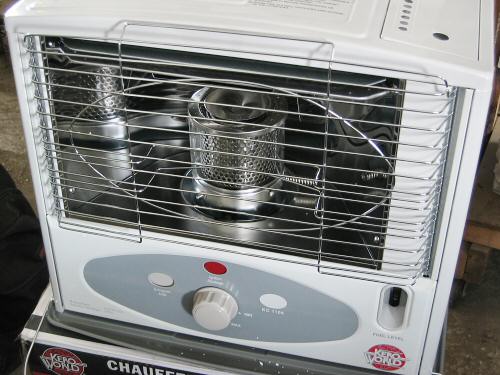
What an odd thought, what image comes to mind: the world of kerosene… And now I’m in it! Purchased new today, at a healthy 35% discount, this small, rather inexpensive, KeroWorld-brand indoor kerosene heater is the core technology in the extended-spring greenhouse plan. The idea is to turn the unheated hoophouse into a barely heated one, by warming it at night so that it stays above 38°F (4°C). That way, I can put out seedlings weeks early, instead of crowding them under scarce indoor lighting until it warms up in April. It should also give the earlier-than-ever lettuce, going into the ground in the greenhouse, a smoother start. This heater is low-powered—10,000 BTU, recommended for 420 sq ft, it’s 640 sq ft out there—but only a wee bit of heat is required. I think. Last year’s propane space heater was quite efficient, but burned too much gas for every-night use, it often went out by itself, and it required lots of ventilation. Plus, I don’t really like relying on pressurized tanks. This heater will hopefully burn low and steady, and it’s pour-to-fill! Aided by a fan to keep the air moving, and row cover on the coldest nights, it should get the job done. This all reminds me of Patrick of Bifurcated Carrots’ comment a while ago about the line between good and bad technology. It seems a personal decision as much as anything. Why don’t I dream about full-blown winter greenhouses, with high-intensity lighting and industrial-strength heating and ventilation, I wonder? Dunno. I just don’t. But an extra growing month in the strengthening sun, and a little less reliance on indoor lights, traded off against some kerosene, well, THAT would be cool!
Exploring down below…
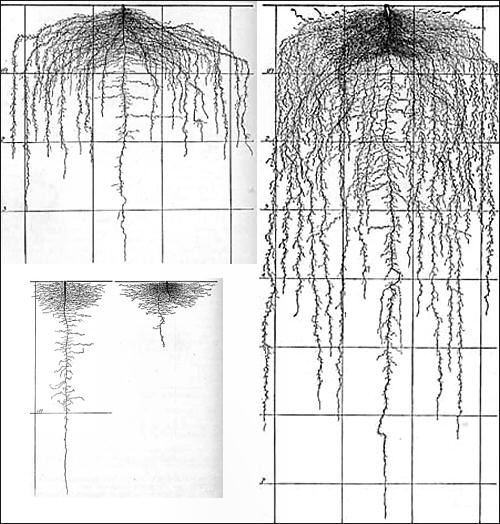
These technical drawings of a lettuce root system are from Root Development of Vegetable Crops*, first published in 1927 and now in the public domain. This is an incredible book that I just discovered. The text is like a complete gardening course delivered from underground. Over 30 North American common garden veggies are covered, a chapter each. The drawings record direct observation, the result of years of root excavation.
I can hardly describe how satisfying and…enlightening it is to simply look at page after page of painstakingly drawn root systems! Here, the top two pictures are lettuce at two months and then at three months and flowering. Each square in the grid is one foot. The little side-by-side illustratation shows 3-week-old seedlings, grown on the left in loose soil (nearly 2′ down!!), on the right in compacted soil (and to think, I have 3-week seedlings in tiny plug sheet cells, 2-1/2″ deep!). One look at this and your mind expands!
*I downloaded it from the fantastic Soil & Health Holistic Agriculture Library, an online repository for numerous excellent books, mostly from 1910-1960, and all entirely free—there are many organic farming classics, tons of great, practical stuff!
Seedling treatment
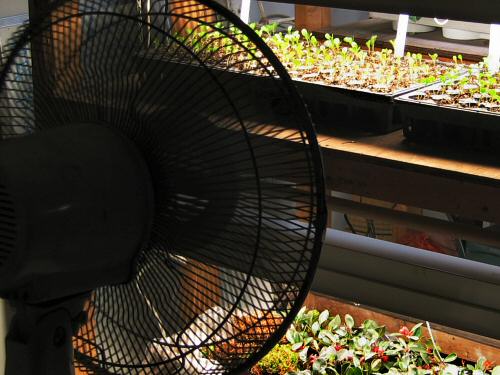
The fan is oscillating and the grow racks are slowly filling up. Parsley—curly and flat-leaf—are underway, and there’s more lettuce and some herbs…
Fanning the seedlings is particularly satisfying because it does a lot for such a simple thing. I forget where I heard about it, probably from a book, and I’ve been doing it since Year 1 or 2.
The idea is that plants develop differently when they have to deal with wind, or rain, or otherwise being pushed about. Seedlings raised indoors lead an extremely sheltered life; providing a bit of a breeze toughens them up, and this sort of mechanical stimulation (brushing is another approach) also encourages stockier growth instead of stretching.
It makes sense to me—seedlings definitely wouldn’t be so coddled growing out in the field! There’s even a term for this: thigmomorphogenesis! While hunting down the word, I found an interesting article about mechanical stimulation of seedlings as well (and here’s another).
I don’t follow a particular schedule, just give ’em at least an hour or two a day, sometimes more, turn the fan on and move it around every once in a while (I also make sure the seedlings are properly watered, since wind is great for drying out plants).
All in all, it’s easy, sounds good, hasn’t hurt! The fanning also dries the soil surface, which helps prevent damping-off, so you can’t lose!