
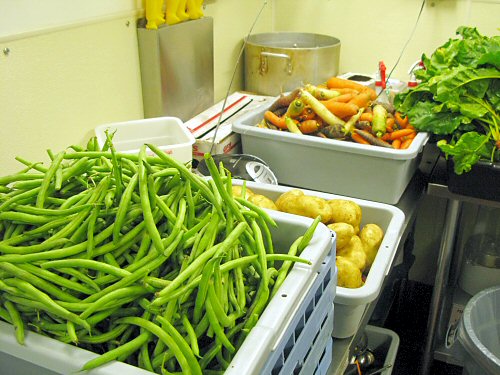
A phone call on the weekend lead to this, our first real restaurant sale. It was cool! A chef called looking for local, organic veggies for a special menu this week. They’d joined at the last minute a regional food festival, featuring local food in restaurants in several towns. I ran down what we had available and followed up with an emailed price and available quantity list. Today, we harvested and delivered: green beans (Jade), potatoes (Kennebec), beets (Golden Detroit, Scarlet Supreme), carrots (Nelson, Purple Haze, White Satin), and onions (Stuttgarter-type yellow cooking, yellow Spanish), in the 25lb (11kg) range for each. Pricing was the normal market unit price, no “wholesale” discount. It was great pulling up to the back of the building, delivering into the kitchen, checking out and describing each veg with the chef. The dinner plans: a “hearty fall soup” and a “steamed vegetable pasta with olive oil and herbs.” Market gardens and progressive local restaurants are a natural and quite common direct fit…as seen on TV (I’ve been known to watch the Food Channel)! I’ve had some minor dealings with restaurants in seasons past, but we’d never got round to a classic chef’s order and kitchen delivery. so it was interesting to go through the whole routine. We had lunch there afterwards, and the food was refreshingly good: bruchetta, flatbread pizza, sweet potato fries, salt and pepper rib tips, an asparagus sandwich (yeah, the asparagus aren’t exactly in season around here, but their special local food menu is a step in a cool direction…). Fun! Oh, and no frost last night.
Harvest
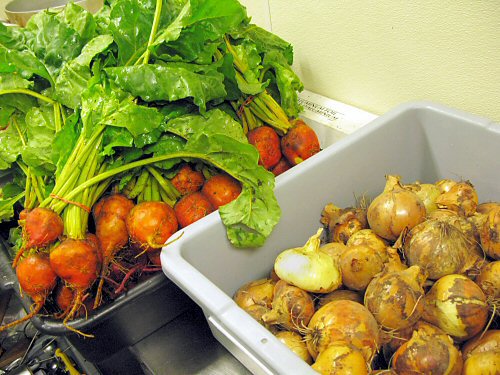
Fall harvest…
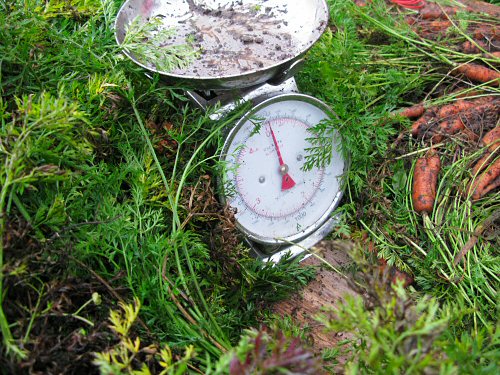
We’re definitely into fall weather now: the thermometer may still read “warm” but there’s always a cool edge in the air. This is the best field-working weather, you can go on for hours. Today was a bit damp, and the abundant root crops were muddy from the overnight rain (they get rinsed, with a spray of the hose on Jet for the roots, then a dunk in the laundry sink to rinse off the leaves). Carrots were in 2 lb (900g) bundles, by the trusty kitchen scale we’re still using…
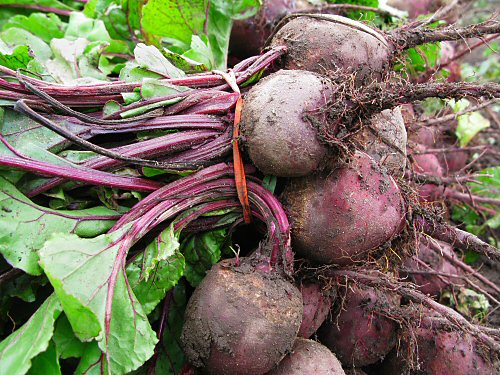
We bundled the beets in the field—these are the red standbys of the season, Scarlet Supreme. Always reliable, they’re in great shape and flavor, and the greens are particularly substantial…
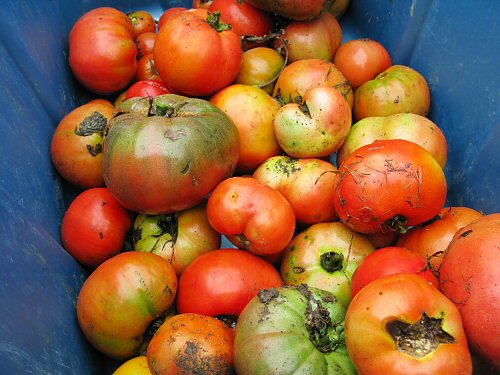
The tomato harvest was fairly slim and motley, maybe 120 lbs (54kg), enough for CSA shares only. We’re picking them even partially ripe—frost may come at any time, no sense in waiting. The toms may not be too pretty, but they’ve somehow become real tasty in the last couple of weeks, steadily developing from the milder flavors of the first pickings, to really quite fine! Was it the recent sunshine? Whatever the reason, it’s a pleasant surprise!
Violet returns: visiting with worms

Young Violet (2) returned to the field, sans siblings. She seemed to have fun on her first garden visit, on a sunny afternoon—today’s cool, cloudy, wet conditions didn’t faze her in the least. Interacting with earthworms occupied a good hour…
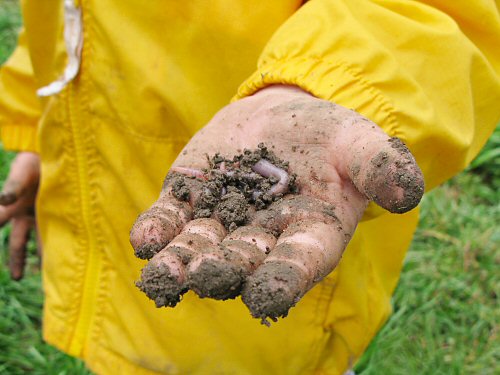
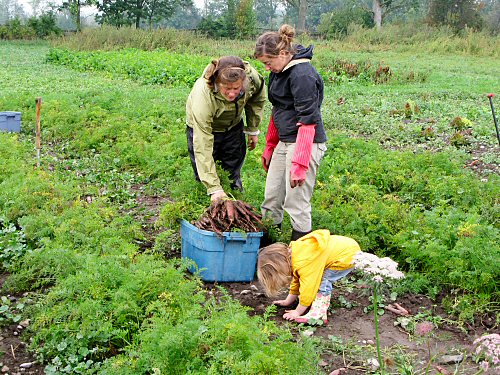
While Libby and Lynn dug carrots, Violet helpfully and with great interest relocated disturbed worms. A hands-on biology lesson, an early pre-school start… (Looking back, for the most part, I’d have much rather grown up in a field than in a classroom!)
Trimming garlic
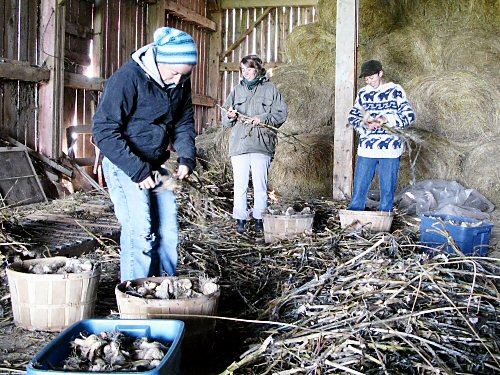
From the long stack of garlic drying in the barn, we’ve been taking out about a bushel a week since harvest began in late July. Today, we finished preparing the rest of the harvest. Lynn, Raechelle and Mel snipped the stems and sorted at the same time. (The roots weren’t trimmed; that can be done for some as we go through the bins and baskets each week for CSA shares and the farmers’ market.) In past years, the sorting was for size: dividing the mostly medium and large bulbs, and putting aside the very few tiny and damaged ones. Garlic does best with a dry final month of growth—this time, coming out of ground that had remained quite wet all summer, the harvest wasn’t in as good shape…
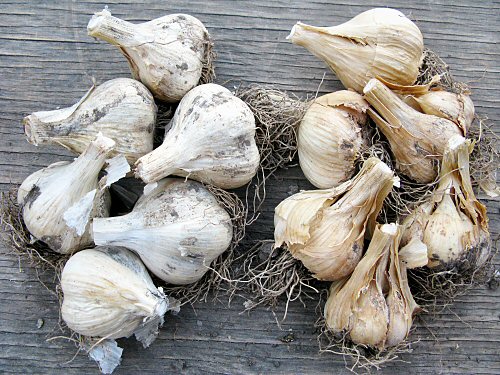
Sizing evened out, with most bulbs about what I call “medium” (this is the most useful size for cooking, but the big ones are so…impressive, everyone loves ’em). A little over half dried not to the usual tight, white skin, instead, to a tan color, wrinkled and split. So, we sorted into “good” and “not so good”… There was also a much higher proportion of really damaged bulbs, maybe 10% compared to a usual couple per hundred. Still, the taste is great, and the cloves themselves are fine. Only appearance and storage life are affected. We’re selling the less pretty, less storable bulbs at a couple of dollars less per pound. They’re good for immediate use (within 3-4 weeks, maybe a little longer) and as seed garlic for fall planting. Overall yield was great, although I’m not sure whether the hugely reduced number of large bulbs was due to weather, or to the more intensive 5-across planting we tried for the first time. As usual, more to observe and learn from. All in all, given the poor garlic weather, it all worked out quite well!
Fantastic egg tray technology!
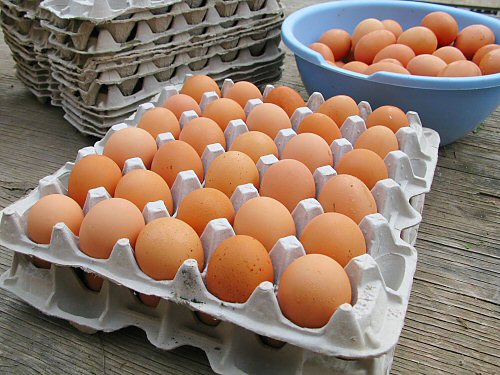
OK, so they’re just regular cardboard egg trays from the commercial kitchen world, and they’ve probably been around exactly like this for decades. BUT, they haven’t been around HERE. Lynn recycled them from Shelter Valley Folk Festival, where she was last week, where they were feeding big groups of volunteers. The trays are fantastic! Our chickens produce only about two dozen eggs a day, but that still adds up. I’d been keeping them at first in regular one-dozen cartons, then in bowls and small baskets. It was getting a little out of control. Now, they simply, efficiently stack in the fridge, 30 per tray. Every second week, like today, we bring a bunch to the farmers’ market as a bonus in the CSA shares, and the trays make transport a lot easier as well. Amazing. :)
Cutting spinach
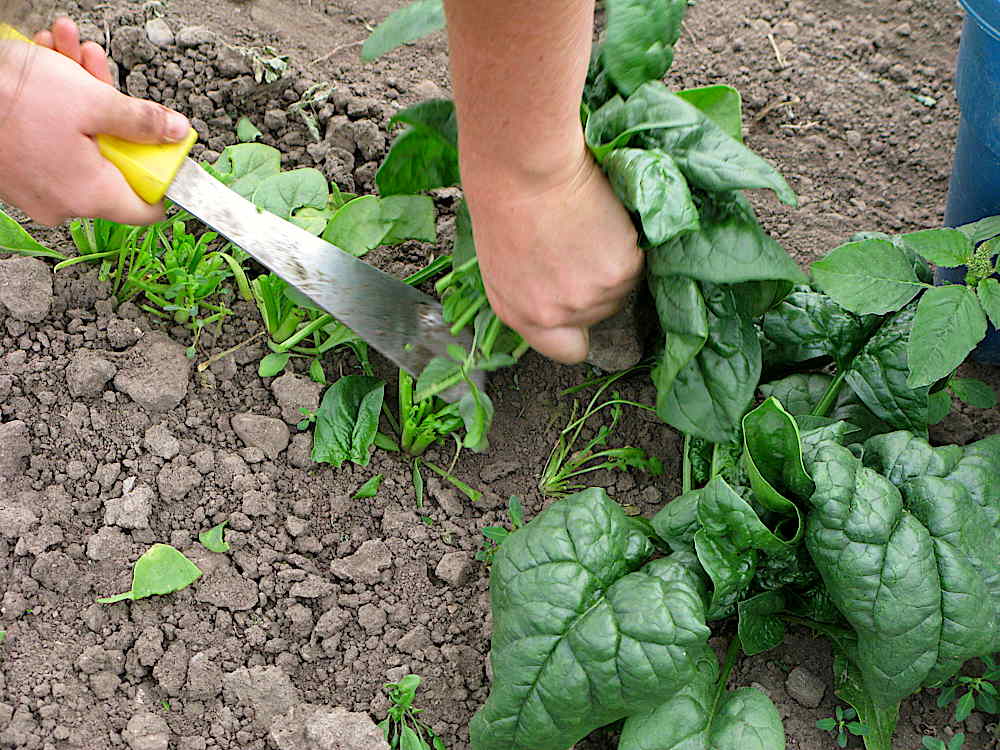
Spinach has kinda been the star of the harvest for the last couple of weeks. After a “normal” summer—hot and dry for the last three years—it’s usually not around at this time of year due to poor germination. This season, with cloudy, cooler days and all the rain, spinach is in abundance: glossy, deep green, succulent, full of flavor. Libby and Lynn chop away, cutting an inch or two up the stems. This technique takes out the small new growth leaves, but it’s fast and efficient, and the plants still grow back for a second harvest. The alternate picking-single-leaves approach is more laid back, great for leisurely field chats—this harvest, we opted for quick…
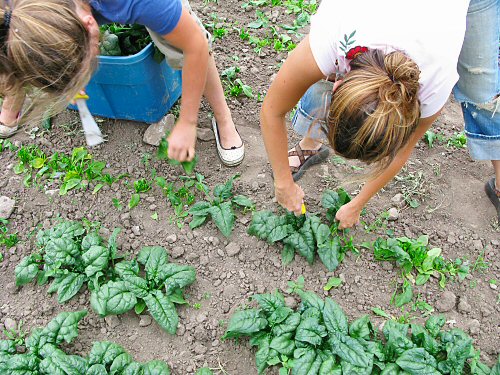
Nothing like teamwork: head down, knife in hand, side by side…
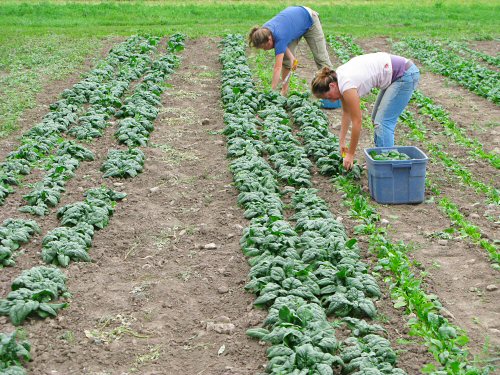
My, what a nice, wide path!
More post-harvest action
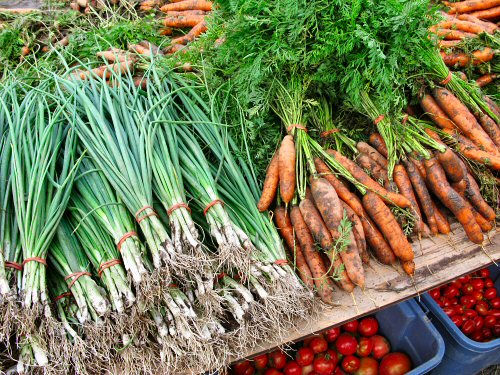
If it’s Friday, it must be time to harvest! After a beautiful weather week with barely a cloud in sight, an otherwise welcome gentle rain today meant a bit of a muddy harvest. Here, the picking and pulling has all been done, and we’re about halfway through the sorting and rinsing. Ramrod green onions are all bundled and ready for a quick rinse. Nelson carrots are underway. And, a couple of several bins of tomatoes, with Juliet saladette in one, and a mix of smaller heirlooms in the other. With toms, we only fill the bins 2-3 layers deep to avoid squashing and splitting, especially with big heirlooms. (I suppose getting cardboard tomato flats, one tomato deep, would be more space-efficient, ’cause the pick-up truck that we use does get full around this time of year, but so far, we’ve managed without.) Everything’s looking and tasting good!