Post-harvest aftermath

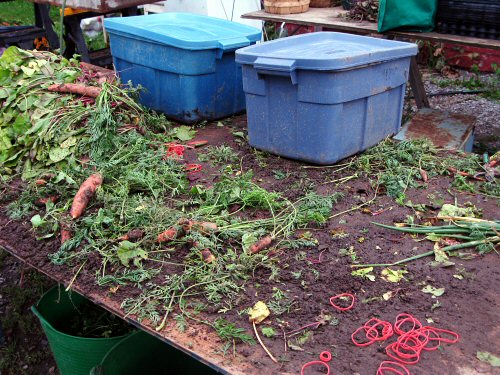
Sorting and packing after harvest—post-harvest processing!—is in good part a wet job, made a lot messier in rainy weather when root crops come in with a load of mud attached. Once again this season, the main work surface for sorting is a 4’x8′ sheet of plywood set on sawhorses. Actually, we added a second table, so now there are…two. Here, we’ve just finished sorting and bundling carrots, which then went for a rinse on the screen table. Sometimes, rinsing is done first, depending mostly on who’s doing what and what else is going on. In the closed blue bins, which hold a little over a bushel each, are carrots already bundled, rinsed and ready to go. This week, there are four bins of carrots, around 160 lbs (73kg). The residue is sorted out: here, damaged carrots will probably be topped and kept for house use, and the greens (there are some beet greens as well at the end of the table) are fed to the goats, some to the chickens, and the rest onto the compost pile. Then the table is hosed off. Couldn’t be simpler or wetter!

Scrabbling for potatoes

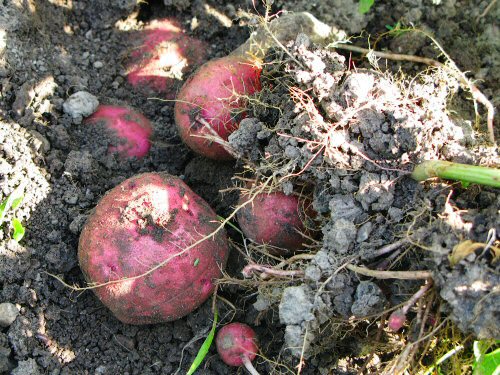
Thursdays are potato harvest days. Without a walk-in cooler, the main weekly harvest for CSA and Saturday farmers’ market is mostly confined to Fridays, with potatoes being one of the few crops that can be done a day or two ahead. Towards the end of the season, we dig up all the remaining spuds in one shot, but until then, it’s easier to go weekly. And since I don’t sell potatoes in bulk, curing them for storage is not an issue. It’s a tiny harvest, and the method of choice goes with it. Simply pull up each plant—they’re at 12″ (30cm) spacing—and scrabble around! Fingers work great. I used to use a digging fork, but that’s more work than it’s worth, and potatoes often get skewered. By hand, it takes 20-30 minutes per bushel (about 50lbs/23kg), really fast this year with quite huge potatoes after all the rain, and sometimes stretching to maybe 40 minutes if they’re small and the ground is drier and harder (this’ll happen in a really dry year, where potatoes get little or no irrigation). When the ground is dry, especially in clayey soil like ours that can get really hard, a hand tool like a trowel or tined cultivator can be good to break things up here and there after pulling. I kind of like how primitive the method is, and most people who try it REALLY seem to enjoy it. For the 2-3 bushels we need most weeks, it’s quick and effective! The variety here is Chieftain…

Harvesting around the rain

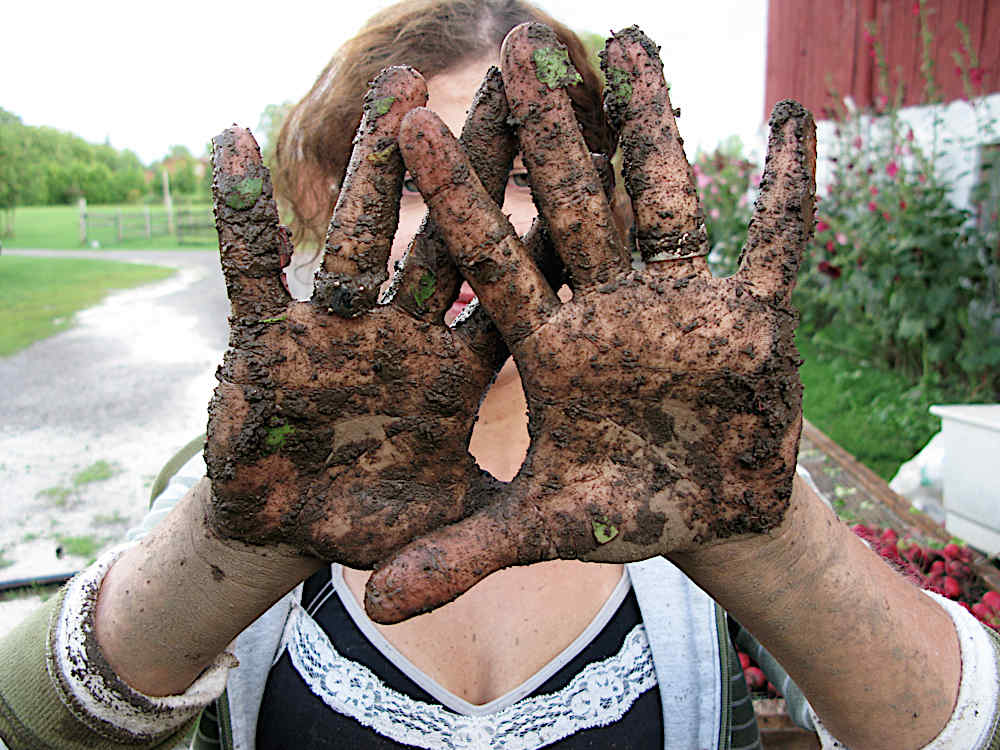
Muddy hands

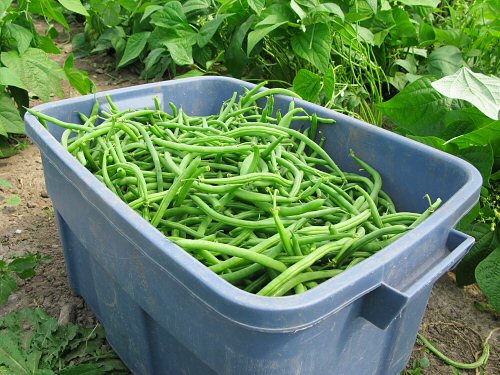
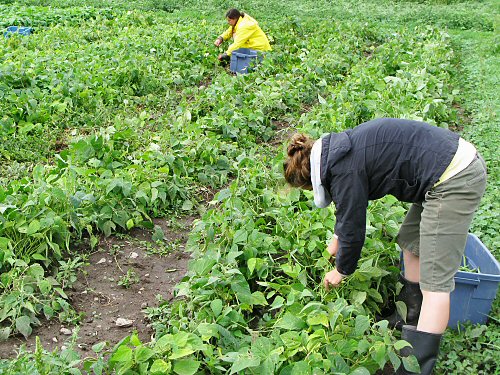
Have I mentioned that it’s been RAINING a lot all summer, like, a few times a day? We’ve taken to planning the Friday harvest to fit the slots between downpours, using…weather radar on the web! It works pretty well, checking the national and local maps, you can see precipitation quite accurately up to 3-4 hours out (it’s a little…high tech, but so is this crazy weather!). To avoid a late morning downpour, we started picking beans—finally, our first snap bean harvest of the year!—first thing in the morning (Maria, Lynn and that’s my bin at the top left of the pic below), so that we wouldn’t be messing with wet bean plants (they really don’t like being touched when wet, they get…diseased). That was pretty satisfying, picking about five bushels before the first shower, which arrived as foreseen. And so it went for the day. You can work between the daily rains, but mud avoidance is not an option—Michelle illustrates!

Laid back Friday harvest…

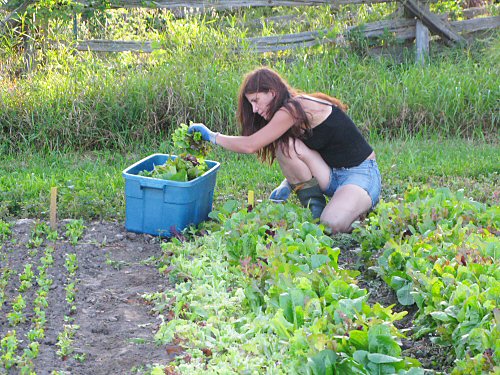
With the poor weather-driven slow growth and setbacks (like, hail), Friday harvests so far this year have been nothing like last year, much easier, less to do, relaxed. There are usually three to five people for all or part of the day, compared to six to eight last season. Comparisons don’t mean much on a practical level—the season you’re in is what you’ve got!—but it’s interesting, and human nature, I guess, to rank and rate and contemplate. Michelle has become this year’s mesclun cutting specialist, cruising in later in the afternoon and slicing up 60-70 lbs (approx. 30 kg) in no time. This year, depending on the veg, we’re doing about 20-40 units for sale, and around 30 for CSA shares for pick-up at the farmers’ market. Harvest on!

Garlic all in

Harvested in three parts over the last week, the garlic is now all in! This crop seems to’ve done well once again (I LOVE growing garlic!). For the first time, there’s a small pile of damaged goods, water-logged from all the rain. But overall, things are looking good. The combination of oat straw (from last fall’s cover crop) and grass mulch worked great (below)—weeds were kept down, and although the paths weren’t as heavily mulched as around the plants, they weren’t bad. We’ve been having trouble starting the riding mower, which means no trailer, so the tractor bucket took its place for transport duties. The garlic is stacked on pallets in the barn. Lynn seems to’ve taken to garlic harvesting and went to town: fork and pull, fork and pull…around 3,000 garlic bulbs hit the local food chain!

CSA share check-in

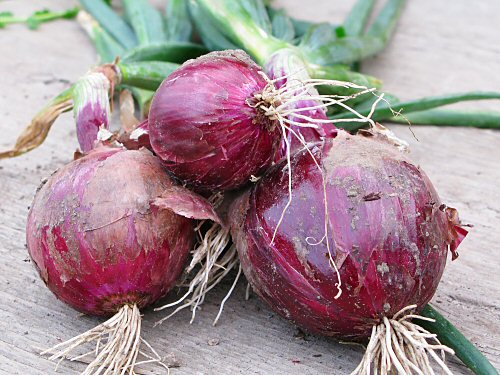
Monday morning means a quick small harvest for about half a dozen CSA shares. What’s in each share is my main harvest concern each week. The goal is to maintain the basics, like lettuce, carrots, onions, and also have some exciting new stuff each time. In a year like this one, with slow growth, this can be tough. But we’re doing OK so far. Today’s veggie menu, taken directly from the CSA newsletter: “In your share this week: basil (sweet); bean (Jade); beet (Scarlet Supreme); carrot (Touchon); garlic (Music); green onion (Ramrod); mesclun (all-lettuce); parsley (curly & flat-leaf); potato (Yukon Gold); Swiss chard (Bright Lights).” This season, shares are packed in really nice reusable shopping bags from one of the supermarket chains. They’re big and roomy, decorated with an assortment of veggie and fruit photo blow-ups, cost a buck, and can be replaced free of charge when they wear out. Much cooler than the hundreds of plastic grocery store shopping bags with the farmers’ market logo on ’em that I used to go through, and we also pass on the bags at cost at the market.

Rinsing…

On-going debates about the merits of rinsing are…academic right now as the near daily rains continue, and the soil remains between moist and mucky. Even on a rare hot and sunny day like today, crops are coming up caked in mud. Carrots are messy…

…and so are green onions (being rinsed by Mike) with tangled roots that hold clumps of mud so well…