
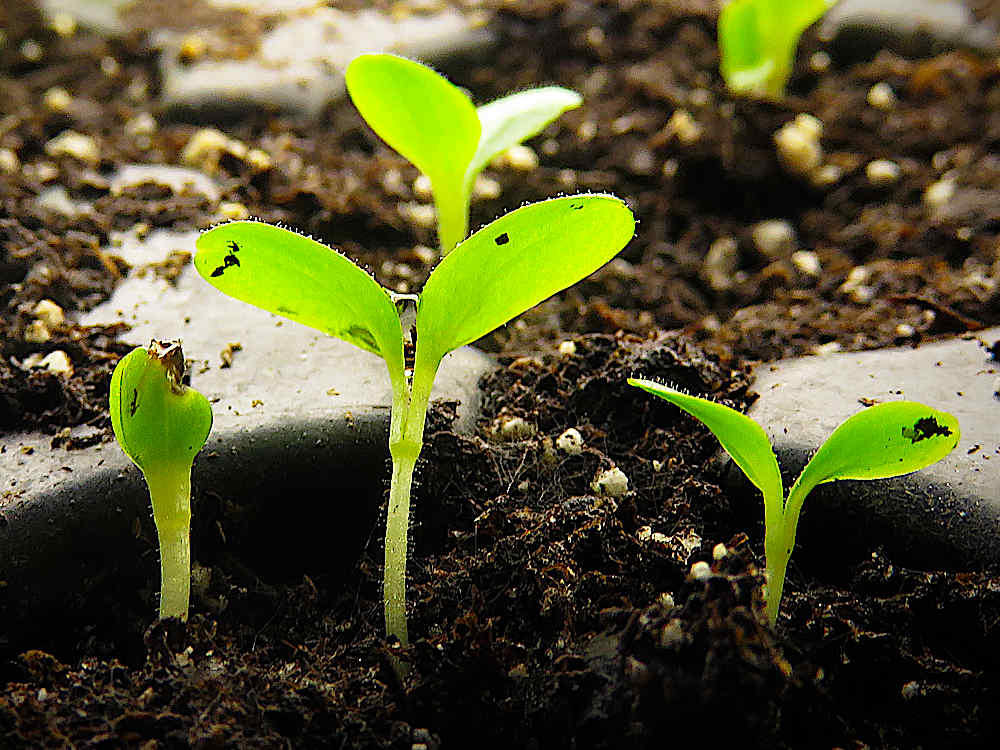
The first round of lettuce, five days from germination, under the lights. I could have started them earlier: two weeks, three, four? It all depends on the weather, when it seems right to transplant, and when you’re hoping for the first harvest. This year, hopefully young harvestable lettuce is ready by late June, so if I can plant them out in mid-May, great! Some years, I’ve started lettuce as early as February, for planting in April in an unheated hoophouse. This time around, it’s straight to the open field. We’ll see how it works out!
Tools
Equipment for large-scale agriculture is too big or too expensive, and many home gardening tools don’t work efficiently on larger jobs or break easily. Tiny farming on plots up to two or three acres requires its own special gear…
Tomatoes a month in
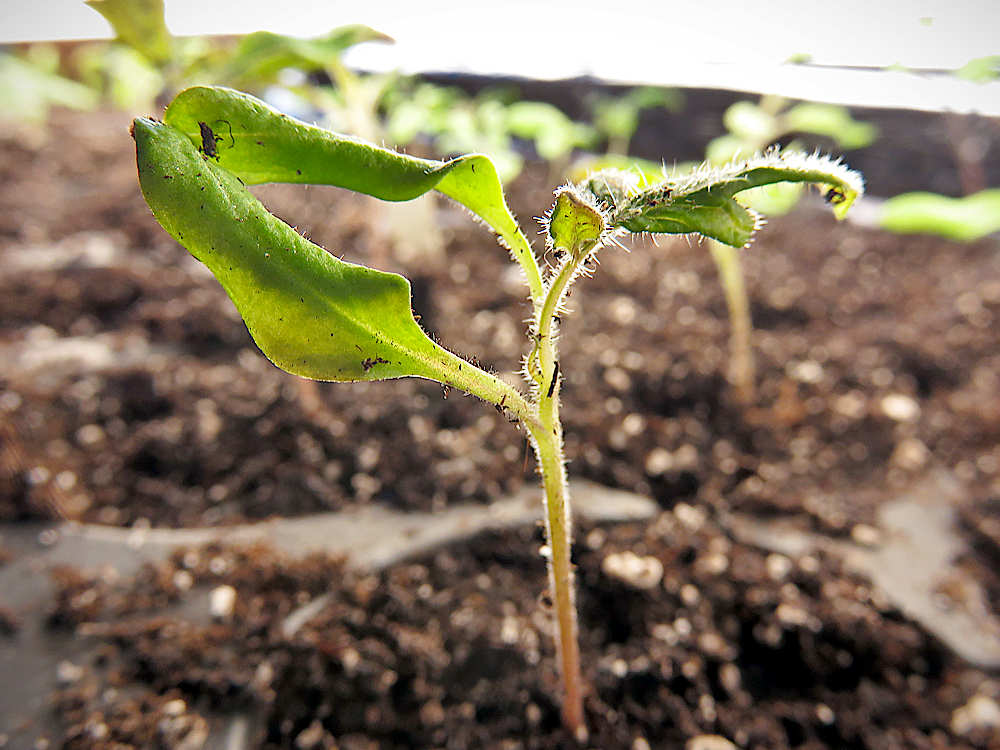
Tomato check-in, around a month after germination. On the left, the pair of plain, generic-looking seed leaves that come first—they’re still stuck together at the tip by a tiny bit of the seed shell. On the right, the true tomato leaves are taking over. See the tomato grow! :)
Pepper’s eye view
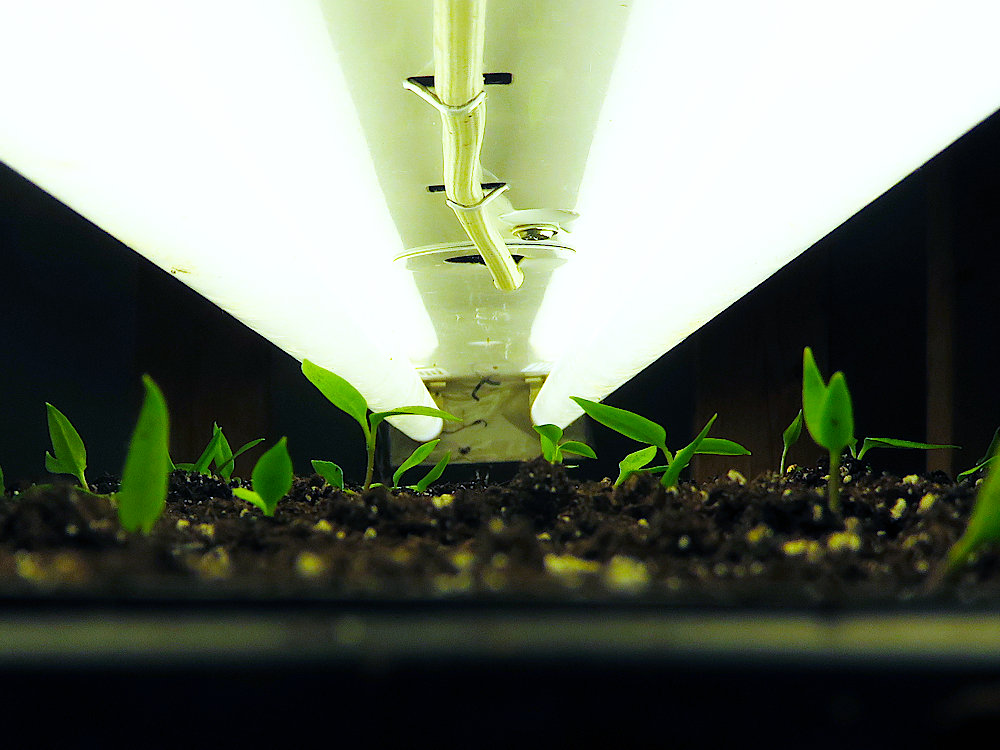
Here’s what the tiny sweet pepper plants would be seeing if they saw like we do, from under the fluorescent tubes in one of the light racks. It has a bit of an alien spacecraft hovering feel. The seedlings would be more pleased with the zillion times stronger real sun, but considering that it still drops down to freezing outside at night, they have to make do with weak substitute sun and indoor warmth as they get an early start on the growing season. These peppers are about a month old, still with only their seed leaves. Welcome to this season’s tiny farming transplant production!
Hauling water
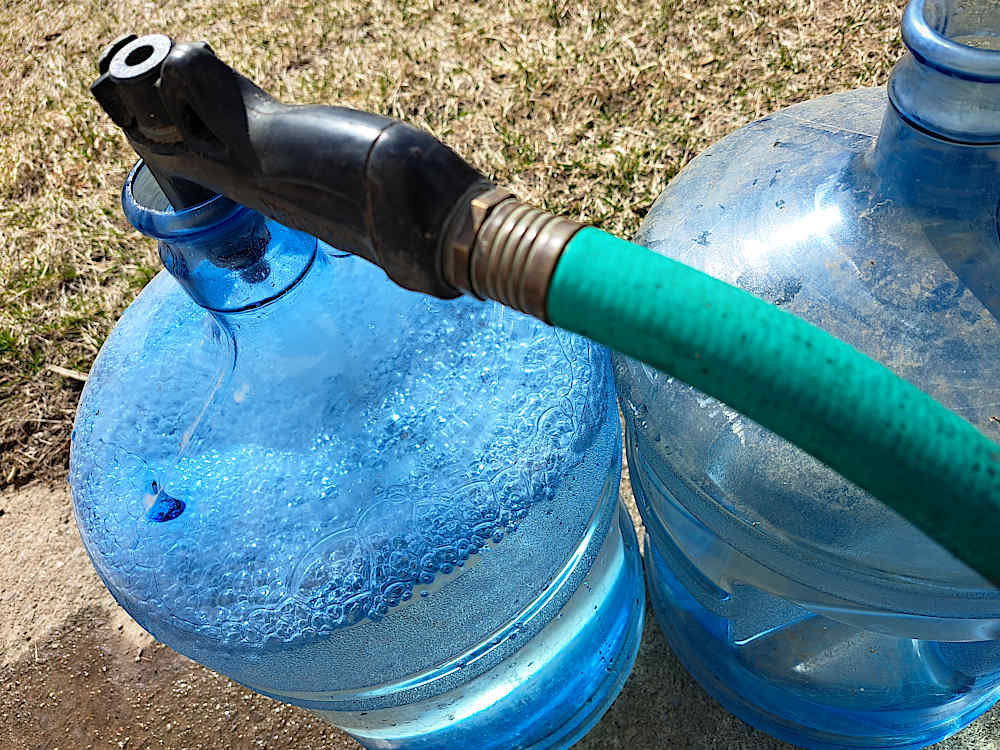
The seedling room is in a fully modern building with all the modern conveniences like electricity, heating, ample insulation and screened windows well-positioned for a bug-free cross-breeze and lots of natural light. The only thing missing is a handy supply of running water. Drilling for a new well located nearby ended in failure after a couple days of exploration produced only an expensive dry hole. So, until the gutter-fed rain barrels are turned over in warmer weather—overnight freezing of collected rainwater could crack them—I bring over water for the seedlings in 18 liter jugs filled from another well in a building not too far away. Simple systems and the rituals of spring!
First look of the year!
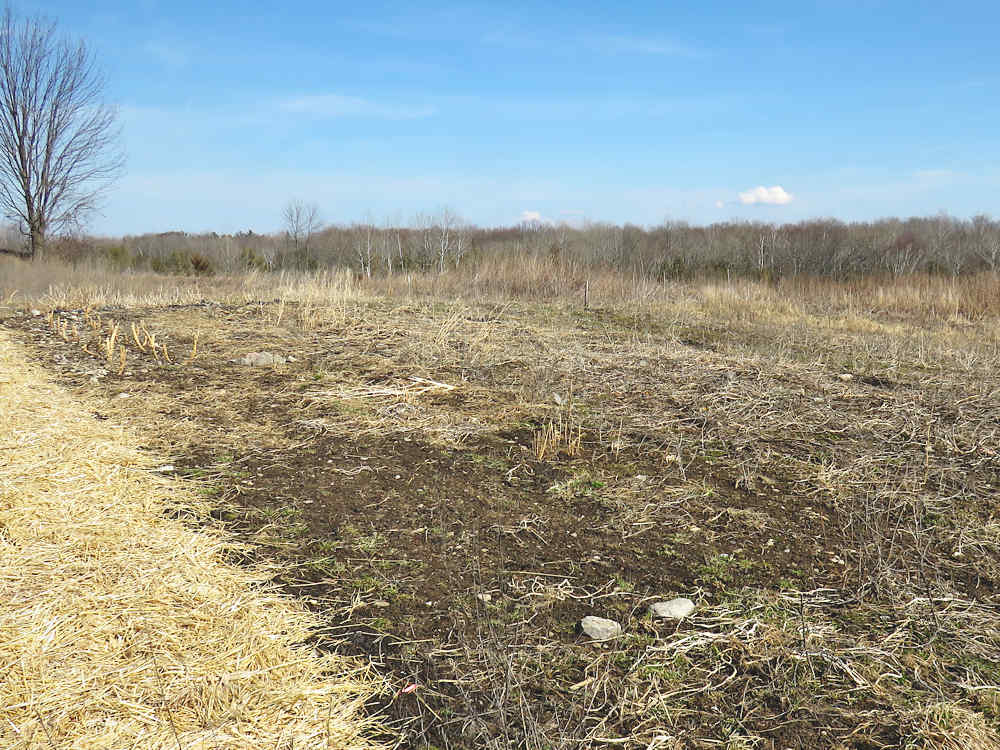
Today’s view of the field, my first since last fall! I’m about a mile (1.6 km) down the road, and I do sometimes pop by in the off-season. Usually, though, it’s out of sight, not out of mind for the whole winter. I’m still getting used to how much tinier the garden has been since I left the farmers’ market and the pandemic had its way. In any case, it’s looking fine. Most of it was cleared last fall. The straw-mulched garlic on the left seems cool, nothing poking up yet, I suppose not too early is good. And it’s really not wet, not the former usual dense, clinging, suck-you-down mud of the after winter melt-off (I’ve pulled my foot out of rubber boots trying to step forward in that stuff). Unless there’s a mini monsoon season coming up, I’ll be able to get out there pretty early, to set up the anti-deer-and-groundhog electric fence and prep beds. There’s still a broken rototiller to deal with on the tiny tractor, so that could slow things down. As always, we shall see!
Firestarter II
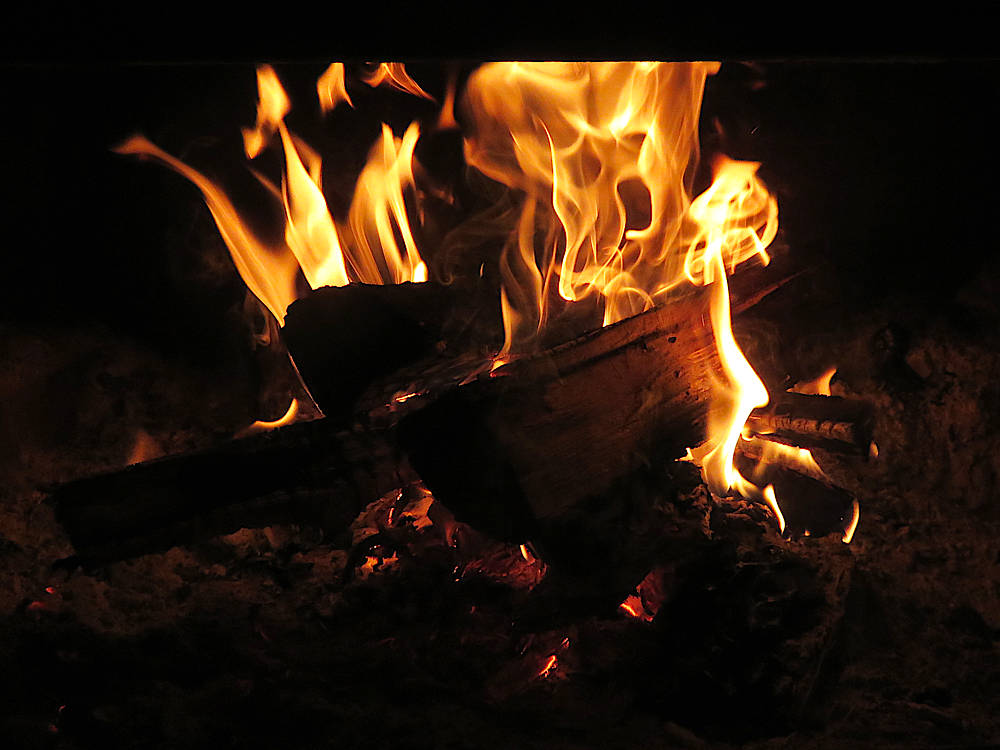
Enjoying the flames and the slowly building heat from starting the wood stove for the night. Guess this is saying goodbye to the semblance of winter we’ve just had. Wood heat and tending the fire seems best enjoyed when it’s so cold outside, you really bask in the indoor warmth and outdoors seems like a harsh alien force trying to get in. This year, it’s hardly ever gotten so chilly inside that a decent sweater wouldn’t offset if you had to make do. Of course, the wood stove did bring a huge level of…comfort! Here, it’s in what I think of as stage two of firestarting. The kindling and smaller pieces have done gotten things started. Now, medium pieces are kicking in. The air vents are at least partially open, so fire burns hotter and faster. After 15 minutes or so like this, it’s burning nicely, and there’s the start of a bed of hot coals. Then the full-size chunks go in, the vents are closed, and another round of wood heating is underway. That’s my method with this particular stove, and it does seem to work!
Temperature the old way

It’s around noon, and an unseasonably, pleasantly warm 62°F/17°C. This cheap old plastic analog thermometer has been hanging in a doorway for at least the last 10 years. It’s a quick and reliable way to see how warm or cold it is. No worrying if batteries are running down. No looking for the right angle to read the screen. Only this column of dyed-red alcohol—safer-than-mercury!—expanding and contracting, going up and down. The simplicity is soothing. The way it’s positioned, the afternoon summer sun hits it on one side, causing it to shoot up. Otherwise, all through the winter, it’s shaded from the direct sun, and it gives a roughly accurate reading of the air temperature, 24/7. Why not reposition it so it’s always shaded? Checking it for the temperature on a hot summer afternoon hasn’t seemed to be a big concern. Not sure why!
For tiny farming, I’ve used a few electronic weather gadgets, alongside analog devices like the trusty old min-max thermometer, and a plastic weather vane/thermometer/rain gauge combo that looked like a toy, that I stuck on a post. The thing about seeing the temperature in real-time, it’s a little late to do anything. It’s mostly about satisfying curiosity. On the other hand, min-max thermometers, that record the lowest and highest temperatures they hit until you reset them, they’re super-useful tools, for example, to monitor how cold it gets in the greenhouse at night and adjust! And soil thermometers, now they can come in handy!
Weather forecasts are another story. A day or so out, I’d say they’re around 60% right maybe a bit more (I could be off, it’s just a guess). Overall, it’s hard to tell how useful they actually are, though if you’re in tornado country, you may have a different view! Since yesterday, there’s been a weather alert on my phone. Not color-coded in alarming red and yellow, so far this one is only grey. Still, it’s a “warning”, not the milder “advisory”… The temperature may suddenly plunge in the afternoon, with heavy gusting wind, and the chance of instant ice on the roads. A cold front is coming, so, I guess, beware…