
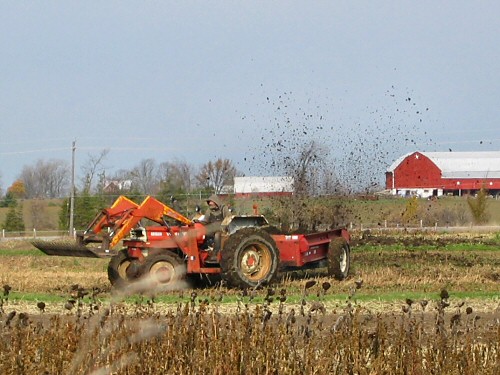
A satisfying few hours today, spreading year-old cow manure on the market garden. Bob and the old White 70hp handled the spreader (and you can see a rock picker attached in front!). I used the Kubota compact tractor to fill from the aging pile in the yard outside the loafing barn. Spreading, and the infrequent moldboard plowing, add up to an average of maybe a couple of full days a year of big tractor action. For 2007, this was a good chunk of it! (Guest photo by Karen.)
‘Tis the season…
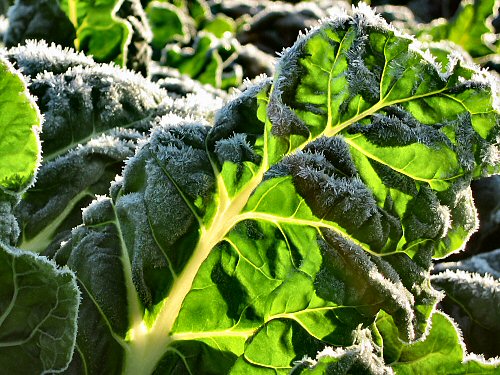
As a friendly reminder that the weather hasn’t gone entirely haywire, the nights have been cold lately, freezing or below, and some days begin with a reassuring blanket of frost on the field. Here, the Swiss chard (it’s trusty Fordhook Giant) is moments before melt-off in the morning sun. The chard can take a freezing and keep on tasting great. In fact, so can the rest of what’s out there: there’s still lots of spinach, kale, cauliflower, collards, plus beets and carrots safely in the ground. People are dropping by daily to get a last bit of whatever there is, so it all works out!
The new year begins here!
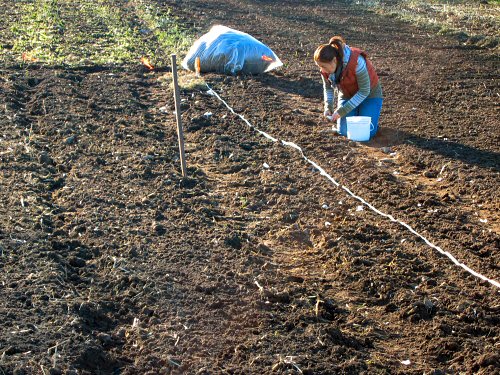
A perfect moment in tiny farming time as the first garlic goes in for next season’s harvest! It’s all Music (that’s the hardneck variety), and for the first time it’s 100% my own seed stock (last year, I had to buy some to add to what was set aside). The new garlic plot should be the best so far, with oats green manure and year old cow manure tilled in. Lynn and Conall dropped by to help. The row set-up is new. Previously, I’d done two double rows per 5′ (1.5m) bed, each double row spaced 6″ (15cm) in-row and between, with about 18″ (46cm) between the doubles. This year, a more intensive approach: five rows with 6″ spacing both ways, in a 4′ (1.2m) bed. What does all that mean? 500 garlic in 4’x50′ instead of 400 in 5’x50′. It should make mulching, watering and weeding that much easier! I tilled up the bed a couple of days ago to allow pushing in the cloves by hand (the moist, clayey soil gets pretty dense this time of year). The rows were marked out (you can just make out the lines in the soil), and we ran a measuring tape down the beds for quick checks on the in-row spacing, ’cause I’m a little concerned with crowding. They were planted about 4″ deep, from both sides, three and two rows, to avoid uncomfortable leaning (the greens machine was a little too narrow!). Afterwards, the beds were raked to fill in the holes. In the pic, there’s a bag of that new mulch, ready to go (although I ended up not spreading it today). The first 2,000 went in in three hours. I’ll add some more, another 500-1,000, a little later on!
Making mulch, part 4
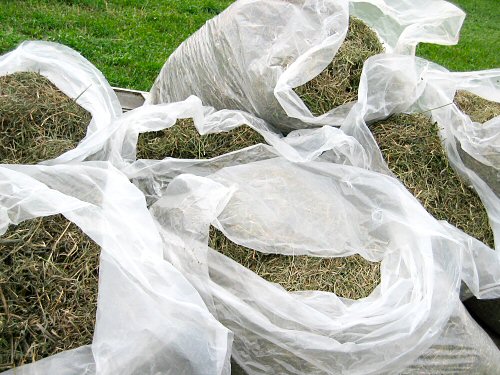
Fat bags of kinda fluffy grass-and-alfalfa mulch are the satisfying end of this little experiment (well, the real end comes next spring when we see how it does at sheltering the garlic for the winter). For this second batch, the bags are actually step 2, not part 4: I eliminated the greenhouse drying stage by letting the cut dry in the field and bagging it on the spot (which was always the plan—cut, wait, bag—the first time was just a bad weather thing). A small but to me really satisfying part is reusing those big clear leaf bags. We go through at least three or four new ones almost every week of the market season, for fresh cut spinach, mesclun, and other greens. They’re used once, and then I’ve been saving them for the last three years for JUST THIS PURPOSE! It’s great to see your plans materialize, right before your eyes!! Little things, big pleasure…
At the wheel
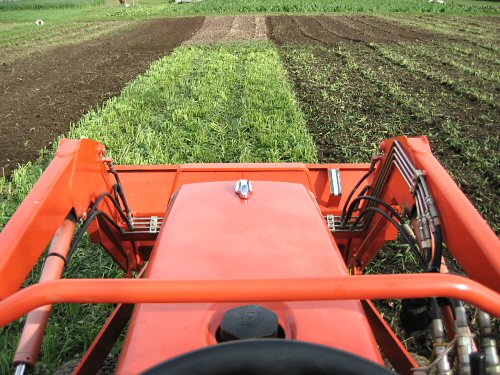
Tilling in the monster oats green manure/cover crop is a task where the Kubota compact tractor sure comes in handy. The oats is tall, dense and seemingly unstoppable by cold. It took a double mowing to get it down to a manageable state, and even then, it’s a slow till. The walking rototiller could’ve gotten the job done as well, but it would’ve taken several passes and a couple of tanks of gas, so I was happy to be at the wheel for this one. Originally, the plan was to let the oats winter kill, and work it in in the spring, but there’s just so much of it, I decided to take it out now rather than lose an extra week or two next year, waiting for it to break down. Decisions!
Zinnia vs calendula
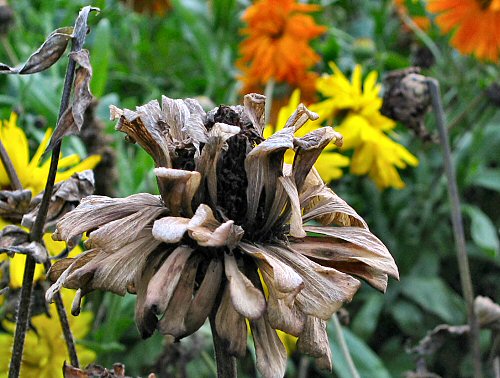
A vibrant slash of orange and yellow—the half-row of calendula seemed to be fairly unfazed by the recent blast of sub-zero cold, where the zinnias didn’t do so well. Another bit of first-hand frost experience to file away. Elsewhere in the flower test plot, the very few centaurea and asters seem to be kinda OK, still holding color. Otherwise, it’s all terminal shades of brown.
Killing frost, kinda
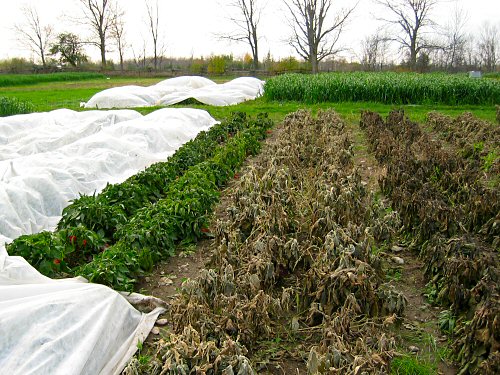
Yes, the weather’s crazy. According to the min/max thermometer outside the greenhouse, last night’s low was a chilly 18°F (-8°C), cold enough to kill off all but the hardiest. Finally, and only six weeks or so late—the endless autumn harvest is interesting, great for personal use veggies, but otherwise, it mainly throws off the fall clean-up schedule (I haven’t changed zones, have I?!). Here, the eggplant is clearly toasted, while the peppers, which had been under fairly light row cover (I pulled it back today to harvest some), came through in relatively fine shape . And the oats, well, it’s a monster, lush and green and if not exactly growing anymore, it seems to be getting thicker. It’s fascinating the way cold works in the field. Wind, cloud cover, mini-windbreaks, slight elevation, all kinds of factors add up differently in spots only a few feet apart to determine life or death by cold. Anyhow, can’t wait around forever. I’m soon going to roll up the row cover and till it all down!