
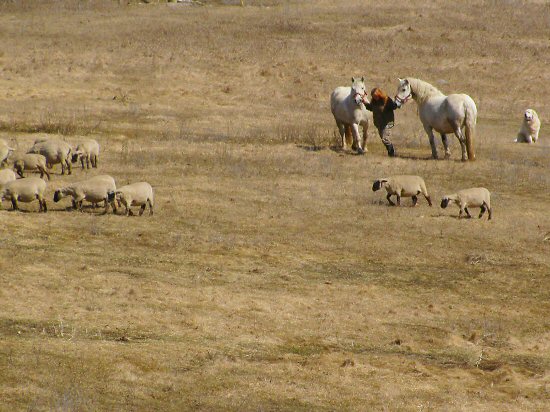
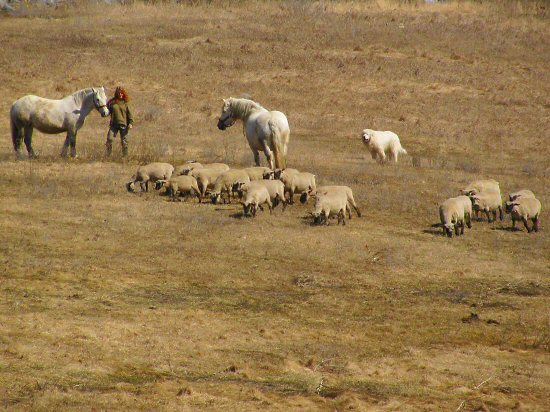
After only chickens last season, it’s farm animals in full force this time around. In the pic, Montana with the new-to-the-farm pair of Percheron work horses, the Shropshire sheep, and Rollie, the youngest of four Great Pyrenees livestock guardian dogs, looking on. Elsewhere, there are heritage breeds of pig, chicken, turkey and goose, plus other dogs, and two cats, as well. I’m looking forward to learning a lot. And if I ever fall behind in posting to the blog, quick and easy photo opportunities are…everywhere! :)
1440 onions
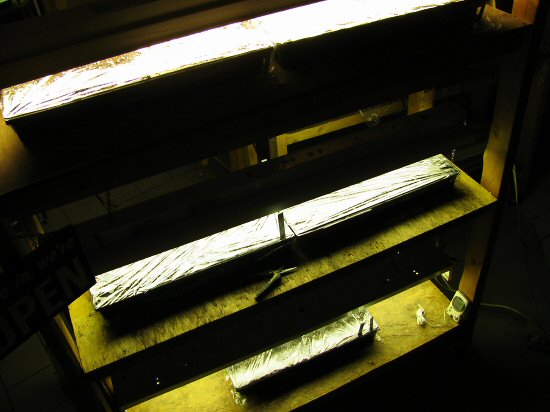
I’m sure I’ve taken this photo before, but somehow, it’s still new—the first transplants of the season! This is the look of 1,440 onions, starting out. These are 72-cell plug sheets, and the plan is to multi-plant four onions in each spot. Do a little multiplication—5 trays, 72 cells, 4 onions per—and the results are clear. Whether things will turn out exactly like this, perfect bushels of Red Globe red and Utah sweet Spanish, is anybody’s guess, but I’m quite confident we will get…something! :)
All the usual tools and methods for this tiny farm are back for another run. There are still at least a couple of years left on the roll of donated food-grade plastic wrap that I use (and re-use for the season) to hold moisture and increase heat, just until the tiny seedlings emerge. To check temperatures in this new seedling room, on the lowest shelf of the light rack, where it’s coldest, is one of the minimum/maximum digital recording thermometers. And of course, there are the trusty, home-built light racks themselves, with an assortment of T-12 and T-8 fixtures and Cool White fluorescent tubes, providing the bare minimum of heat and light to get things started.
I’m always up for trying new approaches and new gear, but a lot of the time, if it gets the job done and you’re already having fun, what more could you need?!
In the beginning, again
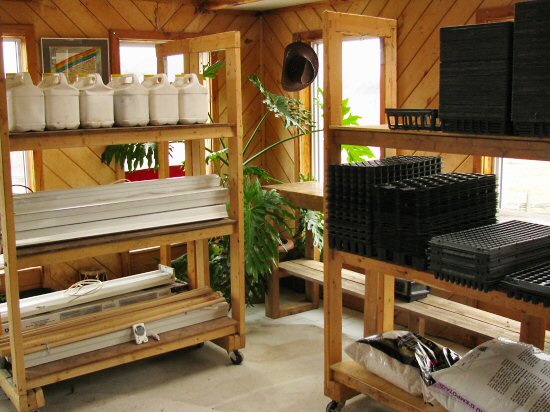
There is really no one absolute moment when a new growing season begins, so I guess today is as good as many to make the call. All the familiar gear is in a new farm home (there’s a bit of backstory here, that I’ll eventually get to in the About…), and right now, we’re setting up the light racks and getting ready to seed. This will be my eighth season of tiny farming, and it should be an interesting one!
Play in mud!
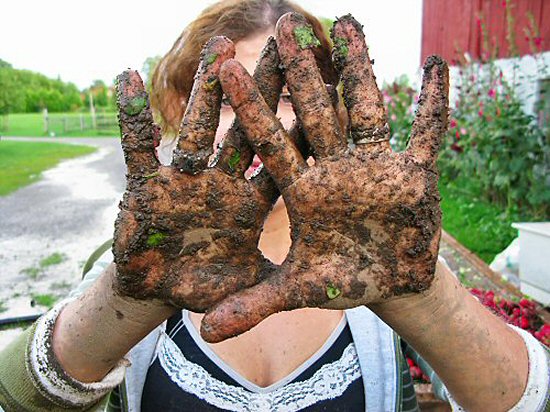
A mid-winter flashback to one of my favorite farm photos—it’s just so…hands-on. On the tiny farm, many of the things we otherwise consider inconvenient, like rain and MUD, are actually just fine. Sunny days are NICER, but there’s plenty of room for wet as well. Originally posted on Friday, Aug. 8, 2008, when we were harvesting-around-the-rain. (That’s Michelle.)
Winter storage
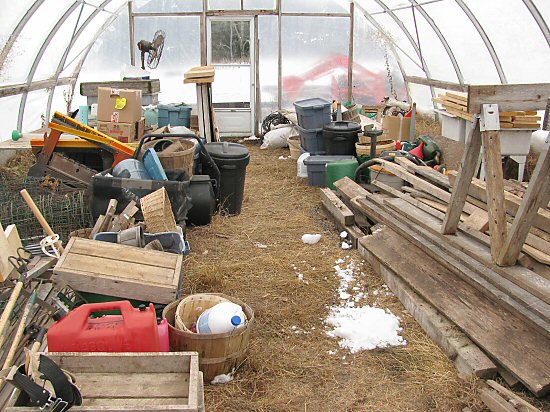
Snow’s here—it’s definitely overwinter storage time! Winter storage is a little different every year, as needs, facilities, and plans change. This time around, a fair bit of gear is in the 20’x32′ (~6×10 m) hoophouse, with its full sun exposure and fairly extreme temperature spread (from double-digit subzero at night, to 80-100°F/25-38°C on a sunny day!). Sooo, you don’t want to be storing just anything in there. Anything that’s damaged by freezing isn’t a good idea. And plastics that aren’t UV-resistant will break down, fading and weakening (really, most plastics not meant for constant outdoor use should probably be kept out of the sun whenever possible). Here, it’s mostly wood—extra rough cut cedar from a project a couple of years back, tomato stakes, tables, farmers’ market display trays—which is OK, and I’ll get the plastic items under cover. Except for checking the snow load on the hoophouse after big storms, that’s all she wrote until early spring. The outdoor part of veggie farming in our growing zone will now take a bit of a snooze…
Snow pile
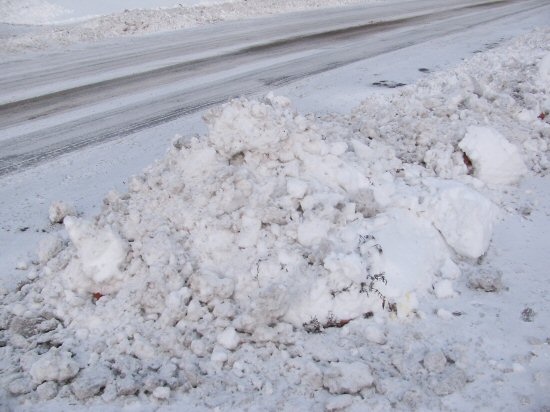
A familiar season-marking sight for anyone in snow territory, this is the start of what may turn out to be a growing, winter-long snow bank. The mini-blizzards of the last couple of days laid down at least 7-10 cm (3-4″). Road clearing mixes up dirty snow in hard-packed windrows, and driveway clearing creates mini-mountain piles. Will it stay or will it go? The indoor part of tiny farming veggies in a cold climate begins…
Front yard farming!
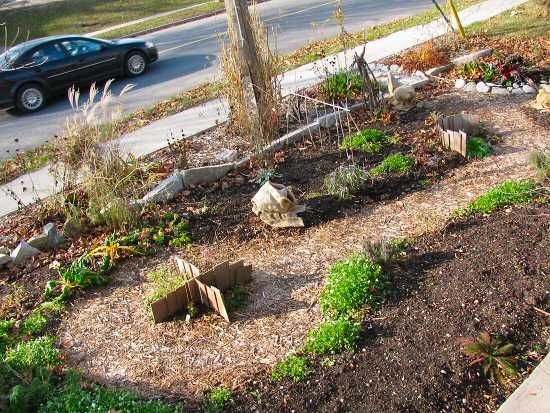
Often heard about, never before seen first-hand, this is front-yard tiny farming in action—late fall edition. I’m at the home of Andrew and Sue and Margo, in a town of 70,000, leaning on the front porch rail on a residential street lined with single homes on small lots. Typical front lawns all along. Except here, where the grass is gone, replaced by an eclectic collection of veggies and herbs. Beets, carrots, tomatoes, corn and several other crops are already gone for the season. Still up and struggling along in the cold, there’s colorful Swiss chard in a couple of spots, parsley and sage, and a few other things that need a closer look to ID. Andrew also mentioned native edibles, like ostrich fern (fiddleheads), wild ginger and wild leek. And more. The keyhole path set-up comes from permaculture methods: minimum path for maximum access to the growing area. It’s a front-yard revolution! After a season or two of sidewalk-side veggie abundance for all to see, I wonder if this alternate land use will start to spread up and down the street! Urban agriculture. Pretty cool!