
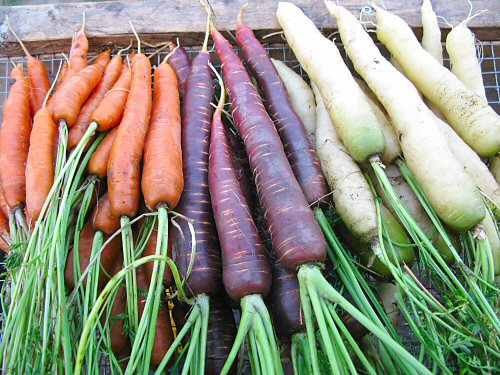
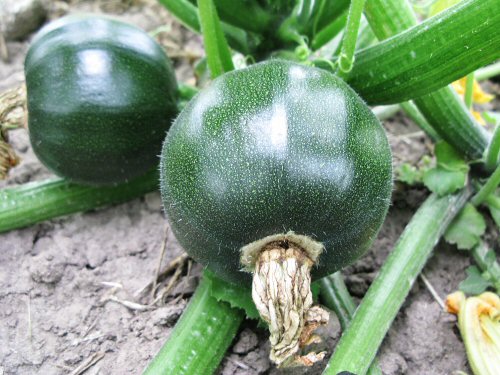
This isn’t the first time I’ve pondered the question of variety on TFB, but the consideration recurs, so here’s another take… It would seem to be all around easier to grow just one variety of each veg crop, but that wouldn’t be any fun! One round, red beet, one big, round, red tomato, one shell pea, and so on. That’s the standard approach for most of the other full market garden growers at our small farmers’ market. There is SOME variation: green and yellow snap beans, maybe French Breakfast (red and white) radishes along with the standard round red ones, a few types of winter squash… Which is cool. Why bother growing three or more types of orange carrot, let alone orange (Nelson), purple (Purple Haze), and white (White Satin, for the first time this year)? I dunno. By growing several varieties of each veg crop, I’ve learned a bit, like the performance difference between hybrid and open pollinated varieties (in general, the OP tend to do better when field conditions get a little extreme, but that’s not a….scientific conclusion!). It’s not to be a novelty act, the guy at the market with the purple carrots, golden beets and round, yellow cucumbers. Or the round Eightball zucchini (below). If efficient tiny farming was the sole goal, I don’t have a really compelling…justification for all of the complicating seed ordering, transplant organizing, and extra direct seeding work it takes to grow as many different crops as I can, and numerous varieties of each. On the other hand, growing and offering variety, choice, and the non-standard make tiny farming so much fun. Which sounds good to me! It seemed like the thing to do from when I first pored over a seed catalog six years ago, and nothing’s changed my mind since! :)
Potato fruit
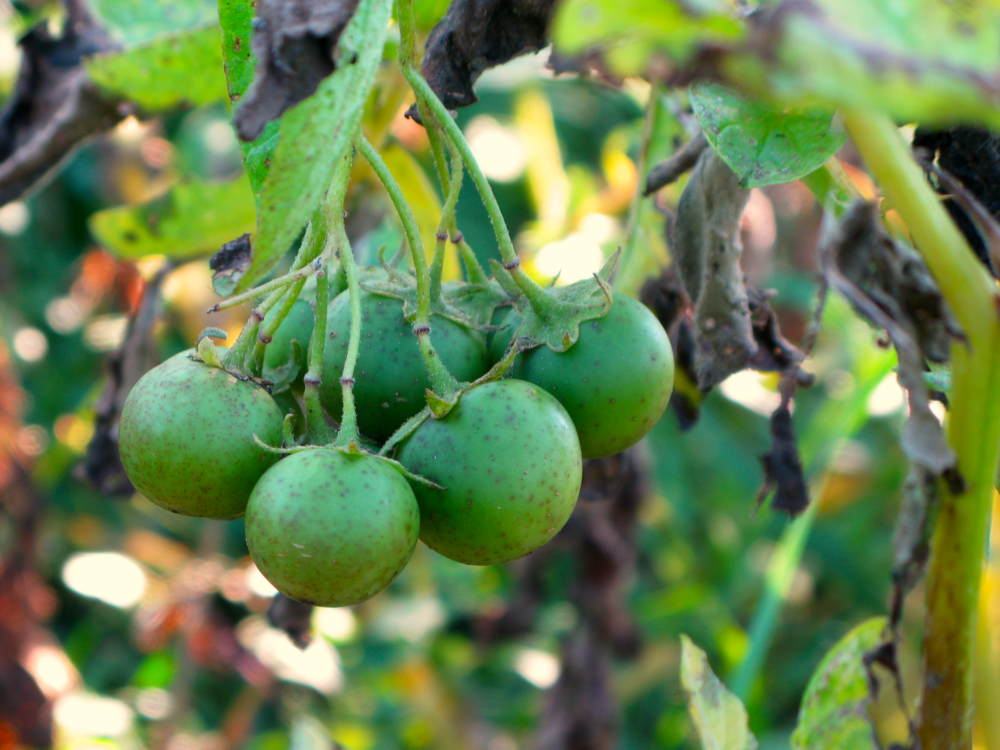
Here’s something I haven’t seen before in my, uh, six years of growing potatoes: green, tomato-like, walnut-sized potato fruit. Bob hadn’t seen ’em either, in 40 plus years of farming. I hit the web for education.
These are genuine fruit (also called berries), but not that common. Usually, potato flowers just drop off. Pollination can be an issue, but even when pollinated, little details of the season’s growing conditions can make the the difference. When fruit do form, they’re more likely found on certain varieties, like Yukon Gold. This year, there were fruit on just about every Chieftain plant, here and there on the Kennebec, and none that I noticed on the Yukon Gold. Since they suddenly appeared this year on two varieties I regularly grow, I’d guess it was about the weather!
Each fruit contains 300-500 seeds that don’t come true: planting them doesn’t result in the same potatoes as the parent plant or each other, there’s lots of genetic variation, each seed will produce a genetically different plant! Potato breeders plant out thousands of seeds, check out the results, then keep replanting the most desirable potatoes for many years or generations to get new commercial varieties—this is the traditional way new potatoes are bred.
Meanwhile, it takes only two seasons and one generation to breed a new potato, so for the small farm or home garden, as opposed to the big potato breeder, this seems worth a try. At least as an experiment. Harvest seed one season—you can hand-pollinate to cross two varieties—plant out the next and select the best-looking plants. The tubers (potatoes) from each individual plant are ready to go: planting out the tubers will produce genetically identical plants.
But there’s a kinda big BUT: even though a potato grown from a tuber is genetically the same, you can’t be sure how its genetic makeup will react to different growing conditions. For example, it may be the perfect potato after a wet summer, and quite different after a dry one. (That’s why professional breeders check over several generations, and now there’s also high tech genetic analysis, to make sure it will be the same potato in the full range of growing conditions.) Still, at the very least, fun to see what happens!
And, the fruit are poisonous, rich in solanine, not for eating. Potatoes, tomatoes, peppers, eggplant and tobacco are all members of the “deadly nightshade” family, all prone to having toxic parts (potato fruit are somewhat similar to little, hard green tomatoes). Interesting!
Since this is such a popular post, being dug up over and over via Google, I’ve started to update the article as I discover more. The post sounds the same as it always did, just surgically filled out a bit with more info. This is unusual. In general, I don’t edit old blog posts, and clearly mark the updates when I do!
Outhouse deluxe in action
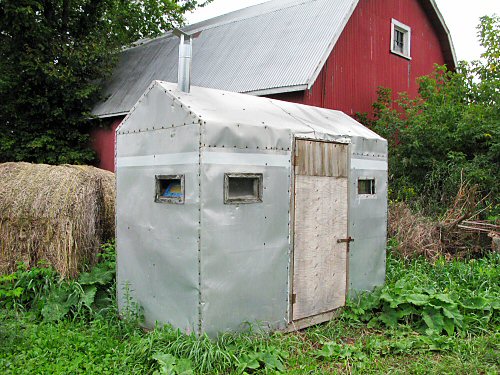
The deluxe outhouse—deluxe because this converted ice fishing hut houses a slick new composting toilet—has been sitting out in the field for a month now, nestled behind the drive shed, just inside the gate at the top of the market garden field. It’s all clean and shipshape, but the interior decorating plans bouncing around back in early summer haven’t come to pass. No whitewash, no Tibetan prayer flags, candles, incense, or other deluxe fittings and accessories, just single-ply toilet paper and a small bucket of peat moss, for tossing in, a handful a day. No frills! The toilet is equipped with an electric heater and fan for dealing with high traffic—up to eight people, three times a day—but I haven’t plugged it in so far, as I’m the only regular client. So far, in fact, there’ve been only TWO other takers to pass through the door. Oh well, if you haven’t experienced convenient, in-field evacuation, without plumbing…you haven’t tried it all! No odor, no flies… It’s great!
Parsnip surprise
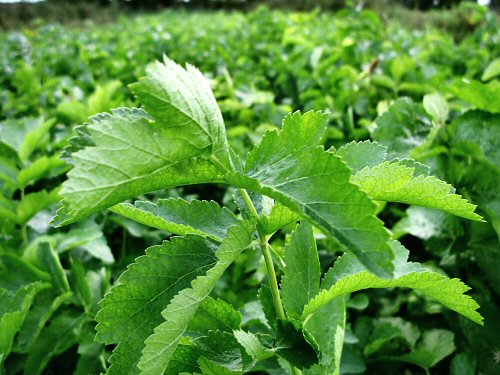
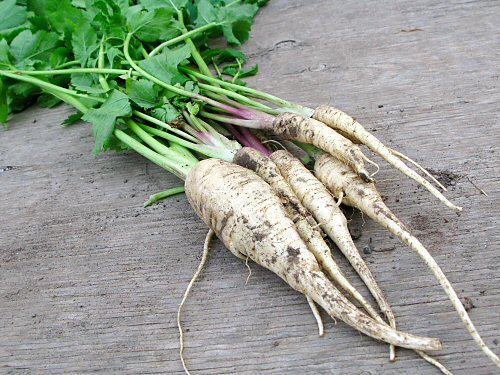
Parsnips, at last! This is a crop I’ve tried to grow almost every year, but until this season, it’ hasn’t come through. Parsnips take a while to germinate, a couple of weeks or more, right in the middle of the spring planting-out rush. Weeds would start to take over, parsnips weren’t a priority, and I’d never find the time to save them. This year’s warm, wet spring made a difference. Germination was quick and the seedlings surged ahead of the weeds! Nearly four months later and, even in dense, unthinned rows, the parsnips are thriving. Yay! Today, I dug up about 6″ (15cm) of a row to check ’em out. With the crowding, there’s a motley assortment of sizes, but overall yield looks good. Another month in the ground, a little post-harvest sorting, and it’ll be parsnips for all!
Farmers’ market set-up
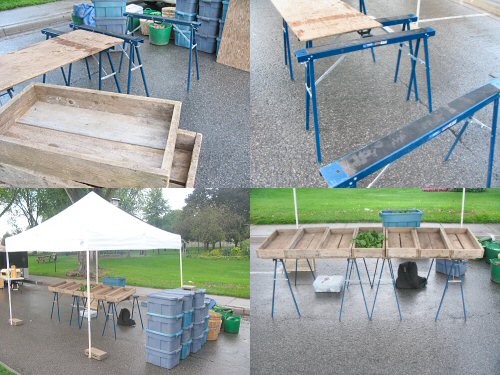
Settting up at the farmers’ market is definitely fun, although I tend to be in a mild daze with an average of literally three hours sleep before getting up at 5:30 (that’s just how it always works out for me :). Today, I planned to take pics of the whole routine, but forgot to start snapping from the beginning. At this point, the truck is unloaded, the canopy’s up, and we’re setting up the tables and trays, and starting to load up the veggies! Unfolding the sawhorses and placing the boards and trays takes maybe 10 minutes tops. Then, it’s on to placing the produce, after that, the price cards and signage. Stay tuned for more complete coverage…maybe next week!
More post-harvest action
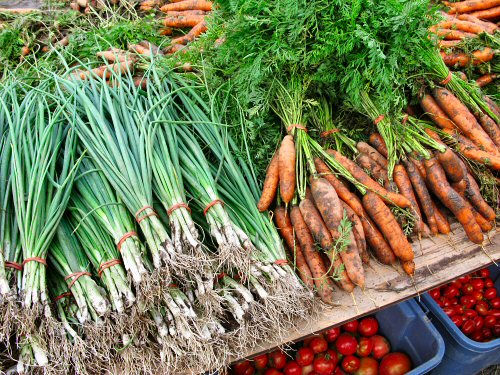
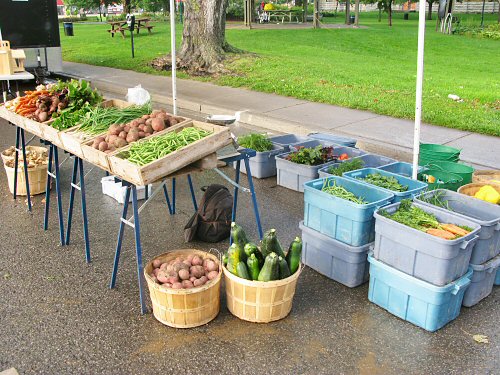
If it’s Friday, it must be time to harvest! After a beautiful weather week with barely a cloud in sight, an otherwise welcome gentle rain today meant a bit of a muddy harvest. Here, the picking and pulling has all been done, and we’re about halfway through the sorting and rinsing. Ramrod green onions are all bundled and ready for a quick rinse. Nelson carrots are underway. And, a couple of several bins of tomatoes, with Juliet saladette in one, and a mix of smaller heirlooms in the other. With toms, we only fill the bins 2-3 layers deep to avoid squashing and splitting, especially with big heirlooms. (I suppose getting cardboard tomato flats, one tomato deep, would be more space-efficient, ’cause the pick-up truck that we use does get full around this time of year, but so far, we’ve managed without.) Everything’s looking and tasting good!
Onions from seed!
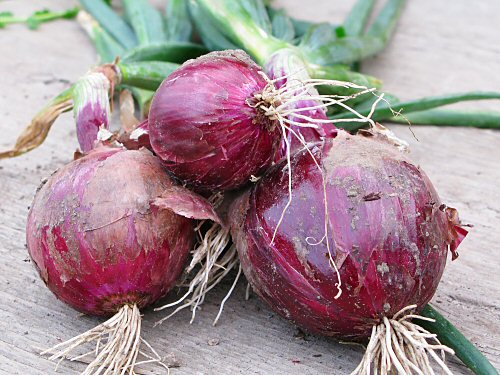
This is the first year I’ve tried growing onion from seed, and they’re doing fine. Today, I pulled up one multi-planting of Red Wing to check ’em out. Multi-planting onions was also a first-time experiment, with 3-4 seedlings transplanted in one spot, at 12″ (30cm) in-row spacing. They’ve done a good job of pushing themselves apart, they’ve stayed pretty round, not flattening out where they touched.
Another thing I was a little concerned about didn’t come to pass. For around a month, the onion seedlings had already been under the usual 14-16 hours a day of fluorescent light on the grow racks, when I read about the possibility of daylength sensitivity at the seedling stage. When the amount of sunlight reaches a certain threshold, over 12 hours or so for long-day varieties, the onions move from leaf growth to producing bulbs. A couple of sources said that premature bulbing can be triggered by too much light too early on, even at the beginning seedling stage, and you’d end up with tiny, marble-sized onions after a season in the field. Other sources disagreed, but in any case, that didn’t happen here! Still, in future, I’ll start long-day onions under reduced artificial light…to be safe.

As usual, the cracked surface of our clayey soil looks rougher than it is: it isn’t really hard, only a thin, dry layer with moist soil right underneath. Here, four out of five seedlings have pushed apart, rotating the stems outward, and grown into decent-sized…onions!