
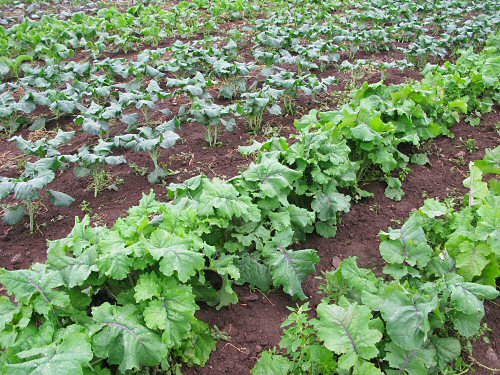
After a good weeding and another round of rainy days, the fall brassicas are pretty well on their own. It’s amazing how quickly growth slows down in September—what a difference the sun pulling away makes! The kale and collards are doing fine—we’ll be harvesting some Red Russian kale tomorrow. Broccoli and cauliflower will come through. Whether cabbage, planted this late for harvesting at baby size, will make it by mid-October is up in the air. More gambling and waiting to see…!
Donkey care
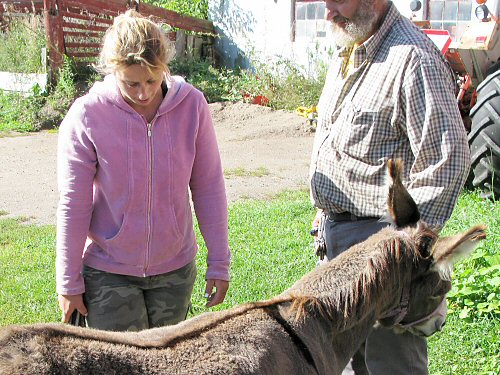
Tanya the Farrier drops in on Jack the Miniature Donkey every 6-8 weeks to clean and trim his hooves. It’s a pretty quick operation, maybe 20 minutes. You might expect trouble, Jack being a fairly frisky, 400+ pounds of muscle, hard head and hoof, but he’s also easy-going, and Tanya seems to have established authority way back. I’ve been watching this routine for the six years I’ve been here. Bob does the holding, and Tanya goes to work…
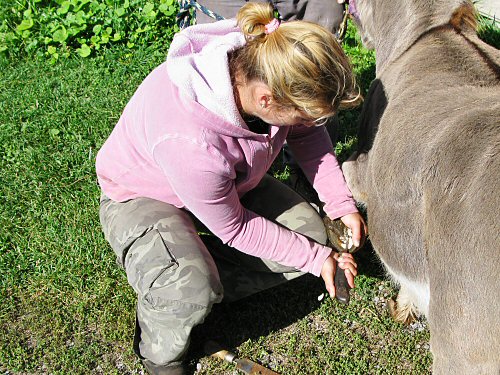
…using a hooked knife to prying out built up gunk…
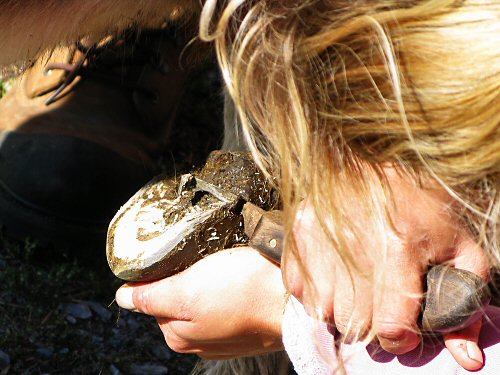
…and trim down the hoof.
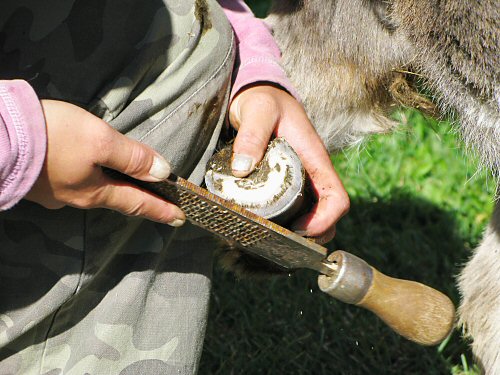
A rasp is used for finishing touches…
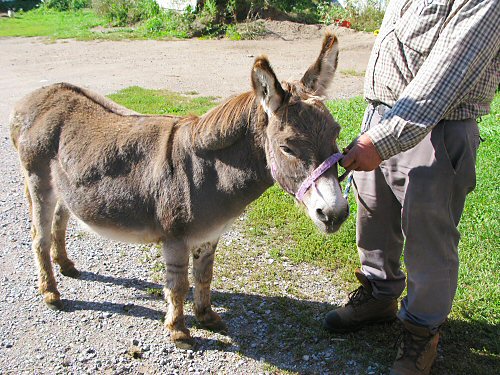
…and in no time, Tanya’s gone and Jack’s good to go…
Trimming garlic
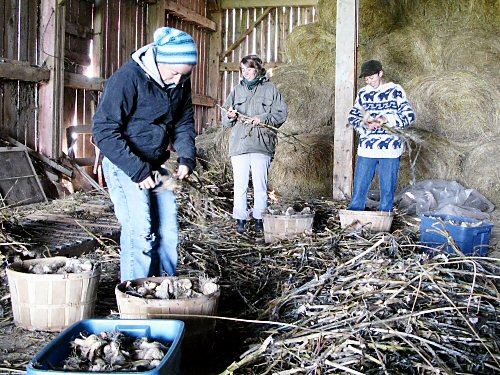
From the long stack of garlic drying in the barn, we’ve been taking out about a bushel a week since harvest began in late July. Today, we finished preparing the rest of the harvest. Lynn, Raechelle and Mel snipped the stems and sorted at the same time. (The roots weren’t trimmed; that can be done for some as we go through the bins and baskets each week for CSA shares and the farmers’ market.) In past years, the sorting was for size: dividing the mostly medium and large bulbs, and putting aside the very few tiny and damaged ones. Garlic does best with a dry final month of growth—this time, coming out of ground that had remained quite wet all summer, the harvest wasn’t in as good shape…
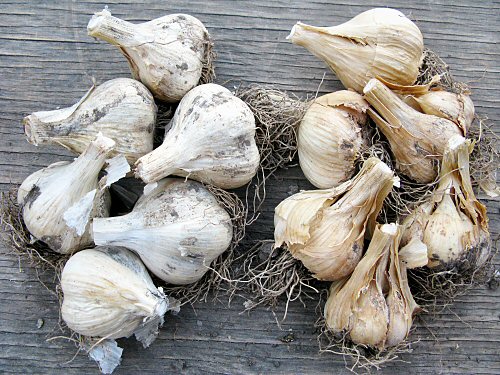
Sizing evened out, with most bulbs about what I call “medium” (this is the most useful size for cooking, but the big ones are so…impressive, everyone loves ’em). A little over half dried not to the usual tight, white skin, instead, to a tan color, wrinkled and split. So, we sorted into “good” and “not so good”… There was also a much higher proportion of really damaged bulbs, maybe 10% compared to a usual couple per hundred. Still, the taste is great, and the cloves themselves are fine. Only appearance and storage life are affected. We’re selling the less pretty, less storable bulbs at a couple of dollars less per pound. They’re good for immediate use (within 3-4 weeks, maybe a little longer) and as seed garlic for fall planting. Overall yield was great, although I’m not sure whether the hugely reduced number of large bulbs was due to weather, or to the more intensive 5-across planting we tried for the first time. As usual, more to observe and learn from. All in all, given the poor garlic weather, it all worked out quite well!
The Omnivore’s Dilemma
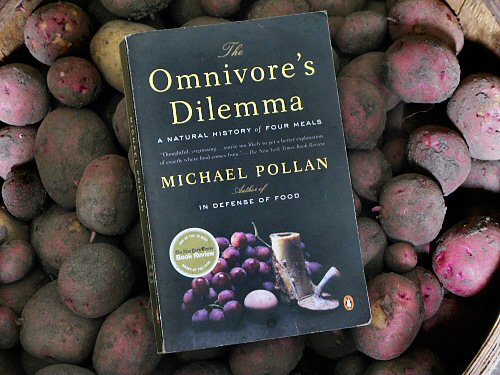
Since I mentioned buying this book a while ago, I might as well wrap it up! I recently, finally read Michael Pollan’s The Omnivore’s Dilemma: A Natural History of Four Meals, an investigative reporter’s full-on indictment of modern food. It came out in 2006, but with all of the praise and recommendation I’d heard from people around me and online, it almost felt like I was waaaay behind a life-changing, or at least, EYE-OPENING, experience. In fact, I’d read excerpts and heard Pollan speak on radio and TV, and I had a pretty good idea of what the book would be like: HIGHLY ENTERTAINING and densely packed with condensed bits of accessible scientific explanation, intriguing and disturbing facts, and involving eyewitness accounts. OD definitely delivered on all counts.
I read it over a couple of days, a real page-turner! For a week afterward, choice nuggets of often alarming info swirled in my head. And then, the details started to fade. It’s now a couple of weeks later, and a few choice bits remain. I really like the idea of being driven by the complementary opposing forces of neophilia and neophobia (kinda like the angel and the devil, sitting on each shoulder…), and that we humans developed big, powerful brains in order to figure out what to eat (something like that). The description of grass farming was absorbing. Mushroom hunting sounds…extreme! And so forth. Oh yeah, and we’re feeding ourselves crap!
The one big downside of this sort of intensely involving overview, covering so much territory in just 400 pages, is that you can’t absorb that much in a practical way. So, you’re entertained in an agri-suspense/thriller/horror style. The result: if you weren’t already convinced (I was…), you’re now likely quite certain that our food industry and the food it produces are both…horrifying (that’s not good!). You also hang on to some interesting facts that you didn’t know before, maybe stuff that you’ll go on to explore. And perhaps all this will fuel some significant personal action (that would be good).
All in all, OD is engagingly written edutainment, and I’d recommend it as a good read. As for its life-changing impact, the mileage no doubt varies.
Fantastic egg tray technology!
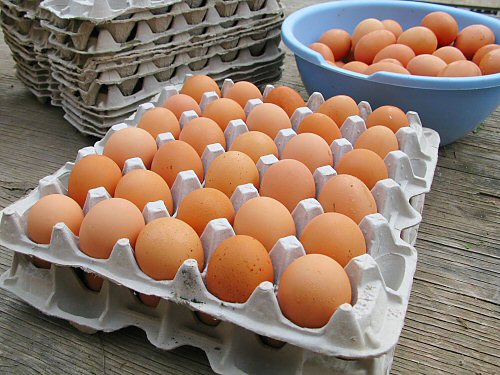
OK, so they’re just regular cardboard egg trays from the commercial kitchen world, and they’ve probably been around exactly like this for decades. BUT, they haven’t been around HERE. Lynn recycled them from Shelter Valley Folk Festival, where she was last week, where they were feeding big groups of volunteers. The trays are fantastic! Our chickens produce only about two dozen eggs a day, but that still adds up. I’d been keeping them at first in regular one-dozen cartons, then in bowls and small baskets. It was getting a little out of control. Now, they simply, efficiently stack in the fridge, 30 per tray. Every second week, like today, we bring a bunch to the farmers’ market as a bonus in the CSA shares, and the trays make transport a lot easier as well. Amazing. :)
Cutting spinach
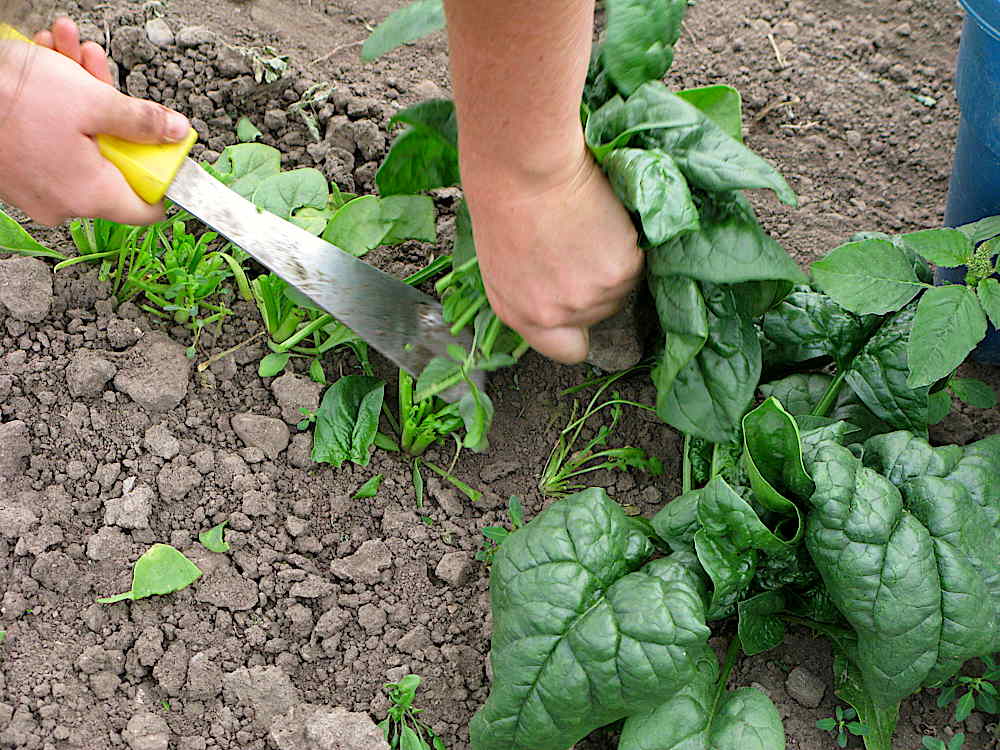
Spinach has kinda been the star of the harvest for the last couple of weeks. After a “normal” summer—hot and dry for the last three years—it’s usually not around at this time of year due to poor germination. This season, with cloudy, cooler days and all the rain, spinach is in abundance: glossy, deep green, succulent, full of flavor. Libby and Lynn chop away, cutting an inch or two up the stems. This technique takes out the small new growth leaves, but it’s fast and efficient, and the plants still grow back for a second harvest. The alternate picking-single-leaves approach is more laid back, great for leisurely field chats—this harvest, we opted for quick…
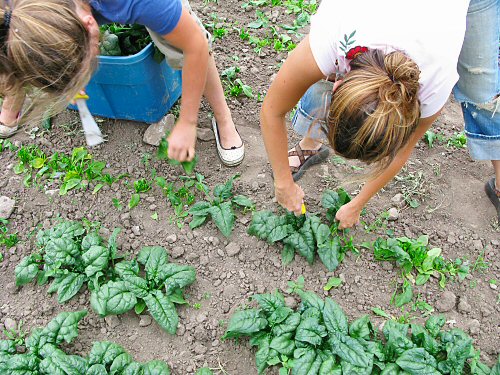
Nothing like teamwork: head down, knife in hand, side by side…
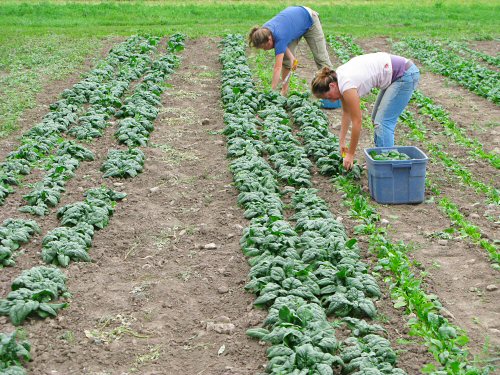
My, what a nice, wide path!
After the row cover: weeding!
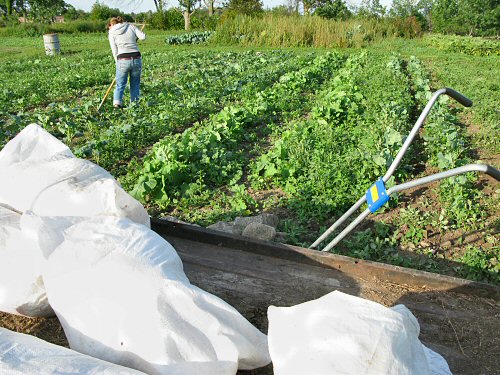
It’s been about six weeks, time to permanently remove the row cover from the last transplanting of fall brassicas! There are two sections, about 20 x 50′ beds in all, with broccoli, caulflower, cabbage, collards, kale. The cover protected against flea beetles, and at this point in the season, the FBs aren’t around much. Which leaves the post-cover weeding! I generally plan to remove the cover earlier, weed, and then replace it quickly, but this seldom seems to happen. Instead, it’s one big weed-a-thon at the end… Here, the mainly pigweed looks fairly big and dense, but it’s actually not much of a problem. The row cover has protected the ground from many days soil-packing rain, so the beds are nice and loose (it’s amazing how much rain can compact clayey soil). Weeds come out easy! With two people, it’s a relatively quick job, 2-3 hours for a pretty thorough clean-up. We worked with a combination of hoe and wheel hoe, me doing the paths and between-row clearing, and Lynn hand hoeing in-row, between the plants spaced at 18″ (45cm)…
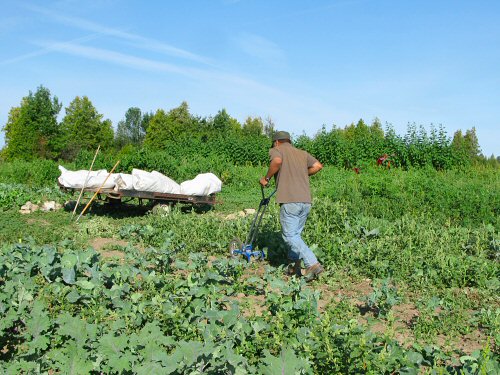
Each time I use the wheel hoe, I grow to love it that much more. So easy, so TIME-SAVING! It’s such a sophisticated yet simple tool, a perfect marriage of wheel, leverage and steel (you could say! :)… Today’s job is heavier work than it’s usually used for, the weeds aren’t just emerging, they’re pretty big. Rather than rolling the wheel hoe continuously down the rows, I’m cutting the weeds with a series of forward and backward strokes that either slice the plants below the surface, or pull them out, roots and all…
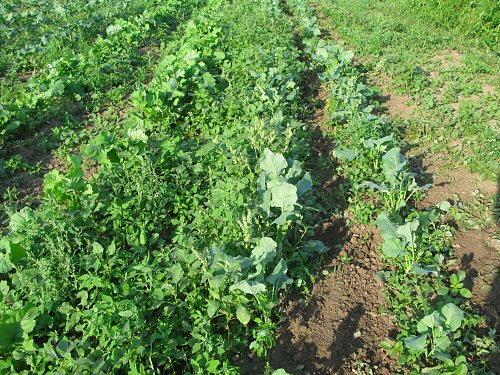
Clearing a path (before and after, above) in the loose soil takes maybe 3 minutes for 50′, many times faster than hoeing or hand pulling…
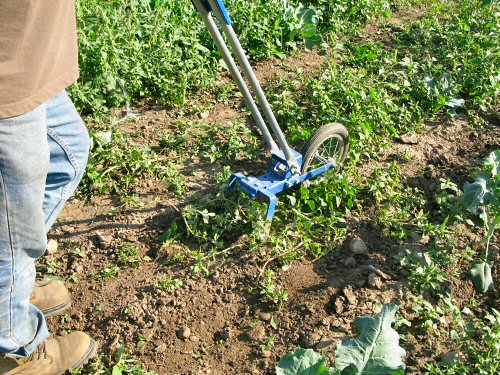
For this heavier weeding work, I use a fairly forceful forward stroke that travels about 1-1.5′ (30-45cm), then raise the blade to clear the felled weeds as I step forward to start the next bit…
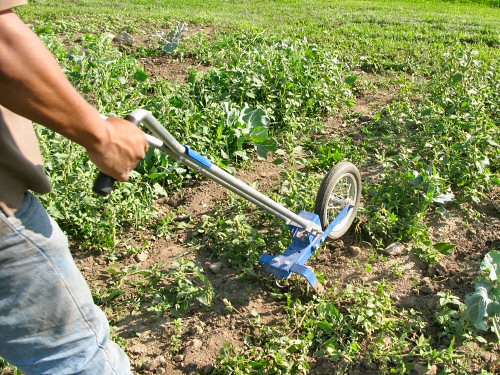
The wheel hoe is equally good at cutting on a backstroke, which comes in handy for dense areas and tough specimens… It’s not particularly strenuous work: the blade is sharp, the wheel and angle of the handles give lots of leverage and momentum, and some part of the hoe is always in contact with the ground, so you’re never completely lifting the whole tool. Like most things I do here in the field, I’ve figured out how to use the wheel hoe on my own, by reading instructions, looking at pictures and applying my version of common sense. Techniques no doubt vary. It’ll be interesting to eventually see how others do things! Meanwhile, everything seems to work out…especially, the wheel hoe! (Wheel hoe action photos by Lynn)