Chickens: ranging too far

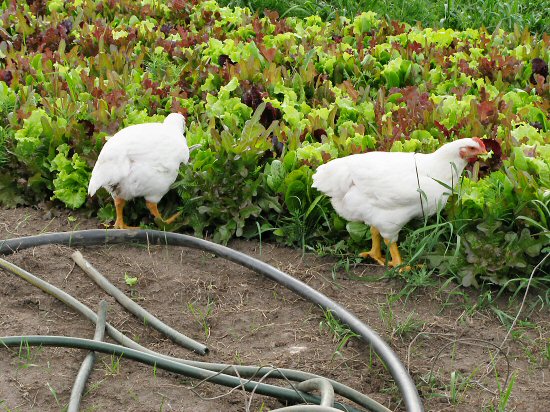
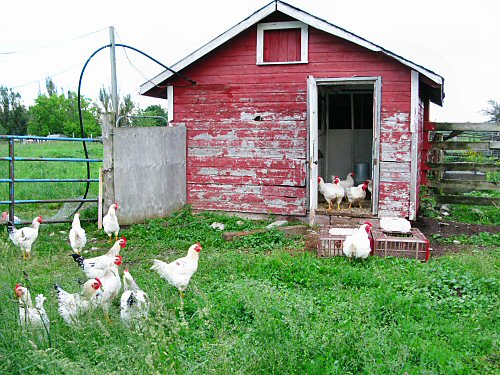
These guys, the White Rock Cornish X meat birds, have free-ranged too far, making it to the edge of the veggie garden in the big field. Luckily, although it looks good in the photo, this all-lettuce mesclun is done, cut at least twice and now too full of damaged and crowded, stretched leaves to make harvesting for market worthwhile. So, the chickens are actually putting it to good use. But  of course, they won’t stop here.

So far, they’ve been completely free to roam during the day. I count and shut ’em in out of harm’s way at night, and pop open the door soon after sunrise. If they found farm life dull, they could hit the road and head to town, just like that. Instead, they tend to wander further from home bit by bit.

I’ve been watching their circle of foraging territory gradually expand away from the chickenhouse. A few advance scouts lead the way, sometimes alone, or in twos or threes. Eventually, over a couple of days, more follow. It’s fun to watch the process, and they seem to appreciate the freedom (since they use it), but it’s still three weeks to Processing Day, and they’ll keep on exploring right into the garden. Time for some fencing action…

(In front, pieces of old hose and water pipe are being sorted out on a clear patch of ground.)

Another rainbow

It’s almost “yet another rainbow,” but not quite. We’ve seen a good collection so far this season, including quite spectacular horizon-to-horizon double rainbows two nights in a row. Which means there’s been lots of rain, and all the cloudiness that goes with it. It’s nowhere near as miserably wet as last season, though—rainfall this year has actually been great, averaging around the golden inch-a-week (2.5cm-a-week)—but 4-5 mainly cloudy days out of 7 is slowing things down.

How slow? The first summer squash that should’ve popped in size in a few sunny days, has been slowly expanding for well over a week. Root crops like beets, carrots, potatoes, aren’t affected as much, and seem to love the rain. But toms, peppers, eggplant and the whole cucurbit family (squash, melons, cucumber) are in slow motion, maybe a week or two from where they’d be with lots of sun.

Still, all in all, everything is growing along well enough, and we’re bound to hit a sunny stretch. Right?

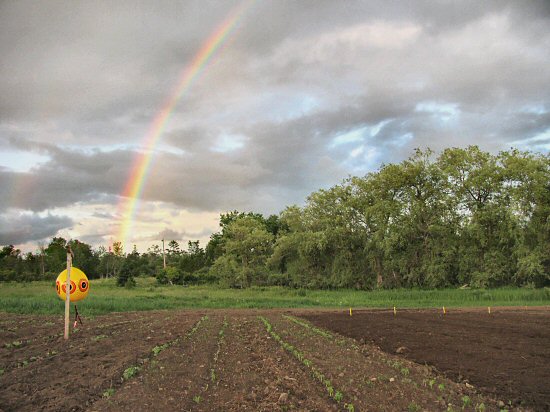
In the photo, a third planting of green and yellow snap beans, with scare ball in place to scare off birds (it seems to work). To the right, a freshly tilled section, waiting for a third planting of spinach… This weather’s great for summer spinach!

Eggs everywhere!

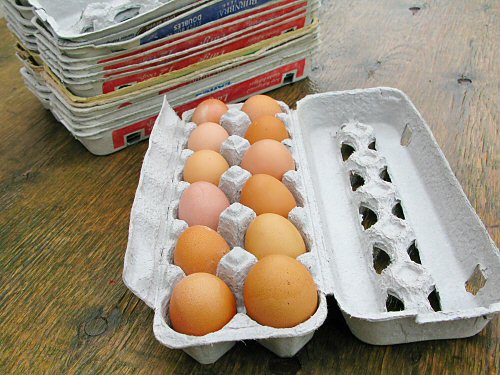
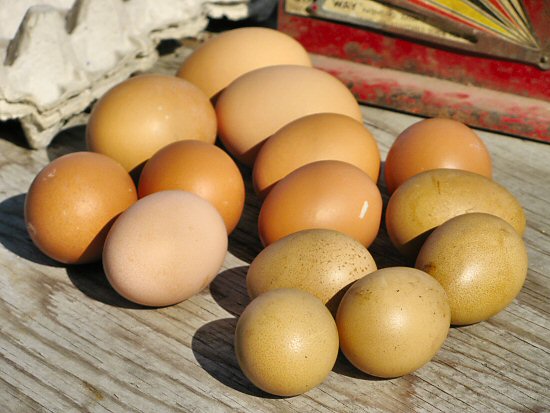
Barely a week after the arrival of the laying hens, egg production is in full swing, with about 20-21 eggs a day from 25 birds. From the start, all of the hens took to laying in one particular nest, I only occasionally find the stray egg elsewhere. They’re averaging about medium size, getting closer to large by the day (that’s the extent of my egg size terminology so far). Donated stacks of egg cartons are coming in from all directions. We’re surrounded by tasty little brown eggs…!

Chickens to the slaughter

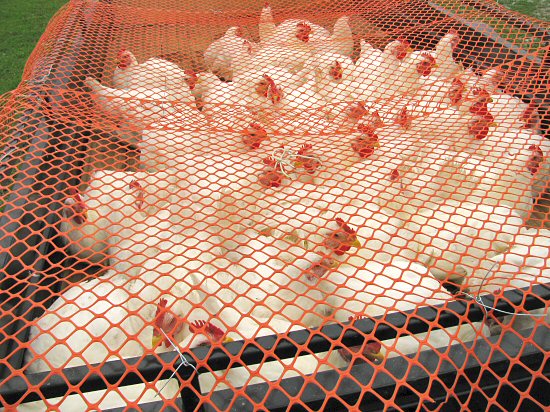
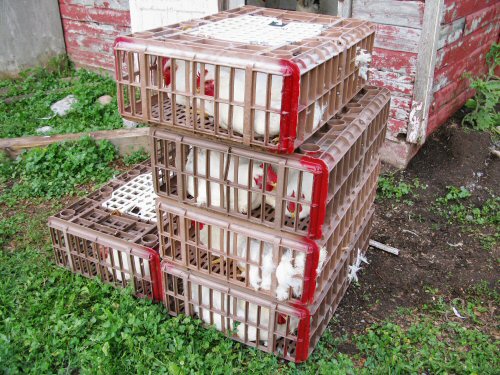
Raising your first chickens, killing them, and eating them has gotta rank up there with other Firsts worth a little attention. Now, I’m at least part of the way there: the killing this time was done behind closed doors, with me on the outside—chicken PROCESSING. Still, first enough to be worth a few photos… I’d been cutting it close with booking a processing day for the White Rocks, the local processor is known to get solidly booked for weeks. I finally called yesterday, looking for a date in two weeks, and was told there was also a cancellation for tomorrow (today!). I checked out the WRs, and, man, how could I imagine them getting any bigger (I think I was mesmerized, waiting for them to explode)? So I called back and booked. We drove over last night to pick up crates (20 minutes each way), then it was up at 5:30 this morning to load ’em. As soon as I opened the door, all of the Frey’s dual purpose darted out immediately, as usual, while the WRs, who mostly go nowhere, stayed in: it was kinda fitting that the Frey’s stood around in unfenced-in freedom, ready to run (and they would’ve!), while the WRs kinda dumbly looked out at their crates (above).

Five to a crate, 25 in all, 30 minutes or so to loaded…no need to chase down these lumbering beasts (while I was packing, most of the Frey’s figured out no good was afoot and entirely disappeared around the other side of the chickenhouse, something they’d never done before, while a couple stayed to watch).

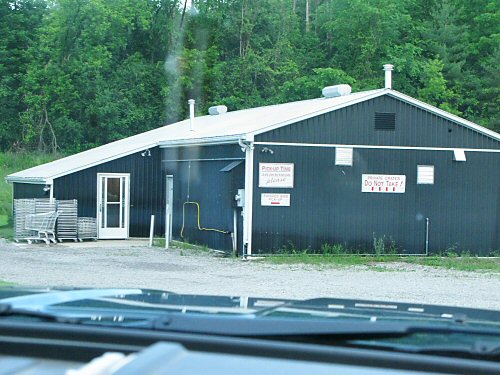
The processor is on a farm, a low building where birds go in live on one side, and come out the other, cleaned and chilled, weighed and government-inspected, ready to go…

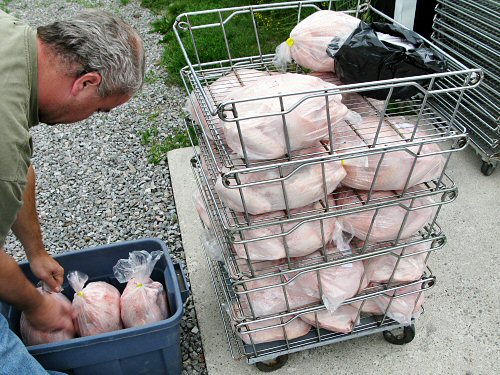
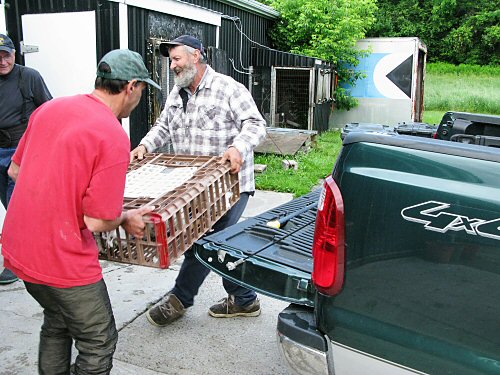
Bob and a processing guy unload. It’s 6:45am. The paperwork is quick and painless, I didn’t even have to write or sign anything. The only sign of bureaucracy in action is the required chicken purchase number, a serial number that’s on the form that you fill out when purchasing the chicks. And the on-premises government inspector popped out and did a little of his own paperwork. Other than that, just processing choices. For a few cents more (like 75-85), you can have the chickens halved and put in separate bags, or halved or quartered in the same bag. We got 10 halved and separated, for when cooking a whole fat chicken would be a little too much. Modern conveniences?! :) I also chose to get the organs back (in the black bag; below).

Eleven hours later, it’s 5:30pm and we’re back. Matthew helps pack the big birds for the trip home and into the freezer. Average weight is around 8lbs (3.6kg), where the Frey’s are maybe barely 3lbs. Hmmm… Not the most satisfying little adventure, with three 40-minute round trip drives, and the chickens disappearing through yet another middleman, reappearing neatly packaged for $3 more… With the processing fee tacked on for good measure, these are EXPENSIVE chickens, but I’ll do the math, and review the overall, somewhat unsettling White Rock Experience…later. On the other hand, you can’t beat the results: a lotta REALLY plump chickens! Next up in Meat Birds, Take 1: waiting for the free-ranging Frey’s to bulk up, and THEN it’ll be a fully DIY field-to-table chicken dinner!

Frey’s vs White Rock

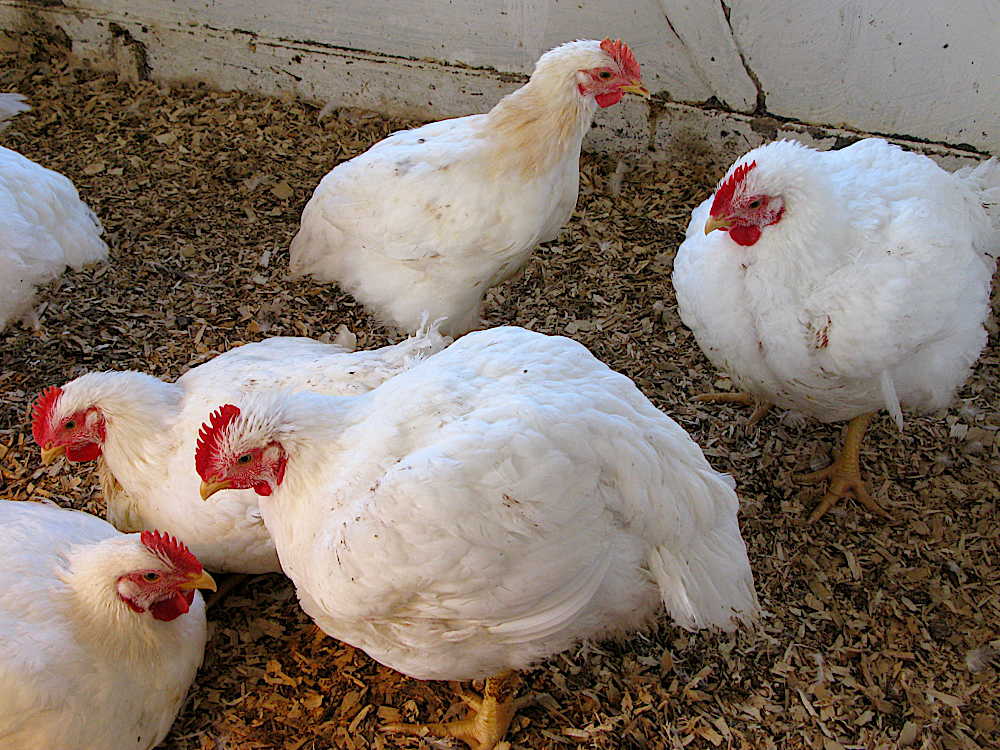
At this point, it’s safe to say that I’m no fan of White Rock Cornish X chickens. Without a doubt, they convert feed to meat incredibly…efficiently—compare the lone Frey’s Special Dual Purpose at the top center of the pic, surrounded by hulking, waddling White Rocks two and three times its size. What they gain in meat, they lose in basic chicken-ness… This first flock of mine are lumbering birds, with no taste for the outdoors, no built-in scratching skills, they’re definitely not up for dust baths or foraging through tall grass. They sit around, eat like crazy, drink, and, here and there, just kinda spontaneously DIE. I’ve learned a lot from this first go-round with meat birds, and I haven’t entirely rejected the White Rocks—I’m saving my final…evaluation for after they’re off to the slaughter in 2-3 weeks. More to follow…

Chickens just wanna eat…

The chickens are blowing up! At least, the White Rock Cornish X super-converting chickens are, turning feed into meat at a startling rate. The 10 or so Frey’s Special Dual Purpose are sleek and speedy, and all their feathers are in, but I guess that’s not what a truly modern meat bird is supposed to be like. Most of the White Rocks are double the size of the Frey’s. When I think of the chickens these last few days, it’s a vision of pink, partially-feathered butts in the air, circled round the feeder… Oh well, we’ll see what happens when we get them outside and cut back a bit on FOOD…

Meanwhile, despite entirely different sizes, speeds and eating habits, they’re still all getting along. My first chicken adventure continues…

Catalog shopping: chickens on order!

Chickens are on the way! On the left, a reportedly prolific brown egg producer, the Shaver Red Sex-Link. On the right, the reputedly hardy, healthy Frey’s Special Dual Purpose as our meat bird.

I almost broke a pretty basic rule on this one—get your questions answered first!—and ordered White Rock Cornish X for meat. Chatting with Bob, we’d decided on the Frey’s Special, but at the last minute—on the phone ordering them from the feed store—I asked about the Frey’s, and was told that “99%” of the small quantity meat birds were “White Rock” (meaning WR Cornish X), that people were often disappointed with the dual purpose for meat, that for meat, White Rock is the way to go. White Rock! White Rock!

So I got off the phone, and did some quick extra research. Talked to Bob again, who said the thousands of meat chickens he’s raised were all White Rock, BUT, they have to stay indoors, WR just stand around and EAT, which is why he thought Frey’s would be better for outdoors.

Next, hit the Web, and found stories of people successfully free-ranging WRs, even in the heat. BUT, they also said things like: “They did wander around a lot but nothing like the regular birds. They did all the normal bird things just a whole lot less gracefully. Only thing they couldn’t do was perch or fly.” Hmmm…

Which took me back to the original stuff I’d read in the hatchery catalog, things like: “Unfortunately, the White Rock’s increased efficiency at feed conversion has not been matched by improvements in the bird’s cardiovascular system. Simply put, too often the bird’s heart just can’t keep up with the rest of its body.” Yikes… Hello flip-over disease (aka Sudden Death Syndrome, aka…heart attacks), which tends to afflict the biggest, healthiest birds… And there’s lots more disease warnings, feeding restrictions, general strict instructions… Extremely fast-growing meat chickens, no doubt, and I’ll probably try some…later, but too weird for now…

For good measure, I got through to the Frey’s hatchery. The woman on the phone was great. She said most people just want to produce meat quick and go for the WRs, and they may do OK free-ranging, but really, they’ve been bred for rapid growth in a controlled broiler barn environment, AND, for a hardy, free-ranging, TASTY meat bird, dual purpose are great, friends of hers raise the Frey’s Special and love ’em. So Frey’s Special Dual Purpose it is, more traditional chickens that grow a little slower and weigh a little less, but can actually have fun, run around, eat insects, scratch in the dirt, and won’t…flip over! There are 50 2-week Frey’s Special cockerels coming either April 16 or 30, and 25 ready-to-lay Red Sex-Link on June 23.

Entering the world of CHICKENS, I’m excited!

(UPDATE: After writing this post, I read the comments below, did some more online reading, and switched the order to 40 White Rock Cornish X and 10 Frey’s Special…)

(UPDATE 2: It’s a year and a half later, and we recently processed a second flock of White Rocks. My original last-minute double-switch to White Rocks was a good one. I still want to raise other breeds, but you absolutely can keep healthy, free-ranging WRs, and they do get to a good size!)