Seedling treatment

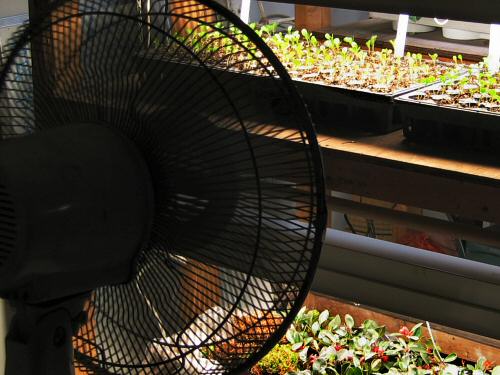
The fan is oscillating and the grow racks are slowly filling up. Parsley—curly and flat-leaf—are underway, and there’s more lettuce and some herbs…

Fanning the seedlings is particularly satisfying because it does a lot for such a simple thing. I forget where I heard about it, probably from a book, and I’ve been doing it since Year 1 or 2.

The idea is that plants develop differently when they have to deal with wind, or rain, or otherwise being pushed about. Seedlings raised indoors lead an extremely sheltered life; providing a bit of a breeze toughens them up, and this sort of mechanical stimulation (brushing is another approach) also encourages stockier growth instead of stretching.

It makes sense to me—seedlings definitely wouldn’t be so coddled growing out in the field! There’s even a term for this: thigmomorphogenesis! While hunting down the word, I found an interesting article about mechanical stimulation of seedlings as well (and here’s another).

I don’t follow a particular schedule, just give ’em at least an hour or two a day, sometimes more, turn the fan on and move it around every once in a while (I also make sure the seedlings are properly watered, since wind is great for drying out plants).

All in all, it’s easy, sounds good, hasn’t hurt! The fanning also dries the soil surface, which helps prevent damping-off, so you can’t lose!
More weather

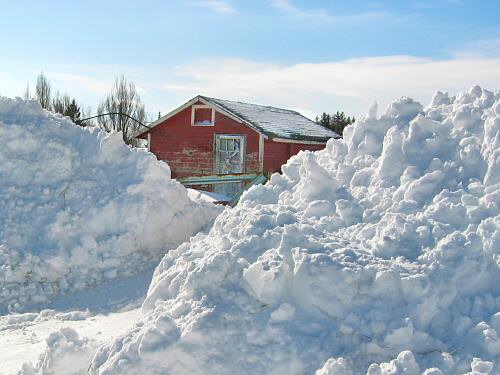
This February, tiny farming for me is mostly about, inside, watching seedlings in a growing number of plug sheets under lights, and outside, watching the weather. In this zone, Feb is a little early for thinking about garden conditions. Well, “normally”, it would be. Now, given the increasingly erratic winter, I’m trying to figure out a new early season production strategy. Conceivably, end of March could be shockingly warm and the ground dry enough to work, and instead of just seeding early peas, I could try some super early field transplants. But then, what if winter happened to come back, not for a day or two of April snow, as sometimes happens, but for a week or two, with freezing temperatures. Early plantings could get killed off, and then I’d need a second set of seedlings! This is how I’m kinda starting to think, about trying to plant around the weather, take advantage of unpredictably good conditions, while expecting some weird bad turns as well. What do last and first average frost dates really mean, given the last five years? Is a 30-year local rainfall average still in any way a useful guideline? Am I…exaggerating? Two days ago, it was 40°F (5°C) and raining right through the night. I was sure the forecast for an even warmer Wednesday would come through to finish off another, fourth big melt-off. Instead, yesterday morning it did a sudden 180, froze up and dumped a ton of snow. Today, there are 7-8′ snowbanks all around the barnyard (from snow plowing). The once and future chickenhouse practically disappeared… ;) Will spring and summer be different from that?!

First cuts

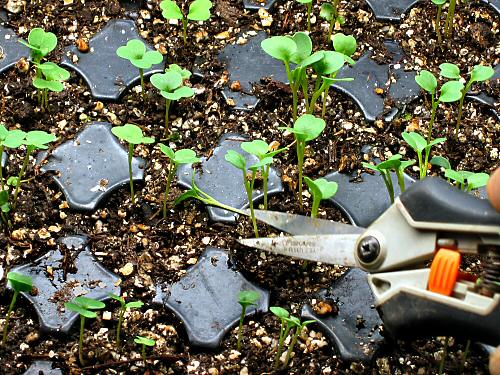
Time to thin out the lettuce and arugula. Between the seven varieties, some of the seed I used was up to four years old, so to be safe, I was quite generous, maybe 4-5 seeds per cell for the arugula, and a bit more for the lettuce (that tiny seed can get away from you, though with new seed, I try to go lighter). Germination was good, and the little seedlings are already shading out each other as they push for the light. I’m still getting used to timely, to-the-point thinning, both in the trays and in the field. I usually have the urge to leave ’em a while longer, but almost always, this ends up being not the best thing to’ve done. Give the best ones the biggest break as early on as possible, which means, kill off the rest. This also takes some timing experience, but in general, it’s hard to go wrong by not waiting around. Sounds brutal, but that’s about it! The lettuce will eventually be one per cell, although for now I’ll leave a couple per. Starting arugula indoors is a first for me, I usually direct-seed, so I’m figuring things out this time around. I’ll leave two per cell, and plant them out two together at 6″ (15cm) spacing and see how that works out. Here, I’m snipping arugula at the soil level with wickedly pointy little shears…

Arugula emerges

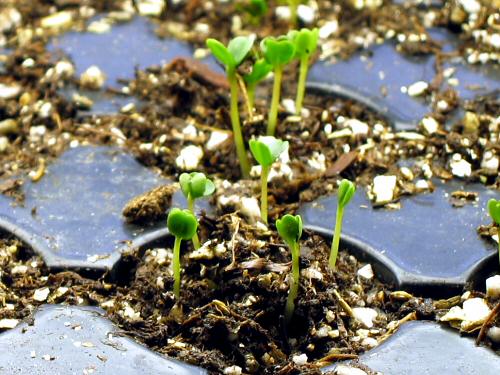
That was quick! Early morning, and the arugula (and Granada lettuce) has popped up in barely two days. Air temperature in the Milkhouse where the grow racks are stays mostly in the 60-65°F (15-17°C) range. Around the plugsheets, the close fluorescents warm things up an extra 5°F or so, and the clear plastic over the trays creates a little greenhouse effect that adds at least a couple more degrees. Altogether, ideal germination temperature! It’s kinda fun to think you’re in control of precisely what’s going on, but in any case, however they pulled it off, the first seedlings of the year are good to see! :)

Grow lights, on!

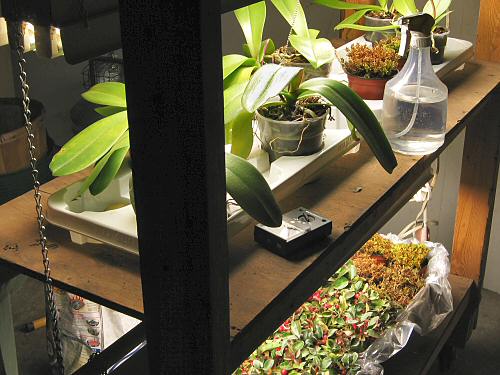
Grow rack lights went on today for the first time this season. They’re only for the rescued houseplants (orchids, wintergreen, heather)—I guess every plant deserves a place in the sun—but, I’ll be starting super-early lettuce soon, a month earlier than ever, for an experiment in planting them out to the greenhouse at the beginning of March. Getting the grow racks ready is another familiar routine. In early summer, I remove the fluorescent light fixtures and the chains and dowels they hang from and store ’em somewhere (last year, it was on the new Big Shelf). For spring, I dust them off, wipe them down, hang them, and a new seedling season begins!

The Big Shelf

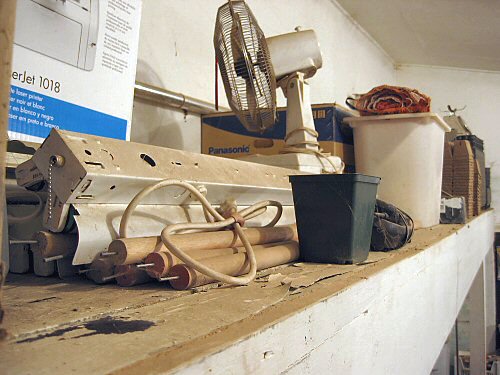
The choice storage spot for tiny farm gear, especially during winter, is this giant shelf, where it’s warm and dry. It’s at the back of the Extended Milkhouse, the last 3-1/2′ of the old ceiling, propped up on the leading edge by a beam across and 4″x4″ posts. It would maybe qualify as an upper level, if you could actually stand up: clearance is only 3-4′ under the new sloped ceiling. It’s 3-1/2’x20′ (1mx6m) of up out of the way space…a big shelf! About 7-1/2′ feet high, I get up there by ladder. Only one season old, it’s still startlingly clear, orderly, and almost entirely filled with immediately useful stuff as opposed to sure-to-be-useful-sometime gear (though the inevitable packing boxes saved just in case of return already have a presence). It’s dusty up there. At this end are the many fluorescent light fixtures (12, I think) for the grow racks. They hang from chains from those dowels in front, and the dowels in turn hang by the nails from more chains on the rack! When seedlings are all done, I remove the lights and use the racks for harvest storage. The oscillating table fan is used to give newly emerged seedlings a bit of a toughening up, conditioning breeze. Down at the other end, stacks of 3″ peat pots and plug sheets and trays. Time to start seedling room set-up!

Last of the seedlings

Red Russian kale

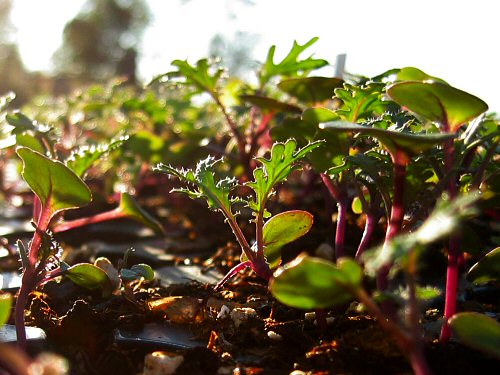
A tray of Red Russian kale are the last transplant seedlings for this year. It’s extremely late to be planting this out now, but RR is a fast grower, there’s space, and it’s always fun (and good experience) to see what happens! Any extra kale is a bit of insurance against a cold October that would see hardy crops as the last ones standing…