Seedlings away!

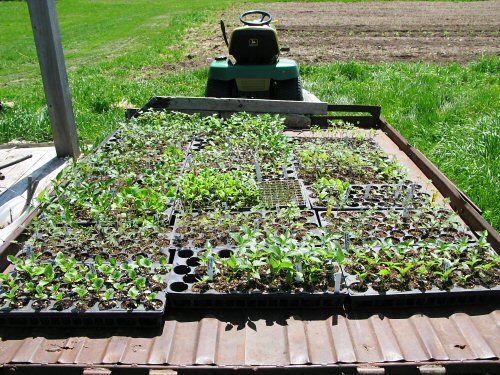
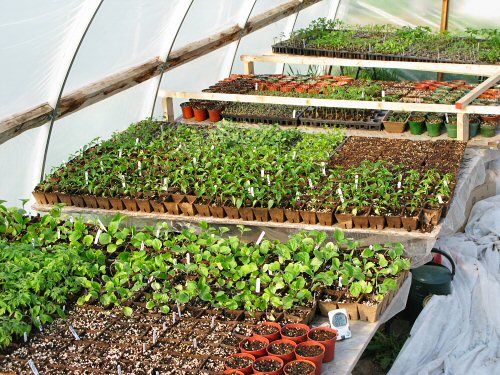
Things can change suddenly on the tiny farm. I picked today to move the majority of seedlings to the greenhouse. Although this was MUCH later than hoped for earlier this year, it’s all about the (recently COLD) weather, and I didn’t want to spend much on heat. But you can’t wait forever. There’ll probably be at least a couple of freezing nights in the next two weeks, but it IS getting to mid-May, and these guys will be out in the field, one way or another, before the end of the month. So, it’s out of the Milkhouse and onto the trailer behind the little John Deere riding mower for a little trip…

The greenhouse tables are now just about full, and that’s with a fourth one added a week or so ago. Plus, there are a few more trays of plug sheets on the ground off to the right. Lots more seedlings than ever before… On the closest table, there’s the (excellent) digital min-max thermometer/hygrometer, recording critical highs and lows, right after the fact! New this year are those red and green plastic pots (with cukes, squash, pumpkins, melons)—I decided to stop using the 3″ peat pots and try soil blocks, BUT, I didn’t feel like learning about block making right in the rush, so I used the last of the peat and then dipped into the collection of plastic pots I’ve been given over the years. (I’ll get the soil block maker in the summer, so I can play around with it first…)

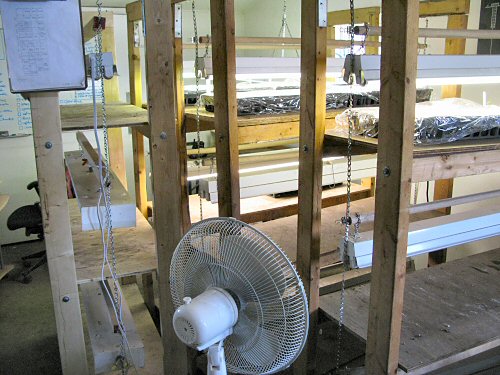
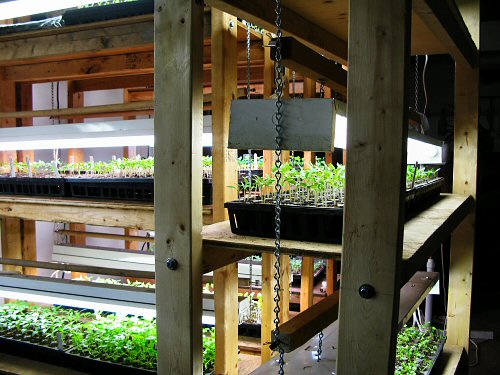
It’s always a little…sad when bright, cheerful gear goes dark and empty… There are still a few trays of really young tomatoes, brassicas, and a couple of other late-started things, but the grow rack days are just about over for the year. We’ll soon be stowing the lights and chains, and presto, instant rolling racks for harvest bins. Transplants for late spring and summer will get started in the greenhouse…

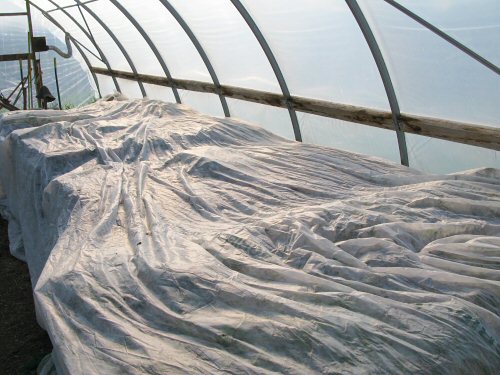
And so, the seedling greenhouse gets tucked in for its first full-house night of the season. Boy, imagine if something WENT WRONG in there… :)
Herb garden time…

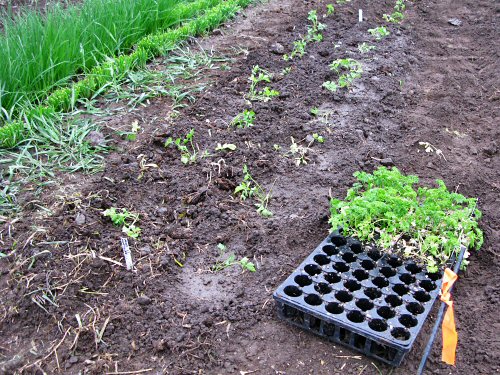
It’s right in the middle of the spring garden rush, for sure. but we’re in that little lull of sorts between direct seeding and transplanting the hardy and cool-soil-germinating crops (brassicas, peas, carrots, lettuce, etc) and waiting on temperature to transplant the more tender guys (tomatoes, eggplant, peppers, cucurbits). This year, for the last three weeks or so, we’ve been cooler by a few degrees than recent Mays, both days and nights, which slows things down a bit more, as I don’t see an advantage in planting out some of the tender stuff early by a week or two, since the extra growth probably wouldn’t add up to much. Sooo, there’s more time now—a longer lull—to concentrate on the kinda B-iist crops (I don’t like putting it that way, but for practical purposes, well, some ARE more important to the overall market garden than others…). That means the herbs and flowers are getting great extra attention: earlier planting, dividing established growths of sage, thyme, oregano, much needed weeding… Today, I did the parsley. There are several varieties, I couldn’t resist seeing how they’d compare. For curly: Krausa Market, Green Pearl, Green River, Green Forest. For flat-leaf: Plain Italian and Hilmar. At the top left of the pic, some chives, up and thriving from last year’s planting, and you can see the well-established grass in the path that is being meticulously forked and pulled, drawing out the runners by hand, sifting with fingers to leave all the top soil. This is what I think of as really hardcore, basic gardening: crawling around, hands-in-the-dirt work, where you’re literally attending to each plant. It’s incredibly relaxing, soothing, really, so much…fun, alone or with others. Of course, this particular approach doesn’t scale up too well! Tiny farming comes in so many shades, degrees, intensities… It’s great! :)

Field day!

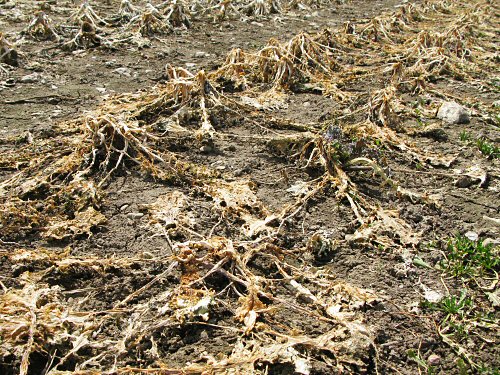
Winter-killed brassicas

Left to the last possible harvest in the fall, brassicas like kale, Brussels sprouts, cabbage, broccoli and cauliflower (above), were eventually winter-killed and now have to be cleaned up—one of the first field-readying jobs of spring! Today, I started. (EVERY day is a field day from here on in, through November at least, or the first heavy snow that sticks.) A day of tiny farming fieldwork is really just a whole lotta gardening… Now that the ground has dried out enough to be tillable (that could’ve been yesterday, but…errands and CHICKENS), and warmed up enough to direct seed the crops that germinate in cooler soil, it’s a whole new world of things to do…and think about doing. There are two basic ways to ponder the progress of the season’s garden: by timing and by area, each useful in its own way. Timing is mainly about the plants: when to seed, when to water, when to harvest. Area is about where to locate particular plantings, which in my case doesn’t mean absolutely running out of space, since there’s lots more field to expand the garden into if I wanted to (which I don’t), but more like where to position stuff efficiently, so you’re maintaining crop rotation, but not having to, say, drag hoses all the way down the garden to a couple of newly seeded beds that need daily watering in (although there’s a field production plan made up, there are lots of adjustments on the way—where to put stuff will come up again and again!). So, the start of the season is mainly about area, because you have to prep beds and get veggies in in a rough order—cool soil seed, then cool weather transplant, then warm soil seed and transplants—and the timing is a constant: it’s all right away! One way I keep overall track of this garden is by counting sections: it’s about 2.5 acres, divided into 40 50’x50′ squares (each fits 10-16 beds, depending on width). At some point in the next six weeks or so, almost all SHOULD be planted out, nearly 40/40. Today, I started seeding in one…

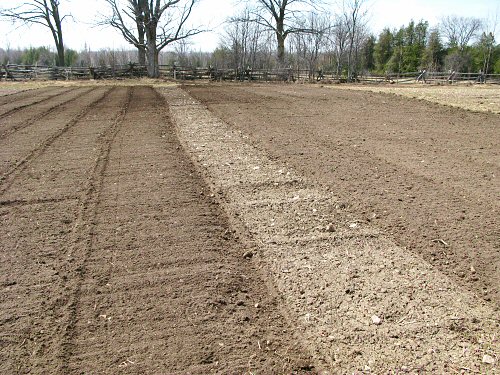
Tilled and untilled: Partially composted cow manure was spread and incorporated in the fall. Now, a light rototilling to prepare for seeding is all that’s needed. Today, I used the tiller on the Kubota compact tractor.

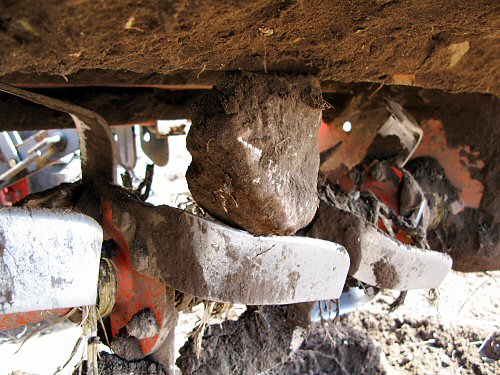
Rock beats tiller: There are lots of stones in this field, they work their way up continually, and even a fist-sized rock, caught in the right way, can stall out the 48″ rototiller on the Kubota (it’s a tiny tractor!). No problem: remove and restart.

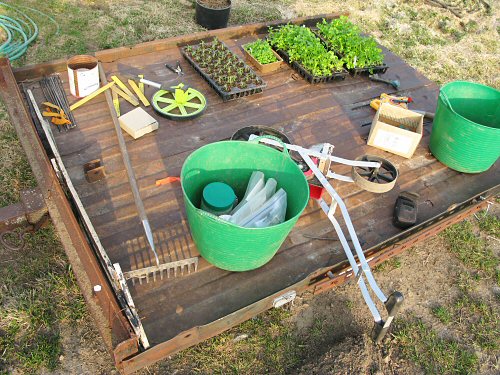
Getting set to seed: I work mostly one or two sections at a time, prepping an area with the tiller, marking the beds, then seeding (or transplanting). This way, I can get the crops that need to be started in as quickly as possible. Here’s the cart towed by the riding mower, loaded with assorted seeding gear (and some transplants being ferried to the greenhouse).

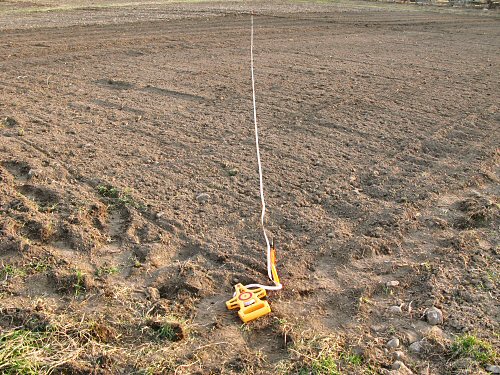
Making beds: Oh, there’s A LOT of tiny farm history behind my bed marking methods. :) I’m still working on the most efficient way to set up beds. Right now, it’s fairly streamlined, involving a 100′ tape measure, stakes, and pacing off distances. This year, I’m planting in 3′, 4′, and 5′ beds (that’s path included), depending on the crop.

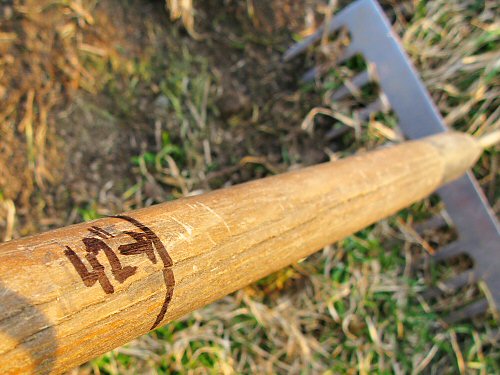
Customizing the Rake: Every season, I re-ink faded measurement markings on a couple of hand tools I use the most. Here’s a convenient mark for 42″ from the top of the handle (that’s the planting area width for a 5′ bed. There are other marks further up the handle, and the whole rake is exactly 5′. It’s convenient for quick checks, especially on the favorite rake that I use for touching up beds right before seeding. And so, off we go…!

Seedlings everywhere!

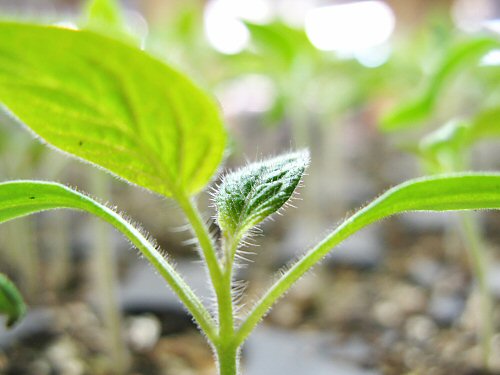
Striped German tomato seedling

Seedlings are everywhere. The first set of tomatoes is putting on its hairy true leaves: that’s a Striped German in the pic. With Lynn honing her new putting-seeds-in- plug-sheets skills today, the early seedling starts are just about done. From the top (the end of January), that includes lettuce, rosemary, leek, parsley, peppers, eggplant, onion, celery, celeriac, tomato, cauliflower, broccoli, cabbage, collards, tomatillo and Brussels sprouts. Between the Milkhouse and the greenhouse, there are about 40 trays of plug sheets going. Most have 72 cells, and there are a few 128’s and 200’s. The seedling grand total so far is somewhere around 3,000. Actually, that’s the cell total, and many have two or more seedlings per, some to be thinned or divided, or else transplanted together. So, maybe 3,500 seedlings. I’ll start a few more veggies tomorrow, another 500 seedlings on the way, and that’ll be it for now. The most ever, although the number is kinda meaningless, except as a measure of the space they take up, since one tomato will produce for the season, while a cauliflower is off with its head and it’s done… Timing wasn’t great on a bunch of the starts, I waited in some cases 2-3 weeks later than I could’ve, which means transplanting out smaller or…later. This wasn’t meticulously planned, I was just playing off the weather (cold April forecast…that doesn’t seem to be happening anymore) and not wanting to be stuck with lots of overgrown seedlings. And, I’m always trying to reduce overall seedling time by seeing how late I can go… Anyhow, it’s about five weeks to average last frost. In another week, I’ll start the last wave, the CUCURBITS: summer and winter squash, pumpkin, cucumber, melons. They go directly into 3″ pots, usually take 3-4 weeks to get to transplant stage, and absolutely want HEAT, especially, toasty soil, when they hit the field. OUTSIDE, it’s getting warm!!!!

Greenhouse growing

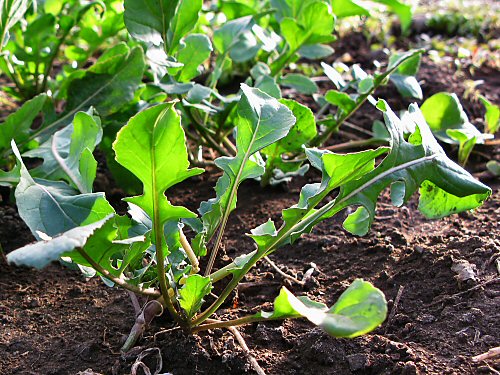
With the warmer weather of the last few days, things are moving along a little quicker in the greenhouse. The patch of arugula transplanted so long ago is finally starting to fill in new, full-size, TASTY leaves. And the all-lettuce mesclun, direct seeded two weeks ago, has been appearing. Even though days in the greenhouse have been way warm for weeks, the frigid nights really slowed down growth. Warmer nights mean faster greenhouse action!

Seedling action

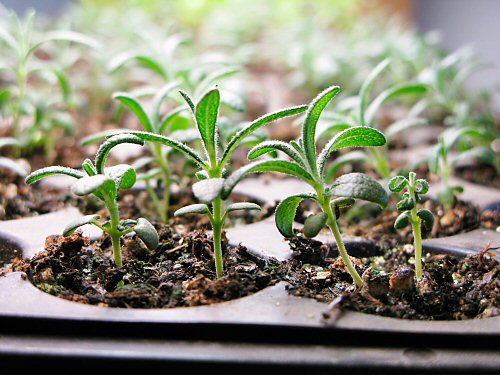
Rosemary seedlings

The main tiny farming action is with the seedlings now; even if the snow melted off tomorrow (which it won’t), it’d still take a sunny, windy couple of weeks, give or take, for the field to dry out enough to fully work. Indoors, with the new grow rack, there is still space, but there’s also quite a bit left to be started, including most of the tomatoes. And some of the seedlings are beginning to call out for MORE ROOM. The rosemary (above) did really well, germinating steadily over several weeks, to the point where there are up to four and five crowded in 1.5″ (3.75cm) diameter cells. And the celeriac (celery root; below), a trial crop this year and the only one started in flats not cells (I sprinkled a packet of seed across two fibre trays), is healthy, dense and stretching. Transplanting tiny seedlings is fun at first few, but can get tedious, especially if you have hundreds to do in a session. To save on time and tedium, I try to avoid potting up by sowing into final locations whenever it makes sense. One way or another, the trays inevitably start adding up, until there’s not enough LIGHT to go around. Into the equation, there’s the barely heated seedling greenhouse and the WEATHER: as soon as it’s reasonably warm enough at night, I can move the hardier stuff out—this month, at least every other night has dropped down to around 5°F (-15°C)… And that’s what this stage of the action is all about: adjusting lighting, timing and starting cell size and, as always, gambling on the weather…!

New gardener

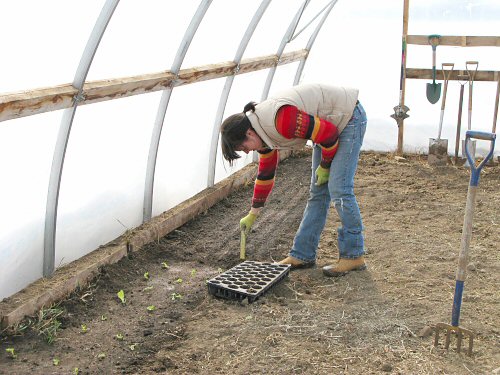
Hannah dropped by today to check things out. She’d gotten in touch through the farm web site, wanted to volunteer for a day or two every week through the season, to learn about small-scale farming and how to grow stuff. No garden experience. We spoke briefly on the phone, but the only way to see is to meet in the field and get hands dirty! It’s amazing how easily people can take to tiny farming when given the chance to dive in. So, a quick tour, and then, to work. She weeded, forked and raked a bed in the greenhouse, transplanted a couple of dozen lettuce, seeded a bed of all-lettuce mesclun using the Earthway seeder (tightly spaced rows), tried out the mini-cultivator (a rototiller attachment on a heavy duty weed eater), drove the Kubota compact tractor and worked the bucket on a big snow bank, trimmed a couple of trays of onion seedlings, checked out the production standards and paperwork for organic certification, and seemed fine with my mildly intense stream of background info and general microfarming explanation. All in three hours. Everything for the first time. She did great, no problem! Just as important, at least for this tiny farm, she seemed to have FUN, had a cool energy, and didn’t make me WONDER when handling machinery, tools and plants! After last year’s great crew, standards are pretty high. Will this season of people in the field go as well or even better? There’s no real advertising or recruiting plan, I’m trusting that, through general word of mouth (and maybe, good karmic energy!), things will…pleasantly unfold. We shall see!