Checking under row cover

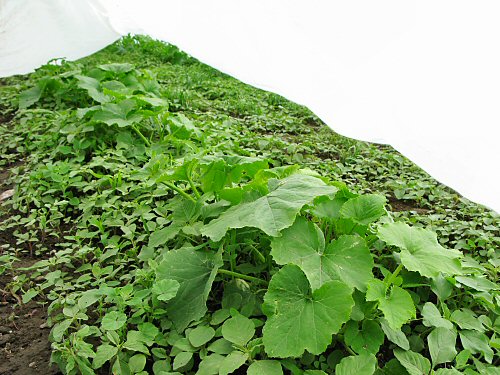
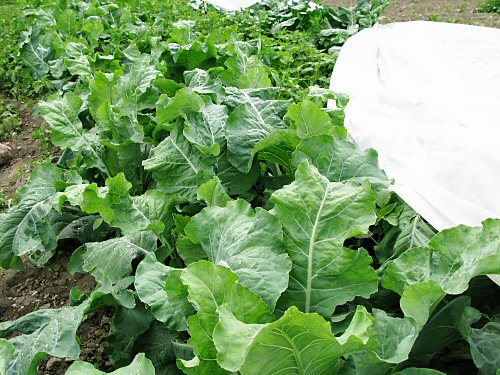
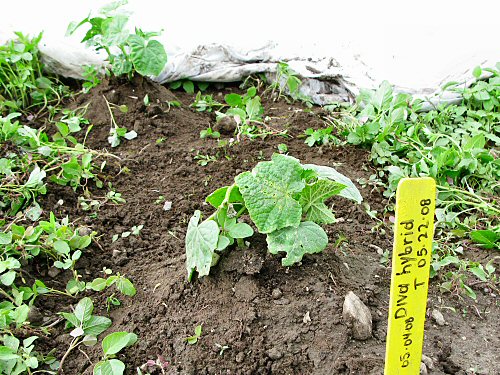
Three weeks ago, it was floating row cover everywhere. So, what was it worth? Today, I checked things out. Overall, growth has been startlingly slow, due to the lack of sun. This is really noticeable in the summer squash (above), which could be huge at this point, but…aren’t. Under cover, these zucchini (I didn’t check the variety) are doing fine, no cucumber beetle damage, but of course, weeds are doing fine as well: unmolested under there, pigweed runs rampant. I’ll take the cover off here in another week or so, and then there’ll be a whole lotta weeding to do… I removed the cover from the first beds of cauliflower (Snow Crown) and broccoli (below), they’re big enough to take a little flea beetle munching. The leaves have shaded out much of the potential weed action in the beds, but you can see a nice collection in the path (top center, where the row cover ends). The plants look untouched, although the flea beetles managed to get under and at the kale and collards, (they’re out of sight just to the left)—I left them covered, back in a week. If there’s any doubt about what the FBs will do, just check the radishes, which grow MUCH faster than these guys and can survive the damage…

Back with the cucurbits, the cucumbers are the most noticeably slow: after a month, they’re hardly bigger than the transplants they started as (hope it’s all going into the roots!)… I’ve cleared away the weeds between a couple of the plants, beetle damage is minimal (they tend to get in at the ends of rows, where the cover can get blown up by the wind), but there are weeds everywhere. Cover goes back on here for a while. Weird stunting weather and floating row cover: not the most peaceful and inspiring natural garden combo, but it should all straighten out in a bit… ;)
Weird weather day

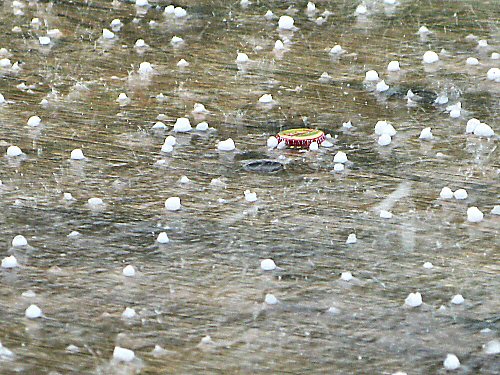
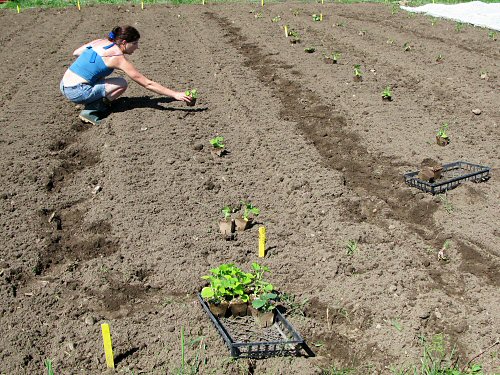
This was one of the strangest single days for weather that I can remember. Transplanting more squash in the morning—Michelle is checking out working on the farm one day a week—it was beautifully sunny, with a nice breeze. Around mid-morning, suddenly, it shifted to humid and sticky. I headed in to change into shorts, but before I’d even walked out of the field, the humidity started fading again, so I didn’t bother. A bit later, covering the squash with row cover, a nice breeze from the north, enough to easily float the cover, casually shifted 180°, coming from the south, in the 20 minutes it took to lay down the cover and unfurl the next. Early afternoon, the wind picked up, and within half an hour what had been a largely clear sky had totally clouded over, then, pounding rain and HAIL (not too big, only some leaves got battered, no smashed plants, you can used the bottlecap below for scale). Then back to calm and clear for a couple of hours. Then heavy clouds again, and a massive wind storm that tore some branches off of trees. Then back to…sunny. As extreme as this day’s been, two or three quite drastic changes in a single day have been happening quite a lot recently. This is our new weather…?

Sweet potatoes!

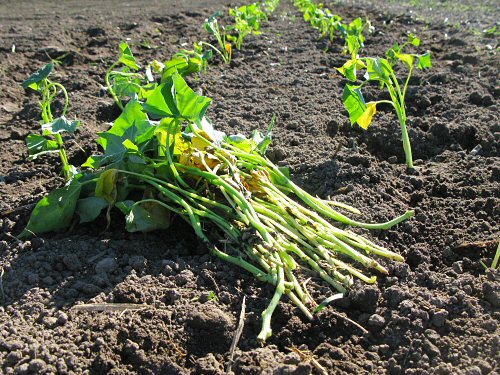
Sweet potatoes are in! They were a last minute addition this year, I was expecting them by the end of May, and then started to write ’em off when I couldn’t get in touch with the grower who was supplying them. But he came through, and they arrived by UPS yesterday, one box with around 1000 slips. Bob P., the sweet potato farmer who sent them, is also here in Ontario, but further south in a microclimate zone near Lake Ontario that’s a lot warmer. Still, they should grow here as well. The variety is Beauregard and they’re started from slips, which are vine cuttings. This is the first crop I’ve started strictly from direct grower-to-grower info, it was great to chat about them on the phone, rather than do the usual new crop…research. And they sound unbelievably trouble-free. Bob’s instructions: stick ’em in the ground with the growing point 2-3″ (5-7.5cm) above the surface, 12″ (30cm) in-row spacing, and as little as 12″ between row, all the way up to 3′ or whatever you like for tractor transplanting and cultivation. That’s it! No watering in, no watering except in extreme drought conditions. Just…weed. Hmmm… I’ll look into them more, but for now, that’s what I did, and there they are. The leaves will probably die off, it’s new rooting that should happen. One mild concern: sweet potato grows best in loose, sandy soil, where here the heavier clay loam is being well-compressed by lots and lots of at times pounding rain. Also, the slips are apparently supposed to be planted within 7 days of cutting, and it’s about a day after that. We’ll see. In 100 days, sweet potatoes? ;)

Shifting gears for summer…

The spring rush is over, and fieldwork is shifting into summer mode, from mainly planting to mainly weeding and watering, and then, HARVESTING. Seedlings for the most important crops and varieties are in, although there’s still quite a lot to transplant.

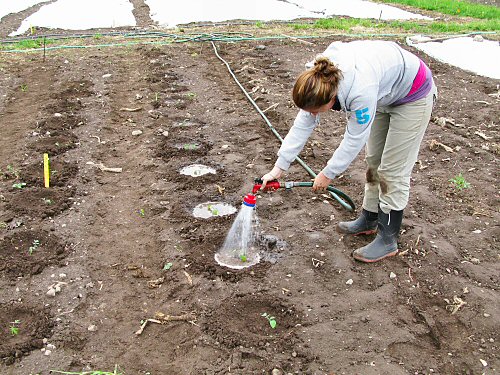
Here, we’ve just finishing another 100 or so tomatoes, with Lynn watering them in (the Redhead water breaker is GREAT, delivers as much water as you’ve got pressure, while softening the flow so that you’re not smashing or burying the seedlings). Creating a little basin around each seedling makes the most of hand watering in.

In my continuing experiment with shortening seedling production time, these are the youngest toms to go out ever, a third set started at the beginning of May, with their first true leaves now just coming in!

There are also more squash, melons, and a few more toms to transplant—in years past, I’d’ve been concerned about the date, but I’m learning to adapt the season’s resources (time, people, irrigation capacity,…) to the WEATHER.

Keep the workflow balanced is my new first mantra, so we also spent a few hours weeding today (Ryan dropped by to help for a few hours, he’s a new CSA-er this year who is also about to move his family to their own tiny farm at the end June!), instead of rushing on the last transplants.

It’s hard to measure, but for this type of small, diverse market gardening, in this time of extreme weather, things quite often don’t work out as they traditionally should. For example, the recent rain and cold, and now, more heat, have created a situation where the dominant weeds—pigweed, mallow, and lamb’s quarters—are seemingly slow, but are in fact about to explode. Weeding now will probably save way more time and deliver more harvest than putting off weeding just to transplant a few more beds a few days earlier.

I dunno, I’m figuring this out as I go, but I think traditonal garden rules and timing have to be increasingly bent as the weather gets crazier… I guess you could say: EXCITING TIMES! :)

Ah, the Home Garden…

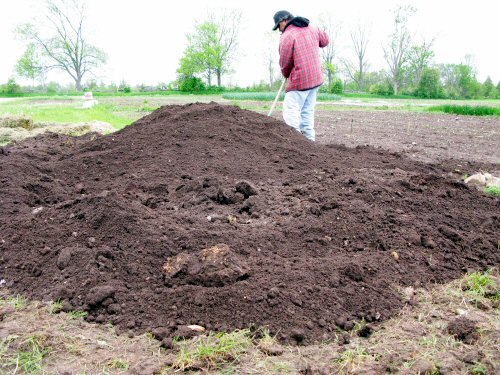
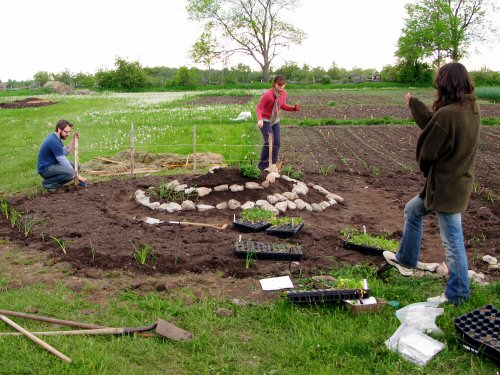
After quite a bit of talking about it, and last year’s false start, a Home Garden is suddenly in place in one corner of the field. The idea is to have a small demonstration veggie plot, to encourage people to grow at least some of their own stuff in whatever space they have. Why? Well, it seemed like fun. Located by the farm stand, it would be an extra little attraction to farm visitors… Just a thing worth doing… Anyhow, last year, I staked out a section, but didn’t get too far in planting anything in it, a couple of tomatoes and a few potatoes… This time around, I’d been chatting with Shannon, who has a lot of permaculture-based ideas, from reading and interning, so I asked her to plan it out. The final design was done really quickly earlier today (it was a busy month…), it’s more a freeform, jumbled garden with a permaculture flavor: all annual veggies, no rows, lots of interplanting, a herb spiral on a mound (a mix of annuals and perennials), an anti-pest barrier of alliums (onions and garlic chives) around the perimeter, and three little keyholes, which are dugouts that you can kneel in to garden within reach around you, as an alternative to working from paths. At about 10’x20′ (3x6m), it’s fairly small. One cool thing: the home garden layout is entirely unlike the rest of the market garden, which is all flat, linear and grid-like, lots of rectangles and squares and straight paths. Now, we have a deliberate elevation and CIRCLES! To make the mound, I dumped a few buckets of compost using the Kubota compact tractor, and raked it into shape. We then added stones for the spiral, and Erin and Mike dropped in and helped plant it out, using odds and ends of transplants and also seed, with Shannon directing. The rough plan is to have Lynn and Raechelle develop and tend it over the season (Shannon leaves tomorrow after a solid month in the field).

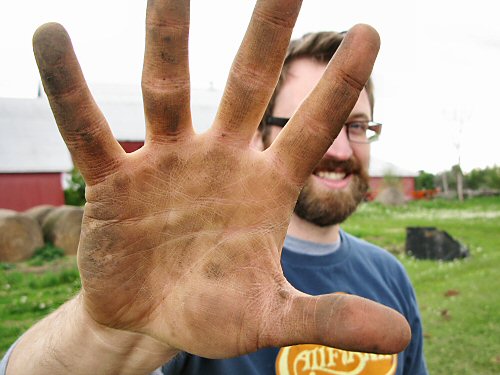
At just over two acres of veggies, the tiny farm is really small by most any modern agricultural standard, and starting up a MUCH TINIER space is its own private…thrill for me. It’s so…opposite! ;) It’ll be interesting to see how Home Garden 1 turns out as the season rolls along! Any way you can, getting your hands dirty is what it’s all about… (Guest photos: top by Shannon, below by Erin.)

Where we’re at…

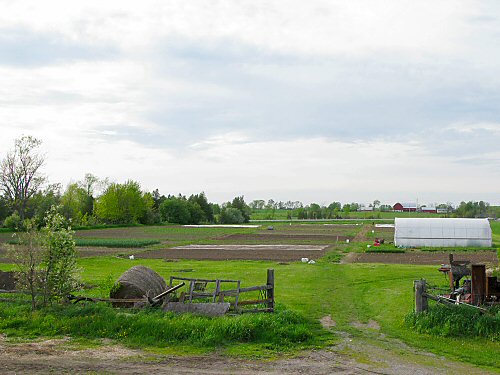
If you can average a month’s weather with one photo, this is pretty well it for the days of May this year, hovering between bright and sunny and gloomy and overcast, veering one way or another for a day or two, or even from one end of the day to the other. The freezing nights have just let up, which is good. We’ve also been getting a nice amount of rain: the month’s average so far is that magic inch-a-week (25mm), the veggie gardening rule of thumb for perfect rainfall. Many hours of dragging around and positioning hoses and sprinklers, and gassing up the irrigation pump, have been SAVED! That’s a big bonus, the total opposite of the last two years. The field is clear and amazingly weed-free (at a distance, at least)—more sun would benefit both the direct-seeded crops and the (kinda evil) pigweed. Less sun and cooler temperatures are also great for transplanting, which is the main thing going on right now. So it’s a toss-up, but I’m slightly more liking the colder, cloudier weather for now than not. As if I had a choice… :)

Great day in the field

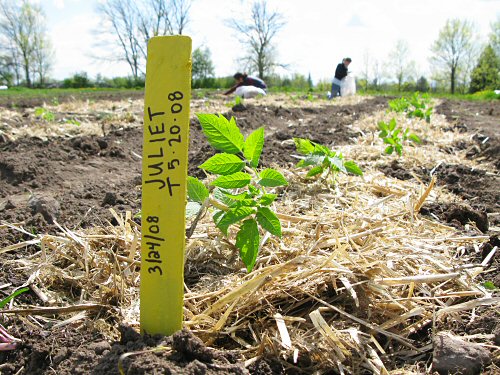
Especially compared to yesterday, today’s mainly sunny, quite warm weather added up to a glorious day in the field. Lynn, Raechelle and Shannon were all on hand, plus the inadvertent pet chicken, Colonel Saunders (I guess there’s no going back to the flock for him now, he’s been separated for a few days and probably wouldn’t be welcome, but, uh, he will be eaten…). It’s so absolutely fun to do even the most potentially tedious tasks (like hand-weeding between tiny green onion seedlings—done!) in a group with such a happy vibe. Besides a good amount of weeding, and putting ALL the chickens outdoors for the first time (those White Rocks don’t seem to want to do anything chicken-normal on their own, except eat), we transplanted the first 100 tomatoes. These were the deluxe early starts (Juliet, Striped German, Big Beef, Stupice), and they got the best transplant treatment ever: a deep, dug hole with a generous amount of compost, burying to the topmost leaves, a thorough watering in, mulching with the oat straw, and then, floating row cover over top for the coming few cold nights—it’s hard to imagine this is a…commercial operation, especially when you’re selling toms for only $1.50-2/lb. :) We mulched directly around the plants with straw, I’ll fill out the rows with grass mulch as soon as there’s enough. On the marker stake, there’s the variety, seedlng start date, and today’s transplanting date. At the other end of the row, Raechelle and Lynn mulch (Shannon seems to mysteriously avoid the occasional snapshots most of the time…). With all of the recent cold, we’re definitely at least a week behind the last couple of years in transplanting and in growth, but with a few hot, sunny days to complement the decent amount of rain we’ve been getting (not usual in recent years at this point), we might even catch up… Anyhow, a fine day!