
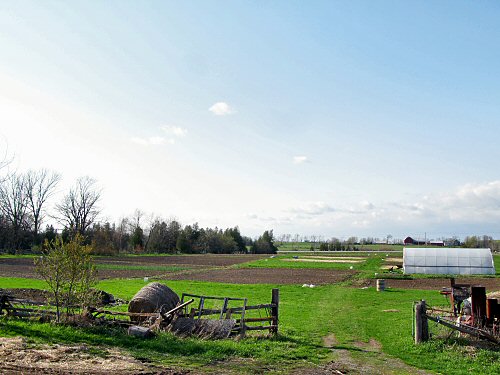
Looks pretty good from here, the bottom end of the field is well-prepped and partially seeded, but the weather is COLD. As forecast, this time, the cold snap arrived Sunday, and we’re now treated to daytime temperatures around 5°C (40°F) or lower, and, after the incredibly warm last couple of weeks, what seem like FRIGID nights going down to -7°C (20°F). Seedlings are piling up in the Milkhouse, but I’m waiting until the cold breaks, which should be around Friday, to start moving things out to the greenhouse. On top of the usual everything-to-do-at-once of April-May, the late melt-off followed by instant mid-summer weather were a little disorienting, and germination of the early direct-seeded crops is SLOW, first hindered by the dryness, now, not helped at all by the sudden cold… Next, I still haven’t settled plans for help this season (people in the field!), which makes a BIG…psychological difference, head space, whatever, it’s harder to focus when you can’t even estimate what will get done each precious day. There’s quite a line-up of potential volunteers, and one person coming later in the week to check things out who may stay on for the season, but it’s all UP IN THE AIR until it’s happening. And these are the few weeks that largely set the quality of the entire season… So, the Almost Overwhelming days are in particularly fine form this year… Of course, take a deep breath, think about it, and really, what’s to worry: tiny farming is all about long odds and doing the improbable… That sounds kinda cool to me! :)
Planning
Field day!
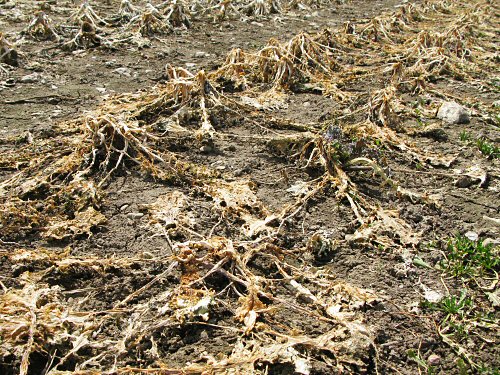
Left to the last possible harvest in the fall, brassicas like kale, Brussels sprouts, cabbage, broccoli and cauliflower (above), were eventually winter-killed and now have to be cleaned up—one of the first field-readying jobs of spring! Today, I started. (EVERY day is a field day from here on in, through November at least, or the first heavy snow that sticks.) A day of tiny farming fieldwork is really just a whole lotta gardening… Now that the ground has dried out enough to be tillable (that could’ve been yesterday, but…errands and CHICKENS), and warmed up enough to direct seed the crops that germinate in cooler soil, it’s a whole new world of things to do…and think about doing. There are two basic ways to ponder the progress of the season’s garden: by timing and by area, each useful in its own way. Timing is mainly about the plants: when to seed, when to water, when to harvest. Area is about where to locate particular plantings, which in my case doesn’t mean absolutely running out of space, since there’s lots more field to expand the garden into if I wanted to (which I don’t), but more like where to position stuff efficiently, so you’re maintaining crop rotation, but not having to, say, drag hoses all the way down the garden to a couple of newly seeded beds that need daily watering in (although there’s a field production plan made up, there are lots of adjustments on the way—where to put stuff will come up again and again!). So, the start of the season is mainly about area, because you have to prep beds and get veggies in in a rough order—cool soil seed, then cool weather transplant, then warm soil seed and transplants—and the timing is a constant: it’s all right away! One way I keep overall track of this garden is by counting sections: it’s about 2.5 acres, divided into 40 50’x50′ squares (each fits 10-16 beds, depending on width). At some point in the next six weeks or so, almost all SHOULD be planted out, nearly 40/40. Today, I started seeding in one…
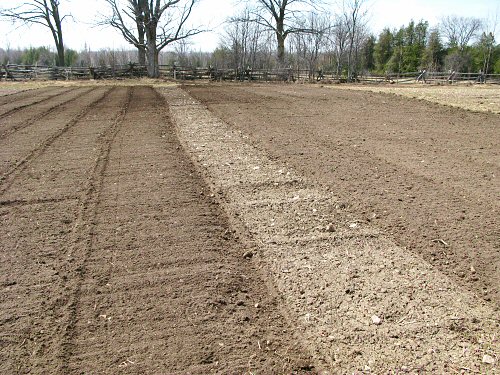
Tilled and untilled: Partially composted cow manure was spread and incorporated in the fall. Now, a light rototilling to prepare for seeding is all that’s needed. Today, I used the tiller on the Kubota compact tractor.
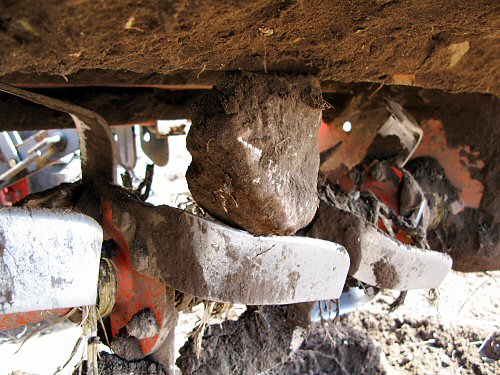
Rock beats tiller: There are lots of stones in this field, they work their way up continually, and even a fist-sized rock, caught in the right way, can stall out the 48″ rototiller on the Kubota (it’s a tiny tractor!). No problem: remove and restart.
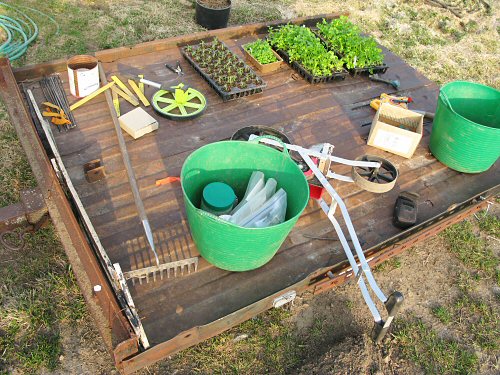
Getting set to seed: I work mostly one or two sections at a time, prepping an area with the tiller, marking the beds, then seeding (or transplanting). This way, I can get the crops that need to be started in as quickly as possible. Here’s the cart towed by the riding mower, loaded with assorted seeding gear (and some transplants being ferried to the greenhouse).
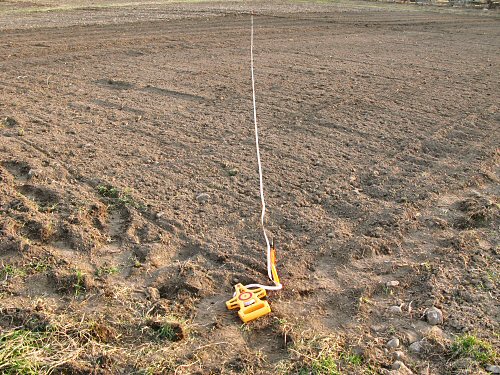
Making beds: Oh, there’s A LOT of tiny farm history behind my bed marking methods. :) I’m still working on the most efficient way to set up beds. Right now, it’s fairly streamlined, involving a 100′ tape measure, stakes, and pacing off distances. This year, I’m planting in 3′, 4′, and 5′ beds (that’s path included), depending on the crop.
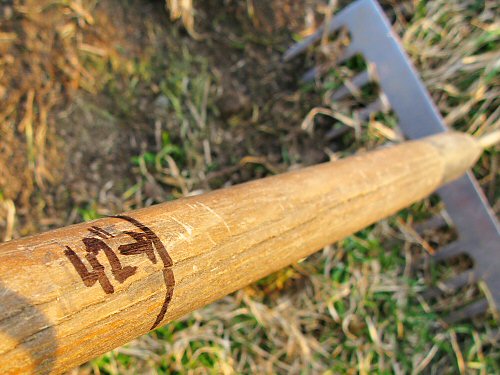
Customizing the Rake: Every season, I re-ink faded measurement markings on a couple of hand tools I use the most. Here’s a convenient mark for 42″ from the top of the handle (that’s the planting area width for a 5′ bed. There are other marks further up the handle, and the whole rake is exactly 5′. It’s convenient for quick checks, especially on the favorite rake that I use for touching up beds right before seeding. And so, off we go…!
Head out on the highway…
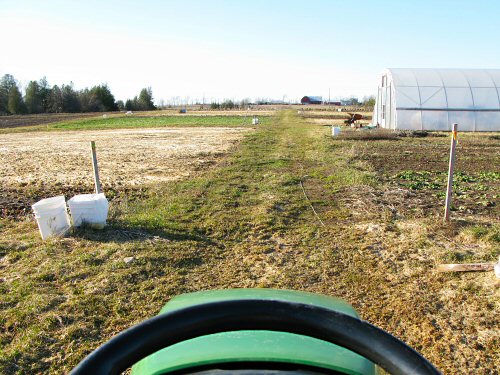
A couple of days ago, things seemed to be moving in slow motion, today, it’s the wide open highway! (A poor analogy, perhaps, given the soaring price of gas, but anyway…) Sitting at the wheel of the little riding mower, heading to the greenhouse down the main path with trays of seedlings in tow, a warm sun shining down, a good part of the field just about ready to work, all the possibility of a brand new garden season ahead, and no weeds in sight felt…really fantastic. With a nice adrenaline rush!
As the warm weather kicks in, there’s a whole series of winter-to-summer changes, and my body memory of fieldwork details starts to come back. It’s not like I’ve been doing this forever, each new season, there’s a spring ramp up of remembering routines, pathways, ways to do a thousand little things.
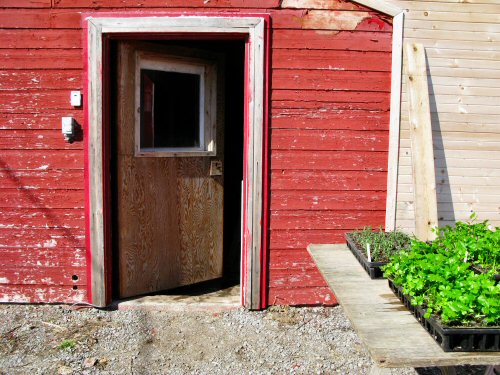
Last week, I moved the Kubota compact tractor and the riding mower out of winter parking in the drive shed, to make room for summer storage. The greenhouse is now almost completely set-up for full seedling mode. Today, I test started the Horse walking rototiller and walked it around, set out the rain gauge, stripped off the draft-sealing duct tape to open the Milkhouse side door (a milestone spring moment!), and hooked up the hose from the barn well to the pipe that runs down the field and supplies the greenhouse (the hose goes through one of the holes at the bottom left of the door). Practically overnight, there is SO MUCH TO DO, RIGHT AWAY. There’s tons of tilling as soon as possible so the cover crop residue can start breaking down, and immediate seeding of, at least, peas and spinach, in the next couple of days of sunny weather, before the big rain forecast for Friday and the weekend. And CHICKENS should be here tomorrow… Fun!
Catalog shopping: chickens on order!
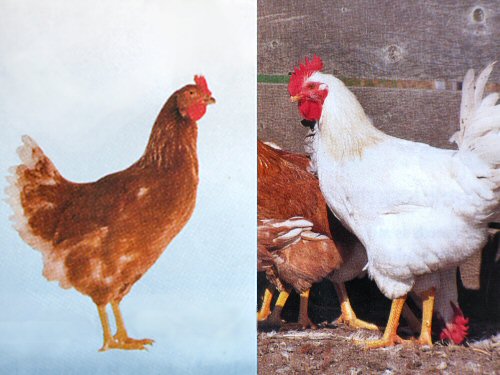
Chickens are on the way! On the left, a reportedly prolific brown egg producer, the Shaver Red Sex-Link. On the right, the reputedly hardy, healthy Frey’s Special Dual Purpose as our meat bird.
I almost broke a pretty basic rule on this one—get your questions answered first!—and ordered White Rock Cornish X for meat. Chatting with Bob, we’d decided on the Frey’s Special, but at the last minute—on the phone ordering them from the feed store—I asked about the Frey’s, and was told that “99%” of the small quantity meat birds were “White Rock” (meaning WR Cornish X), that people were often disappointed with the dual purpose for meat, that for meat, White Rock is the way to go. White Rock! White Rock!
So I got off the phone, and did some quick extra research. Talked to Bob again, who said the thousands of meat chickens he’s raised were all White Rock, BUT, they have to stay indoors, WR just stand around and EAT, which is why he thought Frey’s would be better for outdoors.
Next, hit the Web, and found stories of people successfully free-ranging WRs, even in the heat. BUT, they also said things like: “They did wander around a lot but nothing like the regular birds. They did all the normal bird things just a whole lot less gracefully. Only thing they couldn’t do was perch or fly.” Hmmm…
Which took me back to the original stuff I’d read in the hatchery catalog, things like: “Unfortunately, the White Rock’s increased efficiency at feed conversion has not been matched by improvements in the bird’s cardiovascular system. Simply put, too often the bird’s heart just can’t keep up with the rest of its body.” Yikes… Hello flip-over disease (aka Sudden Death Syndrome, aka…heart attacks), which tends to afflict the biggest, healthiest birds… And there’s lots more disease warnings, feeding restrictions, general strict instructions… Extremely fast-growing meat chickens, no doubt, and I’ll probably try some…later, but too weird for now…
For good measure, I got through to the Frey’s hatchery. The woman on the phone was great. She said most people just want to produce meat quick and go for the WRs, and they may do OK free-ranging, but really, they’ve been bred for rapid growth in a controlled broiler barn environment, AND, for a hardy, free-ranging, TASTY meat bird, dual purpose are great, friends of hers raise the Frey’s Special and love ’em. So Frey’s Special Dual Purpose it is, more traditional chickens that grow a little slower and weigh a little less, but can actually have fun, run around, eat insects, scratch in the dirt, and won’t…flip over! There are 50 2-week Frey’s Special cockerels coming either April 16 or 30, and 25 ready-to-lay Red Sex-Link on June 23.
Entering the world of CHICKENS, I’m excited!
(UPDATE: After writing this post, I read the comments below, did some more online reading, and switched the order to 40 White Rock Cornish X and 10 Frey’s Special…)
(UPDATE 2: It’s a year and a half later, and we recently processed a second flock of White Rocks. My original last-minute double-switch to White Rocks was a good one. I still want to raise other breeds, but you absolutely can keep healthy, free-ranging WRs, and they do get to a good size!)
Seedlings continue to grow…
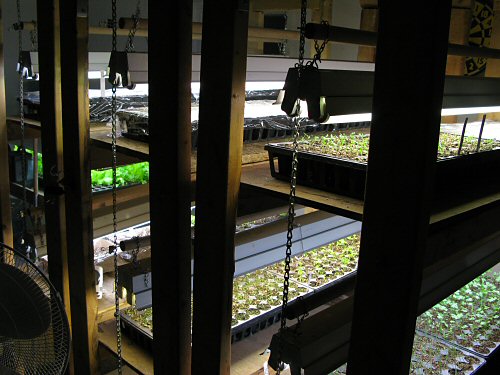
Seedling production is on about the same schedule as last year, except there are a few new things on the go: celery, onions, leek, celeriac. The three grow racks aren’t yet full (and there’s a fourth to build), but all that will change in a couple of days, when peppers and eggplant start. This is also when gambling on the weather begins, which at this point affects when I choose to start certain crops. Already, based on the 15-day forecast, it looks like a much colder March ahead than in the last couple of years, and with all the snow cover, a quick thaw towards the end of the month will still mean a few extra days of drying out time. And then there’s April to “consider”—it’s all basically pure guessing, colored by a little wishful thinking. IF there’s gonna be cold and snow for a good part of April, early transplanting will be delayed. So, starting some things in a couple of days, or in a week, or in two weeks, could make a fair bit of difference. If I have to hold things for an extra 2-3 weeks, there won’t be room under the lights as I start more, and out in the greenhouse, given real sun, growth will be quicker and the seedlings will get crowded. And so on, tons of little calculations and gambles… Nothing is THAT critical, but a little more work here, a little crop slowdown there, it all adds up. I enjoy this, juggling increments in the face of the weather, but it could drive some people into quite a state! :)
The wild bunch
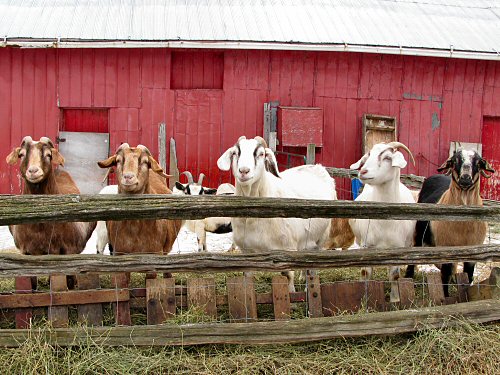
Mainly mucking about today. Visited with the goats. Around 15 of ’em. These girls upfront are the current kingpins of the goat yard. Goats have their pecking order (just like the chickens to come!), which mainly means a few get first crack at food, or crowding at the fence, or whatever else they all want to do, while the rest back away and wait or get butted. It’s mostly rank by size, but a vicious streak counts, too. The one in the middle is on top now (with her friend on the right), the brown pair on the left (the Evil Twins), used to be a vicious tag team running the yard, but they lost their edge. Not that they’re always fighting, a brief burst of deterrent action goes a long way. It’s like a soap opera if you watch ’em every day. Goats…
Every year, this little period in the first half of March is kinda like waiting for the starting gun. I’m full of energy and waiting on the weather. A little EDGY. All the early starts are now under lights: onions (first time from seed), celery (another first), more leek and parsley, plus the stuff started around the end of January (leek, parsley, rosemary, arugula, lettuce). It’s another week to the peppers and eggplant, and then the grow racks will start to get full, and I’m also holding off till then to transplant the early lettuce to the greenhouse. As soon as the snow clears and the temperature warms up a bit, there’s outdoor fix-it work, starting with an old ice fishing hut to turn into a home for the composting toilet (an outhouse for the field!) and the chickenhouse to renovate. There’s a list. Plus a lot of garden clean-up, crops left over winter, that should be pulled as soon as I can. MEANWHILE, I’m waiting…
Chicken catalogs
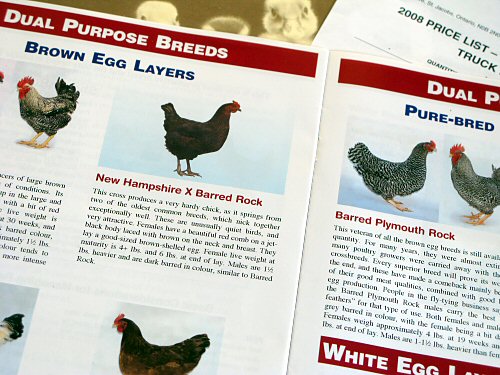
There’s a catalog for everything. Bob dropped off two with chickens (turkeys, ducks, pheasants, partridge and quail, too). I’m looking at dual purpose birds… It’s pretty sure that chickens will return in small numbers to the farm this year, but not a done deal till April. For me, it’s a completely new tiny farming…adventure. I’m going into it much more casually than usual with new farm stuff, because for this year it’s mostly for fun. I don’t really have a PLAN. We have room for about 50 birds in the current chickenhouse set-up, so it’s not such a big thing. We’ll see next month!