
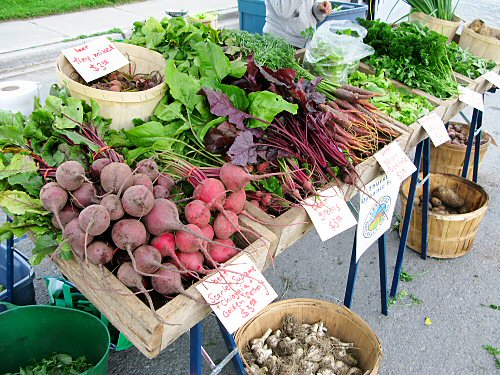
The farmers’ market stand is getting crowded. Actually, it’s been that way for…seasons. Somehow, plans aside, I haven’t yet gotten around to doubling the table area. It’s about time…
Planning
Tiny farming: it’s a garden party!?
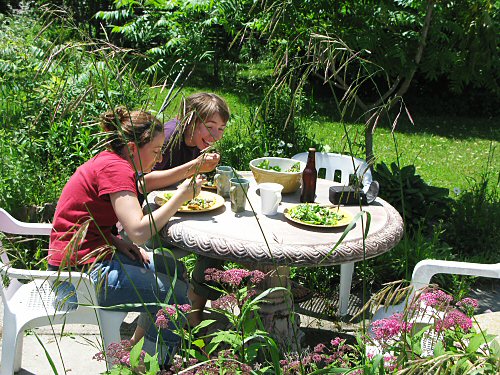
For the month of June, after Shannon, who’d been in the field just about every day in May, and while waiting for Lynn to start full-time for the rest of the season (July 1st!), I’ve been back working in solo mode, which has been, surprisingly to me, a little strange and…unfamiliar. Right now, there are several great people sharing the tiny farm experience (TFE ;) each week, but coming on single days. Here, with Lynn and Raechelle (Tuesdays!), we take an extended Endless Salad lunch break in the backyard. It’s as relaxed and fun as it looks. This, I think, is how it SHOULD BE, a laid back mix of fieldwork and practical leisure. It’s a lot different than the 10-12-hour, garden-obsessed days of the first 3-4 start-up years, when I worked largely alone. After working with Conall right through the season last year, I realized that my original solo mission, one-farmer-one-field mode had…changed. Evolved. To continue to grow on this tiny farm, it seems I’ve taken the path that needs not more production acreage or machinery or straight, head-down hours of labor, but simply more happily committed PEOPLE. Hmmm… Not a brand new discovery, but driven home over the last month. An interesting twist on tiny!
Measuring peak oil by the can
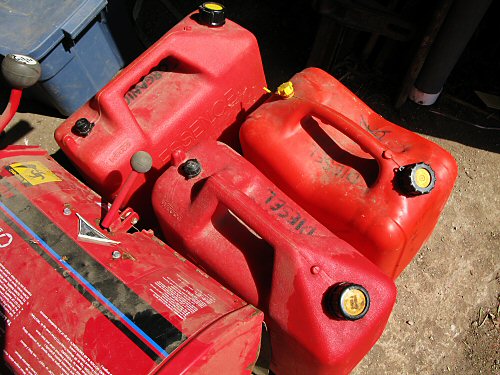
This tiny farm’s entire direct connection with the world of oil is simple: six red, 20-liter gas cans, three for gasoline, three for diesel. It’s a really stark way to watch spiralling gas prices and the so far bubbling-under peak oil panic, made more so for me because I don’t drive (never bothered to get a license), and I’ve lived 100% in big city cores until the farm—North America’s deep-set gas station culture had been a spectator thing for me. And now, gas is suddenly connected in a very straight-flowing line, from pump to a handful of tiny farming tools that perform clear and specific tasks. On the gas side, there’s the riding mower (mowing, mulch collecting, hauling stuff in trailer, used a lot), a walking rototiller (only moderately used since the wheel hoe last year), the pond irrigation pump (with so much RAIN, not used at all this year!), a weed eater (used only moderately), and another weed eater converted into a mini-cultivator (seldom used). On diesel: the Kubota compact tractor (rototilling, moving stuff with the front-end loader, quite used). That’s it! I filled three cans in mid-April, two diesel, one gas (above), today, two months later and all out, I filled two more, one of each. In my five years of tiny farm experience, cost has gone from $15 a can of gas (and quite a bit less for diesel), to about $30-35 a can (with diesel more expensive?!). It’s worrisome, but I don’t get too agitated, probably because the containers are so few and so relatively SMALL. But every time I’m tilling on the Kubota, or driving the length of the field loaded down with harvest and gear, I’m increasingly, acutely aware of the amount of work that comes out of a little gas, and what the manual labor alternative would be like. It’s like a little calculator program running in the back of my mind: how long would it take me to do this by hand? How about with help? What would it be like to do without? I feel great satisfaction when the six cans are filled and set in the drive shed all in a row: supplied for…a while! Of course, gas figures big in getting to the market and getting to town, and I pay my share there (I have an arrangement with Bob for the market season, and for the rest, I get lifts when others are going where I need to). And I also never forget how all those store shelves get filled. And how people get to market, pick up CSA shares, get to the farm. And I’ve started calculating highway mileage to reimburse everyone who volunteers here for their travel. Not to mention all the flying and driving it takes WWOOFers to get here from far and wide. And so on… Oil is everywhere, not easy to avoid or make sense of. At this point, for me, it still comes back to the cans: the color of oil is RED… :)
Plastic…fantastic?
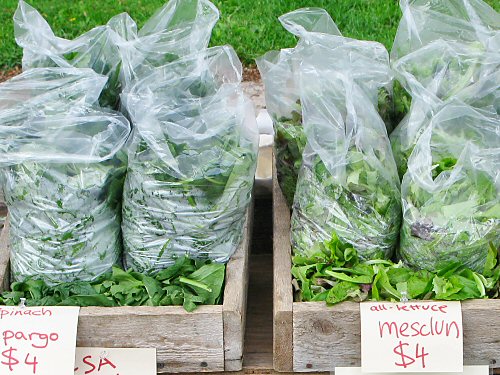
At the market today, greens were finally in great supply, with loads of mesclun and spinach: two giant, clear leaf bags full of each. I went home with quite a bit—no sold out sign this week!—which was great, ’cause I was selling right up to the end. And, as usual, I noticed all of the disposable plastic involved…
Greens, and market/CSA share harvests in general, usually involve lots of PLASTIC BAGS. In the beginning, this didn’t overly concern me on any level, other than that buying bags by the hundreds and thousands was kinda costly. But being on the dispensing side of this steady stream of plastic gradually made me realize how much of it is continuously being tossed out there FOR NO LASTING PURPOSE.
What got to me first wasn’t the environmental issue, but the fact that people were profiting off of this useless mass consumer habit of taking tons of “free” bags at every stop… Don’t like being fooled again and again… This culminated in one way for me about two years ago, when I stopped taking shopping bags for, like, 98% of my store shopping. Last year, I started cutting down on the way I offer shopping bags at the market: instead of automatically grabbing a bag for a customer as I asked if they needed one, I ask in a leading way, kinda eying what they’re carrying already—not surprisingly, with all of the anti-plastic bag attention lately, the majority of people so far this year bring a basket or cart, or fit their purchases into a bag they already have.
I mean, to grow greens, it takes 40-60 days of watching, watering, weeding…and suddenly, in less than 24 hours, they’re harvested, bagged, distributed, and, hopefully, within another 2-3 days, EATEN. And the really useful life of the plastic in a bag of fresh-market greens is more like a very few hours, because once you’ve gotten your greens home, there are many more efficient ways to refrigerate them (like in a nice cotton bag, in a salad spinner, in a big bin,…). But there’s nothing that easily replaces the convenience of plastic for that last little trip between stand and home (a couple of people have asked that everything, greens and all, be tossed loose into their own shopping tote, which is kinda cool and should work no problem, but doesn’t sound too easy to encourage amongst ALL…).
So what am I getting at exactly, besides the OBVIOUS? Well, I guess it’s that plastic is curiously useful stuff, I’m not about to outright REJECT it in all its many handy shapes and forms, but I should learn more about it for a start… More as it unfolds! ;)
Ah, the Home Garden…
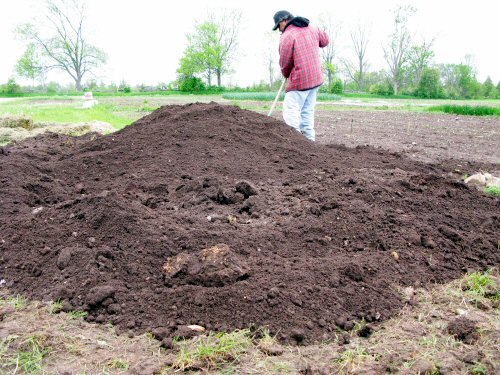
After quite a bit of talking about it, and last year’s false start, a Home Garden is suddenly in place in one corner of the field. The idea is to have a small demonstration veggie plot, to encourage people to grow at least some of their own stuff in whatever space they have. Why? Well, it seemed like fun. Located by the farm stand, it would be an extra little attraction to farm visitors… Just a thing worth doing… Anyhow, last year, I staked out a section, but didn’t get too far in planting anything in it, a couple of tomatoes and a few potatoes… This time around, I’d been chatting with Shannon, who has a lot of permaculture-based ideas, from reading and interning, so I asked her to plan it out. The final design was done really quickly earlier today (it was a busy month…), it’s more a freeform, jumbled garden with a permaculture flavor: all annual veggies, no rows, lots of interplanting, a herb spiral on a mound (a mix of annuals and perennials), an anti-pest barrier of alliums (onions and garlic chives) around the perimeter, and three little keyholes, which are dugouts that you can kneel in to garden within reach around you, as an alternative to working from paths. At about 10’x20′ (3x6m), it’s fairly small. One cool thing: the home garden layout is entirely unlike the rest of the market garden, which is all flat, linear and grid-like, lots of rectangles and squares and straight paths. Now, we have a deliberate elevation and CIRCLES! To make the mound, I dumped a few buckets of compost using the Kubota compact tractor, and raked it into shape. We then added stones for the spiral, and Erin and Mike dropped in and helped plant it out, using odds and ends of transplants and also seed, with Shannon directing. The rough plan is to have Lynn and Raechelle develop and tend it over the season (Shannon leaves tomorrow after a solid month in the field).
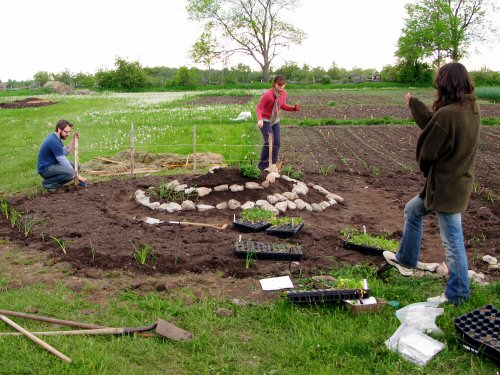
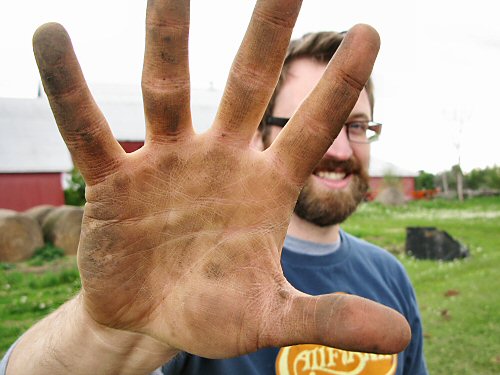
At just over two acres of veggies, the tiny farm is really small by most any modern agricultural standard, and starting up a MUCH TINIER space is its own private…thrill for me. It’s so…opposite! ;) It’ll be interesting to see how Home Garden 1 turns out as the season rolls along! Any way you can, getting your hands dirty is what it’s all about… (Guest photos: top by Shannon, below by Erin.)
Veggie Outpost 2
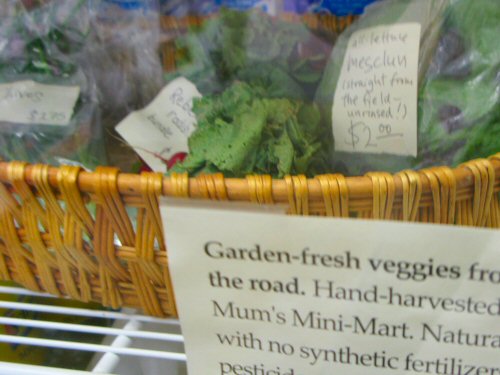
Last year, a little experiment with veggie sales in a town 12 miles (19km) away didn’t go so well. I guess you could sum it up as No Quality Control. This year, in line with the tiny farming trick of thinking SMALLER, I had the sudden idea to put some veggies in at the convenience store three minutes down the road in the village. This is now the only store for quite a ways around, and it has the post office where everyone in the village picks up their mail. Since I’m always meaning to get the farm stand fully open, putting veggies out a couple of minutes away hadn’t quite made sense, but the way it came to mind now was a little different. If I could get a single shelf in one of the coolers, this would be an interesting, easy way to learn about veggies and refrigeration, and even be able to watch a mini version of the supermarket, convenience-shopping experience, by seeing what sells, the effects of labels and pricing, and…whatnot. All on the most casual level. Refrigeration is, of course, yet another of those many worrisome topics that come up along with Peak Oil and the generally somewhat alarming state of the world, BUT, fridges will likely be around as long as any number of other taken-for-granted things, I figure, so whatever’s learned from a little, low-impact experiment like this should be worth it. It’s an extremely simple set-up, with a small sign taped to the inside of the cooler door, hand-labeled bags, and an honor-system account book for inventory. I also like the idea of super-fresh garden veggies popping up in this most unlikely place, just below the shelf where a few supermarket-purchased veggies are kept for resale. Outpost 2, the Shelf, has been open for around three weeks now, stocked with ones and twos of mesclun and spinach, a few radishes, some herbs. I’m by there every day anyway, so I check the veggie condition often…and things are selling… Interesting enough…!
Work for a dreary day
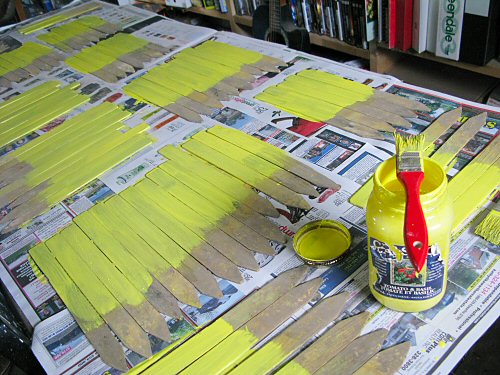
Rain is usually the only thing that stops work in the field, and not even that on harvest days, but this crazy cold May has had it’s particularly nasty, stay-inside days, and today was one of ’em. With a sharp, damp wind, and temperature around 50°F (10°C), stepping outside instantly set you to shivering. It wasn’t THAT bad, of course, and I think it was so off-putting mainly because of the sudden shocks of drastic day-to-day changes we’ve been having lately. In any case, there was no super-urgent fieldwork, that couldn’t wait a day, so we decided to hide out and do…indoor stuff. Bad weather days have their place on the tiny farm, you can catch up on all sorts of things that might get put off otherwise, and later get in the way or interrupt your…flow. Today, we repainted garden marker stakes (these guys are kinda expensive, you don’t wanna waste ’em) with a thinned out latex exterior paint. I’d only done this once before, by dipping (it took 4-5 years to accumulate enough that a good number were so written on and faded, they needed a little makeover!). This time, I figured a brush would be quicker, which it was (except, don’t use a newspaper liner, the paint makes it soggy and then it sticks; for the other side, we just painted on the table directly, and wiped up afterwards).
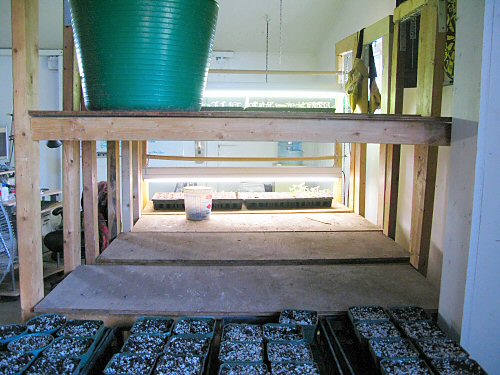
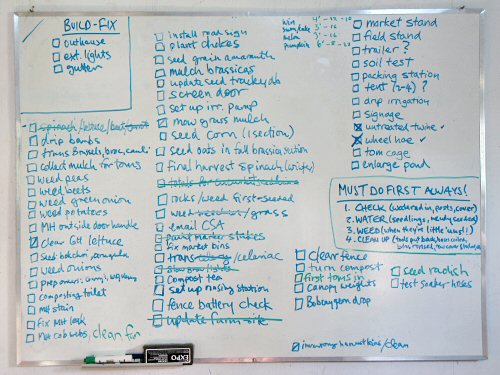
Other pleasantly sheltered jobs included removing the lights and chains to turn the grow racks into harvest bin storage (left a couple of lights on for a last few seedlings) and packing up the lightbox set-up to free up space, reorganizing part of the drive shed with all the farmers’ market gear, doing some work on the enclosure for the composting toilet, seed starting for another wave of broccoli and cauliflower transplants, making some calls,… Most of these weren’t on the whiteboard task list of the most important things for the next few days. For the to-do list, I used to use the notebook I carry in my back pocket everywhere, but since last season, with Conall full-time, I switched to the big board (it joined the smaller harvest board), to make it easier to SHARE the fun with everyone…!
It’s mostly immediate stuff. The list on the top right is bigger projects and purchases to keep in mind. The “Must do first always!” is a distillation of things to do every day, kinda like a day-to-day framework for tiny farming fieldwork, meant for anyone helping in the field on a regular basis—it’s a work in progress! :)