
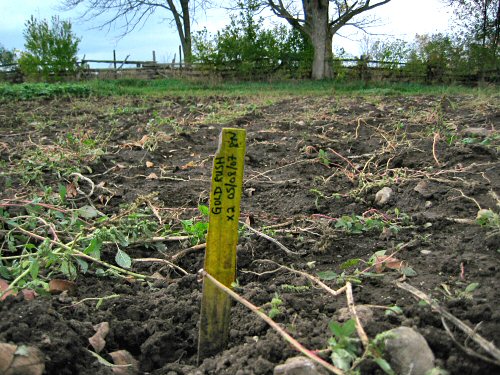
Finally, today, no more potatoes in the ground! After a near-pristine potato patch for much of the season, field priorities got switched around and pigweed had its turn with the taters. Eradicating the weeds before digging up the last 50’x50′ section seemed to take forever (but was actually a few hours spread over the last couple of weeks). Anyhow, this last haul is about 200 lbs (91 kg). It’s not much when you can buy a 50lb (22 kg) bag of great, unsprayed, unwashed potatoes for $14CDN at the farmers’ market. But in my crop mix, it makes sense. We harvested somewhere around 1,000 lbs (454 kg) this year. In the usual 1-2 lb bags, some sold at a by the pound (not bulk!) price, and the majority used for CSA shares, that works out just fine… Of the Yukon Gold, Norland and Gold Rush, YG performed the best, from small, early, supertasty new potatoes to a good amount of nicely big mature ones—they’re not for storage, but who stores a pound!
Year: 2007
Making mulch, part 2
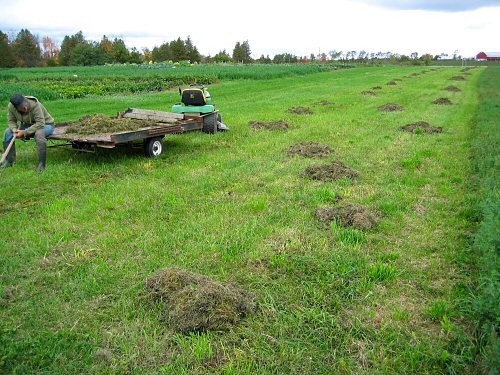
Working just ahead of more rain, Conall (fighting a cold that’s knocking people out around here—farmers can’t get sick!) and I raked the mini-windrows of grass and alfalfa into little mounds, piled it on the trailer, and dumped it in the greenhouse to finish drying. In the week since it was mowed, there was enough rain here and there to keep it damp, which wasn’t in the plan. Oh, well. A grass catcher for the riding mower would be the time-saving mechanical approach. This was a lot more fun, quite relaxing, a couple of hours well spent. Now, let’s hope it’ll dry, not rot!
Big beets
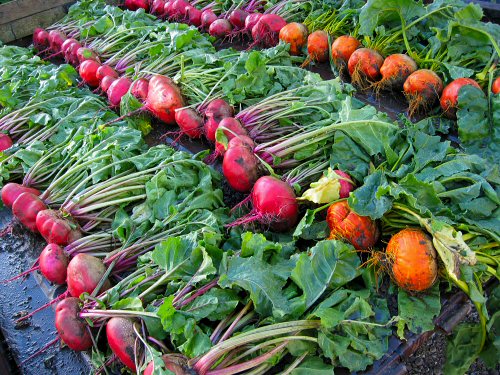
Something excellent and hard to pin down happened with the last planting of beets: they became HUGE. This was the fourth planting of the season, around mid-July (see them on the left), and the seedlings got caught in the near drought, although they were around the top of the irrigation list and got a decent share of water. In mid-September, the steady, plentiful rains started, along with continuing warm weather, but that was well into their growth (they’re all 50-60 day varieties). And thinning was good, though just the usual. Whatever the cause, all of them—Scarlet Supreme, Golden Detroit, Bull’s Blood, Chioggia—blew up, most weighing in at 1.5-2.5 lbs (700-1100 gms). Maybe I don’t get out enough (to check out other people’s produce around the country and the world :), or maybe more irrigation would do the trick, but to me it’s somewhat of a mystery how these got to double and triple size. I’ve tasted them all, raw and cooked: they’re firm, tender, with great color and flavor. Smaller beets are more convenient for some purposes, but these big guys are versatile and…easy to harvest and pack… Two to a beet!
Seasonal eating
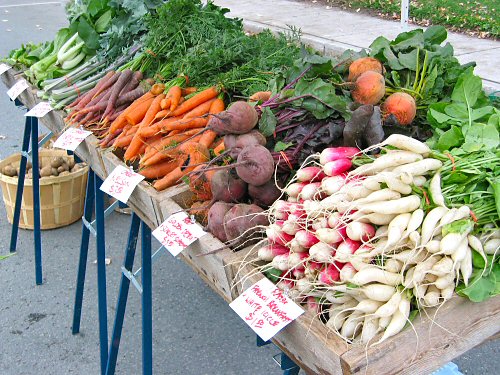
The veggie selection changes over the season, but it’s not necessarily reflected too dramatically on the stand at the farmers’ market this year. Compared to mid-August, the absence of snap beans and tomatoes is clear (with the mild weather, some vendors did have standard field tomatoes today). As for early June, well, more variety now is to be expected. Still, most of the cool-season crops for around here, like broccoli, cauliflower, and collards, also, winter squash, I have only enough of for CSA. On the stand, two types of radish (White Icicle, French Breakfast), three types of beet (Golden Detroit, Scarlet Supreme, Bull’s Blood, in smaller sizes here), two types of carrot (Nelson, Purple Haze), Red Russian kale, two types of bok choi (Mei Quing, Joi) and mesclun, plus Yukon Gold potatoes, Music garlic and Stuttgarter onions in baskets. The stand could be a lot bigger, offering more display space, and the harvest could be expanded (there are still herbs, summer squash, sweet and hot peppers, tomatillos, Brussels sprouts,…) but the marginal sales for many “secondary” veggies at this slowing down time of year don’t make it worthwhile. I’m still working on the balance between production planning, labor, harvest selection, post-harvest prep, and presentation… Sounds complicated, but it’s just…work! ;)
Frost protection
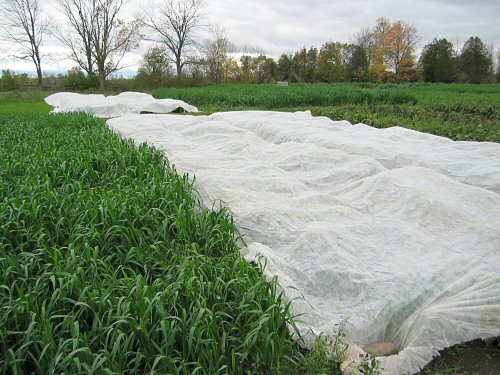
With last night’s forecast calling for -3°C, I finally figured a little floating row cover frost protection might be a good idea. In fact, though, with the cloudy, windy, wet conditions right through to Saturday evening, a solid freeze didn’t seem all that likely. And that turned out to be the case. The min/max thermometer outside the greenhouse registered a low of -5°C, but only a few crops suffered minor damage. Even the basil, which is really tender, did well: the top layer of leaves took one for the team, but the rest were fine. Here, some sweet pepper plants sit under cover, but the forecast for the next week is…quite warm. When exactly does the season end?
Making mulch, part 3
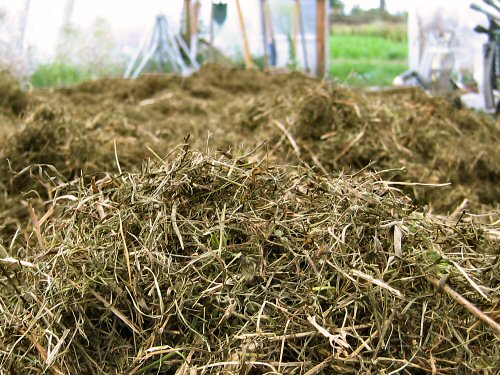
The grass and alfalfa mix spread in the greenhouse a few days ago is drying nicely—it’s almost done! It was a tad touch and go at first, the rows in the field were starting to turn black and decompose, and no sun in sight. So I turned it a couple of times a day for the first couple of days, doors wide open on both ends let through lots of air…and things worked out! Seems like a nice mix, with good bulk, not too fine. Then again, my mulch experience is in its early days, so we’ll see. Rough calculation: there should be enough to spread a fluffy 3″ (7.5 cm) over the new garlic plot. This experiment so far: not too labor-intensive, room for easy improvement to the process, seems like it would scale well (for covering larger areas), and RELAXING (some fieldwork is particularly enjoyable)… Grass-and-alfalfa mulch may have a big tiny farm future!
Cows at the gate
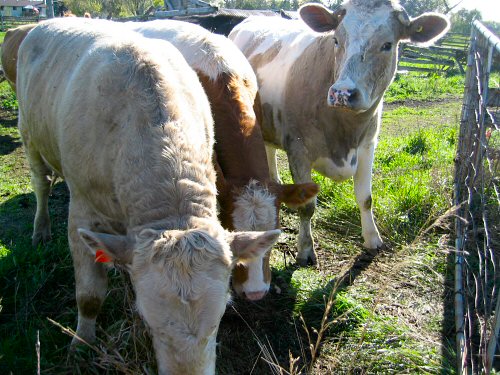
Rampaging cattle! Well, more like, a few cows wandering into the field. This happened once before, three years back, and that time, the potential for disaster was a little greater. Unthinkably, TWO critical gates had been left open overnight, and around a dozen cows headed in at dawn. It was also around June, with a whole market garden full of new crops, there to be ravaged. Just by chance, the intruders were spotted early, and it took three sleepy people, lots of running, and a pick-up truck, to head ’em out (it’s a 9 acre field). Luckily, the cows were most interested in the hay, on the way there trailing giant hoof prints down just about every bed in the garden, leaving the veggies otherwise untouched. So it turned out fine. This time, with most of the cattle gone from the farm, the remaining little posse of five cows and a bull, all friendly and laid back, made their way up an 11 acre pasture and slipped through the garden field gate in the four or five minutes when my eye wasn’t out there. I’d been using the Kubota compact tractor to move manure from the barnyard, about a dozen trips, with a few minutes of blind time each trip as I spread on the new garlic bed. Crafty, stealthy guys… There was a moment of sharp…concern as I eyed the wide open double gate across the field, leading to the side road and on to unfenced houses on the subdivision, and the wide open two-lane highway not far down. But the cows were absolutely fixated on the first lush patch of oats they encountered. With the other gates closed, herding them out went surprisingly smoothly. The whole adventure: 20 minutes! An interesting break…