The other sunflowers…

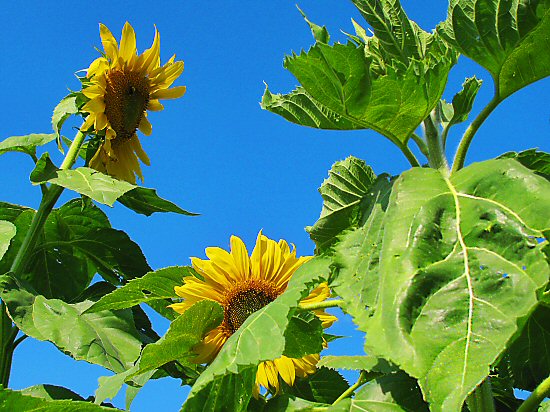
There are pretty ornamental cutting sunflowers, and then there are these monsters of the field, towering Early Russians, and their almost as imposing kin, the rugged Jerusalem artichoke (last photo). They’re the genus Helianthus, North American natives, supposedly dating back 8,000 years, and by the look of it, really not too disturbed by the crazy weather right now.

Both of these are experiments. This is the second season for the Russian giants, grown exclusively for their potential as a plant-protecting wall. It’s the third time around for the JAs, a crop that can do double duty as a living wall… Neither were strategically placed for action this year, but the idea is mainly to use them as shade during scorching summers. They get to a pretty good height by sometime in July, so the timing works. Even at 7-8′, they won’t protect too far out, a dense and high-value crop like all-lettuce mesclun would make it worthwhile. They could be good as windbreaks as well, but I haven’t considered for what…

The sunflowers are around 8′ tall now, it’s quite incredible (with a longer season, they can apparently get up to 14′). You’d think with them growing so fast and big, they’d always stand out, but with all that’s going on in the field, you can forget and then one day, turn around and BAM, there’s that wall o’ green, STARING at you…

The flowers are practically as big as my head, and so heavy, they eventually wind up completely face down.

The Jerusalem artichoke are a little more refined, but still big and resilient. They’re around 7′. Both sunflowers and JAs are planted in double rows, and held up to this year’s helping of storms and massive winds no problem. Reliable…

Eggs from the wild

Collected eggs

Four or five of the girls have been escaping every day, creating their own day pass, and doing a fair imitation of flying while they’re at it. In the morning, I open the chickenhouse door and barricade it with a strip of plastic fencing that leaves a 2′ gap at the top. After I leave, they hop up on the roost, propel themselves, furiously flapping, to the top of the fencing, perch there for a moment, and then head out.

I’m not sure if it’s always the same ones. There are 25 Shaver Red layers, and I haven’t spent enough time hanging out with them to really tell them apart. But I suspect it’s a gang.

They spend the day foraging far and wide around the farm, and return at night, waiting to be let back in. This has been going on for several days, since the meat birds left…

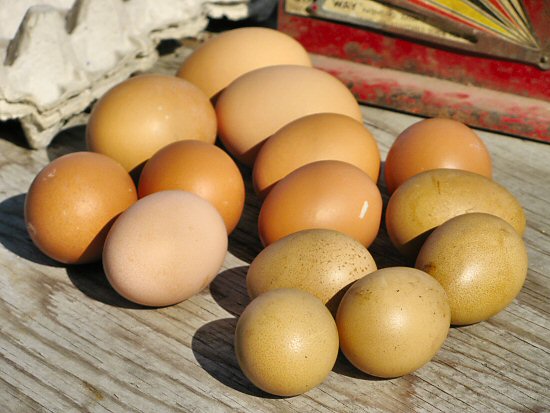
Today, Connor found a few eggs in a thicket they seem to like. Besides being a different color  from all that exposure, the eggs are clearly getting SMALLER (they’re the ones in front). As varied and nutritious as their free-ranging diet may be, it’s lower in protein than the carefully concocted feed available inside. I guess that’s what’s up.

In any case, we’ll soon put up some kind of fence, cut out a chicken door, and they’ll have the best of both worlds: grass and bugs on the outside, protein-rich feed from the feed store inside, and a convenient place to lay.  That will be our state-of-the-art in natural eggs for the next little while…

Carrot-burlap method gets a twist

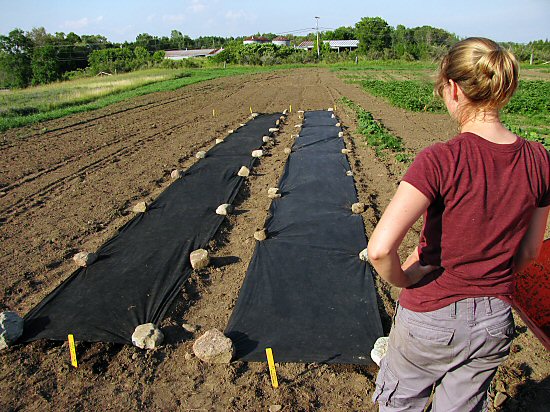
Here’s one of the more extreme displays of crazily labor-intensive tiny farming technique. Andie surveys our work, the result of deciding to try landscape fabric in place of burlap to help carrot seed germination. It’s actually a double experiment, because one of the beds is green onions.

The burlap method has been the way to start carrots around here for the last two seasons: tried and true. The main purpose is to preserve moisture in the seed drills, and the increase in heat helps as well.

After a good run, the first round of burlap expired, and I couldn’t find rolls of it in time for this season (I know it’s out there, somewhere). But, I spotted this gear, landscape fabric, a porous plastic mulch used to permanently suppress weeds in…landscaping. It’s light, and just wide enough (3’/30 cm) to cover 4 rows of carrots (that’s a little closer than usual for the bunching onions). I tried it on two beds earlier in the season, and it works fine!

One little problem: it tears easily, so how to hold it down? With the burlap, we made wire staples out of heavy gauge wire. Here, we placed a LOT of heavy rocks, close enough together that there’s no room for the wind to get under and start really pulling. This does the trick for now, but overall, it’s a little TOO intense. The hunt for burlap: still on!

Chickens: ranging too far

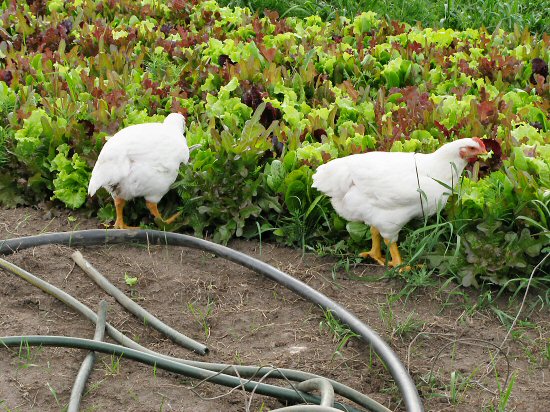
These guys, the White Rock Cornish X meat birds, have free-ranged too far, making it to the edge of the veggie garden in the big field. Luckily, although it looks good in the photo, this all-lettuce mesclun is done, cut at least twice and now too full of damaged and crowded, stretched leaves to make harvesting for market worthwhile. So, the chickens are actually putting it to good use. But  of course, they won’t stop here.

So far, they’ve been completely free to roam during the day. I count and shut ’em in out of harm’s way at night, and pop open the door soon after sunrise. If they found farm life dull, they could hit the road and head to town, just like that. Instead, they tend to wander further from home bit by bit.

I’ve been watching their circle of foraging territory gradually expand away from the chickenhouse. A few advance scouts lead the way, sometimes alone, or in twos or threes. Eventually, over a couple of days, more follow. It’s fun to watch the process, and they seem to appreciate the freedom (since they use it), but it’s still three weeks to Processing Day, and they’ll keep on exploring right into the garden. Time for some fencing action…

(In front, pieces of old hose and water pipe are being sorted out on a clear patch of ground.)

Spring-planted garlic…

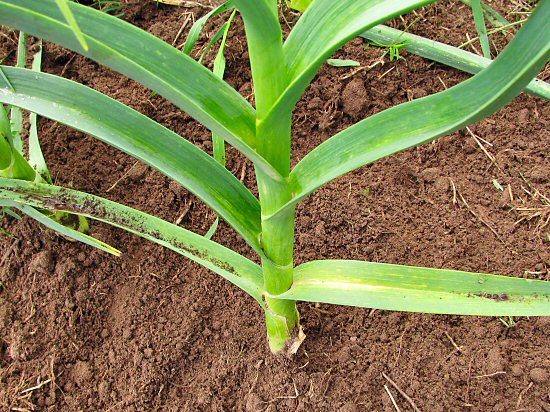
This first spring-planted garlic experiment is coming along just about as I imagined it would, from what I’d heard: slower and smaller. It’s 3-4 weeks behind where fall garlic usually is at this point, scapes are just emerging. Then again, everything has been growing slowly in the cool and cloudy weather we’ve been having. Plus, they only went in at the end of April, could’ve been a couple of weeks sooner. Earlier in, in better weather, maybe they’d go a little faster. Then, they’re SMALLER, and I don’t think anything would change that.  At least half of the stems look pencil-thin. Well, like FAT pencils. In case it makes a difference, I snapped a shot of one that’s…bigger (below). Positive thinking! Anyhow, they’re planted in 3 rows x 35′, 6″ spacing, not mulched, been weeded a couple of times, and that’s about it for the spring-planted garlic so far!

More onions

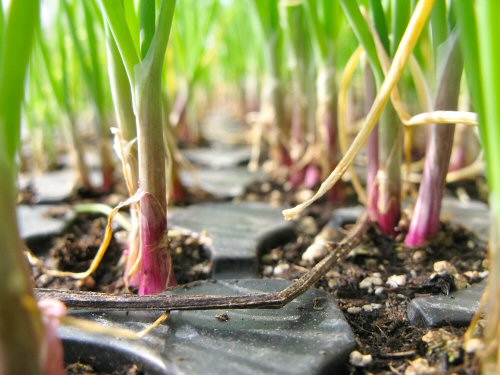
Red Wing onion seedlings

A last tray of onions—Red Wing hybrid red onions that did well last year—is hanging around the seedling room. What are they doing still not in the ground? Well, most of our onions—Stuttgarter-type yellow cooking, yellow Spanish, Red Wing, around 3,o00 in all—are already planted, in two sections, far apart. As I jigsawed together this season’s garden layout (now with the garden MAP), these guys just didn’t fit in the first two onion plots. So, they’ll get a bed of their own, somewhere, real soon, and we’ll see how they do compared to the others. Timing!

Spring garlic?

Garlic cloves prepped for planting

With the timing of the move to the new farm, there was no fall garlic planting for this year. Very sad—over the last three seasons, we’ve grown 2,000-3,000 bulbs a year, it’s a much-loved crop all around (starting with me!), and it’s been the very first sign of new veggie life as the fields wake up every spring. Oh, well, we should be back to full-on garlic this fall!

Meanwhile, what we have INSTEAD is about 200 of the toughest, most I-will-survive garlic cloves ever, going in today for a really late start, late even for spring planting! After long months of storage, and an accidental total freezing, the loss of garlic I’d been saving was pretty huge, these 200 out of maybe a thousand.

The guys who made it got an overnight cleansing and rejuvenating bath in a mild solution of baking soda (anti-fungal) and kelp extract (boost), and they’ll be quickly rinsed in alcohol just before going in. Especially for this small, late planting, all this prep probably doesn’t matter much, but they deserve it (personify and pamper your seeds and plants when you can, it’s friendly, until you harvest and eat ’em!).

So, it’ll be a first-hand test of whether it’s worth planting spring garlic at all. From what I’ve heard, chances are we’ll get at best smaller, later bulbs, some misfires with no bulbs forming, and the same great garden-grown garlic taste! We shall see…!