Thinning and weeding

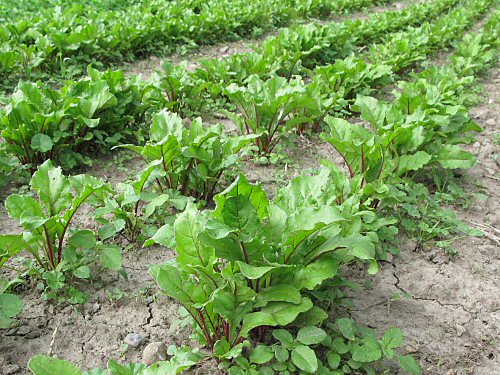
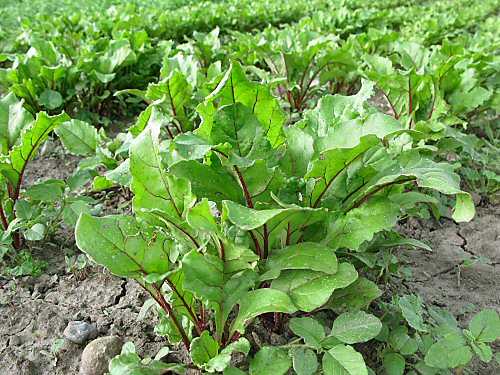
The first beet greens have sized up: lush and looking delicious, they’re ready to harvest. I love beet greens, both raw in salad, and lightly sauteed in olive oil and/or butter (a kind of deluxe spinach). I’ve never grown them as a separate crop, instead, they’re a happy byproduct of thinning the beets—removing the extra plants so that the remaining beets have room to grow. So the greens are both a harvest crop…and a weed. (I guess this is a continuation of yesterday’s post about WEEDS!) As you can see below, with the exception of a few gaps where nothing germinated, the first-planted beets are growing quite solid in their rows, which means a lot of plants have to be removed, maybe as much as 6-8 out for every one left behind (did you know, beet “seed” is actually tiny dried beet fruit containing several seeds?). There’ll be so much from four or five 3-row beds of beets, I won’t be able sell, eat, store or give away all of the greens that’ll pile up, but I can’t leave them in to stunt each other, so at at some point, the thinning becomes…weeding. Funny how that works! :)

Meanwhile, after a quite intensive weeding by hand and hoe a few days ago, the beet beds and paths are in fine shape, with only some growth near the plants that’ll come out during the thinning. (The cracks in the ground are what happens with our heavyish clay-loam soil: it’s not at all concrete-solid, it’s nicely moist, but as the surface dries out, it tends to…crack.) As far as overall weeding, with some quick touch-up hoeing along the way, these beds should be fine till harvest in 3-4 weeks (maybe earlier for some). The increasing leaf cover will keep down weeds near the plants, and the increasingly narrow paths and between-row strips can be quickly walked down with the weed hoe. It should be…sweet! On the other hand, in the potato patch…

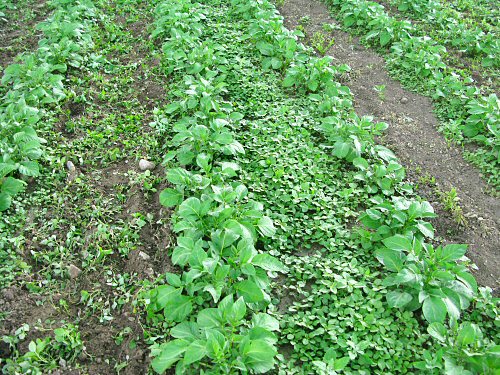
…things have gotten a little crazier. A dense and vigorous mix of mostly pigweed and some lamb’s quarters has carpeted one of the two potato sections. Here, you can see the difference a pass with the wheel hoe makes. On the left, a just-hoed path still looks pretty green. In the middle, it’s untouched and looking a little scary. I’d call this…Stage 2: leave these little guys just a few days longer, and it’ll be a fight to hoe as the pigweed stems in particular will start to get tougher. On the right, a path weed-hoed a couple of days ago (I was on the way through while walking back from hoeing another area)—after a day of sunshine, the cut and uprooted weeds dry up, and you can see how much weeding you’ve really done. There’s still a lot of close work around the plants, but the potatoes are really shooting up now, so once that final weeding is done, the plants will shade out and prevent germination of whatever weed seed’s still near the surface. On the other potato section, the weeds aren’t nearly so…dense. On this one, some of last year’s weeds obviously went to seed, which really increases this year’s population. It almost fee;s like a closed system: what work you get away with not doing now, you eventually pay for later, usually with a little interest…
Crops among the weeds

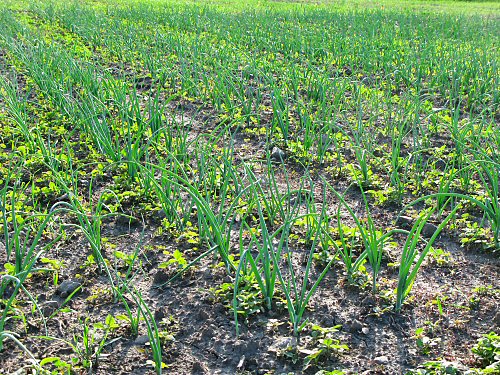
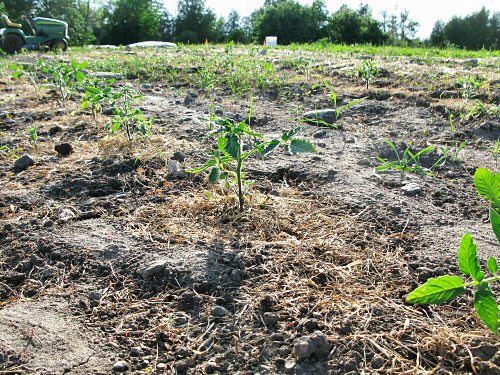
Weeded with the wheel hoe and hoop hoe, the onions looked impressively clear just six days ago, but after a few days of heat and moisture, the tiny weeds that were left shot up to the point where it’s time to do it all over again. Pigweed and lamb’s quarters, along with outbreaks of grass, are working to take over. It may look like a lot was missed. but weeding intensity depends on the crop. With onions, weeds tend to cluster close to the stems, so it usually seems easier to work more quickly and come back again, than spend double or triple the initial time, getting painstakingly close all around each plant (that’s how it seems, maybe not!). With the first section of tomatoes (below), things aren’t so advanced on the weed front, but there’s more grass in this area, and it’s still hard to see the crops in the general green haze of unwanted stuff growing. Hopefully, there will be enough grass mulch ready soon so we can extend the coverage between plants, and then onto the paths. This battle against weeds is the big one. All across the garden, both the veggies and what’s growing with them are at different stages, and require different weeding approaches. Typically, if you’re not using herbicides, tractor cultivation is the quickest way to keep the majority of the weed population down by working between rows. Even then, in-row weeding (between the plants) is still a hand job. It’s a LOT of work, and every few days that a section is not handled, the amount of work required increases as the weeds grow bigger and harder to kill. In a smaller market garden like this, with relatively short 50′ (15m) beds, the tractor is not an option; hand tools and methods rule. The idea is not to keep up this battle year in year out, but to progressively work smarter to reduce the load, through better timing and various techniques: mulching is the most obvious one, but there are lots of things to try. It’s not overnight, but things do improve as you go…!

Shifting gears for summer…

The spring rush is over, and fieldwork is shifting into summer mode, from mainly planting to mainly weeding and watering, and then, HARVESTING. Seedlings for the most important crops and varieties are in, although there’s still quite a lot to transplant.

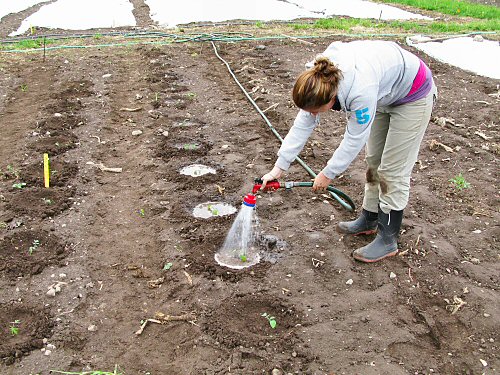
Here, we’ve just finishing another 100 or so tomatoes, with Lynn watering them in (the Redhead water breaker is GREAT, delivers as much water as you’ve got pressure, while softening the flow so that you’re not smashing or burying the seedlings). Creating a little basin around each seedling makes the most of hand watering in.

In my continuing experiment with shortening seedling production time, these are the youngest toms to go out ever, a third set started at the beginning of May, with their first true leaves now just coming in!

There are also more squash, melons, and a few more toms to transplant—in years past, I’d’ve been concerned about the date, but I’m learning to adapt the season’s resources (time, people, irrigation capacity,…) to the WEATHER.

Keep the workflow balanced is my new first mantra, so we also spent a few hours weeding today (Ryan dropped by to help for a few hours, he’s a new CSA-er this year who is also about to move his family to their own tiny farm at the end June!), instead of rushing on the last transplants.

It’s hard to measure, but for this type of small, diverse market gardening, in this time of extreme weather, things quite often don’t work out as they traditionally should. For example, the recent rain and cold, and now, more heat, have created a situation where the dominant weeds—pigweed, mallow, and lamb’s quarters—are seemingly slow, but are in fact about to explode. Weeding now will probably save way more time and deliver more harvest than putting off weeding just to transplant a few more beds a few days earlier.

I dunno, I’m figuring this out as I go, but I think traditonal garden rules and timing have to be increasingly bent as the weather gets crazier… I guess you could say: EXCITING TIMES! :)

Ah, the Home Garden…

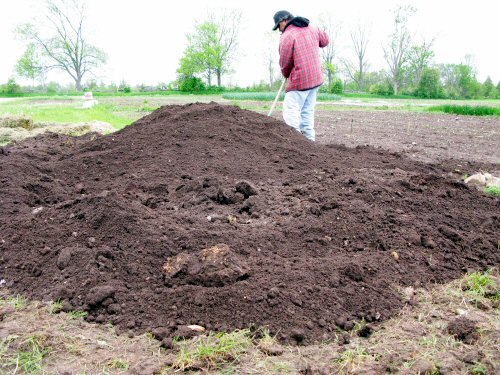
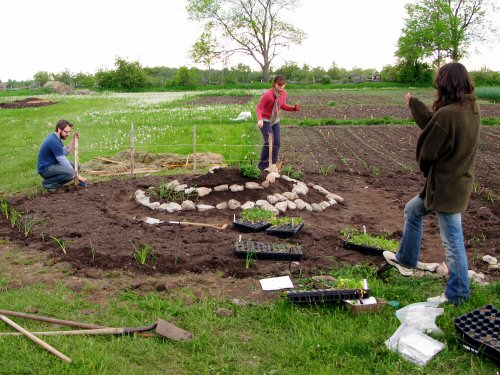
After quite a bit of talking about it, and last year’s false start, a Home Garden is suddenly in place in one corner of the field. The idea is to have a small demonstration veggie plot, to encourage people to grow at least some of their own stuff in whatever space they have. Why? Well, it seemed like fun. Located by the farm stand, it would be an extra little attraction to farm visitors… Just a thing worth doing… Anyhow, last year, I staked out a section, but didn’t get too far in planting anything in it, a couple of tomatoes and a few potatoes… This time around, I’d been chatting with Shannon, who has a lot of permaculture-based ideas, from reading and interning, so I asked her to plan it out. The final design was done really quickly earlier today (it was a busy month…), it’s more a freeform, jumbled garden with a permaculture flavor: all annual veggies, no rows, lots of interplanting, a herb spiral on a mound (a mix of annuals and perennials), an anti-pest barrier of alliums (onions and garlic chives) around the perimeter, and three little keyholes, which are dugouts that you can kneel in to garden within reach around you, as an alternative to working from paths. At about 10’x20′ (3x6m), it’s fairly small. One cool thing: the home garden layout is entirely unlike the rest of the market garden, which is all flat, linear and grid-like, lots of rectangles and squares and straight paths. Now, we have a deliberate elevation and CIRCLES! To make the mound, I dumped a few buckets of compost using the Kubota compact tractor, and raked it into shape. We then added stones for the spiral, and Erin and Mike dropped in and helped plant it out, using odds and ends of transplants and also seed, with Shannon directing. The rough plan is to have Lynn and Raechelle develop and tend it over the season (Shannon leaves tomorrow after a solid month in the field).

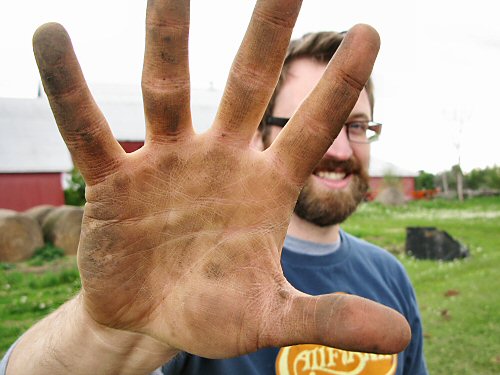
At just over two acres of veggies, the tiny farm is really small by most any modern agricultural standard, and starting up a MUCH TINIER space is its own private…thrill for me. It’s so…opposite! ;) It’ll be interesting to see how Home Garden 1 turns out as the season rolls along! Any way you can, getting your hands dirty is what it’s all about… (Guest photos: top by Shannon, below by Erin.)

Potting for market

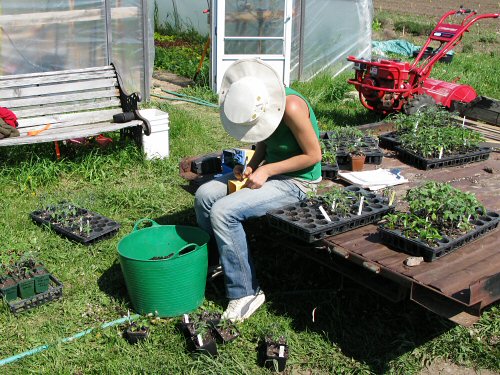
With the recently warming weather, field crops have started to grow more quickly, but nothing but radishes will be ready for this Saturday’s farmers’ market, and the early lettuce in the greenhouse has gotten pretty low after two weeks of harvesting. This is a first: by the end of May, mesclun and usually spinach have been ready in the field. Not this time. Sooo, we decided to fill out the week’s market stand offerings with seedlings. Selling my extra insurance seedlings at the market is something I’ve avoided until now: for the few dollars more, it didn’t seem worth the chance of complaints if anything goes wrong (I’ve heard people blame all kinds of things on the plants they buy)—usually, I’d sell or give only to people I know. There’s always a first time, so Shannon potted up and labeled a couple of dozen spares. We’ll take a walk on the wild side and see what happens… :)

Good germination

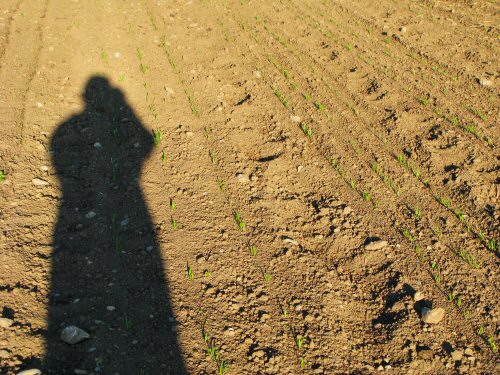
With all the rain, and things finally warming up at night, the evening walkaround was good today, with a fair bit of GROWTH now on display. The third seeding of Spargo spinach (above) is doing very well indeed. Carrots, beets, green onions, chard are all coming along. Most everything is pretty cool… And all of this without irrigation, only some of the mesclun beds were ever watered. This is more like it!

Row cover everywhere

Row cover on spring transplants

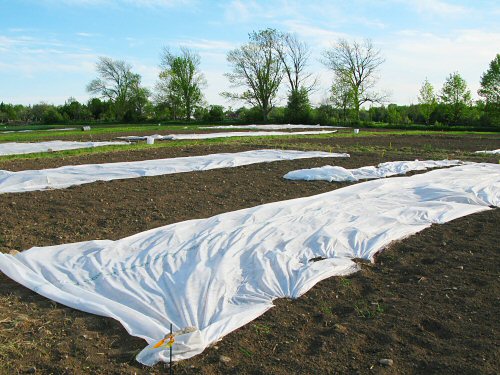
It was impossible to capture all the floating row cover outposts scattered around the feel in just one shot. This pic shows maybe a third of the area under the light, white, spunbond polyester protection. Right now, it’s being used as protection from two separate things: frost and bugs. Let’s see, it’s on all the cucurbits (so far, that’s cucumber, summer and winter squash, and pumpkin) to protect from the cold and striped cucumber beetles, on tomatoes against cold (and coming off in a few days), on the brassicas (broccoli, cauliflower, and the like) against ravaging flea beetles but not the cold (coming off when the plants are fairly big and can withstand the FBs). I’ve used row cover from Year 1, far as I can remember (there are NOTES and even pics…somewhere). Initially, I really didn’t like it, it looked so…unearthy, synthetic,…not part of the garden. BUT, the alternatives, like planting later, ending harvest earlier in fall, temporary wind breaks and cold air channels, trap crops, and all sorts of complex interplanting (so one crop protects another), encouraging beneficial insects, more elaborate timing (basically, closer second guessing of insect cycles and the weather), not to mention a completely adapted, semi-permaculture set-up where everything is at home no matter what, were all way out of what I could handle as I dove into tiny farming with the intention of heading to the farmers’ market in the first season. Floating row cover lets me extend the season by at least a couple of weeks at each and, and I can avoid all pesticides (and there are some killer insecticides allowed even in certified organics) and a lot of bug grief (stemming from lots of LOSS). I still don’t really LIKE row cover, though, the way I like, say, my Sneeboer three-tine cultivator or even the Horse rototiller (I can understand how the Horse is built, get if fixed, or do without). More and more lately, I wonder when FRC will become insanely expensive, or real scarce, or just plain run out… It’s as oil-based as they come, and kind of in a high tech product class of its own. This year, in a small fit of…paranoia (?), I actually ordered a new 1,000’x14′ (300mx4.3m) roll, even though I have enough for this season at least. It’s not much of a stockpile, but, carefully managed, it could get me through 3-4 more years along with what’s on hand, at this tiny farming scale… Oh, well, the more you know, the less you need is what I believe. I’m learning as I go. Keep farming long enough, and I’m sure I’ll get beyond the cover if it doesn’t run out on me first…! :)